IRCAM Amplify Review 2026: Accuracy, Price, Access
IRCAM Amplify sells the AI Music Detector that distributors and streaming services buy, and it is the most credible name in the category. It is also unbuyable if you are one person with a Suno account, and its headline accuracy figure has never been independently audited. Here is what the vendor claims, what the peer-reviewed literature says about detectors of this kind, and what any of it changes for your next release.
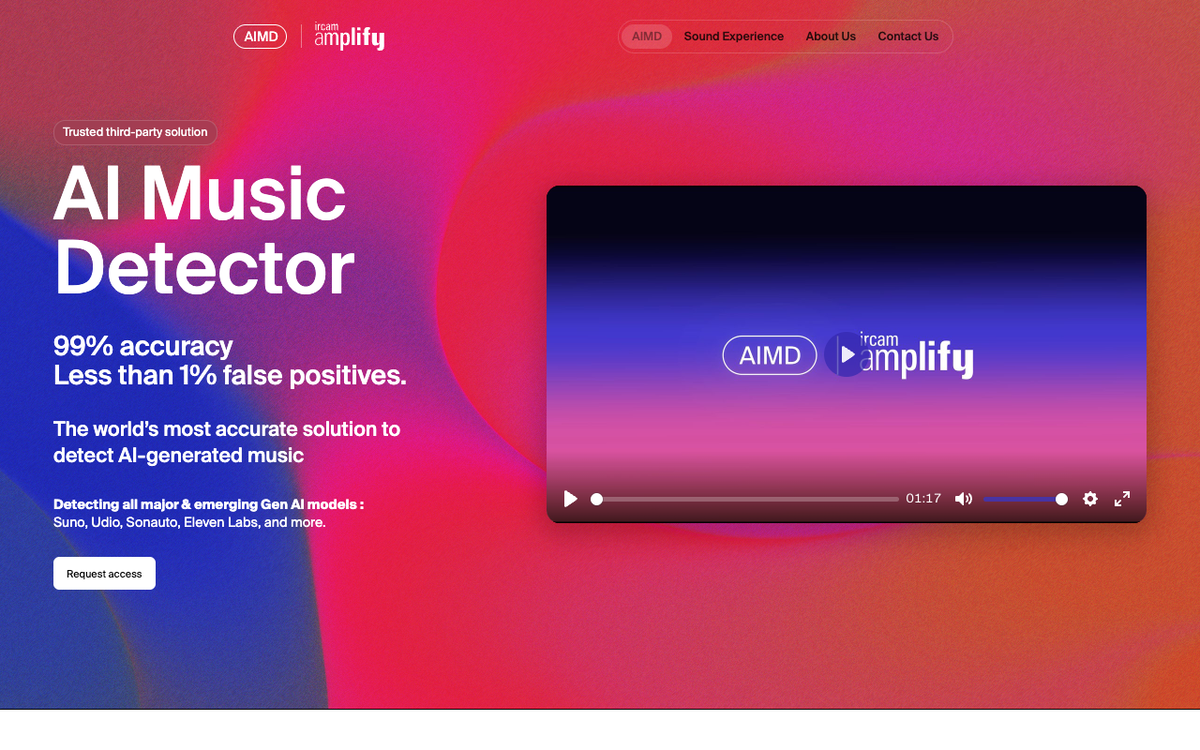
- IRCAM Amplify's AI Music Detector claims 99% accuracy and under 1% false positives on its own site. No test set is published, so this is a vendor figure, not a measured one
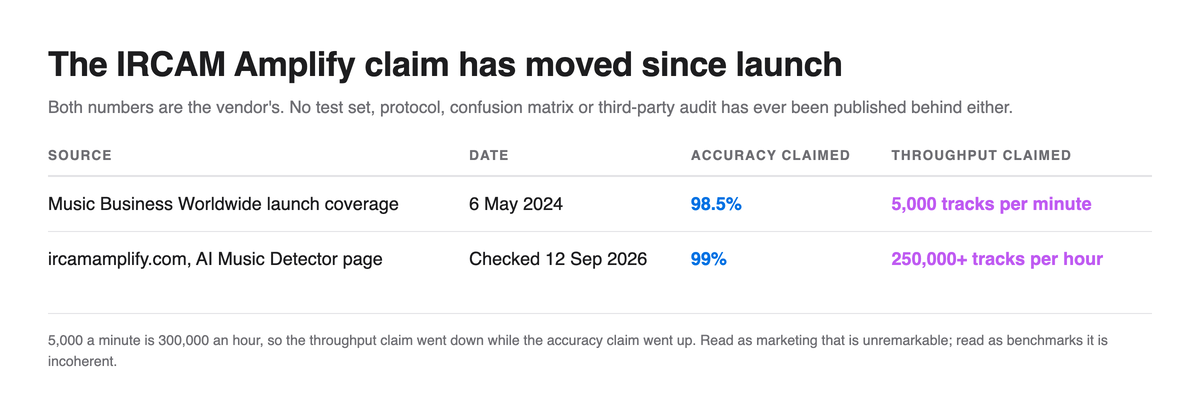
- The claim has moved: at launch in May 2024 the company said 98.5% accuracy and 5,000 tracks a minute. Today's page says 99% and 250,000 tracks an hour
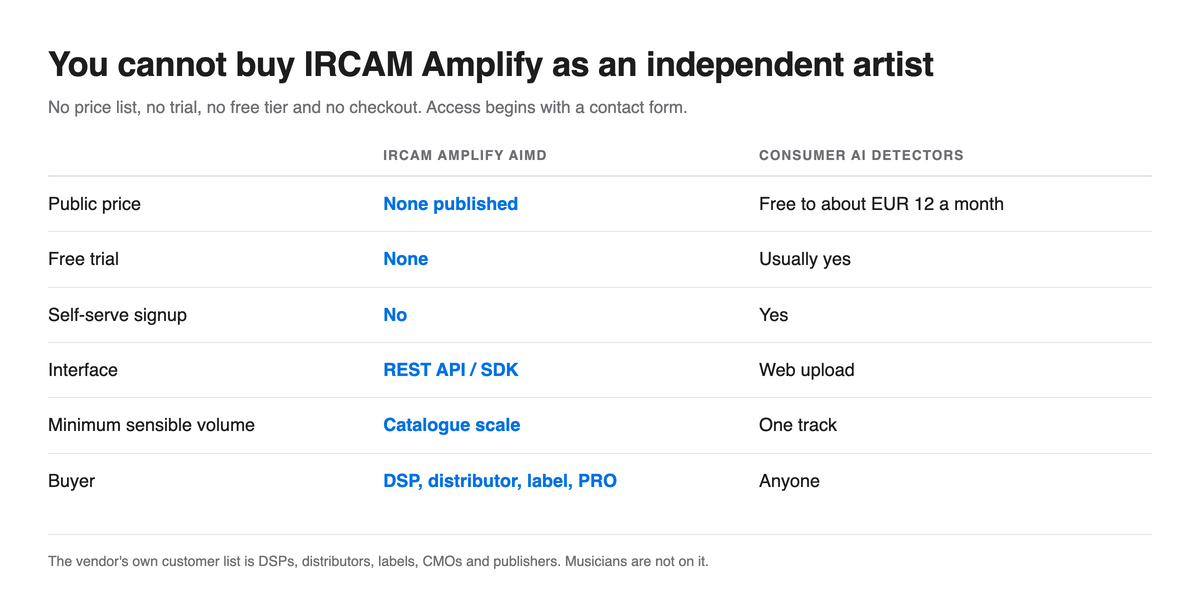
- There is no price, no free tier and no self-serve signup. It is an enterprise API sold to streaming services, distributors, labels and collecting societies, and you cannot buy it as an independent artist
- The best-paper winner at ISMIR 2025 traced AI-music artifacts to deconvolution layers and hit over 99% accuracy on the spectral peaks alone, so the underlying science is strong
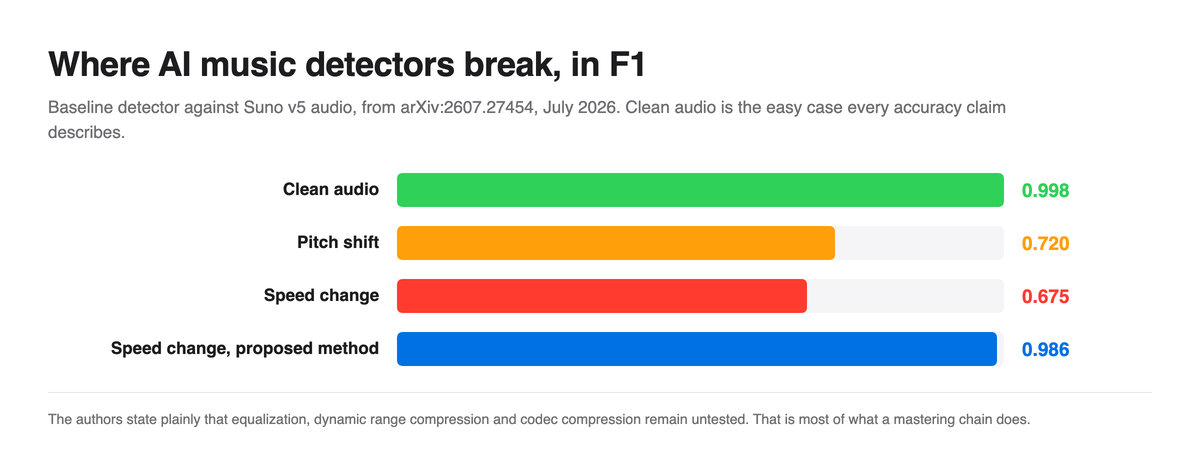
- Robustness is the weak point. One 2026 paper records a baseline detector falling from 0.998 F1 to 0.675 under a speed change, and a separate August 2026 paper scores edited human audio at 0.720 F1 — the false positives are in ordinary editing
- What IRCAM Amplify actually is
- IRCAM Amplify accuracy: where the 99% comes from
- Can you buy IRCAM Amplify as an independent artist?
- What the research says AI music detectors are keying on
- Where AI music detectors break, in numbers
- The false-positive problem at catalogue scale
- IRCAM Amplify vs the detectors you can actually run
- What this means if you are releasing a Suno track
- Getting paid once the track is finished
- The verdict on IRCAM Amplify

IRCAM Amplify is the AI music detector with the best pedigree in the category, and the one you are least likely to ever use. It is sold by the commercial arm of IRCAM, the Paris research institute behind decades of published audio analysis, and its AI Music Detector is an API bought by streaming services, distributors and collecting societies to screen catalogues at scale. The headline numbers on its site are 99% accuracy, under 1% false positives, and more than 250,000 tracks an hour. What the site does not carry is a price, a trial, a test set, or any way for one person with a Suno account to run a single file through it. We went looking for all four, and this page is what we found instead — plus what the peer-reviewed research says about detectors built this way, which is the part no other page on this query covers.
We describe how we evaluate tools on our methodology page. This review is deliberately not a scored bench test, because IRCAM Amplify cannot be bought or tested by a member of the public, and a scored review of a product you have no access to is fiction. Where numbers appear below they are either the vendor's own or they come from published papers, and each one says which.
What IRCAM Amplify actually is
IRCAM is the Institut de Recherche et Coordination Acoustique/Musique, founded in Paris in the 1970s, and it is a genuinely serious institution — Max/MSP came out of it, among a long list of things. Ircam Amplify is its commercial spin-out, and the AI Music Detector, usually shortened to AIMD, is one product in a wider audio-analysis line.
AIMD analyses the raw waveform of a recording and returns a probability that it was machine-generated. That is a different mechanism from content ID or audio fingerprinting, which matches a recording against a database of known reference tracks. The distinction matters because at least one widely-linked review of this product confuses the two, concludes that IRCAM Amplify "is designed for audio fingerprinting and content ID, not AI detection", and reports that it detected none of 500 AI tracks. That is a category error about what the product is, and it is wrong against the vendor's own product page.
| What the vendor's site states | Figure |
|---|---|
| Accuracy | 99% |
| False positives | Less than 1% |
| Throughput | "More than 250.000 tracks within 1 hour, depending on server capacity" |
| Generators named | Suno, Udio, Sonauto, ElevenLabs, "and more" |
| Integration | RESTful API and SDK |
| Sold to | DSPs, distributors, labels, CMOs/PROs, music publishers |
Note who is missing from that last row. Musicians are not the customer.
IRCAM Amplify accuracy: where the 99% comes from
It comes from Ircam Amplify. That is the whole provenance. There is no published evaluation set, no stated protocol, no confusion matrix and no third-party audit behind the number, which puts it in the same category as every other accuracy claim in this market rather than above them.
It is also worth noticing that the claim has moved. When the detector was announced in May 2024, ahead of its showcase at the Music Biz conference in Nashville, the figures reported by Music Business Worldwide were different from the ones on the site today.
| Source | Date | Accuracy claimed | Throughput claimed |
|---|---|---|---|
| MBW launch coverage | 6 May 2024 | 98.5% | 5,000 tracks per minute |
| ircamamplify.com, AIMD page | Checked 12 Sep 2026 | 99% | 250,000+ tracks per hour |
Read those as marketing rather than measurement and the change is unremarkable. Read them as benchmarks and they are incoherent: 5,000 a minute is 300,000 an hour, so the throughput claim went down while the accuracy claim went up. Two years of retraining against newer generators could justify either movement. The point is that nobody outside the company can tell, and no page currently ranking for this query mentions that the numbers moved at all.
None of this means the detector is bad. The published science says detectors of this kind genuinely do work on clean generated audio, which is the next section. It means you should not quote "99%" to anyone as though it were a result.
Can you buy IRCAM Amplify as an independent artist?
No, and this is the single most useful fact on the page. There is no price list, no trial, no free tier and no checkout. Access begins with a contact form, and the target customer is an organisation moving catalogues rather than a person moving a track.
| IRCAM Amplify AIMD | Consumer AI detectors | |
|---|---|---|
| Public price | None published | Free to ~€12/month typical |
| Free trial | None | Usually yes |
| Self-serve signup | No | Yes |
| Interface | REST API / SDK | Web upload |
| Minimum sensible volume | Catalogue scale | One track |
| Buyer | DSP, distributor, label, PRO | Anyone |
This matters because the surrounding SERP does not say it clearly. Several pages ranking for "ircam amplify" walk an individual reader through why they should use it, and one of the top results assigns it a per-check cost that does not exist. If you have arrived here to check one song before you upload it, IRCAM Amplify is not the tool, and our AI music detector roundup covers the ones you can actually open in a browser — ACRCloud and the SubmitHub checker among them.
What the research says AI music detectors are keying on
This is where the category gets genuinely interesting, and where every competing page on this query is silent.
The best paper at ISMIR 2025 was "A Fourier Explanation of AI-music Artifacts" by Afchar, Meseguer Brocal, Akesbi and Hennequin at Deezer. Its finding is that the deconvolution modules inside generative audio models produce systematic frequency distortions — small, distinctive spectral peaks, a relative of the checkerboard artifact familiar from image generation. Crucially the effect comes from the model architecture itself, not from the training data or the weights.
The practical consequence is the part worth holding onto: the authors built a detection criterion from those spectral peaks alone, simple and interpretable rather than a black-box classifier, and it surpassed 99% accuracy in several scenarios, on par with deep-learning approaches. They validated it against open-source models and against Suno and Udio.
So when a vendor says 99%, the number is at least plausible. Detection of clean, unmodified generator output is close to a solved problem, and it is solved for a reason anybody can read. What nobody has solved is the next section.

Where AI music detectors break, in numbers
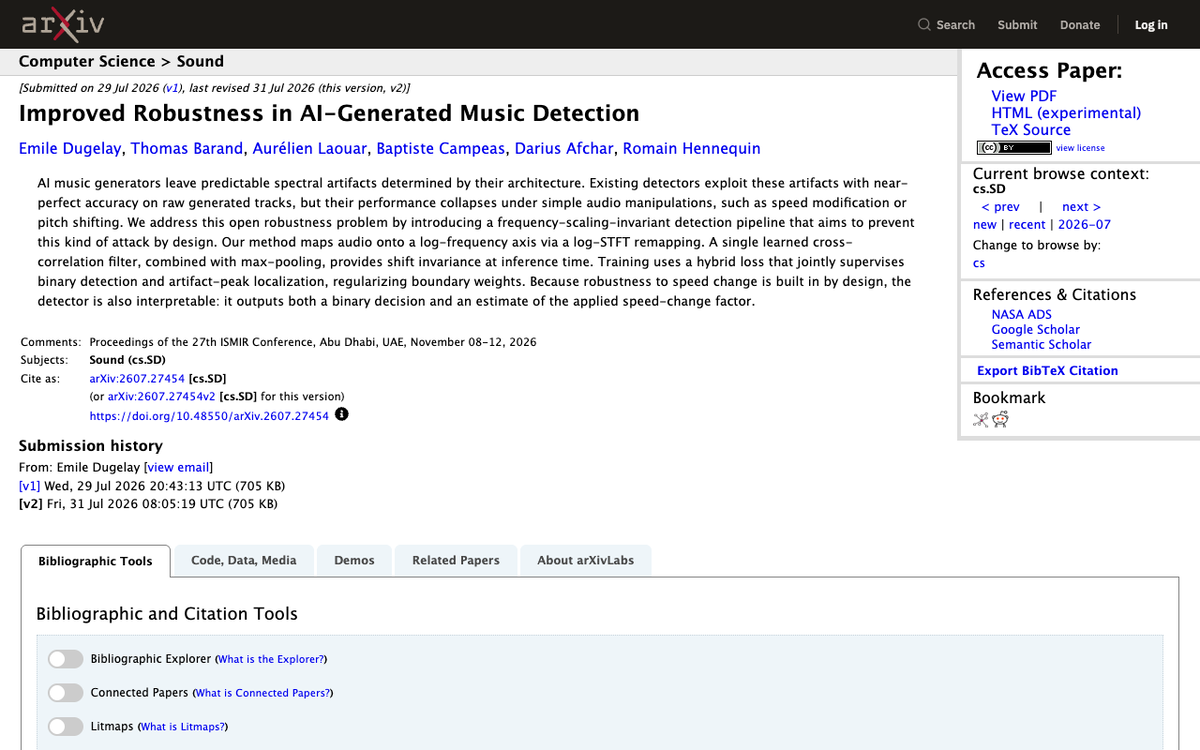
In July 2026 a team including two of the same Deezer authors published "Improved Robustness in AI-Generated Music Detection" (Dugelay, Barand, Laouar, Campeas, Afchar and Hennequin, arXiv:2607.27454). The paper exists because the baseline detectors fall over under changes a teenager can apply in free software.
| Condition, Suno v5 | Baseline detector F1 | Their proposed method |
|---|---|---|
| Clean audio | 0.998 | State of the art |
| Speed change | 0.675 | 0.986 |
| Pitch shift | 0.720 (AUC 0.771) | Partial robustness only |
The paper also cites earlier work finding that resampling the input to 22.05 kHz is on its own enough to flip the predicted label on a large fraction of AI samples.
Two things follow. First, the robustness gap is real and published, so any detector's clean-audio accuracy figure — IRCAM Amplify's included — describes the easy case. Second, and this is the line to remember, the authors state plainly that "other common manipulations (equalization, dynamic range compression, codec compression) remain untested". That is most of what a mastering chain does, which is why we told you the same thing on our BandLab mastering guide: there is no published evidence either way that a mastering pass changes a detector's verdict, and anyone who tells you there is has not read the literature.
The false-positive problem at catalogue scale
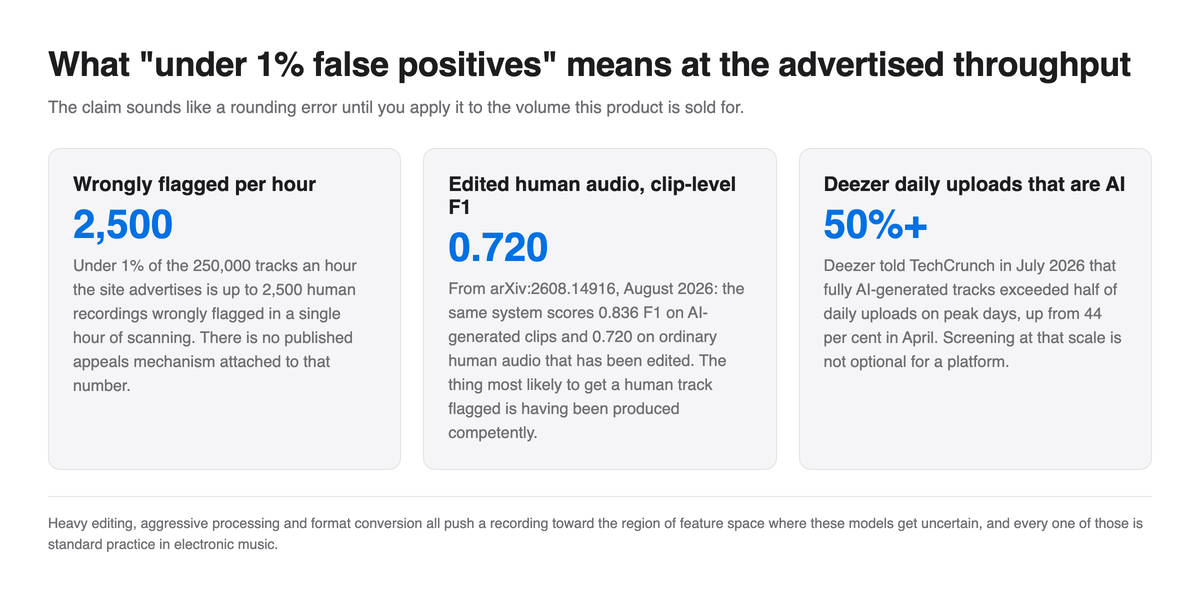
"Less than 1% false positives" sounds like a rounding error until you apply it to the volume this product is sold for. At the throughput the site advertises, 250,000 tracks an hour, under 1% is up to 2,500 human recordings wrongly flagged per hour of scanning. There is no published appeals mechanism attached to that.
It is not a hypothetical risk, either. In August 2026, Morosanu, Cecan, Achirei and Erhan published "Distinguishing AI-Generated Music from Edited Audio as a Hard-Negative Robustness Task", which tests exactly the case that should worry a producer: ordinary human audio that has been edited. Their system scored 0.836 F1 at clip level on AI-generated clips and only 0.720 on edited ones. Their conclusion is that AI music does retain fingerprint-like spectral cues beyond ordinary editing, but that those cues still overlap with the artifacts editing itself introduces.
In other words, the thing most likely to get a human track flagged as machine-made is having been produced competently. Heavy editing, aggressive processing and format conversion all push a recording toward the region of feature space where the models get uncertain — and every one of those is standard practice in electronic music.
The volume context makes the stakes concrete. Deezer, which built its own detector rather than licensing one and has run it since January 2025, told TechCrunch in July 2026 that fully AI-generated tracks exceeded 50% of daily uploads on peak days, up from 44% in April. Screening at that scale is not optional for a platform, and our Deezer AI detection guide covers what their tagging actually does to a release.
IRCAM Amplify vs the detectors you can actually run
Holding the vendor claims and the public alternatives side by side clarifies what you are choosing between, as long as you remember that the first column is self-reported and the others are what those vendors say too.
| IRCAM Amplify | ACRCloud | SubmitHub checker | |
|---|---|---|---|
| Accuracy claim | 99%, unaudited | Not published | Not published |
| False-positive claim | Under 1%, unaudited | Not published | Not published |
| Access | Enterprise contact form | Trial then paid | Free |
| Best for | Screening a catalogue | API-level checks | A quick single-track read |
| Independent verification | None available | None available | None available |
The honest summary of that table is that the entire category runs on unverified self-reporting, and IRCAM Amplify's advantage is institutional credibility rather than demonstrated superiority. That is not nothing — the research lineage is real — but it is a different claim from "the most accurate detector", which is what most of this SERP asserts on its behalf.
What this means if you are releasing a Suno track
Strip out the vendor marketing and the practical position is simple. Detection of raw generator output works, and the published research explains why. Detection of altered audio is unreliable in ways the field is actively writing papers about. And the pre-release check you were hoping to run against the industry-standard detector is not available to you at any price.
So the leverage is not in checking. It is in what you ship. Distributors have not banned AI music — DistroKid, RouteNote, UnitedMasters, LANDR, Amuse and Symphonic all take it, generally with a disclosure step, and we went through the policies in our distributor round-up. What people do run into is automated screening flagging a specific upload, plus audible generation artifacts that make a track sound like what it is.
That second problem is the one worth spending effort on, and it is the job Undetectr is built for: processing a generated track so that the artifacts are gone and it survives automated screening. The boundary matters and we will keep stating it — no processing tool stops a platform labelling a track as AI, because labelling is a disclosure mechanism rather than a detection outcome. Apple's transparency tags are declared by the provider on delivery and Spotify's AI Persona badge is disclosure-driven. If you want the comparison across tools in this bracket, EraseAI's detector explainer covers the same ground from the cleanup side.
Getting paid once the track is finished
The uncomfortable thing about spending a week on detector research is that distribution is rarely the actual wall. Plenty of people get released and then find nobody is listening, which no detector, and no amount of processing, fixes.
Two routes exist that do not depend on algorithmic discovery. Paid sync placement — TV, film, games, advertising — is where the money conversation in this niche is genuinely happening, and played.fm's sync route is built for pitching into it. Selling direct to listeners and keeping the full amount is the other, and it beats the streaming maths by default, given how little a stream returns. Our guide on making money with Suno goes through the numbers.
You cannot buy IRCAM Amplify, and a free detector's verdict is not a prediction of what your distributor will do. What you can control is the file you deliver. Undetectr processes generated tracks for screening and audible artifacts.
See Undetectr pricing → from €19 · €39 lifetime founder pricing · affiliate linkThe verdict on IRCAM Amplify
As a company and a research lineage, it is the most credible name in AI music detection, and the science underneath the category is strong enough that its accuracy claim is believable on clean audio. As a product review, the fair verdict is that it cannot be reviewed: no public access, no published test set, no price, no trial. Every scored ranking of it you will find, including the one this page used to carry, was produced without access to the product.
If you run a platform, a label or a distribution catalogue, it belongs on your shortlist alongside building in-house, which is what Deezer chose. If you are an artist with a track and a deadline, the correct amount of time to spend thinking about IRCAM Amplify is roughly the length of this sentence, and the rest belongs on the file you are about to upload.
Frequently asked questions
Ircam Amplify is the commercial arm of IRCAM, the Institut de Recherche et Coordination Acoustique/Musique in Paris, and its AI Music Detector (AIMD) is an API that returns a probability that a given recording was generated by a model. It is sold to streaming services, distributors, labels, publishers and collecting societies rather than to individual musicians.
The company states 99% accuracy with less than 1% false positives on its own site. That figure is not accompanied by a published test set, an evaluation protocol or a third-party audit, so it should be read as a marketing claim. For comparison, the peer-reviewed work in this area reports over 99% accuracy on clean generated audio too, and then shows that number collapsing once the audio is altered.
There is no published price. Ircam Amplify does not list pricing for the AI Music Detector, does not run a free tier or trial, and has no self-serve checkout. Access starts with a contact form and a sales conversation, which in practice rules out anyone releasing a handful of tracks a month.
Not directly, no. The product is an enterprise API with no consumer front end, so there is no page where you upload one MP3 and get a score. If you want a pre-release check you are looking at the free and low-cost detectors instead, and you should treat their verdicts as indicative rather than as a prediction of what any particular distributor will do.
It is an AI detector. Some reviews confuse AIMD with content-ID style fingerprinting and then report that it fails to detect AI music, which is a category error. Ircam Amplify's own product page describes AIMD as identifying music generated by Suno, Udio, Sonauto and ElevenLabs among others, by analysing the waveform for generation artifacts rather than by matching against a reference database.
Nobody outside the company can answer that, because there is no public access to test it with. What the published literature shows is that detectors of this architecture are vulnerable to geometric changes such as speed, pitch and resampling, and that equalisation, dynamic range compression and codec compression have not been tested at all. Anyone quoting you a pass rate for processed audio against IRCAM Amplify is guessing.
The product is explicitly aimed at distributors and DSPs, and several platforms have said publicly that they screen for AI. Deezer built its own detector rather than licensing one, and has run it since January 2025. Which vendor sits behind any given distributor's screening is not disclosed, so treat any article that names one as speculation.
Not necessarily. A detector returns a probability, and what a platform does with that probability is a policy decision, not a technical one. DistroKid, RouteNote, UnitedMasters, LANDR, Amuse and Symphonic all accept AI music openly, usually with a disclosure step at upload. What people actually report is individual uploads being flagged and bounced by automated screening, which is a narrower problem than a ban.
Ready to release your Suno tracks?
Undetectr was the only tool that passed every distributor in our testing. Clean your first track in under 60 seconds.