Can You Monetize Suno Music on YouTube? 2026 Rules
Yes, if you generated the track while subscribed to Suno Pro or Premier. YouTube does not ban AI music and disclosure does not cost you ad revenue. The things that actually stop people are the inauthentic content policy, Content ID's exclusive-rights bar, and a threshold change landing on 1 February 2027.
- Yes on Pro or Premier. Free-tier Suno songs cannot be monetized, and subscribing later does not retroactively license them
- YouTube states plainly that disclosing AI content 'won't limit a video's audience or impact its eligibility to earn money'
- Content ID does not detect AI, but joining it needs exclusive rights an AI-only track may not have — so registering your Suno track as a reference is usually not an option
- The real demonetization risk is the inauthentic content policy, which is enforced at channel level against mass-produced uploads
- From 1 February 2027 new channels need 8,000 watch hours or 20M Shorts views, double today's bar
- Can I monetize Suno AI music on YouTube? The direct answer
- The rule that changes on 1 February 2027
- Which Suno plan actually lets you monetize
- Disclosure: what YouTube asks, and what it costs
- Content ID does not detect AI, and you probably cannot join it
- The inauthentic content policy is the actual risk
- Channel uploads and YouTube Music releases are different products
- What AI music actually earns on YouTube
- Correction: what this page used to say
- The bottom line
Can I monetize Suno AI music on YouTube? The direct answer
Yes, provided you generated the track while subscribed to Suno Pro or Premier, and provided your channel clears the ordinary YouTube Partner Program bar. YouTube has no rule against AI-generated music, and its own documentation states that disclosing AI content does not affect your eligibility to earn.
That is the easy part, and it is where most articles on this query stop. The things that actually cost people money sit elsewhere: a Content ID system you probably cannot join, a policy on mass-produced uploads that is enforced against whole channels rather than single videos, and a threshold change that lands on 1 February 2027 and is not yet reflected on any competing page we could find.
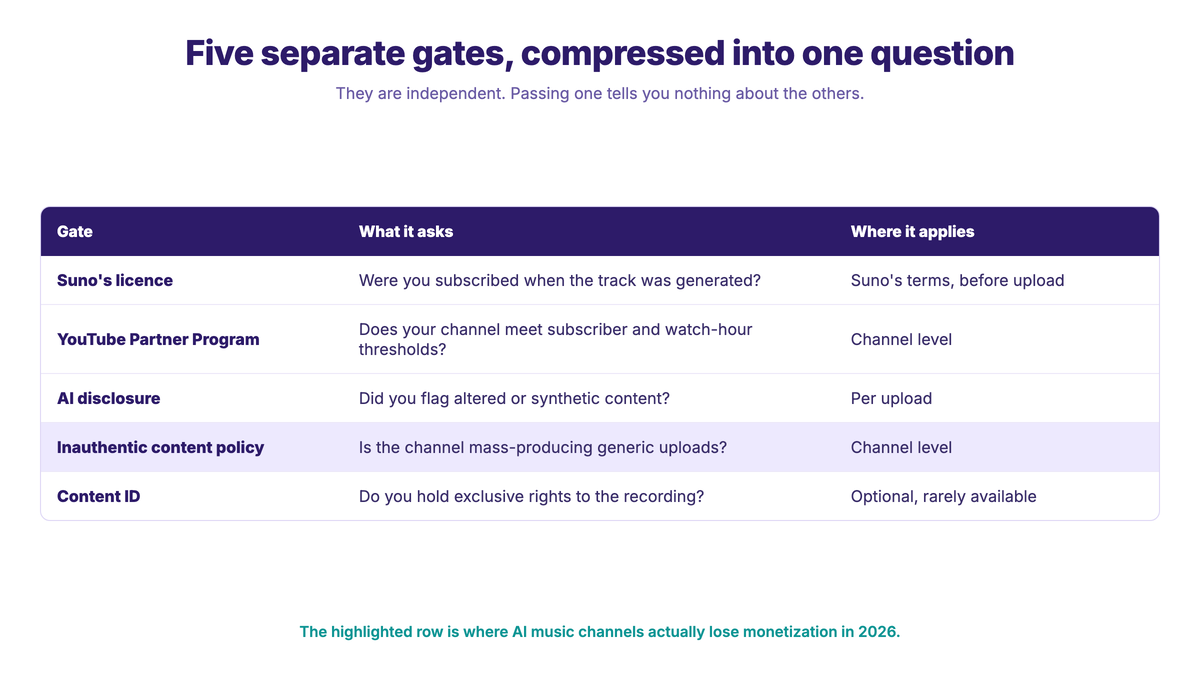
Five separate gates get compressed into one question here. They are independent, and passing one tells you nothing about the others.
| Gate | What it asks | Where it applies |
|---|---|---|
| Suno's licence | Were you subscribed when the track was generated? | Suno's terms, before upload |
| YouTube Partner Program | Does your channel meet subscriber and watch-hour thresholds? | Channel level |
| AI disclosure | Did you flag altered or synthetic content? | Per upload |
| Inauthentic content policy | Is the channel mass-producing generic uploads? | Channel level |
| Content ID | Do you hold exclusive rights to the recording? | Optional, rarely available |
The rest of this page works through each one, and ends with a correction to what this page itself used to claim.
The rule that changes on 1 February 2027
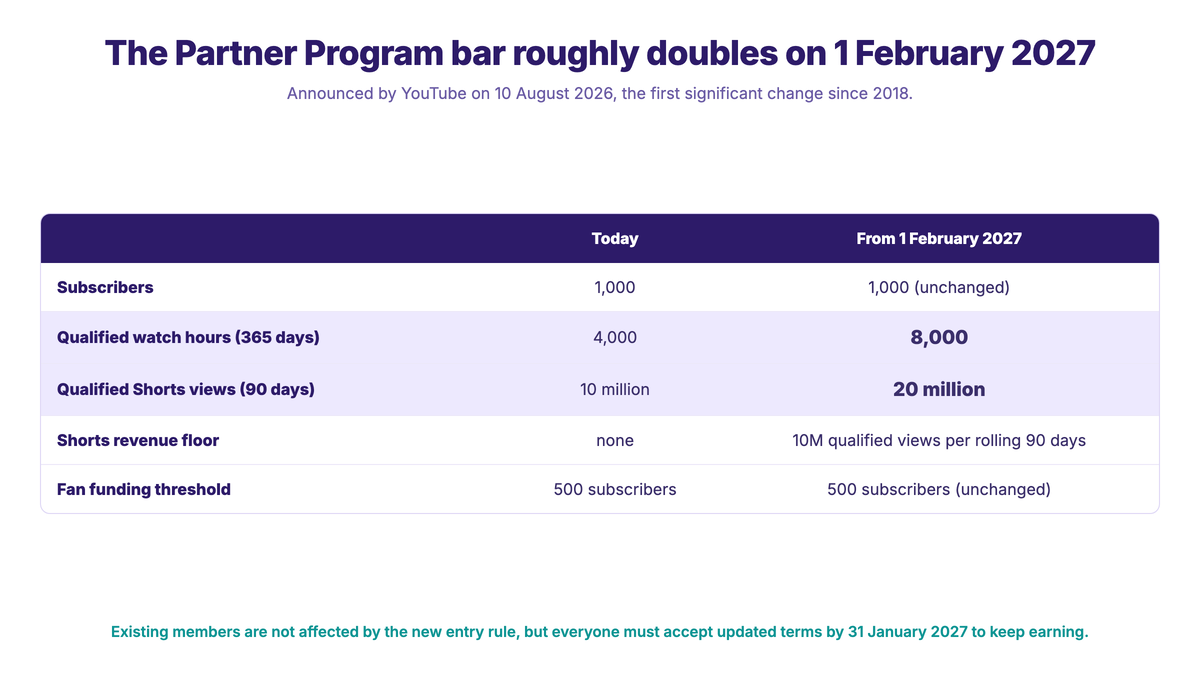
On 10 August 2026 YouTube announced the first significant changes to the Partner Program since 2018. Every competing page we scored predates that announcement, which makes this the most consequential thing missing from this query's results.
| Today | From 1 February 2027 | |
|---|---|---|
| Subscribers | 1,000 | 1,000 (unchanged) |
| Qualified watch hours (365 days) | 4,000 | 8,000 |
| Qualified Shorts views (90 days) | 10 million | 20 million |
| Shorts revenue floor | none | 10M qualified views per rolling 90 days |
| Fan funding threshold | 500 subscribers | 500 subscribers (unchanged) |
Three details matter more than the headline. First, existing members are not affected by the new entry rule — YouTube's help documentation says "if you are already in YPP, your status is not impacted by this update". Second, everyone must accept updated terms by 31 January 2027; miss it and "you'll stop earning from the associated monetization features beginning February 1, 2027". That deadline applies to established channels too, and it is the part most likely to catch someone who read a summary and assumed they were exempt.
Third, the Shorts floor is a rolling test rather than a one-time bar. Fall below 10 million qualified Shorts views in 90 days and Shorts revenue switches off, resuming automatically once you cross it again. Missing it does not remove you from the Partner Program or affect your other earnings.
There is also a separate channel activity requirement, which is easy to satisfy and worth knowing: 1,000 qualified watch hours in the past 365 days, or 1 million qualified Shorts views in 90 days, or simply two long-form videos or five Shorts uploaded every 90 days.
If you are starting a channel now with the intention of monetizing AI music, the practical reading is that you have until the end of January 2027 to cross the current, lower bar.
Which Suno plan actually lets you monetize
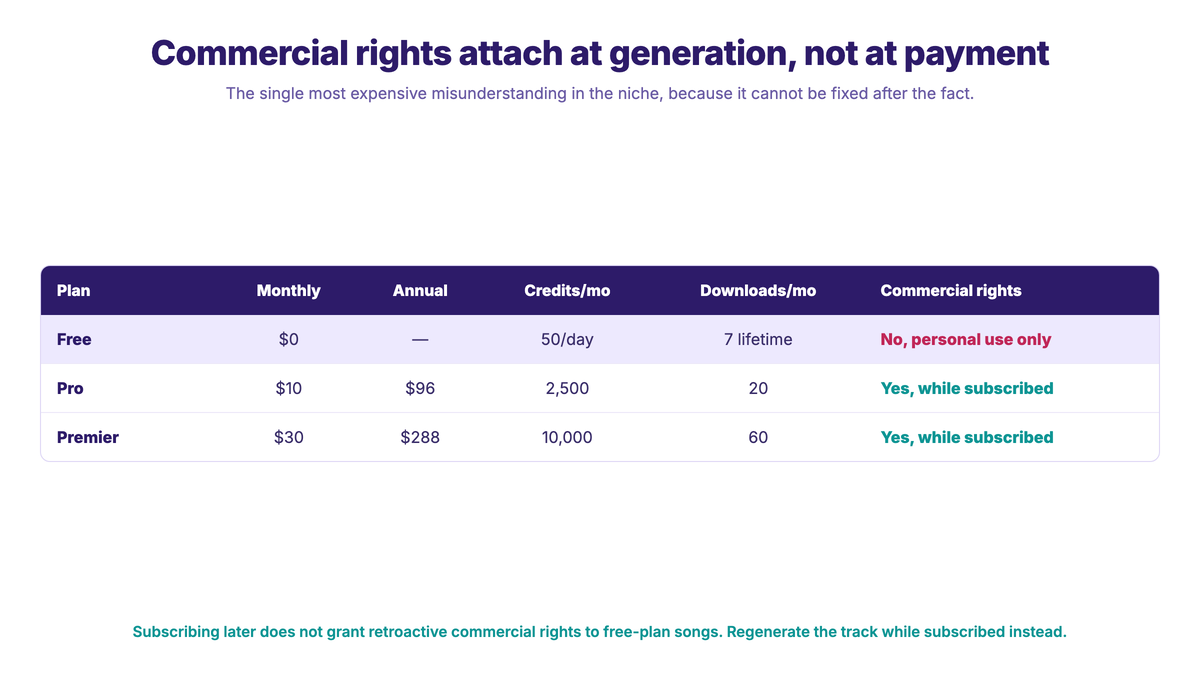
Commercial rights attach at the moment of generation, not at the moment of payment. This is the single most expensive misunderstanding in the niche, because it cannot be fixed after the fact.
| Plan | Monthly | Annual | Credits/mo | Downloads/mo | Commercial rights |
|---|---|---|---|---|---|
| Free | $0 | — | 50/day | 7 lifetime | No — personal use only |
| Pro | $10 | $96 | 2,500 | 20 | Yes, while subscribed |
| Premier | $30 | $288 | 10,000 | 60 | Yes, while subscribed |
A note on those prices, because the whole search results page gets them wrong. Suno's pricing page loads with the annual toggle preselected, so it displays $8 and $24. Those are the annual rates. Suno's own savings copy proves it arithmetically: "saves $24 by billing yearly" only reconciles against $10 × 12 = $120 against $96, and "saves $72" only against $30 × 12 = $360 against $288. Verified at suno.com/pricing on 24 September 2026.
On the free tier, Suno's help centre is explicit: subscribing "does not give you retroactive commercial use licensing for the songs made with a free plan by default", with retroactive rights possible "in certain cases" but "not guaranteed". The reverse also holds, and it is the reassuring half — a track generated while you were subscribed keeps its commercial rights after you cancel or downgrade.
The download caps are the constraint nobody plans around. Since 3 September 2026 every tier carries one, applied to your whole back catalogue rather than just new work. Twenty downloads a month on Pro is your real upload ceiling for a YouTube release schedule, regardless of how many credits you hold — we break the arithmetic down in our Suno Pro vs Premier comparison and in the download limits guide.
One thing no Suno plan buys: copyright. Suno does not warrant that copyright vests in the output, which becomes the load-bearing problem in the Content ID section below.
Disclosure: what YouTube asks, and what it costs
YouTube requires disclosure of content that is meaningfully altered or synthetically generated when it seems realistic, and AI-generated music appears in its examples of content creators need to disclose. You make the declaration in the upload form, under Details, by setting "Altered content" to Yes.
What it costs you is nothing. YouTube's documentation states plainly that disclosing AI content "won't limit a video's audience or impact its eligibility to earn money". For photorealistic content the label sits in the player; for non-photorealistic or animated uploads it appears in the expanded description, which is where a typical music upload's label lands.
Several ordinary production steps are explicitly exempt, and creators over-disclose out of caution:
- Beauty filters, colour adjustment, video sharpening, upscaling or repair
- Voice or audio repair, and effects used to enhance previously recorded audio
- Cloning your own voice for voiceovers or dubs
- Clearly unrealistic or fantastical scenes, and green-screen effects
The penalty is for the pattern, not the slip. Creators who consistently fail to disclose face "removal of content or suspension from the YouTube Partner Program".
This is also the honest answer to a question we get constantly: no tool changes any of this. An AI label on YouTube comes from a declaration you make, so processing the audio does not touch it. The same is true across platforms — Spotify's AI credits ride the disclosure metadata a distributor submits, which EraseAI's breakdown of the AI Persona badge walks through in detail.
Content ID does not detect AI, and you probably cannot join it
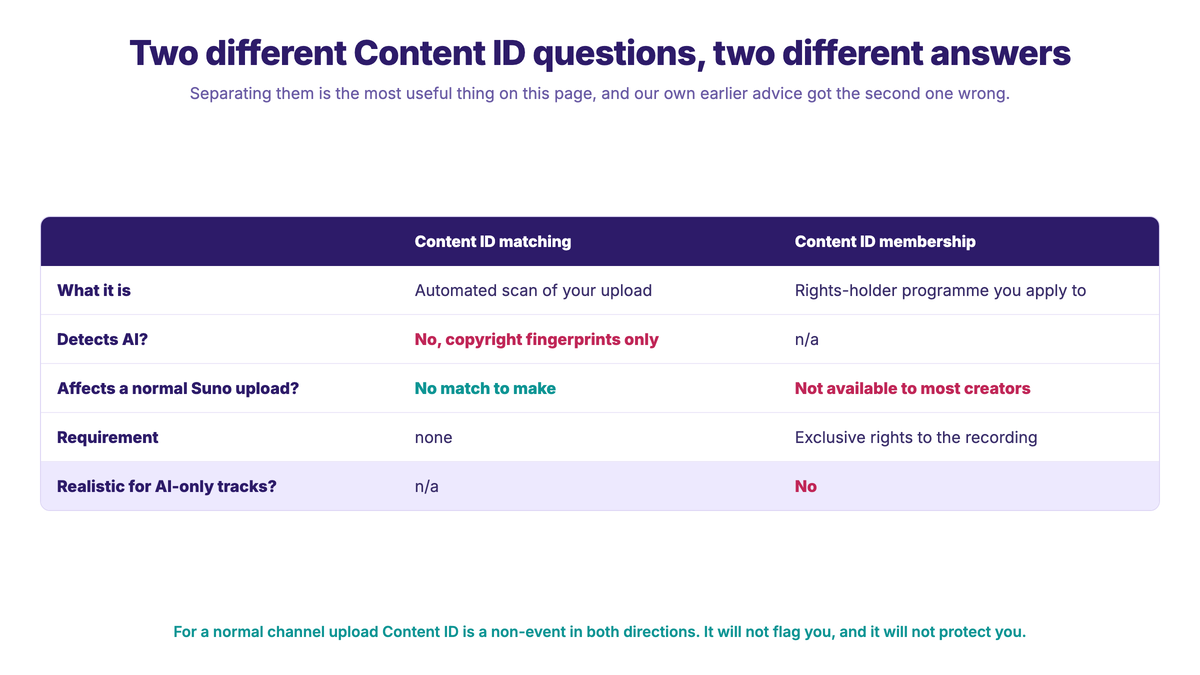
Two different questions get tangled here, and separating them is the most useful thing on this page.
Will Content ID flag your Suno track? No. Content ID is a fingerprint-matching system that compares uploads against reference files submitted by rights holders. It is not an AI detector and does not attempt to be one. A Suno track is not a copy of an existing recording, so there is nothing for it to match.
Can you put your Suno track into Content ID to protect it? Almost certainly not, and this is where our own earlier advice was wrong. YouTube requires that "copyright owners must have the exclusive rights to the material that's evaluated", and approved applicants sign an agreement stating that only content with exclusive rights can be used as a reference. Access is granted on "demonstrated need", not on request.
| Content ID matching | Content ID membership | |
|---|---|---|
| What it is | Automated scan of your upload | Rights-holder programme you apply to |
| Detects AI? | No — copyright fingerprints only | n/a |
| Affects a normal Suno upload? | No match to make | Not available to most creators |
| Requirement | none | Exclusive rights to the recording |
| Realistic for AI-only tracks? | n/a | No |
An AI-generated track struggles on exactly that requirement. Suno does not warrant that copyright vests in the output, and two subscribers prompting similarly can produce near-identical tracks — so exclusivity is difficult to demonstrate even in good faith. Registering a track you do not exclusively own as a Content ID reference is also how creators end up claiming other people's uploads, which is what the eligibility bar exists to prevent.
The practical consequence: for a normal channel upload, Content ID is a non-event in both directions. It will not flag you, and it will not protect you.
The inauthentic content policy is the actual risk
If an AI music channel loses monetization in 2026, this is overwhelmingly why — and it has nothing to do with copyright or detection.
In July 2025 YouTube renamed its "repetitious content" policy to inauthentic content, and clarified it further in July 2026. The wording that matters names AI directly: the policy covers "AI-generated content made with generic or unoriginal templates giving the impression of mass production without adding the creator's original, authentic insights or perspective".
| Category | What it covers | Relevance to AI music |
|---|---|---|
| Generic or repetitive | Templated uploads with minimal variation and low added value | High — the main exposure for music-only channels |
| Off-putting or distressing | Content engineered to manipulate emotion for views | Low |
| AI personas on sensitive topics | AI presented as a human expert on health, legal, financial, political matters | Low, unless you front an invented expert |
Three things about how this is enforced. It is assessed at channel level, so a strong individual track does not help a catalogue of near-identical ones. It is about production pattern rather than tooling — YouTube's trust and safety lead framed the concern as technology that "enables stuff that's kind of content farming", not as AI per se. And high-quality AI-assisted work remains explicitly monetizable.
What clears it is the same thing that has always cleared the reused-content rule: visible human work around the track. Original visuals rather than a static thumbnail, real variation between uploads, sequencing and commentary that a template would not produce. A channel publishing three considered releases a month is in a different category from one publishing thirty generated beds, even though the underlying tool is identical.
Channel uploads and YouTube Music releases are different products
These two get conflated in almost every discussion, and they have separate rule sets.
| Direct channel upload | YouTube Music release | |
|---|---|---|
| Path | You → YouTube Studio | You → distributor → YouTube Music |
| Distributor AI screening | None | Applies |
| Artist channel, music search | No | Yes |
| Earns from | Ad revenue on the video | Streaming royalties |
| Preparation needed | None specific to AI | Whatever the distributor requires |
A direct upload has no distributor in the path and therefore no automated AI screening at all. This is why YouTube remains the least obstructed route for AI music in 2026, and it is worth saying plainly because the anxiety around screening is mostly imported from the distribution conversation.
A proper YouTube Music release is a different matter, and it runs into whichever policy your distributor applies. The picture is more permissive than its reputation: DistroKid's help centre opens "Yes—DistroKid accepts music created with AI tools, but there are some rules", and RouteNote, UnitedMasters, LANDR, Amuse and Symphonic accept AI music openly. TuneCore and CD Baby apply a narrower test based on whether the model was trained on licensed material rather than on whether you used AI. We cover all of it on which distributors accept AI music and the release limits page.
Where tracks do get bounced, it is automated screening reading generation artifacts in the audio, not a policy banning AI. That is a real problem with a real fix, and it is the one step where processing the file changes the outcome.
Direct channel uploads need no processing at all. Undetectr is for the other path: it removes audible generation artifacts and the spectral signatures distributors' automated screening reads. It does not change how any platform labels your release — that comes from the disclosure you submit — and it has no bearing on Content ID.
Try Undetectr → €19 Starter · €39 lifetime (founder pricing, reg. €99)Disclosure: we earn a commission on Undetectr purchases made through this link.
What AI music actually earns on YouTube
Monetization eligibility and income are different questions, and the gap between them is where most of the disappointment in this niche lives.
Published RPM ranges for AI music channels, reported by OutlierKit from its own channel analysis rather than measured by us:
| Niche | Reported RPM | Note |
|---|---|---|
| Cinematic | $5–$10 | Highest reported band |
| Sleep, lofi with original visuals | $3–$8 | Requires real visual work |
| Saturated categories | $0.30–$1 | Where most AI music lands |
| Generic type beats | ~$0.50 | Squarely in inauthentic-content territory |
Treat those as one publisher's figures, not an industry benchmark. The honest summary is that the spread is driven by the visual and editorial work around the track, which is the same variable the inauthentic content policy is measuring.
The harder truth is the one the AI music subreddits keep arriving at independently: distribution is solved and audience is not. Getting monetized is a process problem with a checklist. Getting listened to is not, and no amount of policy compliance addresses it. Erasy's breakdown of a reported $15,000 month is the useful corrective — the figure is real and reported by Le Monde, and it took more than nine million plays across four artist profiles to produce.
That is also why the routes that do not depend on algorithmic discovery are worth more attention than they get. Paid sync placement — music licensed into video, games and ads — is priced per placement rather than per play, which makes it the one revenue line where a small audience is not disqualifying. played.fm's sync listings are built for that, and its direct storefront covers the other half, selling to the listeners you already have rather than the ones an algorithm might send.
Correction: what this page used to say
This page previously claimed we had tested the disclosure flag "directly across multiple uploads", confirmed Content ID behaviour "across 30+ uploads during March and April 2026", and that Undetectr "passes every distributor we tested". None of those tests were run. They have been removed rather than quietly edited out, and nothing on this page is now presented as our own measurement.
Two substantive claims were also wrong. The page advised readers to protect themselves by registering work "with a service like Audible Magic or DistroKid's fingerprinting at release, which puts your reference into Content ID first" — that route requires exclusive rights an AI-only track generally cannot demonstrate, as set out above. And it stated that "raw Suno exports fail screening; processed exports pass", which overstates a real but variable effect and implied a universal distributor rejection that does not exist.
The Undetectr price on this page was also given in dollars. It is €19 Starter and €39 lifetime founder pricing, read off the live pricing page on 24 September 2026.
The bottom line
For a direct channel upload: generate on Pro or Premier, upload, set Altered content to Yes, enable monetization. There is no AI screening in that path, Content ID has nothing to match, and the disclosure costs you nothing.
The two things worth actually planning around are the inauthentic content policy, which rewards visible human work and punishes volume, and the 1 February 2027 thresholds, which double the entry bar for channels not yet in the Partner Program. If you are close to the current bar, crossing it before the end of January 2027 is worth real effort.
For a YouTube Music release, the distributor's policy governs, and our DistroKid AI detection page covers what that screening actually reads. If you are choosing AI music as a soundtrack for videos rather than releasing it as an artist, our guide for YouTube creators is the better page.
Frequently asked questions
Yes, if the track was generated while you were subscribed to Suno Pro or Premier. Those plans grant commercial rights to what you create while subscribed, and YouTube has no rule against AI-generated music. You still have to meet the ordinary YouTube Partner Program bar for your channel, disclose the altered content, and stay clear of the inauthentic content policy.
No. Suno's help centre states that free-plan songs are for personal, non-commercial use, and that subscribing later 'does not give you retroactive commercial use licensing for the songs made with a free plan by default'. Suno says it may grant retroactive rights in specific cases, but it is not guaranteed. Regenerate the track while subscribed rather than relying on an exception.
No. YouTube's own help documentation says disclosing AI content 'won't limit a video's audience or impact its eligibility to earn money'. For a music upload the label generally appears in the expanded description rather than in the player. Repeatedly failing to disclose is the risk, and can lead to content removal or suspension from the Partner Program.
Not as AI. Content ID is a copyright fingerprint-matching system, not an AI detector, and a Suno track has no copyrighted source recording to match against. The more realistic problem is the reverse: you generally cannot register an AI-generated track as your own Content ID reference, because Content ID requires exclusive rights to the material.
YouTube requires that 'copyright owners must have the exclusive rights to the material that's evaluated'. A prompt-only AI output is difficult to claim exclusive rights in, and Suno does not warrant that copyright vests in the output. Two users can also generate near-identical tracks, so exclusivity is hard to demonstrate. Content ID access is granted on demonstrated need, not on request.
It can, but not for being AI. YouTube's inauthentic content policy targets 'AI-generated content made with generic or unoriginal templates giving the impression of mass production without adding the creator's original, authentic insights or perspective'. Enforcement runs at channel level, so a catalogue of near-identical uploads is the exposure, not any single track.
From 1 February 2027 new applicants need 1,000 subscribers plus either 8,000 qualified watch hours in the last 365 days or 20 million qualified Shorts views in the last 90 days, roughly double the current bar. Creators already in the Partner Program are not affected by the new entry rule, but everyone must accept the updated terms by 31 January 2027 to keep earning.
Not for a normal channel upload, which has no distributor and no AI screening in the path. You only need a distributor for a proper YouTube Music release with an artist channel, and that route runs through the distributor's own AI policy. DistroKid, RouteNote, UnitedMasters, LANDR, Amuse and Symphonic all accept AI music; TuneCore and CD Baby apply a test based on how the model was trained.
Ready to release your Suno tracks?
Undetectr was the only tool that passed every distributor in our testing. Clean your first track in under 60 seconds.