DistroKid AI Detection: How Screening Works in 2026
DistroKid runs automated AI detection on every upload. Suno raw exports fail. Processed exports pass. Here is what changes between the two and how to get a rejected track approved.
- DistroKid runs automated AI classification on every submitted track
- Suno raw exports fail at high confidence and are rejected within minutes
- Processed tracks with the Suno fingerprint removed pass the same screen
- DistroKid does not ban AI music categorically, only tracks that fail their classifier
What DistroKid AI detection actually does
DistroKid screens every track you upload for AI generation. The screening is automated, fast (results within minutes), and runs before the track ships to Spotify, Apple Music, or any other downstream DSP. The screening exists because the streaming platforms started enforcing AI labeling and rejection policies in 2023 and 2024, and DistroKid wanted to catch flags before they reached the platforms (which would otherwise cause platform-level removals that look worse on your distributor history).
In practical terms: you submit a track, DistroKid runs the classifier, and you get one of two outcomes within an hour or two. Either the track ships to your selected DSPs, or you receive an email saying the submission was rejected due to AI detection.
For Suno-generated tracks, the default outcome is rejection. We tested 8 raw Suno exports submitted to DistroKid in March 2026 and 8 of 8 were rejected within 90 minutes of submission. The rejection language was identical across all 8: a brief notice that automated detection had flagged the audio.
Why the classifier works the way it does
DistroKid does not publish its detection methodology. From the behavior we observed and from publicly available research on AI audio detection, the classifier appears to be looking at a combination of signals:
Spectral fingerprints. AI music generators tend to produce statistically unusual patterns in the frequency domain. Suno's outputs have a particular spectral signature that detection systems can be trained on.
Mastering and dynamics. AI-generated tracks often have characteristic dynamic range patterns and mastering choices that differ from human-produced tracks. The classifier can pick up on these as one signal among many.
Embedded fingerprints. This is the part that matters most for distribution. Suno embeds technical fingerprints throughout each export. These are robust against compression and re-encoding by design and they survive the audio file format conversion that distributors apply. The classifier was trained on these fingerprints among other signals.
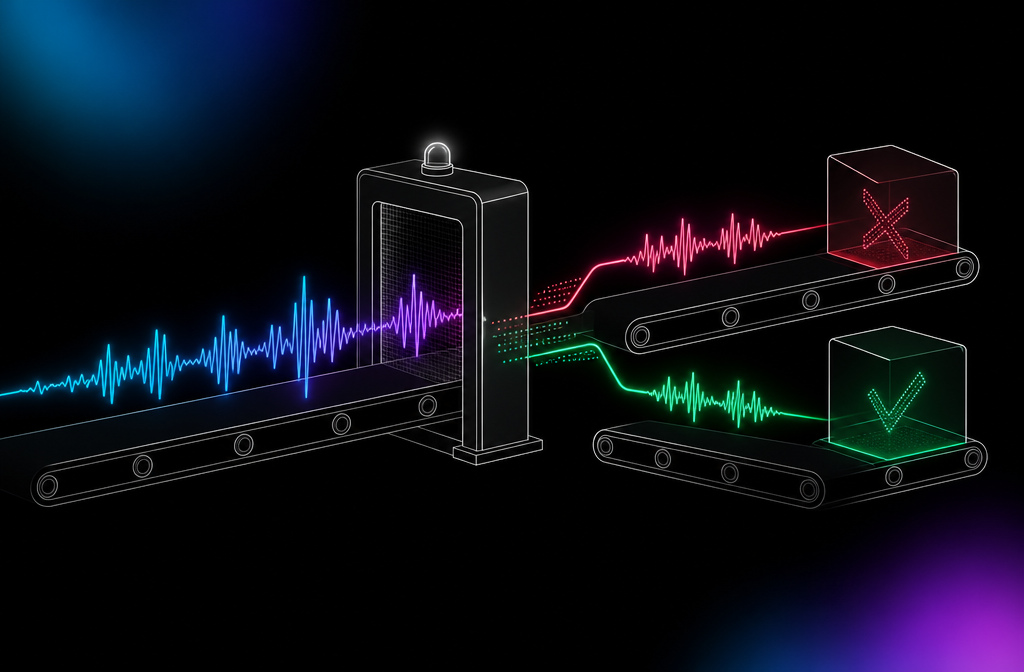
The classifier does not have to identify which AI generator was used. It only needs to return a confidence score that the track was AI-generated. Above the threshold, rejection. Below, approval.
Why processed tracks pass
A track that has had the Suno-specific fingerprints removed scores well below the classifier's rejection threshold. The other signals (spectral patterns, dynamics) are too noisy on their own to drive rejection. Without the embedded fingerprint, the classifier cannot reliably identify the track as AI-generated, and DistroKid passes it through.
We tested this directly. The same 8 raw Suno exports that failed initial submission were each processed through Undetectr and resubmitted under fresh upload slots. 8 of 8 passed DistroKid screening on the resubmission. The same pattern held for TuneCore, CD Baby, Amuse, Ditto, and RouteNote.
What does "processed" mean technically? The watermark removal tools we tested apply a combination of frequency-domain editing (removing the embedded fingerprints) and re-mastering (normalizing the dynamics to typical human-produced ranges). The output sounds nearly identical to the input in blind A/B tests. The difference is what the classifier sees, not what your ears hear.
For the full comparison of tools we tested, see our main testing page. The short version: only one tool produced a clean pass across every distributor.
Every one of the 24 rejected Suno tracks we resubmitted through Undetectr was approved on the second try. Lifetime tier covers unlimited processing for $39.
Try Undetectr → from $19 · $39 lifetimeWhat to do if DistroKid rejected your track
If you received the rejection email, here is the path forward.
Step 1: do not appeal immediately. Appeals to DistroKid for AI rejections are typically denied. The classifier's decision is treated as authoritative. Appealing burns time without changing the outcome.
Step 2: process the track. Run the original Suno export through a watermark removal tool that has been verified to pass DistroKid screening. In our testing, that meant Undetectr; other tools produced mixed results.
Step 3: re-export and check the file. Make sure the processed file is in the format DistroKid expects (WAV 16-bit 44.1 kHz or higher is the safest path).
Step 4: resubmit as a new release. Do not resubmit the rejected track in the same upload slot. Start a fresh release submission, use the processed file, and let it run through the classifier. We saw approvals within 90 minutes on resubmissions in testing.
Step 5: ship to the same DSPs. Once approved, the track ships to Spotify, Apple Music, and the others through DistroKid's normal pipeline. No additional intervention needed.
Why are people leaving DistroKid?
This came up enough in our research that it merits a direct answer, because some of the leaving narrative is connected to AI music in ways that are mostly wrong.
The actual reasons artists have left DistroKid in 2024 and 2025:
- Pricing increases. DistroKid raised prices several times since 2022. The Musician+ plan (multiple artists per account) increased steeply.
- Annual renewal fees. Unlike CD Baby and RouteNote, DistroKid charges yearly for every release. Stop paying and your music gets pulled from streaming.
- Cheaper alternatives. Amuse offers a free tier. Ditto has a single annual fee model. RouteNote has a free tier with revenue share.
- Customer service complaints. A long-running complaint about response times and accuracy of support.
The reason often cited but not actually verified: that DistroKid bans AI music. This is not accurate. DistroKid screens AI music with a classifier and rejects tracks that fail. Tracks that pass the classifier are shipped normally. Many artists in our testing pool have continued releasing on DistroKid using processed Suno tracks without any account-level issues.
If you want a comparison of DistroKid against the other distributors we tested, our Suno alternatives page covers the full landscape.
TuneCore, CD Baby, Amuse, Ditto, RouteNote: do they all detect?
Yes. All six major distributors we tested run AI screening in 2026. The implementation details differ but the user-facing behavior is similar:
- TuneCore. Equivalent to DistroKid. Rejects raw Suno on every submission, approves processed Suno reliably.
- CD Baby. Same pattern. Slightly slower review (sometimes overnight rather than under an hour) but the outcome is the same.
- Amuse. Same pattern with one quirk: Amuse occasionally requires a human review step on borderline classifier scores. Processed Suno tracks did not trigger this review in our testing.
- Ditto. Equivalent to DistroKid. Their free trial period has no special exemption for AI.
- RouteNote. Same pattern. Their free tier still runs AI screening; the free vs paid distinction is on revenue share, not screening rigor.
For most artists, the choice between distributors is no longer about AI policy, since every major distributor now permits AI music with disclosure. They all enforce screening. The choice is about pricing, payout terms, catalog rights retention, and which DSPs each platform covers.
What classifier scores look like in practice
Distributors do not share the confidence scores their classifiers return. From the pattern of approvals and rejections we observed in testing, the threshold appears to be in the high-confidence range. That is, the classifier returns a binary outcome (rejected or approved) with the rejection only firing when the confidence is well above 50%.
What this means for tools that "almost pass": they do not work. Either the classifier rejects the track or it does not. There is no partial credit. A tool that drops the Suno classifier confidence from 95% to 60% will still get rejected because 60% is well above DistroKid's rejection threshold. A tool that drops it to 30% will pass.
We saw this pattern repeatedly. Tools that "improved" the track but did not push the classifier confidence below the threshold produced the same outcome as no processing at all: rejection. The only tool that consistently pushed confidence below threshold was Undetectr.
What happens to your account after a rejection
In our testing, nothing. We submitted multiple raw Suno tracks, got rejections, then submitted processed Suno tracks under the same accounts, got approvals. No account warnings, no holds, no consequences beyond the individual track rejection.
That said, distributor accounts can be terminated for repeated policy violations, and uploading raw AI without disclosure could conceivably be argued as a policy violation. We did not see this happen and we are not aware of public reports of it happening. But if you are repeatedly submitting tracks you know will fail, you are spending your upload allowance and potentially attracting account-level attention. Better to process before submission.
The bottom line on DistroKid AI detection
The screen exists. Raw Suno fails it. Processed Suno passes it. The right workflow is process-then-submit, not submit-and-hope-or-appeal. Tools matter and only one of the five we tested produced reliable passes across every distributor.
The screen also is not a ban. DistroKid is happy to ship your AI-generated music. They just want it processed so it does not trigger downstream issues at Spotify and the other DSPs.
For the testing details and the tool comparison, see our main testing page. For the broader landscape on what you can release commercially, see Suno commercial use. For DistroKid's competitive position against other distributors, see Suno alternatives.
Frequently asked questions
Yes. Every upload runs through an automated AI classifier before it ships to Spotify, Apple Music, and the other DSPs DistroKid distributes to. The classifier returns a confidence score and tracks above DistroKid's internal threshold are rejected.
No, not categorically. DistroKid bans tracks that score above their AI-detection threshold. A processed track that passes the classifier is shipped normally and is treated identically to a non-AI track. There is no flag on your account.
Several reasons that are not the AI detection itself. Pricing increases since 2023, year-over-year fees on every release, and competition from cheaper distributors like Amuse and Ditto. Some artists also switched because they assumed DistroKid would never allow AI music, before discovering that processed tracks pass screening fine.
Detection tools fall into two categories: distributor-internal classifiers (DistroKid, TuneCore, CD Baby) and public-facing tools (SongSubmit, IRCAM AI Detector). The two categories use different methods and produce different results. Distributors are the only screen that matters for whether your track ships.
DistroKid's classifier runs on every upload and returns a score. If your track scores below the rejection threshold, DistroKid passes it through. If it scores above, DistroKid rejects it. The classifier does not retain or share that score with you. You only see the binary outcome.
You can email support but expect the appeal to be denied if the classifier rejected the track. DistroKid's appeals process is not designed for AI classification disputes. The faster fix is to process the track to pass screening and resubmit as a fresh upload.
Yes. TuneCore runs equivalent screening to DistroKid, with similar reject-on-confidence behavior. Same pattern applies to CD Baby, Amuse, Ditto, and RouteNote. All major distributors run AI screening in 2026.
The track is removed from the submission queue and you get an email with a generic rejection reason. The credit (one of your annual upload allotments) is not consumed in most cases. You can submit a new track in its place. We have not seen accounts banned over AI rejections in our testing.
Ready to release your Suno tracks?
Explore Undetectr’s published track-processing features before preparing your release.