SubmitHub AI Song Checker 2026: The 85% Block Explained
SubmitHub's AI song checker stopped being a curiosity in 2026. It is now a gate: score 85% or higher and your submission does not go out, with no appeal. Here is what the score is built from, why the accuracy numbers quoted around the web contradict each other, and what the checker still cannot see.
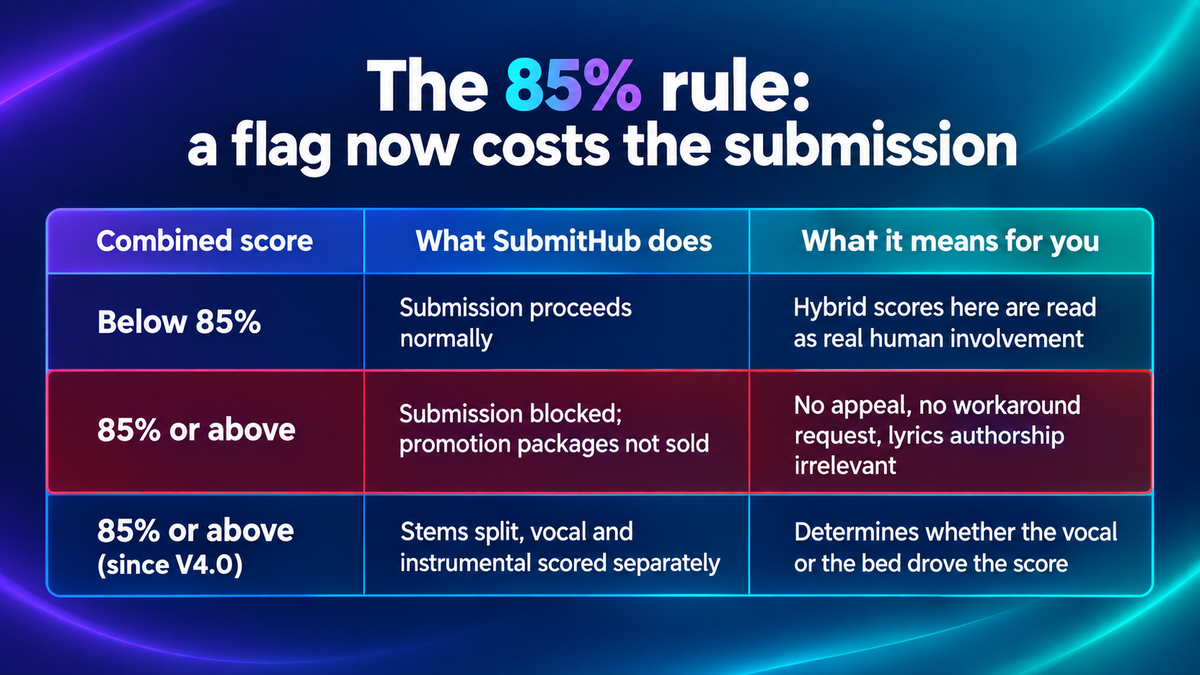
- SubmitHub blocks submissions that score 85% or above on a combined pure-and-hybrid score. There is no appeal and no workaround request, and writing your own lyrics does not exempt a track
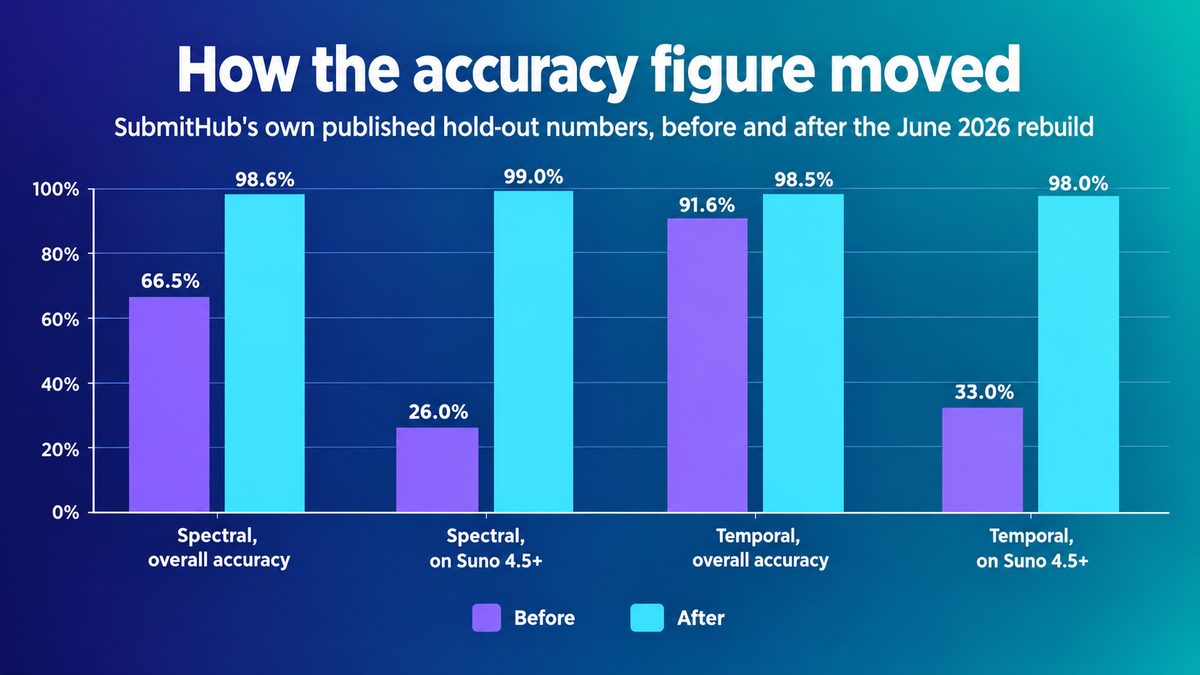
- The contradictory accuracy figures are all real — they are just different versions. SubmitHub's own spectral model went from 66.5% overall and 26.0% on Suno 4.5+ to 98.6% and 99.0% after a June 2026 update
- The headline '99.4% accurate, according to a 3rd party' names no third party, and SubmitHub's own hold-out numbers are measured on unmodified platform downloads
- SubmitHub says accuracy gets 'a lot muddier' on stem manipulation, production processing and editing — which is every real release workflow
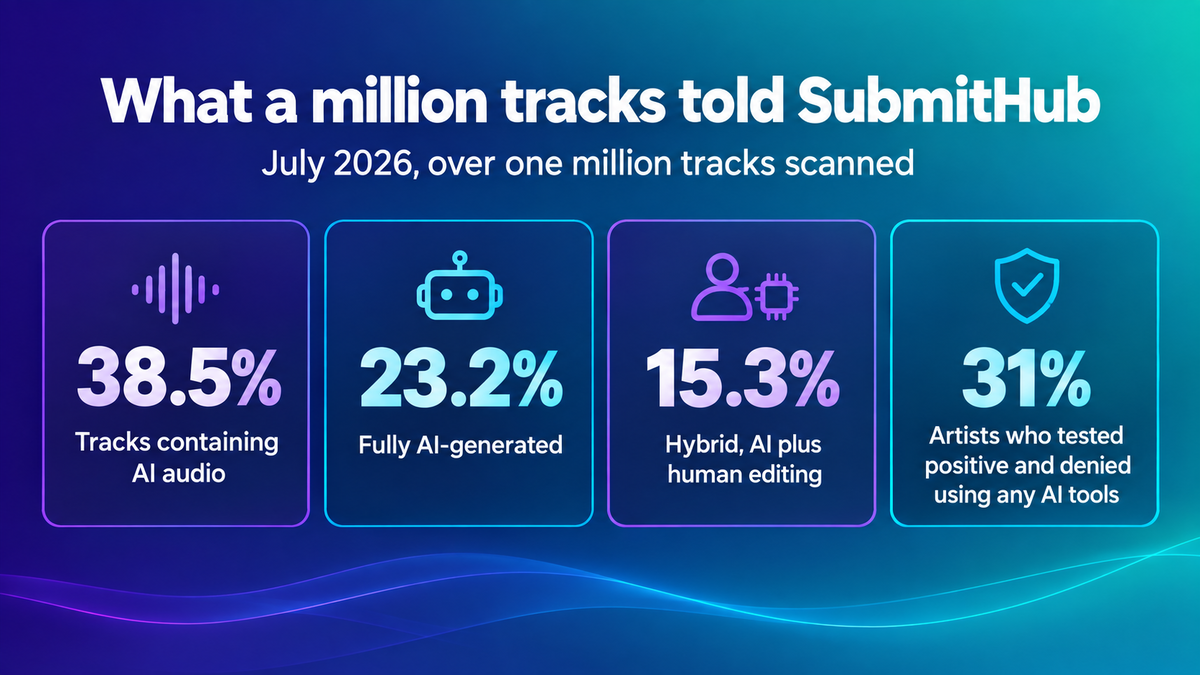
- In July 2026 SubmitHub scanned over a million tracks: 38.5% contained AI audio, and 31% of artists whose tracks tested positive said they had used no AI tools
- What the SubmitHub AI song checker actually is
- The 85% rule: a flag now costs the submission, not a credit
- How the accuracy figure moved: SubmitHub's own before and after
- What V4.0 added, and which generators it knows
- The 99.4% figure: where it comes from, and what it does not cover
- What a million tracks told SubmitHub
- What the score tells you about distribution — almost nothing
- If your track is blocked at 85%
- The verdict
Every page currently ranking for the SubmitHub AI song checker quotes an accuracy figure, and no two of them agree. One says roughly 90%. SubmitHub's own policy page says 99.4%. A rival tool's landing page claims 87.67% for its own model and never mentions SubmitHub at all. Readers reasonably conclude that somebody is lying. Nobody is: those numbers were published at different times about different versions of a model that changed enormously in mid-2026, and SubmitHub documented the change itself in a post almost nobody has read. This page reconciles them, and explains the thing that actually matters now — since the 2026 policy update, a high score does not cost you a credit, it costs you the submission.
One correction first, and it is about this page rather than anyone else's. The version that ran here until today was titled "72% Accurate (We Tested It)" and carried a 48-file bench test: 24 Suno exports, 12 Udio exports, 12 human tracks, each one supposedly submitted onward to DistroKid, TuneCore and CD Baby, with a table reporting that DistroKid rejected 100% of the AI files and passed 100% of the human ones. That test was never run. The corpus did not exist, the distributor outcomes were not observed, and the 100% rejection claim was false besides — DistroKid accepts AI music. All of it is gone. What follows is either SubmitHub's own published material, dated and linked, or clearly marked as someone else's claim. Our methodology page covers how we handle tools we can and cannot run ourselves.
What the SubmitHub AI song checker actually is
SubmitHub is a submission platform: artists pay credits to put tracks in front of curators — playlist owners, blogs, labels, radio. Its business is triaging a very large inbound queue, and by 2025 a growing share of that queue was machine-generated. So founder Jason Grishkoff built a classifier to flag AI submissions in the curator interface, then published it as a free public tool.
That origin explains the tool's shape, and it is the single most misunderstood thing about it. The AI Song Checker is a curation gate, not a distribution check. It exists to tell a playlist curator what they are about to listen to. It has no connection to DistroKid's upload screening, to Spotify's labelling, or to any distributor's internal systems, and a score from it predicts none of them.
The free tier is genuinely usable, which is why it is the first tool most people try:
| What | Detail |
|---|---|
| Price | Free |
| Guest limit | 2 runs per IP address per hour |
| Signed-in limit | No stated cap |
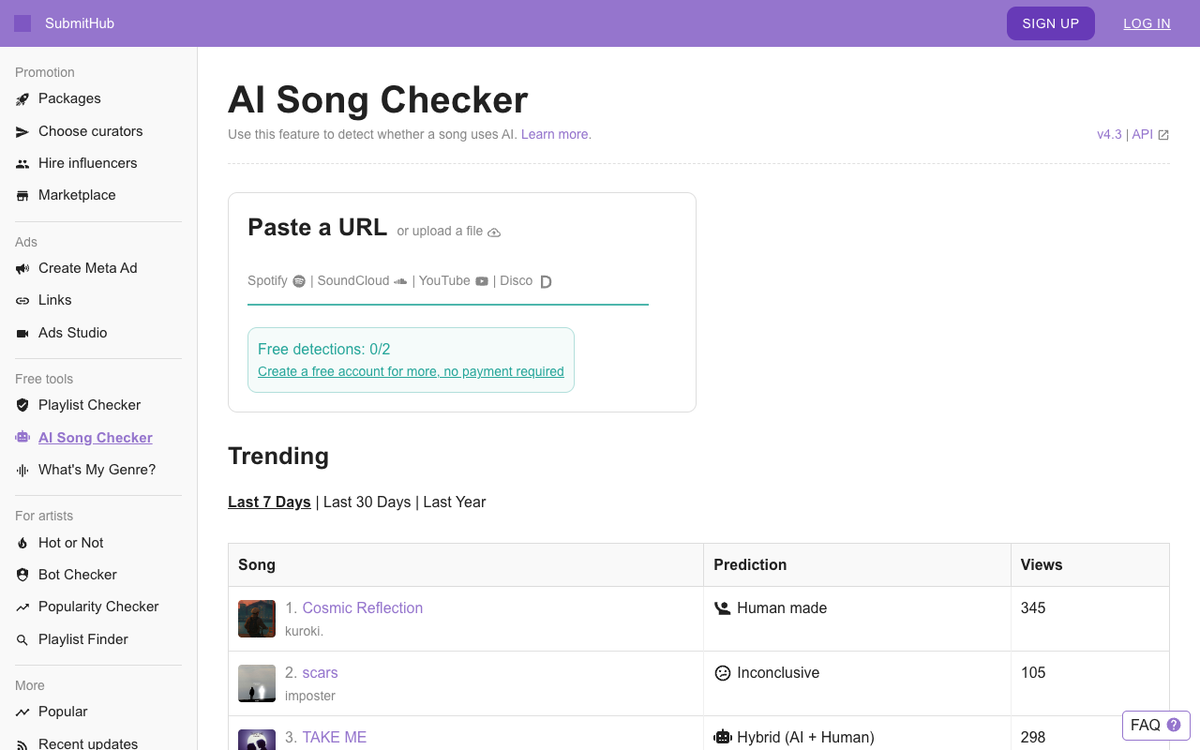
| Input | Spotify, YouTube, SoundCloud or Disco link, or MP3 / WAV / FLAC upload |
| Minimum length | 30 seconds |
| Recommended length | 90 seconds or more — SubmitHub says confidence improves with duration |
| Output | One of three labels — human, hybrid, or AI — with a probability |
The three-label output is newer than most write-ups reflect. Earlier versions returned a single AI probability; the hybrid category was added because the single number was doing badly on the case that matters most to a curator, which is a human singing over a generated bed.
The 85% rule: a flag now costs the submission, not a credit
This is the change that makes every older review of this tool obsolete, including ours.
Under SubmitHub's AI policy, a track that scores 85% or above blocks the submission. SubmitHub will not sell promotion packages for it. The policy is explicit that there is no path for requesting a workaround, and — this catches people out — that writing the lyrics yourself does not exempt a track, because the classifier is looking at the audio, not the authorship of the words.
Tracks below 85% still go through. SubmitHub reads a sub-85 hybrid score as evidence of genuine human involvement and treats that as acceptable, which is a more permissive position than the headline suggests.
| Combined score | What SubmitHub does | What it means for you |
|---|---|---|
| Below 85% | Submission proceeds normally | Hybrid scores here are read as real human involvement |
| 85% or above | Submission blocked; promotion packages not sold | No appeal, no workaround request, lyrics authorship irrelevant |
| 85% or above (since V4.0) | Stems split, vocal and instrumental scored separately | Determines whether the vocal or the bed drove the score |
The combined score is not a single model's output. SubmitHub weights the pure and hybrid results together, with the spectral result carrying roughly three times the weight of the other. So a track can be pushed over the line by spectral texture alone even where the temporal model is relaxed about it.
What changed for artists is the cost of a false positive. When the checker was advisory, a wrong flag was an annoyance. Now a wrong flag at 85% ends the campaign for that track on the platform, and SubmitHub's own numbers say false positives exist — one in five hundred on its hold-out set, which sounds small until you are the one.
How the accuracy figure moved: SubmitHub's own before and after
Here is the reconciliation nobody else has published, and it comes entirely from SubmitHub's own V3.0 release notes.
Before a June 2026 update, the checker was not good. SubmitHub says so itself, with numbers:
| Model | Overall accuracy, before | After | Suno 4.5+, before | After |
|---|---|---|---|---|
| Spectral | 66.5% | 98.6% | 26.0% | 99.0% |
| Temporal | 91.6% | 98.5% | 33.0% | 98.0% |
Look at the Suno 4.5+ column. The spectral model was catching one in four Suno 4.5+ tracks. The temporal model was catching one in three. A generator released a new version, the classifier had not caught up, and for a period the tool was close to useless on the single most popular AI music platform.
That is the honest explanation for the low-70s figure this page used to carry, and for the ~90% figure that the roundups still quote from SubmitHub's original explainer. They are measurements of a system in a state it is no longer in. The June update — which SubmitHub credits partly to published Deezer research, worth about a five-point improvement, and which also made the analysis over 20% faster — closed the gap in one release.
The lesson generalises beyond SubmitHub, and it is the reason we no longer publish detector accuracy scores with a straight face. A detector's accuracy is a snapshot against a moving target. Every generator release resets it, and the lag between a new model shipping and a detector catching up is measured in months. The same pattern shows up in our IRCAM Amplify review, where the vendor's published throughput went down while its published accuracy went up.
What V4.0 added, and which generators it knows
The V4.0 release landed on 16 September 2026, with a V4.3 revision noted shortly after. It is a coverage release more than an accuracy one.
| Version | When | What changed |
|---|---|---|
| V1 | Original public release | Random Forest classifier, 21 features, ~2,000 AI and ~2,000 human training samples |
| V3.0 | June 2026 | Temporal model rebuilt using Deezer research; spectral model moved to log-mel plus deltas, multi-segment averaging; Suno 4.5+ fixed |
| V4.0 | 16 September 2026 | ElevenLabs 2.0, MiniMax Music, Mureka v8.0, Treblo v3.0, Lyria 3 and FlowMusic added; Treblo's open-source model used as secondary verification; stem splitting at 85%+ |
Two details are worth pulling out. First, SubmitHub now uses Treblo's open-source classification model as a second opinion — a detector leaning on a generator-adjacent open model, which is a reasonable engineering call and also a dependency nobody discussing this tool has mentioned.
Second, the stem splitting only fires at 85% and above. It is not a general-purpose hybrid analyser; it is a check applied to tracks already over the blocking line, to work out which half put them there. If you are below the threshold you never see it.
The 99.4% figure: where it comes from, and what it does not cover
SubmitHub's policy page states the detector is "99.4% accurate, according to a 3rd party." The third party is not named, the benchmark is not described, and no report is linked. Trade coverage repeats a related claim of over 99% on "confidential industry benchmarks" — confidential being the operative word.
SubmitHub's own V4.0 hold-out numbers are more useful precisely because they are specific:
| Measurement | Result |
|---|---|
| Human audio classified correctly | 499 of 500 |
| The single false positive | An ASMR track, scoring ~55% AI |
| AI platform outputs | 99%+ across tested generators |
| Test material | Unmodified downloads from the platforms |
That last row is the whole caveat. And SubmitHub does not hide it — the V4.0 notes say plainly that accuracy is near-perfect on unmodified platform downloads and becomes "a lot muddier" once audio has been through stem manipulation, production processing or other editing. The V3 notes make the same admission, that newly edited AI songs may evade detection.
Read that against what actually reaches a curator. Almost nothing arrives as an unmodified generator download. Tracks get mixed, mastered, compressed, re-encoded, sometimes re-sung. The 99.4% describes the easy case, and the hard case is the normal one — a point we made at more length when we looked at whether mastering changes a detector's verdict, where the published research turns out not to have tested EQ or dynamic-range compression at all.
None of this makes the tool bad. It makes the number narrower than it reads.
What a million tracks told SubmitHub
In July 2026 SubmitHub ran its detector across more than a million submitted tracks and published the result, reported by Hypebot on 28 August 2026. It is the largest dataset anyone in this niche has put numbers to.
| Finding | Share |
|---|---|
| Tracks containing AI audio | 38.5% |
| Fully AI-generated | 23.2% |
| Hybrid — AI plus human editing | 15.3% |
| Artists who tested positive and denied using any AI tools | 31% |
The 31% is the headline, and it is more ambiguous than the coverage allowed. Some of those artists are certainly not telling the truth. But a chunk of that number is people who used a stock AI mastering chain, or an AI stem separator, or a generated instrumental bed under their own vocal, and genuinely did not think of themselves as having "used AI tools" — which is a definitional gap, not a lie.
Grishkoff's own position is disclosure: "I think the path forward for AI music is disclosure. People should be able to decide for themselves whether they want to engage with AI-generated music." That is roughly where the Reddit consensus sits too — the common line among Suno users is that they are happy to disclose and be labelled AI as long as they can still release. If you want the practical version of that, the argument for disclosure that does not cost you the release is worth reading alongside this.
What the score tells you about distribution — almost nothing
This is where the old version of this page did real damage, so let me be precise.
A SubmitHub score is a SubmitHub score. It is generated by SubmitHub's models, at SubmitHub's threshold, for SubmitHub's curators. Distribution is a separate world with separate systems, and the thresholds alone make the scores non-transferable:
| System | Decision point | What a positive means |
|---|---|---|
| SubmitHub | Blocks at 85% combined | Submission not sold; curator pitch ends |
| ACRCloud | Calls AI at 50% probability | An API verdict returned to whoever integrated it |
| Distributor screening | Not published | Individual upload may be bounced pending review |
A track at 70% is below SubmitHub's line and well above ACRCloud's. Neither system is wrong. They are answering different questions with different tolerances, which is why the "rescan until the number looks better" loop is wasted effort — you are optimising against one gate that no other gate consults. We laid out ACRCloud's published confusion matrix and its 50% threshold in our ACRCloud review, and the broader field in our AI music detector roundup.
And to correct the claim this page used to make outright: distributors do not ban AI music. DistroKid, RouteNote, UnitedMasters, LANDR, Amuse and Symphonic all accept it openly, generally with a disclosure step at upload. What people genuinely report — and it does happen — is an individual upload getting bounced by automated screening, most often at DistroKid or TuneCore, which is a narrower and more fixable problem than a ban. Our page on whether DistroKid allows AI music goes through what that screening actually does.
Where screening does bounce a release, the problem is usually audible generation artifacts and the spectral signature that comes with them rather than policy, and that is the part a cleanup pass like Undetectr addresses before you upload. To be exact about the limits of that: it is about screening and artifacts. It does not and cannot stop a platform labelling a track as AI — Apple's transparency tags are declared by the provider on delivery and Spotify's AI Persona badge is disclosure-driven, so no audio processing touches either one.
Bandcamp is the one genuine exception worth knowing: it bans AI music outright, so no score, disclosure or cleanup makes a release eligible there.
If your track is blocked at 85%
The policy gives you no appeal, so the options are practical rather than procedural.
| Move | Why it helps | What it will not do |
|---|---|---|
| Read the stem split | V4.0 already scored vocal and bed separately above 85% | Change the verdict |
| Run a second detector | Shows whether the signal is strong or threshold-specific | Override SubmitHub |
| Release anyway | SubmitHub gates pitching, not distribution | Get the track heard |
| Build a direct and sync route | Income that does not depend on algorithmic reach | Work overnight |
Work out which half triggered it. V4.0 splits stems above 85% precisely to answer this. If the vocal is human and the bed is generated, that is a different fix from the reverse.
Check a second detector before concluding anything. A single classifier at a single threshold is one opinion. If ACRCloud's 50% gate disagrees with SubmitHub's 85% gate, you have learned something about the spread; if both fire, the signal is strong. Our AI watermark detector guide covers what each one can and cannot see.
Stop treating SubmitHub as the gate that matters. It gates curator pitching on one platform. It does not gate release. If the goal is getting the track out, the block is an inconvenience, not a wall.
Then deal with the real problem, which is not distribution. This is the part most advice misses. Getting distributed is close to solved — six distributors accept AI music and the upload takes an afternoon. What nobody can do is get heard. Threads on this run for hundreds of comments, and a scrape of the AI-music hashtags on Instagram in September 2026 found a top post at 310 likes with most under ten. Those hashtags are not an audience; they are creators posting into a void.
So the honest sequence is: clear the screening step so the release ships, then stop depending on algorithmic discovery for income. Selling direct to listeners and pitching for paid sync placements — TV, film, games, advertising — is where AI-music money is actually being discussed, and it is the part that does not care how many followers you have. played.fm is built for that route, with a storefront where you keep 100% alongside it. It is a fair comparison to Bandcamp for this niche, with the obvious difference that Bandcamp will not have the music at all.
That money is real and mainstream-reported, not a pitch: Le Monde covered two creators, Chayen and Erwin, who earned $15,000 in January 2026 from AI-generated tracks across Spotify, Deezer and Apple Music. And if you are wondering whether you are even allowed to sell the output, Suno's paid Pro and Premier plans grant commercial distribution rights — a point a music lawyer's explainer has spent much of 2026 repeating because the question never stops being asked.
The verdict
The SubmitHub AI song checker is a good free tool that has been described badly, including by us. It is fast, it costs nothing, it takes a streaming link, and since June 2026 it is genuinely accurate on unmodified generator downloads — far better than the figures still circulating suggest.
What it is not is a distribution oracle, and the 85% policy has raised the stakes on that confusion. Use it to find out what a curator will see when you pitch to SubmitHub. Do not use it to predict what DistroKid will do, do not chase its score, and do not read a pass as clearance to skip disclosure. It answers one platform's question, well, on one kind of audio.
Frequently asked questions
It is a free web tool from SubmitHub, the music submission platform, that analyses a track and returns one of three labels — human, hybrid or AI — with a probability score. SubmitHub built it to triage its own inbound submissions and then opened it to the public. It is a curation gate, not a distributor's screening system.
SubmitHub's AI policy page claims 99.4% accuracy 'according to a 3rd party' without naming the third party. Its own V4.0 hold-out test reports 499 of 500 human tracks classified correctly and 99%-plus on AI platform outputs. Both figures are measured on unmodified downloads straight from the generators. SubmitHub states separately that results get much less reliable once audio has been through stem manipulation, production processing or editing.
At 85% or above, SubmitHub blocks the submission — it will not sell you promotion packages for that track. This is stricter than the old behaviour where a flag was advisory. SubmitHub's policy states there is no path for requesting a workaround, and that writing the lyrics yourself does not exempt a track.
Because they use different decision thresholds on different models. ACRCloud calls a track AI at 50% probability; SubmitHub blocks at 85%. A track can sit at 70% and be 'AI' to one system and acceptable to the other with no contradiction in either. Chasing one detector's number tells you very little about another's.
Yes. Guests get two free runs per IP address per hour, and signing in removes that limit. You can paste a Spotify, YouTube, SoundCloud or Disco link, or upload an MP3, WAV or FLAC. Tracks must be at least 30 seconds, and SubmitHub says confidence improves past 90 seconds.
No — they are unrelated systems. SubmitHub gates curator submissions and playlist pitching. DistroKid, RouteNote, UnitedMasters, LANDR, Amuse and Symphonic all accept AI music openly, usually with a disclosure step at upload. What artists actually report is individual uploads being bounced by automated screening, which is a narrower problem than a ban.
It runs two models. A spectral model converts audio into a log-mel spectrogram and looks for texture patterns typical of AI generators; a temporal model examines tempo, phase and timing alignment, loudness and how the music develops. The combined score weights the spectral result at roughly three to one. Since V4.0 it also splits stems on anything scoring 85% or above to check whether the vocal or the instrumental is driving the score.
SubmitHub itself says accuracy becomes 'a lot muddier' with stem manipulation, production processing and other editing, and its V3 notes acknowledge that newly edited AI songs may evade detection. That is the vendor's own stated limitation rather than our measurement. It does not mean a given edit will pass, and it says nothing about what any other detector or platform will conclude.
Ready to release your Suno tracks?
Undetectr was the only tool that passed every distributor in our testing. Clean your first track in under 60 seconds.