Suno Pro vs Premier 2026: Same Cost Per Released Track
Since 3 September 2026 the tier you pick decides how many finished tracks you may export, not how many you may generate. Pro is $10 a month and Premier $30 — and on both, a releasable track costs exactly the same. Here is the arithmetic, and the point where Premier stops being the expensive option.
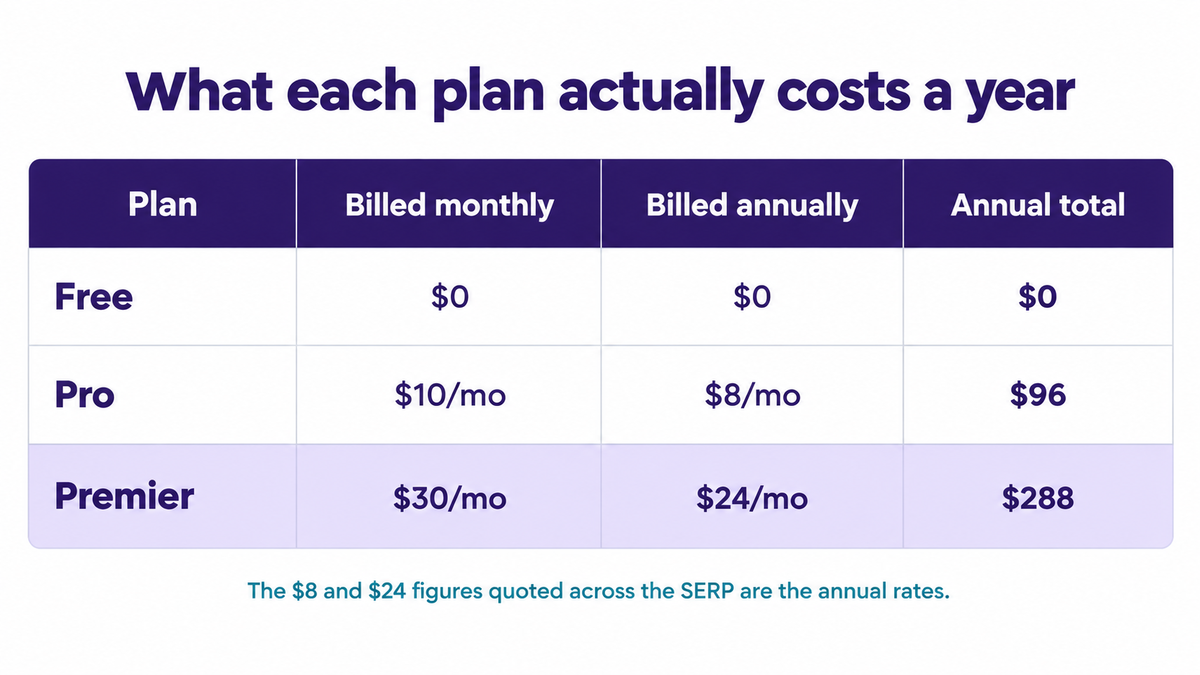
- Pro is $10/month and Premier $30/month. The $8 and $24 figures quoted across the SERP are the annual-billing rates, and Suno's own savings lines ($24 and $72 a year) only reconcile against $10 and $30
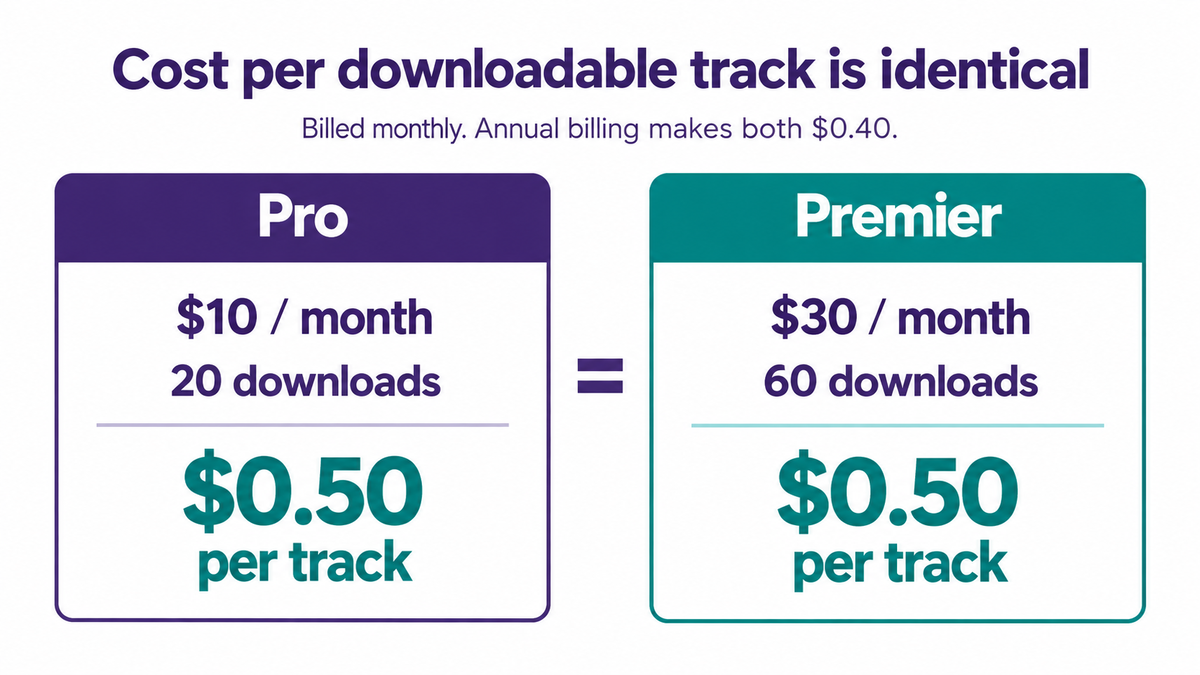
- Cost per downloadable track is identical on both plans: $0.50 billed monthly, $0.40 billed annually. Premier is exactly 3x the price for exactly 3x the downloads, so upgrading buys ceiling, never a cheaper release
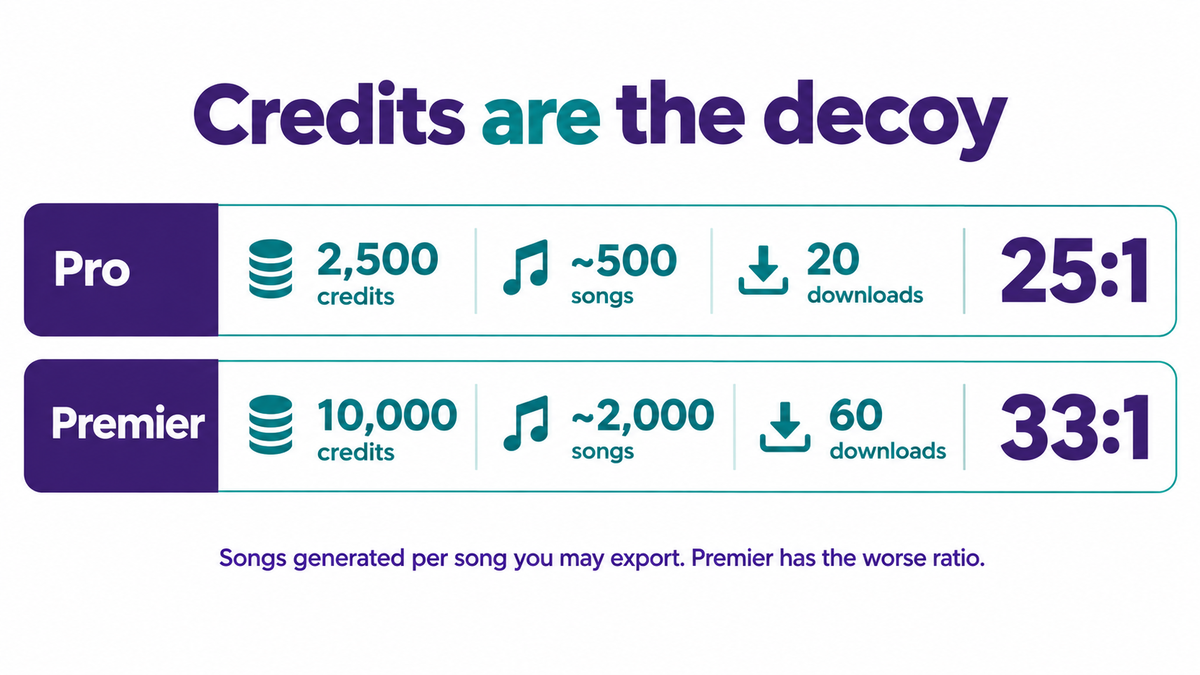
- Credits are no longer the binding limit. Pro's 2,500 credits buy about 500 songs but permit 20 exports (25:1); Premier's 10,000 buy about 2,000 and permit 60 (33:1), so Premier's ratio is the worse of the two
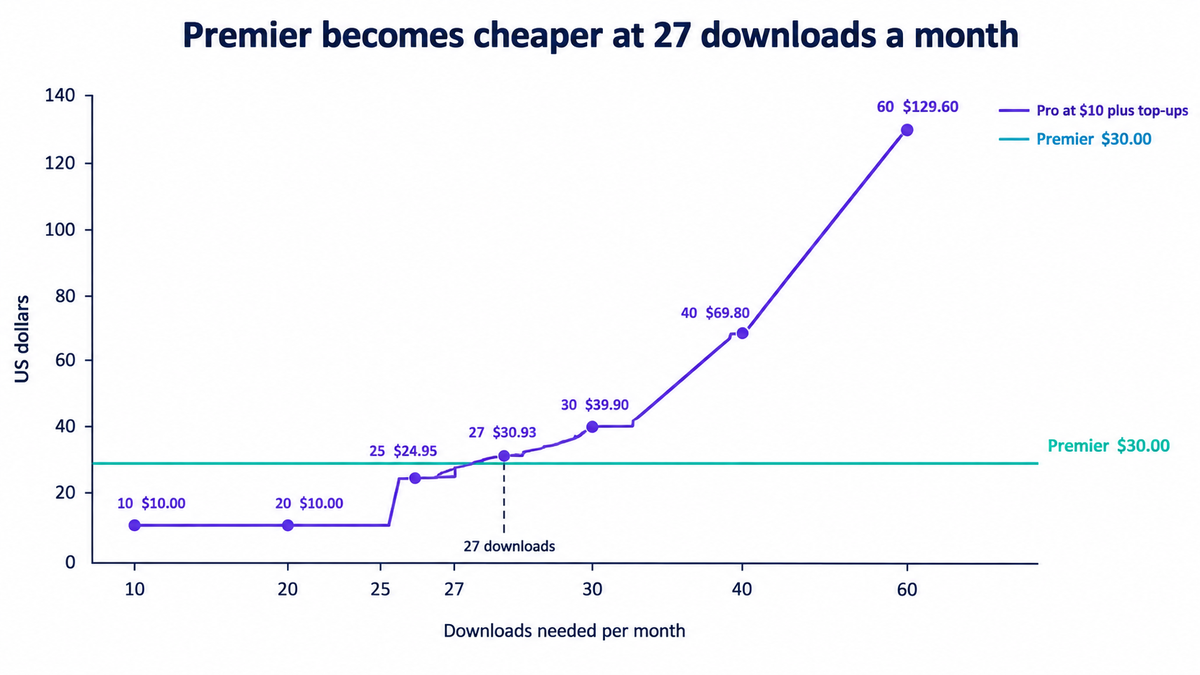
- Extra downloads are reported at $2.99 each with no bulk discount, which puts the Pro-plus-top-ups break-even at roughly 26 to 27 downloads a month. Below that, Pro wins on cost at every volume
- Suno Studio is the only genuine asymmetry: it is Premier-only and its workflows are exempt from download limits entirely
- Suno Pro vs Premier: the real monthly prices
- The number that changed on 3 September 2026
- Cost per downloadable track is identical on Pro and Premier
- Credits are the decoy: 25:1 on Pro, 33:1 on Premier
- When Premier actually becomes the cheaper plan
- Suno Studio is the only thing that breaks the symmetry
- Which plan lets you actually sell the track
- Suno Pro vs Premier: the decision, by reader

Pick the wrong Suno tier in 2026 and you do not lose a feature, you lose releases. Since 3 September 2026 the plan you are on caps how many finished tracks you may export, and it applies retroactively to everything you have ever generated. So Suno Pro vs Premier is now a question about 20 downloads a month against 60, at $10 and $30 — not the $8 and $24 that half the search results quote, which are the annual rates. What follows is the arithmetic nobody on the first page runs: what a releasable track actually costs on each plan, and the exact volume at which Premier stops being the expensive option.
Every figure here was checked against Suno's own pricing page, its download-policy post and four help-centre articles on 22 September 2026. Two of them corrected this page, which until today listed Premier at $24 a month as though that were the monthly rate. Our methodology page covers how we handle numbers we cannot verify at source.
Suno Pro vs Premier: the real monthly prices
| Plan | Billed monthly | Billed annually | Annual total | Suno's own savings line |
|---|---|---|---|---|
| Free | $0 | $0 | $0 | — |
| Pro | $10/mo | $8/mo | $96 | "saves $24 by billing yearly" |
| Premier | $30/mo | $24/mo | $288 | "saves $72 by billing yearly" |
The savings lines are the proof, and they are Suno's own. A $24 annual saving only reconciles against a $10 monthly rate: twelve months at $10 is $120, twelve at $8 is $96, and the gap is $24. A $72 saving only reconciles against $30: $360 against $288. If $8 and $24 were the monthly prices, both savings figures would be arithmetically impossible.
The reason so many pages get this wrong is mundane. Suno's pricing page loads with the annual toggle selected, so a reader — or a crawler — sees $8 and $24 first and reports them as the price. Three of the comparison pages currently ranking for this query do handle it correctly; the two largest pricing explainers we checked do not, and neither did this page.
The practical consequence is small but real: budget at $10 and $30 unless you are committing to a full year, and treat annual billing as a flat 20% discount rather than a different product. It is the only lever on unit cost that exists, as the next two sections show.
The number that changed on 3 September 2026
Suno introduced per-tier download allowances, and they redefined what a subscription is. Before the change, a plan bought generation volume. Now it buys export volume, and the two are nothing like each other.
| Plan | Download allowance | Resets | Covers songs made before 3 Sep 2026 | Commercial rights on the file |
|---|---|---|---|---|
| Free, joined before 3 Sep 2026 | 7 total, for the life of the account | Never | Yes | No — personal, non-commercial only |
| Free, joined on or after 3 Sep 2026 | Occasional trial downloads | n/a | Yes | No |
| Pro | 20 per month | Billing date, no rollover | Yes | Yes |
| Premier | 60 per month | Billing date, no rollover | Yes | Yes |
| Premier inside Suno Studio | No limit | — | — | Yes |
Two details do most of the damage. The free tier's seven is a lifetime figure, not a monthly one, which makes the free plan unusable as a workflow rather than merely limited. And per Suno's own changes FAQ the caps apply to all music from that date "including songs created before that date", so a year-old library of two hundred tracks does not arrive grandfathered — exporting it costs the same twenty a month as new work does.
The allowance also does not roll over. An unused month is gone, which means a batch-generate-then-cancel pattern now has a hard ceiling of whatever a single month permits. Our download caps breakdown has the mechanics in full, and the policy tracker keeps every dated change in one place.
Cost per downloadable track is identical on Pro and Premier
This is the calculation the whole cluster skips, and it produces the most useful number on the page.
| Plan and billing | Cost per month | Downloads per month | Cost per downloadable track |
|---|---|---|---|
| Pro, billed monthly | $10 | 20 | $0.50 |
| Pro, billed annually | $8 | 20 | $0.40 |
| Premier, billed monthly | $30 | 60 | $0.50 |
| Premier, billed annually | $24 | 60 | $0.40 |
Suno priced Premier at exactly three times Pro and gave it exactly three times the downloads. The unit cost of a releasable track is therefore identical on both plans, and the only thing that moves it is the 20% annual discount.
That reframes the upgrade question completely. Premier does not make releasing cheaper; it raises the ceiling from 240 releasable tracks a year to 720. If you are not going to hit 240, the extra $20 a month buys headroom you will not use, and the pages advising Premier "for serious artists" are recommending a ceiling, not an efficiency.
It also explains why the per-track figures elsewhere on the SERP look so much more attractive than this one. The best competitor page we scored quotes about $0.003 per generation, which was a sound number before September and is now describing an operation you can perform five hundred times a month but only bank twenty of. The denominator moved.
Credits are the decoy: 25:1 on Pro, 33:1 on Premier
Every comparison page leads with the credit allowance, because for two years that was the constraint. It is not any more, and the ratio makes the point faster than prose does.
| Plan | Credits per month | Generations (10 credits each) | Songs (2 per generation) | Downloads | Songs generated per song you may export |
|---|---|---|---|---|---|
| Free | 50 per day | ~5 per day | ~10 per day | 7, lifetime | — |
| Pro | 2,500 | 250 | ~500 | 20/mo | 25:1 |
| Premier | 10,000 | 1,000 | ~2,000 | 60/mo | 33:1 |
The generation figures come from Suno's own help centre: one generation costs 10 credits and returns two songs. Suno does not print songs-per-month on its pricing page, so treat the 500 and 2,000 as arithmetic rather than a published claim.
Now the part that inverts the usual advice. Suno multiplied credits by four and downloads by three, so Premier's generate-to-release ratio is the worse of the two. And credits are soft-capped where downloads are hard-capped: Suno's help centre states that Pro and Premier creators receive 50 free credits per day once the monthly allowance is spent. There is no equivalent trickle for downloads.
So the credit column describes something you will not run out of, sitting next to a download column you will. If you are choosing a plan on credits in 2026, you are optimising the wrong axis.
When Premier actually becomes the cheaper plan
Suno says users who hit the limit can purchase additional downloads, but it does not publish the price anywhere on its pricing page or in its help centre. The figures reported from the in-app purchase screen on 4 September 2026, the day after the caps took effect, are $2.99 for one download, $8.95 for three, $14.95 for five and $29.90 for ten — a flat $2.99 with no meaningful bulk discount. We could not verify these at source, so they are cited as reported, not as Suno's published pricing.
At a flat $2.99, topping up Pro has a clean break-even against Premier:
| Downloads you need each month | Pro at $10 + top-ups | Premier at $30 | Cheaper |
|---|---|---|---|
| 10 | $10.00 | $30.00 | Pro |
| 20 | $10.00 | $30.00 | Pro |
| 25 | $24.95 | $30.00 | Pro |
| 27 | $30.93 | $30.00 | Premier |
| 30 | $39.90 | $30.00 | Premier |
| 40 | $69.80 | $30.00 | Premier |
| 60 | $129.60 | $30.00 | Premier |
The crossover sits between 26 and 27 downloads a month on monthly billing, and between 25 and 26 on annual, where Premier's $24 is a lower bar to clear. Either way the number to carry is the same: if you release more than about two dozen tracks a month, Premier is the cheaper plan, and if you do not, it is a 200% price rise for capacity you will not touch.
Note what this does to the old advice of subscribing for one month, generating an album's worth of material and cancelling. That pattern still works — but on Pro it now exports twenty tracks, not the whole library, and a fourteen-track album plus alternate mixes will run it close. Our guide to what you keep if you cancel covers where that leaves the rights.
Suno Studio is the only thing that breaks the symmetry
If the two plans cost the same per track and grant the same rights, Premier needs a reason to exist beyond ceiling. Suno Studio is it.
Studio is Premier's browser-based production environment — a multitrack timeline with MIDI export, advanced stem splitting and custom models — and both Suno's download-policy post and its help centre state plainly that Studio workflows carry no download limit. That is the single asymmetry in the whole comparison, and it is a large one: it is the only route on either plan to unlimited exports.
Read the exemption carefully, though. Suno describes Studio as its suite "for generating and manipulating stems and samples", and the exemption is written around those workflows. Treat it as an uncapped production route rather than a documented way to export five hundred finished masters a month, because Suno has not said it is the latter and the policy is three weeks old. We cover what Studio does and does not justify in is Suno Studio worth it, and the export side in our Suno stems guide.
Advanced stem splitting is the other Premier-only item worth pricing in. If your workflow ends in a DAW rather than in Suno, that plus the Studio exemption can justify the upgrade on their own, independent of how many tracks you release.
Which plan lets you actually sell the track
Neither plan grants more rights than the other, which surprises people who assume Premier buys a better licence. Pro and Premier are identical on commercial use. The meaningful line is between free and paid, and it is harder than most pages make it sound.
Suno's help centre states that if you make music on the Basic (free) plan, Suno owns the songs and you may use them for non-commercial purposes only, and its downloads article adds that trial downloads are not eligible for commercial use. Critically, rights attach at creation, not at payment: subscribing in October does not retroactively license the tracks you made in August. A free-plan back catalogue stays non-commercial no matter what you pay afterwards.
Going the other way is kinder. Suno's download-policy post says that for any song downloaded as a paying subscriber you hold the commercial rights, regardless of what happens to the subscription later — so exhausting your allowance, downgrading or cancelling does not claw back files you already exported. Our commercial use guide works through the edge cases, and Suno's own caveat is worth repeating: output may not attract copyright protection at all, particularly with no human-written elements.
What a plan does not buy you is a clean run through distribution. Distributors do not ban AI music — DistroKid, RouteNote and UnitedMasters publish a plain yes, while TuneCore, Symphonic and CD Baby now apply a licensing test to the model rather than the track — but individual uploads do get flagged and rejected by automated screening, and generation artifacts are a common reason. That is a separate problem from your subscription, and no tier fixes it.
Under the caps, a track bounced by automated screening costs you an allowance slot as well as a re-upload. Undetectr processes generated tracks for screening and audible artifacts before they go out — it does not, and cannot, change how a platform labels or credits a release.
See Undetectr pricing → from €19 · €39 lifetime founder pricing · affiliate link
Suno Pro vs Premier: the decision, by reader
Five cases cover almost everyone:
Releasing under 20 tracks a month. Pro, and annual billing if you are committing to a year. You will not touch the ceiling and Premier's unit cost is no better.
Releasing 20 to 26 tracks a month. Still Pro, topped up. At 25 downloads the top-ups come to $24.95 against Premier's $30, and you keep the option of a quiet month costing $10.
Releasing 27 or more. Premier, on the arithmetic above. Past the crossover the top-up route gets expensive quickly — 40 downloads on Pro is $69.80 against $30.
Working in a DAW, or wanting stems, MIDI or custom models. Premier regardless of volume, for Studio and the download exemption rather than the ceiling.
Still evaluating. Free, with both eyes open: seven lifetime downloads, and Suno owns what you make. Do not build a catalogue there expecting to sell it. If the output is not convincing, our Suno alternatives page compares the rest of the field.
One caveat on the upgrade, because it is the mistake this cluster encourages. A 720-track annual ceiling is only worth $288 if those tracks find listeners, and the honest reporting on that is sobering — sister site erasy's breakdown of a reported $15,000 month shows it took roughly nine million plays across four profiles, not one hit. Volume is not the constraint most people think it is. Our own guide to making money with Suno runs the same numbers from the release side.
Which is the argument for not treating streaming as the only destination. Paid sync placement — television, film, games, advertising — is where the money conversation in this niche is actually happening, and played.fm's sync route is built for pitching into it; selling direct and keeping the full amount is the other route that does not depend on algorithmic discovery. Either one makes a 20-download month look less like a cap and more like a reason to be selective about what you export.
Frequently asked questions
Free is $0. Pro is $10 per month billed monthly, or $8 per month if you pay for a year ($96). Premier is $30 per month billed monthly, or $24 per month annually ($288). The lower figures are annual rates, not a price cut — Suno's pricing page defaults to the annual toggle, which is why $8 and $24 get quoted as headline prices all over the web.
Only above roughly 26 to 27 downloads a month, or if you want Suno Studio. Premier costs exactly three times Pro and grants exactly three times the downloads, so the cost per releasable track is identical on both. What the extra $20 a month buys is a higher ceiling — 720 releasable tracks a year instead of 240 — plus Studio access. It does not buy broader rights or better audio.
Three things, and rights are not among them. Premier has 10,000 monthly credits against Pro's 2,500, 60 monthly downloads against 20, and exclusive access to Suno Studio, whose workflows carry no download limit at all. Premier also adds custom models, advanced stem splitting and a priority queue. Commercial use rights are identical on both.
Twenty per month. The allowance resets on your billing date and unused downloads do not carry over. Suno applied this on 3 September 2026 to all music including songs created before that date, so an existing back catalogue counts against the same allowance.
Yes. Suno's policy says users who want to download beyond their limit can purchase more, but it does not publish the price on its pricing page. The figures reported from the in-app purchase screen shortly after launch are $2.99 for one, $8.95 for three, $14.95 for five and $29.90 for ten — effectively a flat $2.99 with no bulk discount. Treat those as reported rather than Suno-published.
No, and upgrading later does not fix it. Suno's help centre states that music made on the Basic (free) plan is owned by Suno and may be used for non-commercial purposes only, and that trial downloads are not eligible for commercial use. Rights attach at the moment of creation, not at the moment you pay, so a back catalogue built on free stays non-commercial.
Songs you downloaded while subscribed keep their commercial rights. Suno's download-policy post states that for any song downloaded as a paying subscriber you hold the commercial rights regardless of what happens to the subscription afterwards. What you lose on cancellation is future downloads and unused credits, not the licence on files already exported.
Almost never, and that is the point. Generation is soft-capped — Suno's help centre says Pro and Premier creators still receive 50 free credits a day once the monthly allowance is spent — while downloads are hard-capped at 20 and 60. Pro's credits buy roughly 500 songs a month against 20 exports, so the credit column stopped being the number that constrains a release schedule.
Ready to release your Suno tracks?
Undetectr was the only tool that passed every distributor in our testing. Clean your first track in under 60 seconds.