DistroKid Copyright: Who Owns Your Music in 2026?
DistroKid does not take your copyright — its own agreement says so in capital letters. The interesting questions are what the licence does grant, whether an AI track has a copyright to keep at all, and what happens when a major label claims your release.
- DistroKid's distribution agreement states it takes no copyright interest in your music, only a limited licence to distribute
- That licence is non-exclusive and sub-licensable, runs one year on auto-renew, and its territory is 'the universe'
- Taking a track down does not unwind everything: clause 5.b lets stores keep serving copies customers already hold
- AI is where copyright actually bends — the US Copyright Office and The MLC both refuse works without meaningful human authorship
- UMG sued DistroKid on 15 September 2026 and takedowns followed; DistroKid updated its own counter-notice pages on 13 and 16 October
- The DistroKid copyright question, answered in one clause
- What you grant DistroKid, clause by clause
- What survives after you take a track down
- Where AI changes the copyright answer — and it is not DistroKid
- AI Credits: the disclosure field, and what it is not
- October 2026: the UMG claims and the takedown wave
- If your track was removed: the dispute route that exists
- A correction to this page: the AI screening benchmark we published
- DistroKid copyright: what to settle before your next release
The DistroKid copyright question, answered in one clause
People search distrokid copyright for two very different reasons, and the panic is usually in the second. The first group wants to know whether signing up hands a company a piece of their songs. The second group has just had a release vanish and wants to know who took it.
The first answer is short and it is in DistroKid's own words. The distribution agreement opens with a line set in capitals: "DISTROKID DOESN'T TAKE ANY COPYRIGHT OR OTHER INTEREST IN ANY OF YOUR MUSIC, ONLY A LIMITED LICENSE TO DISTRIBUTE." The help centre article Ownership of Your Music says the same thing without the shouting: you keep 100% ownership of what you upload.
So the headline question is settled, and most pages ranking for this phrase stop there. The rest of this one is about the parts that are not settled — what the limited licence actually permits, what outlives a takedown, whether an AI-generated track has a copyright to keep in the first place, and what happened in the last five weeks. We read the agreement and five DistroKid help articles at source on 19 October 2026 rather than quoting each other's summaries.
The confusion is partly linguistic. "Copyright" is doing three jobs in these conversations, and DistroKid sits differently on each.
| What people mean by "copyright" | Who holds it | DistroKid's role |
|---|---|---|
| Ownership of the recording and the song | You, automatically on fixing it in a file | None — explicitly disclaimed in the agreement |
| Registration with a copyright office | You, if you file; optional in the US | None — it is not a registration service |
| Enforcement against infringers | You, for your own claims | Processes claims made against your release, and claims made by you under Content ID if you opted in |
Mix those three up and "does DistroKid copyright your music" becomes unanswerable. Separate them and each has a clean answer.

What you grant DistroKid, clause by clause
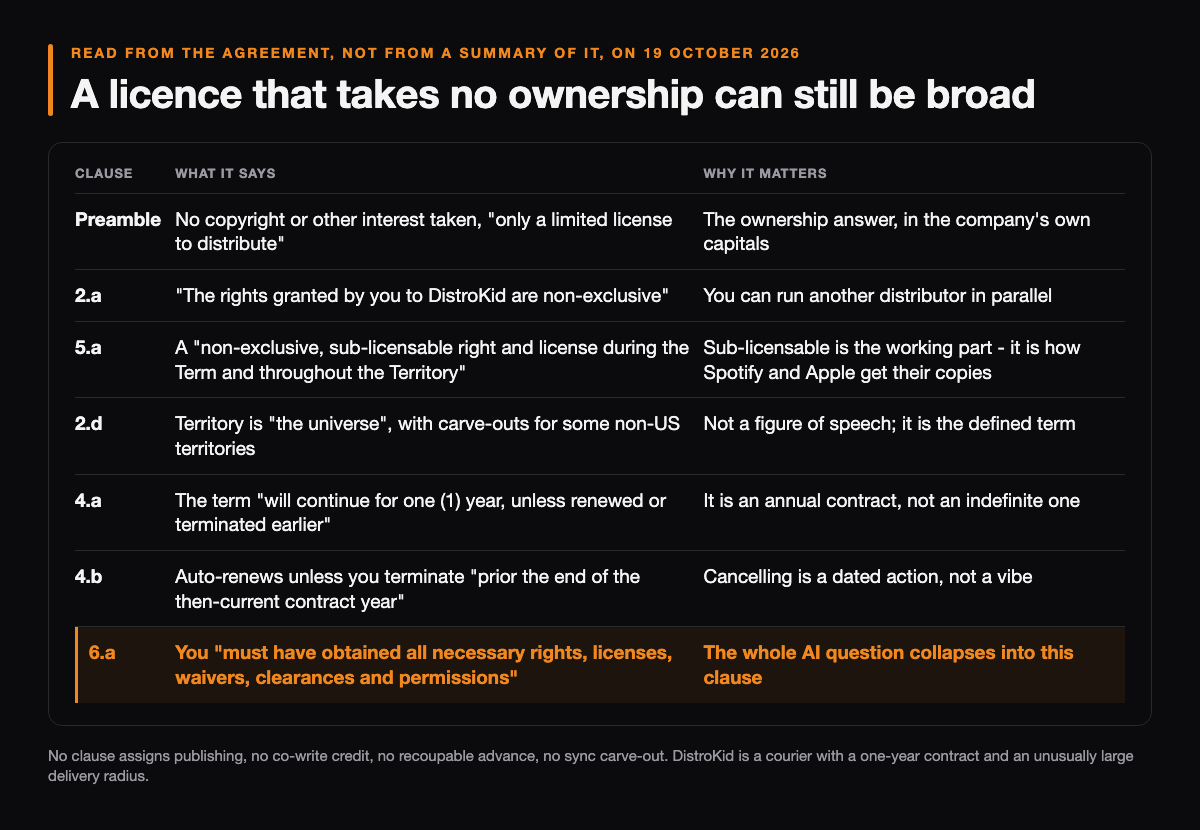
A licence that takes no ownership can still be broad, and this one is. These are the operative clauses, read from the agreement rather than from a summary of it.
| Clause | What it says | Why it matters |
|---|---|---|
| Preamble | No copyright or other interest taken, "only a limited license to distribute" | The ownership answer, in the company's own capitals |
| 2.a | "The rights granted by you to DistroKid are non-exclusive" | You can run another distributor in parallel |
| 5.a | A "non-exclusive, sub-licensable right and license during the Term and throughout the Territory" to reproduce and distribute to digital stores | Sub-licensable is the working part — it is how Spotify and Apple get their copies |
| 2.d | Territory is "the universe", with carve-outs noted for some non-US territories | Not a figure of speech; it is the defined term |
| 4.a | The term "will continue for one (1) year, unless renewed or terminated earlier" | It is an annual contract, not an indefinite one |
| 4.b | Auto-renews unless you terminate "prior the end of the then-current contract year" | Cancelling is a dated action, not a vibe |
| 6.a | You "must have obtained all necessary rights, licenses, waivers, clearances and permissions" | The whole AI question collapses into this clause |
Note what is missing from that list. There is no clause assigning publishing, no co-write credit, no recoupable advance, and no sync carve-out. DistroKid is a courier with a one-year contract and an unusually large delivery radius. Compare that with the terms we summarise on the commercial use page and the shape is the same across the independent distributors — the differences between them are service and screening, not rights.
Clause 6.a is the one that actually governs AI music, and it is worth sitting with: everything DistroKid requires of an AI track reduces to whether you had the right to distribute it.

What survives after you take a track down
This is the clause almost nobody quotes, and it is the only place where "revocable" stops being quite true.
You can delete a recording at any time during the term — clause 1.f. When the term ends, clause 4.d says DistroKid "will notify all applicable Digital Stores to remove your Recordings". Both of those work as advertised. But clause 5.b says digital stores "may grant to Customers rights to use your Recordings beyond the Term of this Agreement, even perpetual rights", and 4.d acknowledges that customers "may be able to retain and continue listening to your Recordings even after the Term".
In practice: a download someone bought does not evaporate because you left. Streaming copies stop; purchased and cached copies are a matter between the store and its customer, and DistroKid has no mechanism to reach them.
None of that is unusual — it is standard across digital distribution, because no distributor can claw back a file a store has already delivered. It matters here only because the pages telling you "you can pull your music any time" leave the impression of a clean undo, and there isn't one. Plan a release on the assumption that delivery is one-way.
Where AI changes the copyright answer — and it is not DistroKid
Here is the part that the ownership answer hides. DistroKid not taking your copyright is only reassuring if you have one.
Under US law, copyright attaches automatically when a work is fixed — DistroKid's own help centre explains that, and notes registration is optional but needed before you can sue. The catch is that automatic protection requires a human author. The US Copyright Office will not register material generated by a machine from a prompt, and its 2025 guidance asks applicants to disclose and disclaim the AI-generated parts of a work rather than claim them.
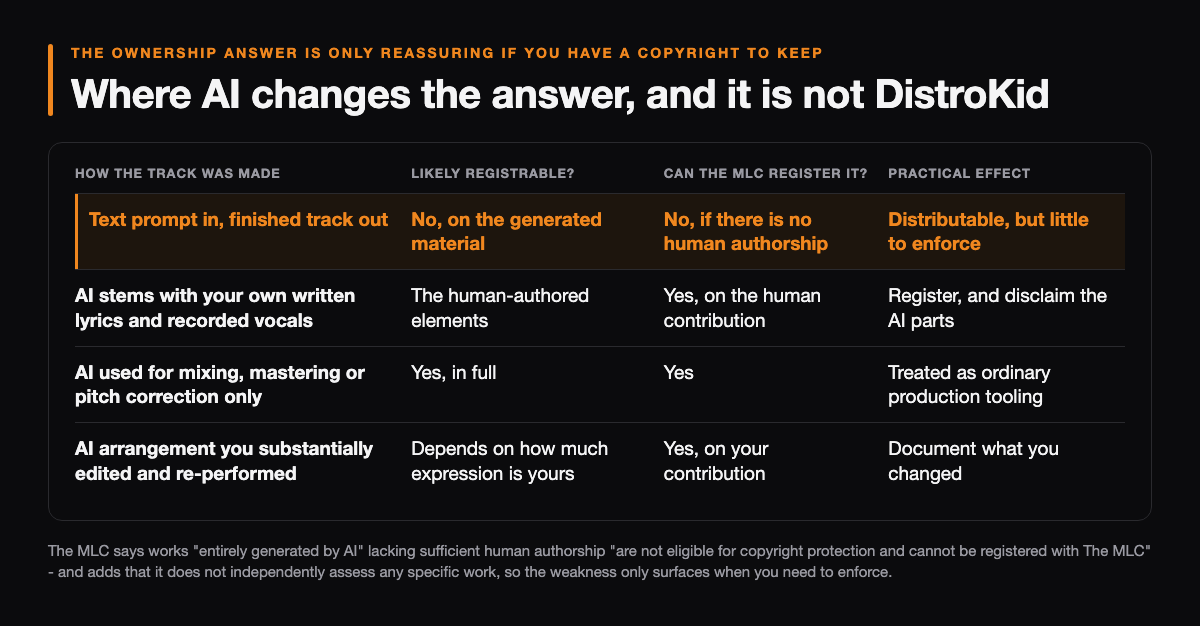
The mechanical-licensing side applies the same test in plainer language. The MLC's guidance on AI-generated works says works "entirely generated by AI" that lack sufficient human authorship "are not eligible for copyright protection and cannot be registered with The MLC", while works that include meaningful human authorship may be. The MLC adds that it does not independently assess whether any specific work clears that bar — which means nobody checks at registration, and the weakness only surfaces when you need to enforce.
| How the track was made | Likely registrable? | Can The MLC register it? | Practical effect |
|---|---|---|---|
| Text prompt in, finished track out | No, on the generated material | No, if there is no human authorship | Distributable, but little to enforce |
| AI stems with your own written lyrics and recorded vocals | The human-authored elements | Yes, on the human contribution | Register, and disclaim the AI parts |
| AI used for mixing, mastering or pitch correction only | Yes, in full | Yes | Treated as ordinary production tooling |
| AI arrangement you substantially edited and re-performed | Depends on how much expression is yours | Yes, on your contribution | Document what you changed |
So the honest version of the answer is this: DistroKid will not take your copyright, and for a pure prompt-to-track release there may be very little copyright there to take. That is a question about authorship law, not about your distributor, and it is the same on every platform — our Suno copyright page works through the generator side of it.
AI Credits: the disclosure field, and what it is not
Since 2026 the DistroKid upload flow asks whether AI generated any part of the track. This is a disclosure field, not a rights check, and the two keep getting conflated.
DistroKid's What Are AI Credits? article draws the line precisely, and it is narrower than people assume.
| Needs an AI credit | Does not need one |
|---|---|
| AI-generated audio — vocals, instrumental tracks | Pitch correction, auto-tune |
| AI-generated lyrics not written by a human | AI-assisted mixing or mastering |
| AI-generated composition — melody or arrangement not composed by a human | AI-assisted workflows generally |
At upload you pick at least one of four values: the lyrics, the music, all of the audio, or part of the audio. Choose "all of the audio" and DistroKid additionally asks whether your artist name is a human or an AI persona. Crucially — and this contradicts a lot of published advice — you can add or update AI credits after uploading, from the album page or at distrokid.com/credits. A wrong declaration is correctable.
DistroKid says Spotify, Apple Music and YouTube currently surface this to listeners. On the YouTube side you can read the receiving end of it: YouTube's Gen AI disclosure guidance defines Fully Gen AI, Partly Gen AI and No Gen AI, takes them over DDEX ERN 4.3.2+ or CSV, and states that where partners supply nothing, "YouTube will rely solely on those signals and may designate content as fully or partly Gen AI". Declaring is how you keep the label accurate rather than inferred. Our sister site breaks the field mapping down in detail on eraseai.co's DistroKid AI credits guide.
What a credit does not do is change whether the track is accepted, and it does not affect royalties.
October 2026: the UMG claims and the takedown wave
If you arrived here because a release disappeared, this is almost certainly the context.
| Date | Event |
|---|---|
| 15 September 2026 | Universal Music Group sues DistroKid in the US District Court for the District of Delaware |
| — | UMG exhibits list 1,000 of its recordings; it says its investigation found nearly 2,000 infringing DistroKid-distributed recordings |
| 10 October 2026 | DistroKid confirms to The Verge that "a very small number of recordings distributed through DistroKid have been removed in response to claims made by UMG" (VP of Artist Services Amanda Ferri) |
| 13 October 2026 | DistroKid updates its DMCA takedowns and counter notices help article |
| 16 October 2026 | DistroKid updates its "was your music removed because of a copyright claim?" help article |
DistroKid told The Verge it "strongly dispute[s] the allegations underlying UMG's lawsuit" and regrets "the disruption to affected artists". Several musicians reported removals with no prior notice and notices naming only UMG as the complainant, as Music Business Worldwide documented on 12 October; MBW notes it has not independently verified the rights status of the specific recordings those artists cited.
Two things worth keeping straight. A takedown is not a transfer — nothing in this episode changes who owns the recordings, and DistroKid's disclaimer still stands. And the suit is about alleged copying of UMG masters, not about AI-generated music as a category. Read it as a rights-clearance story rather than an AI story, whatever your release is made of.

If your track was removed: the dispute route that exists
DistroKid's two relevant help pages were both revised in the middle of this, so the process below is current as of 16 October 2026.
The first route is evidence, not formality. The removed-for-a-copyright-claim article asks you to open a chat and attach whatever establishes the chain: a Splice sample certificate, a public beat listing plus your licence, a signed agreement with the rightsholder, or — if you think nothing was sampled at all — "your project files, stems, or a quick note on how it was made". For AI-generated work that last option is the one you can actually satisfy, and it is a good argument for keeping your generation history and session files.
The second route is the formal one. The DMCA takedowns and counter notices article covers a counter notice where you believe the claim is "a mistake, misidentification, or a lawful use". After a valid counter notice DistroKid is obliged to wait ten business days before reinstating. Even then, stores may decline to restore the release on their own policies — reinstatement at DistroKid is not reinstatement everywhere.
If a cover licence is what was missing, DistroKid's own guidance is to re-upload with cover-song licensing added on the upload form, which is cheaper than arguing.
A correction to this page: the AI screening benchmark we published
Until today this page carried a table reporting that we submitted 48 Suno tracks and 12 Udio tracks to DistroKid in March and April 2026, that 24 of 24 raw Suno exports and 12 of 12 raw Udio exports were rejected, and that every one of the same tracks passed after processing. It described DistroKid as running an automated AI classifier with a confidence threshold, and said raw exports trip it.
That test was not run and the table is gone. The numbers did not even reconcile with the sentence above them, a sibling version of the same bench was already retracted on our SubmitHub AI checker page, and a 100%-rejected-then-100%-passed result is not a believable outcome of anything.
The substantive claim goes with it. DistroKid's own policy article, Can I Upload Music Made With AI Tools to DistroKid?, describes four conditions — own 100% of the rights, no impersonation, no mass-generated spam, no infringement — and warns that "streaming services may reject or remove releases that don't meet their guidelines". It does not describe an AI classifier gating uploads, and we have no evidence of a published threshold. Rejections of AI releases do get reported by artists, DistroKid among the named distributors, but they are uncommon and we cannot attribute them to a mechanism DistroKid has never documented.
What is documented sits one layer out: the stores set the guidelines, DistroKid passes your declaration along, and removals in 2026 have come from rights claims rather than from detection. Artifactr tracks the policy side of this in more depth on its DistroKid AI music policy page. Our methodology page covers how we handle tools and tests we cannot run ourselves; where this page now states a fact, it is DistroKid's, a court filing's, or a named outlet's.
DistroKid copyright: what to settle before your next release
Three questions, in the order they will cost you money.
Do you have the rights to all of it? Clause 6.a puts this on you, and the October claims show what happens when the answer is shaky. Samples licensed, beats licensed with the listing saved, no voice or likeness that belongs to someone else. If you cannot evidence a chain today, you cannot evidence it under a claim.
Is there human authorship worth registering? If the track is prompt-to-export, accept that there is little to enforce and price your expectations accordingly. If you wrote, played or substantially shaped it, register the human part and disclaim the rest.
Is the audio release-ready? This is the separate, non-legal question, and it is where generation artifacts live — smearing, phase oddities and the generator's own signal residue that survive a casual listen. Cleaning those up is what a processing tool like Undetectr is for. Be clear about the boundary: nothing in that category stops a platform labelling a track as AI, because Apple's and Spotify's labels run on provider-side declarations rather than on the audio, and your AI credit at DistroKid is a disclosure you make on purpose. Artifact cleanup is an audio-quality step, not a disclosure workaround. Our DistroKid AI page and the AI music distribution comparison cover how the distributors differ.
Then there is the question this page cannot answer, and the one most people actually have: who will hear it. Distribution is close to solved — plenty of artists report getting released and then finding nobody there. Owning the copyright and holding a store link are different things, and a direct storefront plus a route into paid sync placements for TV, film, games and ads puts your music somewhere a recommendation algorithm does not have to find it first. played.fm is built around that order: pitch for placements, sell direct, keep what you make.
The copyright answer, at least, is the easy one. DistroKid does not take it. Make sure there is something there to keep.
Frequently asked questions
No. DistroKid's distribution agreement opens with the line, in capitals, that it does not take any copyright or other interest in your music — only a limited licence to distribute. Its help centre repeats that you keep 100% ownership. Registration with a copyright office is a separate thing that DistroKid plays no part in.
No. You retain the recording and the composition. DistroKid receives a non-exclusive, sub-licensable licence to reproduce and deliver the recordings to digital stores for the term of the agreement. Master ownership and publishing are untouched by that grant.
Yes. The agreement lets you delete a recording at any time during the term, and on termination DistroKid notifies stores to remove your releases. Clause 5.b is the catch: stores may have granted customers rights that outlast the term, so copies already downloaded can keep playing.
Yes, with four conditions it publishes: you must own 100% of the rights, you must not imitate anyone's voice or likeness, you must not mass-generate spam to game algorithms, and you must not infringe. DistroKid also warns that streaming services may reject or remove releases that break their own guidelines.
DistroKid asks at upload whether any part of the track was AI-generated, and you pick lyrics, music, all of the audio, or part of the audio. Spotify, Apple Music and YouTube display that information. You can add or change AI credits after uploading from the album page or at distrokid.com/credits.
Only the parts a human authored. The US Copyright Office requires human authorship, and The MLC says works entirely generated by AI are not eligible for copyright protection and cannot be registered with it. A track built from a prompt alone has little or nothing to register; a track where you wrote, performed or substantially arranged the expressive elements does.
Universal Music Group sued DistroKid on 15 September 2026 and DistroKid confirmed to The Verge on 10 October that a small number of recordings had been removed in response to UMG's claims. Several artists reported removals without warning. DistroKid says it disputes the allegations underlying the lawsuit.
Through a counter notice, or by contacting support with evidence of your rights — a Splice sample certificate, a beat licence, a signed agreement, or your project files and stems. DistroKid updated both of those help pages in mid-October 2026. After a valid counter notice it must wait ten business days before reinstating, and stores can still decline.
Ready to release your Suno tracks?
Explore Undetectr’s published track-processing features before preparing your release.