ACRCloud 2026: Pricing, Products and the AI Detector
The short version: ACRCloud is a B2B audio recognition company with a 150-million-track fingerprint database, twelve products and no published price list. One of those products is an AI music detector — the only one in its class an individual can actually run. What it sells, what it costs, who uses it, and what its accuracy figures cover.
- The short version: ACRCloud sells twelve recognition products to platforms and rights holders. The AI Music Detector is one of them — the core business is fingerprint matching, a different operation entirely
- There is no public price list. The pricing page carries no figures, plan names or quotas — only 'pay for the recognition you use' and a Contact Sales button. Real rates sit behind a console login
- You can still run it without talking to sales: 14 days free, no credit card, full API access — the one detector in this class an independent artist can test, unlike IRCAM Amplify
- Its developer docs publish 99.98% precision and 99.88% recall with a 0.08% false-positive rate; the product page publishes nothing. That split is why four comparison pages say the figures do not exist
- Symphonic states publicly that it uses ACRCloud to screen uploads for copyrighted content pre-distribution. That is copyright matching, not AI detection — no distributor has named its AI-screening vendor
- What ACRCloud is, and what it sells
- What ACRCloud costs: there is no public price list
- Who actually uses ACRCloud
- The AI Music Detector, and the numbers on the wrong page
- Per-generator accuracy: it matters which tool you used
- The 50% threshold, and why two detectors disagree
- What 99.98% does not cover
- Is ACRCloud scanning your upload?
- A detector reads. It does not write
- Once the track is finished, and the verdict on ACRCloud
Search for ACRCloud and you get an encyclopedia stub, three company-profile directories and some distributor integration pages. None tells you what the thing costs, or whether it is the system reading your AI-generated uploads. That gap matters if you release machine-generated music, because ACRCloud sells to exactly the companies your file passes through, and one of its twelve products is an AI music detector. We read its own pages, its developer documentation and its customers' integration notices on 14 October 2026.
One correction first, about this page rather than anyone else's. An earlier version claimed ACRCloud was "among the most accurate detectors in our testing", with a 98% pass rate and blind A/B listening. None of it was measured and it is gone. Every figure below is ACRCloud's own or from a published paper — see our methodology page.
What ACRCloud is, and what it sells
ACRCloud is a B2B automatic content recognition company. Its core business is audio fingerprinting — matching a file against a database of known recordings, which the company puts at "more than 150 million tracks". That is the technology behind broadcast monitoring, cover song identification and every "what song is this" button you have pressed.
The product list is wider than most people realise, and the AI Music Detector is one line on it rather than the business.
| Product | What it does | Who it is sold to |
|---|---|---|
| Music Recognition | Matches audio against the 150m-track reference database | DSPs, apps, automotive, brands |
| Music Metadata | Returns rights and catalogue data for a matched recording | Labels, PROs, distributors |
| Broadcast Monitoring | Tracks airplay across radio and TV for royalty reporting | Broadcasters, PROs |
| Copyright Compliance | Flags copyrighted material in user uploads, pre-publication | Distributors, UGC platforms |
| Cover Song Identification | Matches performances of a composition rather than one recording | Labels, PROs |
| AI Music Detector | Returns a probability that audio was machine-generated | DSPs, distributors, PROs, labels |
| Live Channel Detection, Second Screen Sync, Audience Measurement | Stream identification for ad and audience data | Broadcasters, advertising |
| Humming Recognition, Offline Recognition, Speech to Text | Query-by-humming, on-device matching, transcription | App developers |
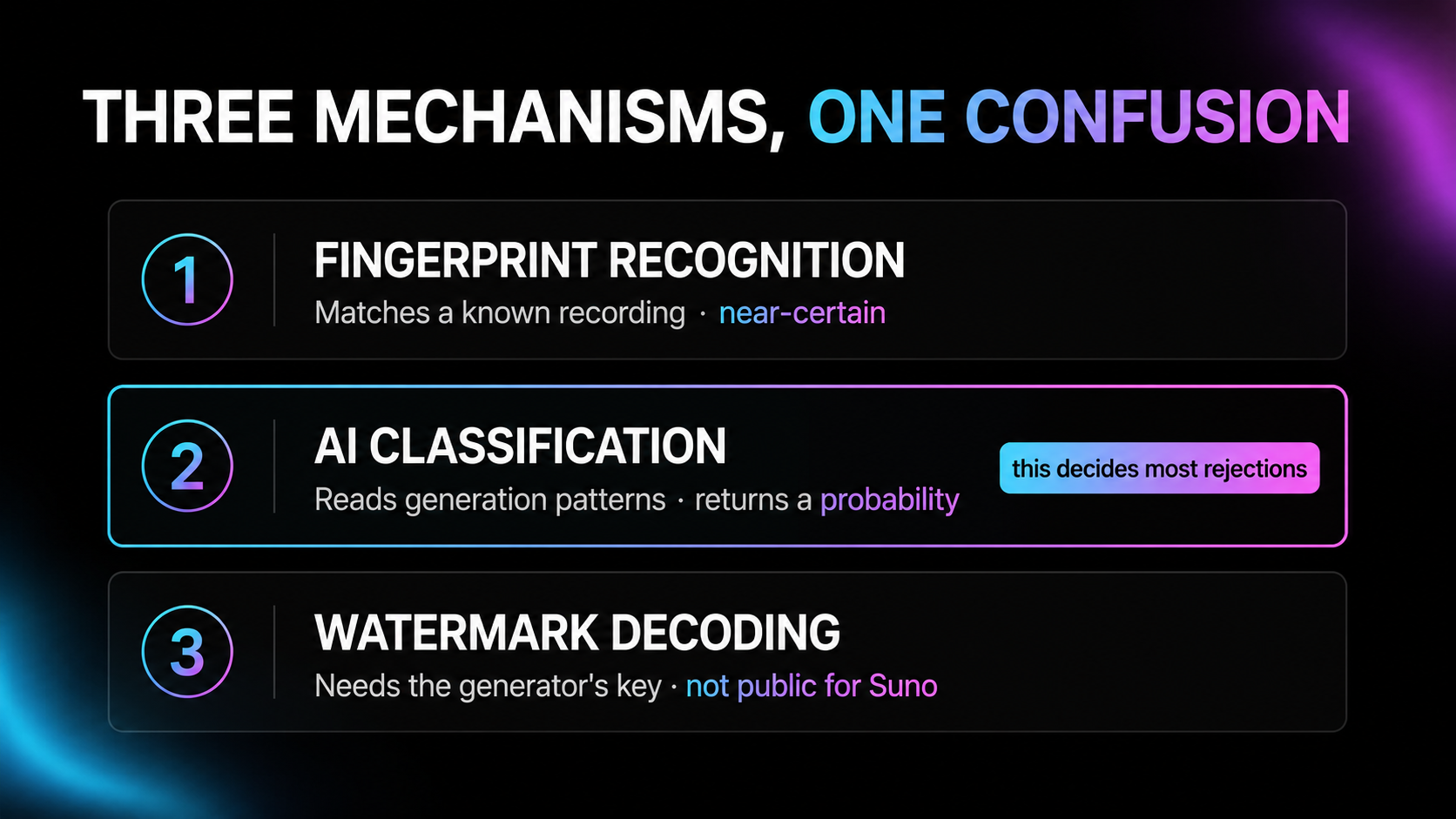
Two things follow. ACRCloud is infrastructure sold to seven named industries — DSPs and apps, PROs and labels, broadcasters, distributors and UGC platforms, advertising, automotive and brands — and musicians are not on the list. And recognition and AI detection get conflated constantly: recognition compares your file against recordings that already exist and can say this is a match with near-certainty, while AI detection compares it against statistical patterns and can only say this looks generated, probably. One is a lookup; the other is a guess with a confidence score, and it is the one this page is mostly about.
What ACRCloud costs: there is no public price list
This is the first question a search for the bare brand asks, and the company does not answer it. ACRCloud's pricing page carries no figures, plan names, quotas or currency — just "Flexible pricing models ensuring you only pay for the recognition you use", a Start Free Trial button and a Contact Sales button. Usage is metered, per recognition for lookups and per scanned hour for file scanning, and the rates live behind a console login.
Worth stating plainly, because it is the wall we hit reviewing IRCAM Amplify, where the finding was that an individual cannot buy it at any price. ACRCloud is only half that story, and the better half.
| Route | What it costs | What you need | Reality check |
|---|---|---|---|
| Free trial | "14 days of free trial. No credit card required. Full API access." | A console account | Genuinely self-serve; no sales call |
| Metered account | Not published; quoted per use case | A sales conversation or console login | The real pricing, and you cannot see it from outside |
| Bundled with Derivative Works Detection | "Free of charge" alongside that service | A Derivative Works Detection contract | The platform route, not the artist route |
| Consumer reseller | From about €14.99/month at one wrapper | Nothing technical | Same verdict as the free trial, with a form around it |
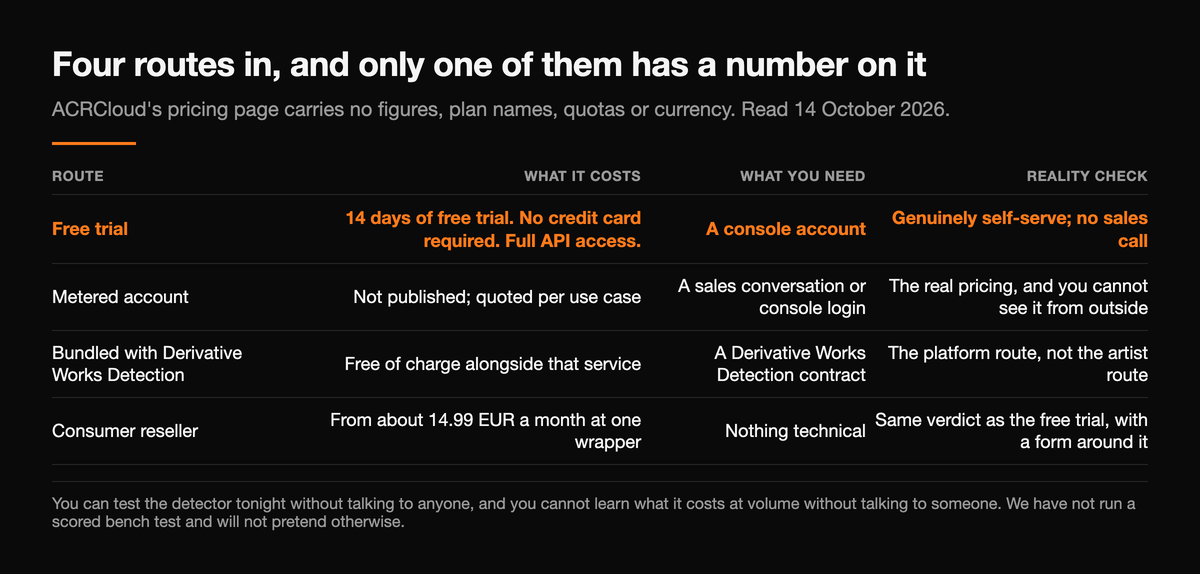
So you can test the detector tonight without talking to anyone, and you cannot learn what it costs at volume without talking to someone. For one musician with one MP3 the trial is the only row that matters — but it is an API, not an upload box. The documented path is the File Scanning tutorial ("select AI Music Detection as the Audio Engine when creating a container"), and the File Scan Tool page still links a Python repository last updated five years ago. We have not run a scored bench test and will not pretend otherwise.
Who actually uses ACRCloud
The customer list is the part no comparison page bothers with, and the best evidence for whether this company sits in your release path.
| Named by | Customers or partners | For what |
|---|---|---|
| ACRCloud's own homepage | Deezer, Believe, Likee, Decibeles, The Orchard | Shown under "Trusted by Industry Leaders"; the use case is not stated |
| Symphonic's integration page | Symphonic itself | Screening user uploads for copyrighted content before distribution |
| Symphonic, describing ACRCloud | Deezer, Anghami, Alibaba, Audiomack, Xiaomi, Musixmatch | "serves customers such as" — not presented as complete |
| ACRCloud press releases | SoundOn (TikTok's distributor), CBAA, ZAMCOPS | Derivative Works Detection; airplay insights; broadcast monitoring |
Two rows deserve a note. Believe and The Orchard are distribution companies, and Symphonic — one of the six distributors that openly accept AI music — states on its own site that ACRCloud "helps Symphonic and other distributors to check the copyrighted content in user-uploaded content", scanning material against ACRCloud's catalogue "to catch infringement before distribution to a DSP". A distributor publicly naming its pre-distribution screening vendor almost never happens.
Note the database figure drifting between sources: ACRCloud's site says more than 150 million tracks, Symphonic's says "over 72m", an older ACRCloud blog post says 40 million. Snapshots from different years — but quote the company's current number, not a reseller's.
The AI Music Detector, and the numbers on the wrong page
The detector launched on 9 January 2026, aimed at DSPs, distributors, collection societies and rights holders, and has moved quickly since — which no competing page reflects.
| Date | What changed |
|---|---|
| 9 January 2026 | AI Music Detector launched |
| 30 January 2026 | Coverage expanded to 8 generators; segment-level detection added, so vocals and accompaniment score separately |
| ~21 August 2026 | Developer docs updated with the confusion matrix and per-source accuracy figures |
| 1 September 2026 | New engine "significantly improving detection performance"; Lyria and Boomy added, taking it to 11 categories |
The segment-level addition is worth holding onto: ACRCloud's reasoning is that "AI is often used for specific parts of a track rather than the whole composition", so it scores the full track, the isolated vocal and the accompaniment separately. Sing over a generated bed and a system exists to notice exactly that.
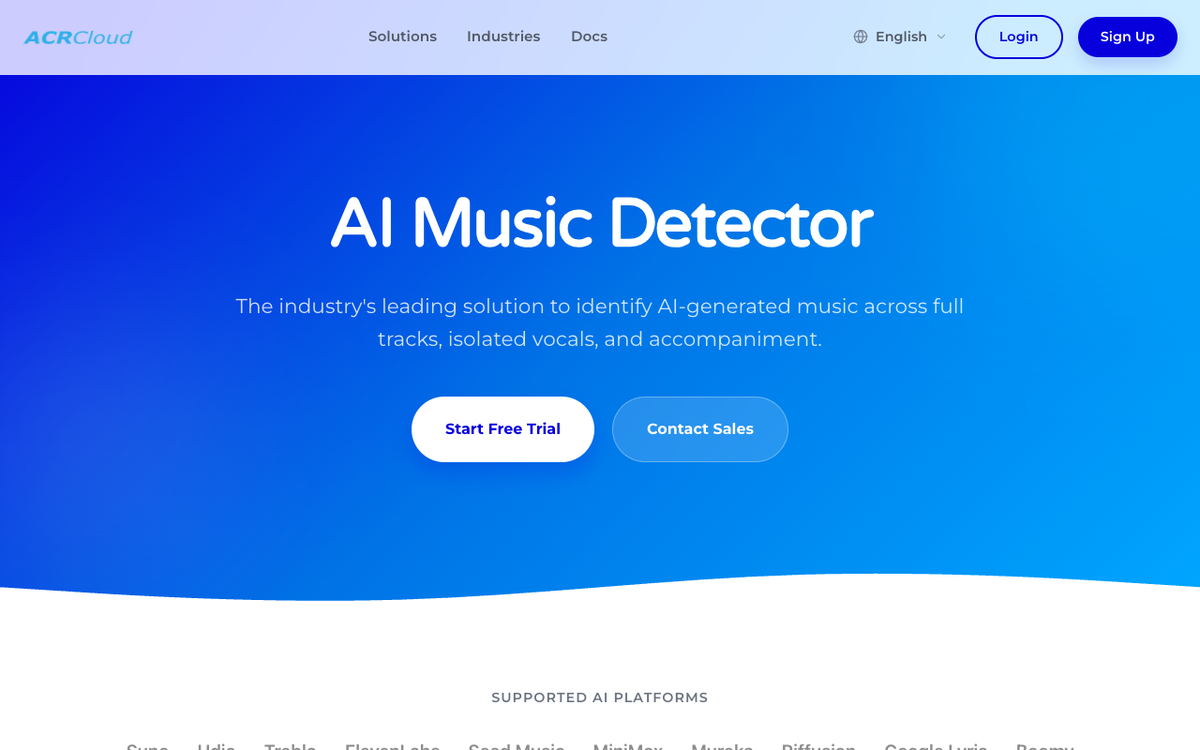
Now the split that produced four wrong articles. The AI Music Detector product page carries no numbers at all — three capability claims, a free trial button, not a percentage on it.
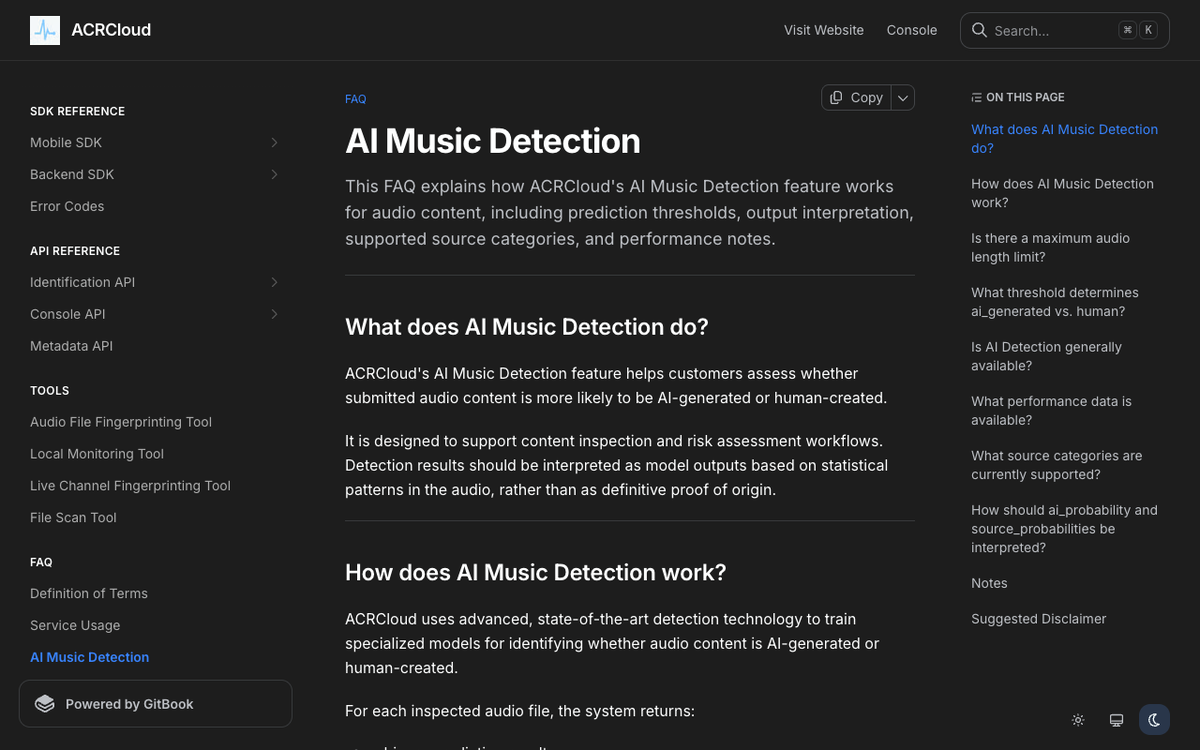
The developer documentation FAQ carries this, and we re-read it today:
| Metric, ACRCloud internal evaluation | Figure |
|---|---|
| Precision (AI) | 99.98% |
| Recall (AI) | 99.88% |
| False positive rate | 0.08% of human |
| False negative rate | 0.12% of AI |
| Decision threshold | 50% |
| Maximum file length | 15 minutes (900 seconds) |
Set that against what the competition says about the same company.
| Source | Claim about ACRCloud's published accuracy | Status |
|---|---|---|
| authio.io comparison (accessed May 2026) | "does not publish accuracy, false-positive rate, processing speed, batch throughput, benchmark dataset" | Outdated; the docs now do |
| fwdmusic detector roundup | "ACRCloud does not publicly disclose accuracy percentages" | Contradicted by the docs |
| aisongchecker.pro comparison | ACRCloud at 97.8%, from its own 1,200-track benchmark | Unrelated to any published figure |
| ACRCloud developer docs | 99.98% precision, 99.88% recall, 0.08% FPR | Primary source |
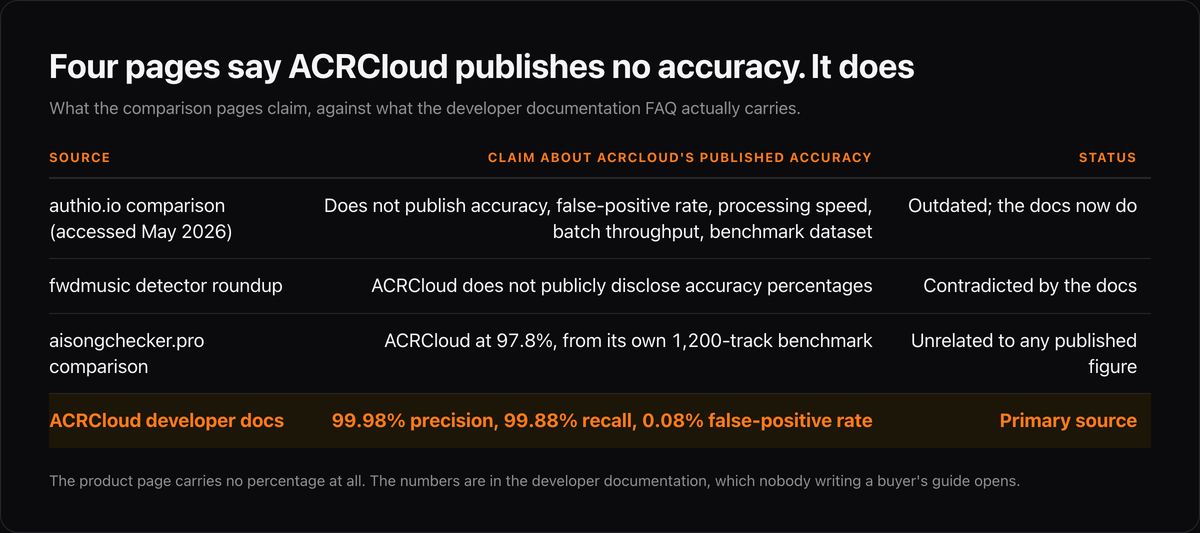
Two caveats, both of which ACRCloud states rather than buries. The figures come from "internal test data and are provided for reference only", and the docs add that "actual performance may vary depending on audio quality, transformations, compression, mixing, editing". Most vendors put a round number on the marketing page and nothing in the docs. ACRCloud did the reverse, and buyer's-guide writers never see it.
Per-generator accuracy: it matters which tool you used
This is the table nobody else has, and the most useful thing here if you are the one uploading.
| Source category | Accuracy (ACRCloud internal) |
|---|---|
| Google Lyria | 99.97% |
| Human | 99.93% |
| Udio | 99.82% |
| Mureka | 99.76% |
| Suno | 99.70% |
| MiniMax | 99.60% |
| ElevenLabs | 98.95% |
| Treblo (previously Sonauto) | 97.70% |
| Riffusion | 97.49% |
| Seed Music | 97.12% |
| Boomy | 96.37% |
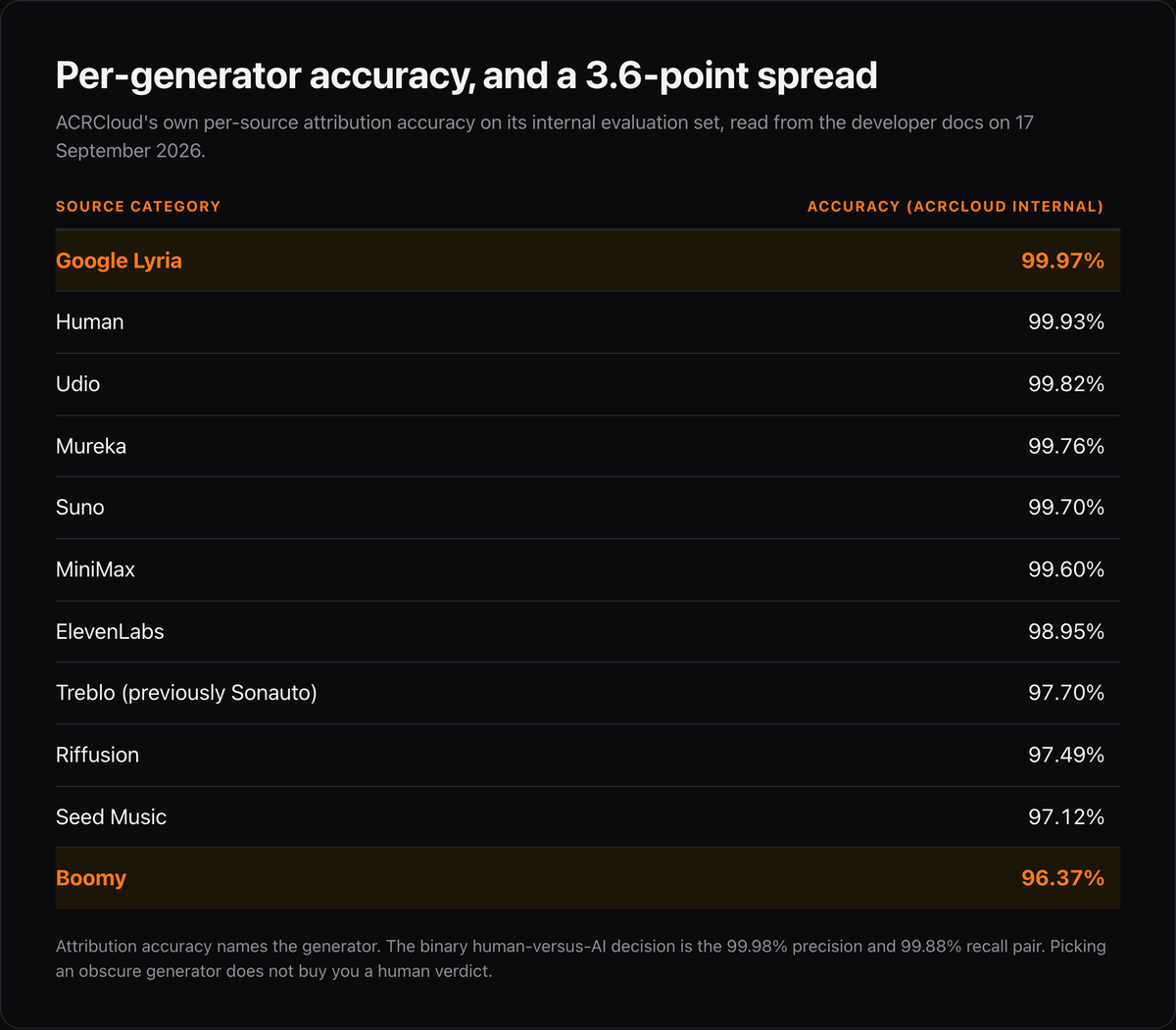
The spread is 3.6 percentage points and the ordering is informative: Suno and Udio sit near the top, the most-studied generators with the most examples available to anyone building a detector, while Boomy at the bottom is the oldest and least fashionable.
There is a trap in that. A 96.37% figure on Boomy does not mean Boomy tracks slip through as human — attribution accuracy is about naming the generator, while the binary human-versus-AI decision is the 99.98%/99.88% pair above. An obscure generator does not buy you a human verdict.
The 50% threshold, and why two detectors disagree
ACRCloud's threshold is published and it is 50%: at an ai_probability of 50% or above the verdict is ai_generated, below that it is human. Both that and the per-source probabilities are, in the docs' words, "generated directly by the model and are not manually adjusted or post-processed by human operators".
Now put that next to the other gates a release passes through.
| Gate | Threshold | Consequence of crossing it |
|---|---|---|
| ACRCloud AI Music Detector | 50% | Labelled ai_generated in the API response; the customer's policy decides what follows |
| SubmitHub | 85% combined score | Submission blocked outright, no appeal |
| Deezer | Not published | Excluded from editorial and algorithmic surfaces |
| IRCAM Amplify | Not published | Enterprise customer decides |
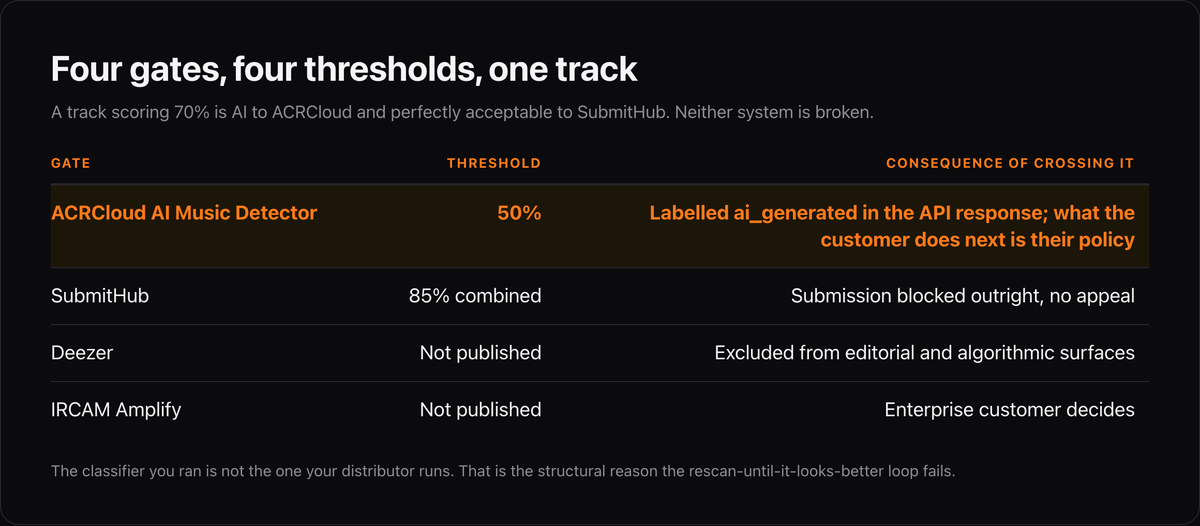
A track scoring 70% is AI to ACRCloud and fine to SubmitHub. Neither system is broken; they were built for different jobs with different costs of being wrong, which is the structural reason the rescan-until-it-looks-better loop fails. Our SubmitHub checker review covers what that 85% block does to a promo campaign, and the detector roundup covers the ones you can open in a browser.
What 99.98% does not cover
Every number above describes clean audio: a file roughly as the generator produced it. The published literature is unambiguous that it stops being easy immediately afterwards.
The best paper at ISMIR 2025, "A Fourier Explanation of AI-music Artifacts" by Afchar and colleagues at Deezer, traced the tell-tale artifacts to deconvolution modules inside generative models — spectral peaks from the architecture rather than the training data. A criterion built on those peaks alone passed 99% accuracy against Suno and Udio, so a vendor claiming 99.98% on clean files has the science behind it.
Then comes the robustness work, which exists because baseline detectors fall over under changes anyone can apply in free software.
| Condition, Suno v5 audio | Baseline detector F1 |
|---|---|
| Clean audio | 0.998 |
| Pitch shift | 0.720 |
| Speed change | 0.675 |
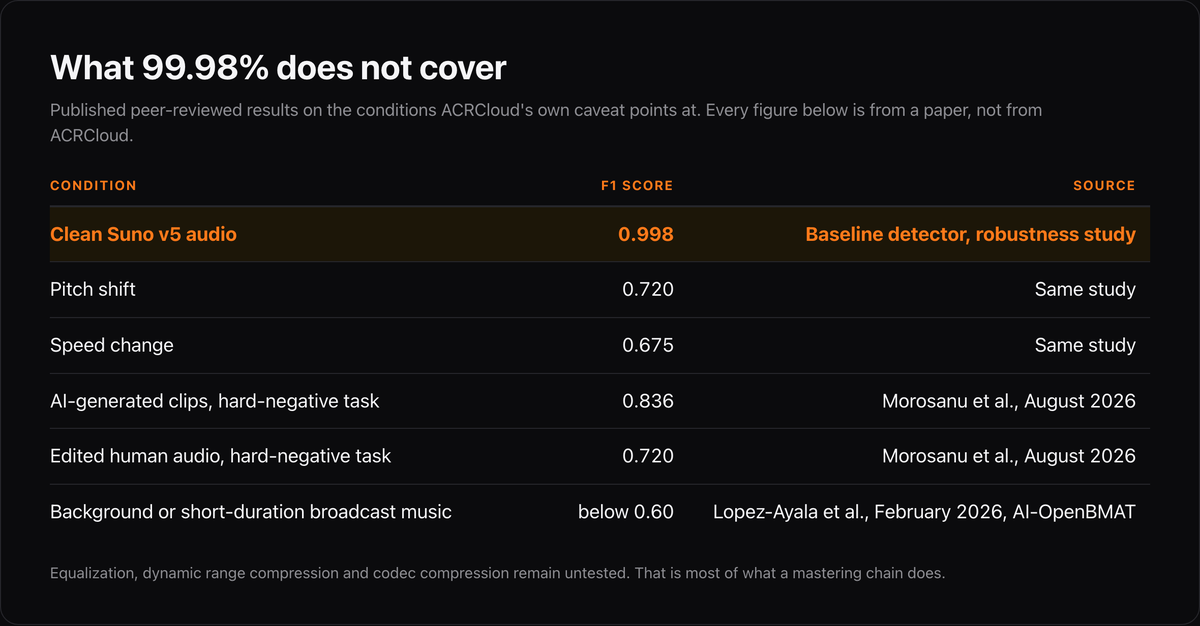
Those are from "Improved Robustness in AI-Generated Music Detection", July 2026, which also notes that resampling to 22.05 kHz alone can flip the label on a large fraction of AI samples, and that "other common manipulations (equalization, dynamic range compression, codec compression) remain untested". That is most of what a mastering chain does — hence the line we keep repeating in our BandLab mastering guide: there is no published evidence either way that mastering changes a verdict.
The false-positive side has its own paper. In August 2026 Morosanu and colleagues tested ordinary human audio, heavily edited — the case that should worry a producer — scoring 0.836 F1 on AI-generated clips and only 0.720 on edited human ones. The thing most likely to get a human track misread as machine-made is having been produced competently.
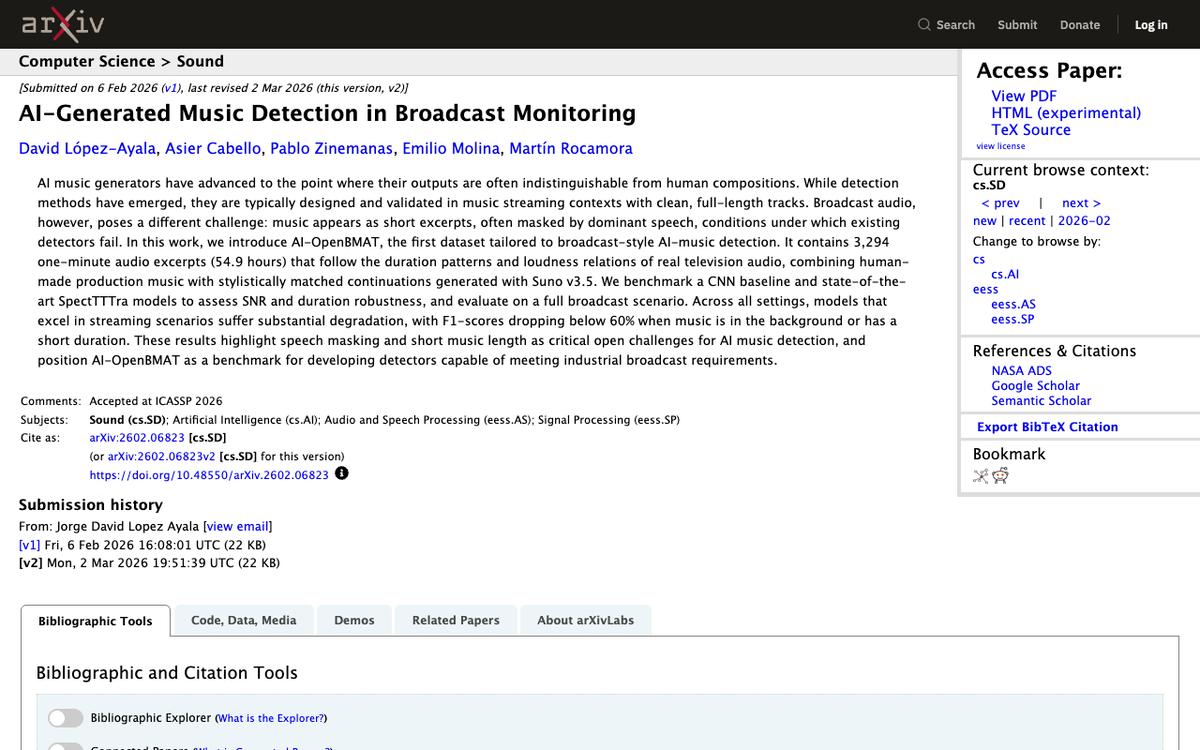
And one study targets ACRCloud's home turf, which no other page on this query mentions. In February 2026 López-Ayala and colleagues published "AI-Generated Music Detection in Broadcast Monitoring", building AI-OpenBMAT from 3,294 one-minute excerpts of simulated television audio. Their finding: "models that excel in streaming scenarios suffer substantial degradation, with F1-scores dropping below 60% when music is in the background or has a short duration." Below 60%, on the business ACRCloud was built for.
Is ACRCloud scanning your upload?
The honest answer rather than the convenient one: ACRCloud sells the detector to distributors and UGC platforms, DSPs and apps, and PROs and labels — unambiguously the systems your file passes through. What is not public is which of them bought that product.
The distinction matters, because the evidence we have is about a different one. Symphonic names ACRCloud for copyright screening, and on 2 April 2026 SoundOn — TikTok's distribution platform — announced a partnership for Derivative Works Detection, which catches copyrighted tracks even when altered by speed or pitch shifting. Neither mentions AI-generated music detection and we will not imply they do. The narrower connection is still worth knowing: ACRCloud says the AI Music Detector is free alongside Derivative Works Detection, so a distributor already running one has the other at no extra cost.
Deezer is the instructive case. It sits on ACRCloud's customer wall and is the loudest publisher of AI-upload statistics — it told TechCrunch in July 2026 that fully AI-generated tracks passed 50% of daily uploads on peak days. But Deezer's research team built its own detector, which is where the ISMIR paper above comes from. Being an ACRCloud customer does not mean using ACRCloud's AI detector, and anyone naming the vendor that runs on your upload is guessing. Our Deezer guide covers what their tagging does once you are through the door.
A detector reads. It does not write
The failure loop we see constantly: a distributor bounces a track, the musician finds a detector, uploads, gets a percentage, changes something, rescans — and the distributor bounces it again.
Two things went wrong, both structural. The scanner is not the screener, as the threshold table shows. And nothing was removed: a detector is a read operation, so the file that failed and the file resubmitted are byte-identical. Our AI song cleaner guide separates the three product classes this gets confused with — if a tool's output is a percentage, it is a meter, not a remover.
The leverage is in the file you deliver, not the score you chase. That is the job Undetectr is built for: processing a generated track so audible artifacts are gone and it survives automated screening. The boundary matters and we keep stating it — no processing tool stops a platform labelling a track as AI, because labelling is disclosure, not a detection outcome. EraseAI's detector explainer covers the same ground from the cleanup side.
Worth saying plainly: distributors have not banned AI music. DistroKid, RouteNote, UnitedMasters, LANDR, Amuse and Symphonic all take it, generally with a disclosure step — see our distributor round-up. What people run into is an individual upload flagged by automated screening, which is narrower and more fixable than a ban.
A detector's verdict is one model's opinion at one threshold, and it changes nothing about your file. Undetectr processes generated tracks for automated screening and audible artifacts — it does not, and cannot, change how a platform labels a release.
See Undetectr pricing → from €19 · €39 lifetime founder pricing · affiliate linkOnce the track is finished, and the verdict on ACRCloud
The uncomfortable part of a week spent on detector research is that screening is rarely the actual wall. Plenty of people clear distribution and then find nobody is listening, which no detector or processing tool fixes. Two routes do not depend on algorithmic discovery: paid sync placement in television, film, games and advertising, which is where the money conversation in this niche is genuinely happening and what played.fm's sync route is built for, and selling direct while keeping the full amount. Our guide on making money with Suno runs the numbers.
On ACRCloud itself the summary is short. It is a recognition company first — twelve products, a 150-million-track database, real customers in your distribution path — and the AI detector is a recent addition, not the business. It is also one of very few in the category where you can check the claim's shape rather than its size: a published confusion matrix, threshold and per-generator table, plus a candid caveat about real-world variance. That is more transparency than IRCAM Amplify offers, and the comparison pages praising IRCAM's numbers while reporting that ACRCloud has none have it backwards.
As something to act on, shorter still. There is no price you can look up, but there is a trial you can start tonight, and it will tell you what one classifier thinks about one file at a 50% threshold. It will not tell you what your distributor will decide, and it will not change a byte of your track. Two different operations, and only one is worth your week.
Frequently asked questions
A B2B automatic content recognition company. Its core product matches audio against a reference database of more than 150 million tracks — the technology behind broadcast monitoring, cover song identification and 'what song is this' features. It sells twelve products to DSPs, labels, broadcasters, distributors and UGC platforms, not to musicians.
There is no published price. ACRCloud's pricing page carries no figures, plan names or quotas — only 'pay for the recognition you use' and a Contact Sales button. Usage is metered per recognition or per scanned hour, with the rates behind a console login or a sales conversation.
Yes. New accounts get 14 days free, no credit card, with full API access through a self-serve console — unusual in this category. The detector is also free alongside ACRCloud's Derivative Works Detection service, though that route is a platform contract rather than an artist one.
Its developer documentation reports 99.98% precision and 99.88% recall with a 0.08% false-positive rate, on ACRCloud's own internal dataset. The docs add that performance varies with audio quality, transformations, compression, mixing and editing. No third party has audited it, so treat it as a vendor number with an unusually honest caveat.
Eleven categories after the September 2026 engine update: human, Suno, Udio, Treblo (previously Sonauto), Mureka, Riffusion, Seed Music, MiniMax, ElevenLabs, Google Lyria and Boomy. Per-generator accuracy runs from 99.97% on Lyria down to 96.37% on Boomy.
The threshold is 50%: an ai_probability of 50% or above returns ai_generated, below that human. Other gates use different cutoffs — SubmitHub blocks at 85% — so the same track can clear one and fail the other with no contradiction.
Neither has been independently audited, so a ranking would be invented. The practical difference is access: IRCAM Amplify has no published price, no free tier and no self-serve signup, so an individual cannot run it at all, while ACRCloud's trial is open to anyone. ACRCloud also publishes a per-generator breakdown; IRCAM does not.
No. A detector returns a probability; what a platform does with it is a policy decision. DistroKid, RouteNote, UnitedMasters, LANDR, Amuse and Symphonic all accept AI music openly, usually with a disclosure step at upload. What people report is individual uploads bounced by automated screening, which is narrower than a ban.
Ready to release your Suno tracks?
Explore Undetectr’s published track-processing features before preparing your release.