Does DistroKid Allow AI Music? 12 Platform Policies (2026)
DistroKid allows AI music. So do five of the six other major distributors. The policies differ in ways that decide whether your track ships, and nobody had put them in one table, so we did, with the date each was checked and a link to each source.
- All 7 major distributors we checked now publish an explicit AI disclosure requirement, as of August 2026
- DistroKid allows AI music with disclosure and rights ownership. CD Baby rejects it. Bandcamp banned it outright on 13 January 2026
- LANDR caps AI releases at 12 songs per month; Amuse caps at roughly 10 releases per rolling 7 days. Both exclude AI tracks from Content ID
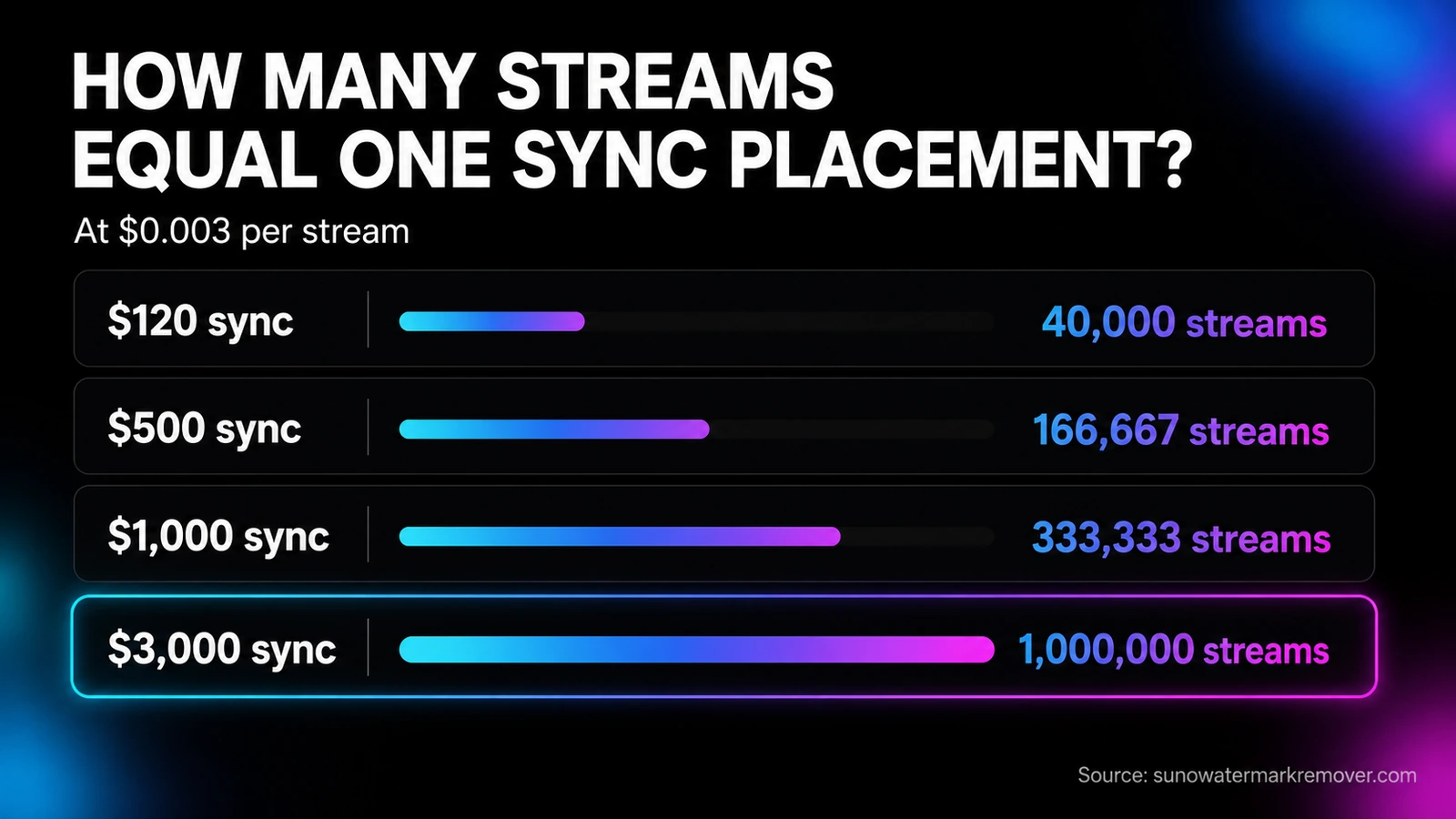
- At $0.003 per stream, a single $120 sync placement equals 40,000 streams. A $3,000 placement equals 1,000,000
- Spotify does not ban AI music. It bans impersonation, filters spam, and since 16 April 2026 surfaces AI credits passed through by distributors
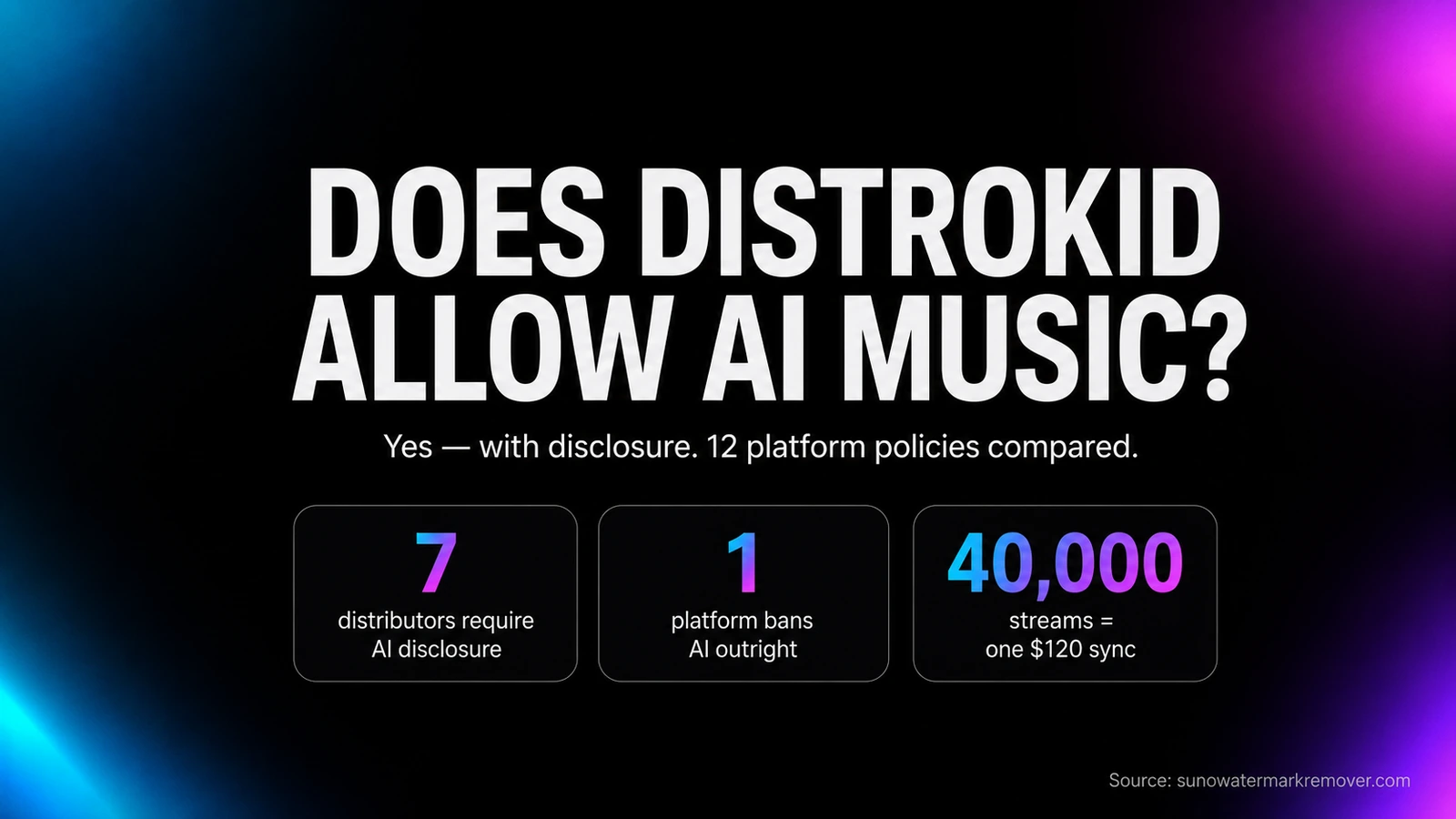
Does DistroKid allow AI music? Yes, with three conditions
DistroKid allows AI music. It requires that you own 100% of the rights, that the track impersonates nobody, and that AI involvement is disclosed at upload. Fully machine-generated tracks with no human input face extra scrutiny and can be rejected when they fail detection or arrive without that disclosure.
That answer is easy. The hard part is that DistroKid is one of thirteen gatekeepers between a finished file and a paid release, and every one of them has a different rule. CD Baby rejects AI-generated music outright. LANDR allows it but caps you at 12 songs a month. Bandcamp banned it entirely on 13 January 2026. Spotify does not ban it at all.
Nobody had assembled those policies in one place, so this page does, with the date each was checked and a source for each row. Then it does the arithmetic almost nobody runs: what a release is actually worth once it clears the gate. At roughly $0.003 per stream, one $120 sync placement equals about 40,000 streams. That number changes what you should do with a track far more than any policy does.
That distinction matters more than the policy text itself. EraseAI walks through how distributor screening differs from distributor policy, and why a release can be fully compliant and still get held.
Every major distributor's AI policy, checked August 2026
Here is the compiled table. "Allowed" means the distributor accepts AI-assisted or AI-generated music under stated conditions. "Disclosure" means the platform requires you to declare AI involvement at upload.
| Distributor | AI music | Disclosure | Notable limits | Checked | Source |
|---|---|---|---|---|---|
| DistroKid | Allowed | Yes | Own 100% of rights, no impersonation, extra scrutiny for fully AI tracks | Aug 2026 | Help centre |
| TuneCore | AI-assisted only | Yes | Blocks Suno-generated tracks at upload, accepts licensed generators | Aug 2026 | tunecore.com |
| CD Baby | Rejected | Yes | Downtown Music content policy, strictest of the majors | Aug 2026 | cdbaby.com |
| LANDR | Allowed | Yes | 12 AI songs per calendar month, excluded from Content ID, Meta, TikTok, Deezer, Pandora, Tencent | Aug 2026 | landr.com |
| Amuse | Allowed | Yes | Approx. 10 releases per rolling 7 days, Meta and Content ID exclusions | Aug 2026 | amuse.io |
| RouteNote | Allowed | Yes | Only major distributor offering free AI distribution | Aug 2026 | routenote.com |
| Ditto | Allowed | Yes | Signed the Spotify AI transparency initiative | Aug 2026 | dittomusic.com |
And the platforms your distributor delivers to, which apply their own rules on top:
| Platform | AI music | What actually happens | Checked | Source |
|---|---|---|---|---|
| Spotify | Allowed | No categorical ban. Impersonation removed, spam filtered, AI credits surfaced from 16 Apr 2026 | Aug 2026 | Spotify Newsroom |
| Deezer | Allowed, tagged | Auto-detected and labelled, tagged tracks excluded from recommendations | Aug 2026 | Deezer Newsroom |
| Apple Music | No public policy | Distributor delivery only, no categorical AI ban published | Aug 2026 | Apple Music |
| Tidal | No public policy | Distributor delivery only, no categorical AI ban published | Aug 2026 | tidal.com |
| Bandcamp | Banned | Wholly or substantially AI-generated audio prohibited since 13 Jan 2026, human review, no algorithmic detection | Aug 2026 | Hypebot |
| Played.fm | Allowed | No AI gatekeeping, direct-to-fan sales and open sync briefs | Aug 2026 | played.fm |
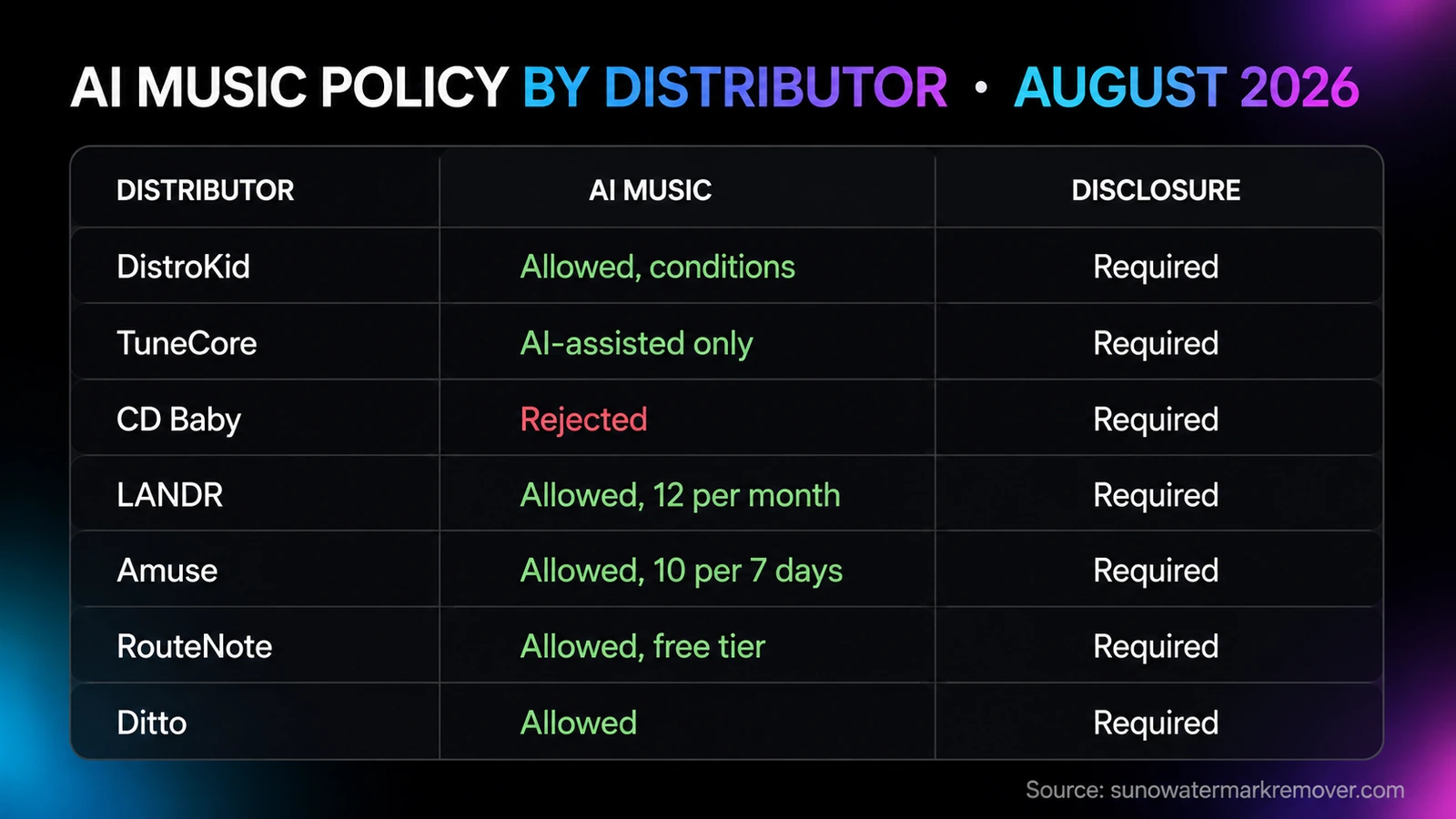
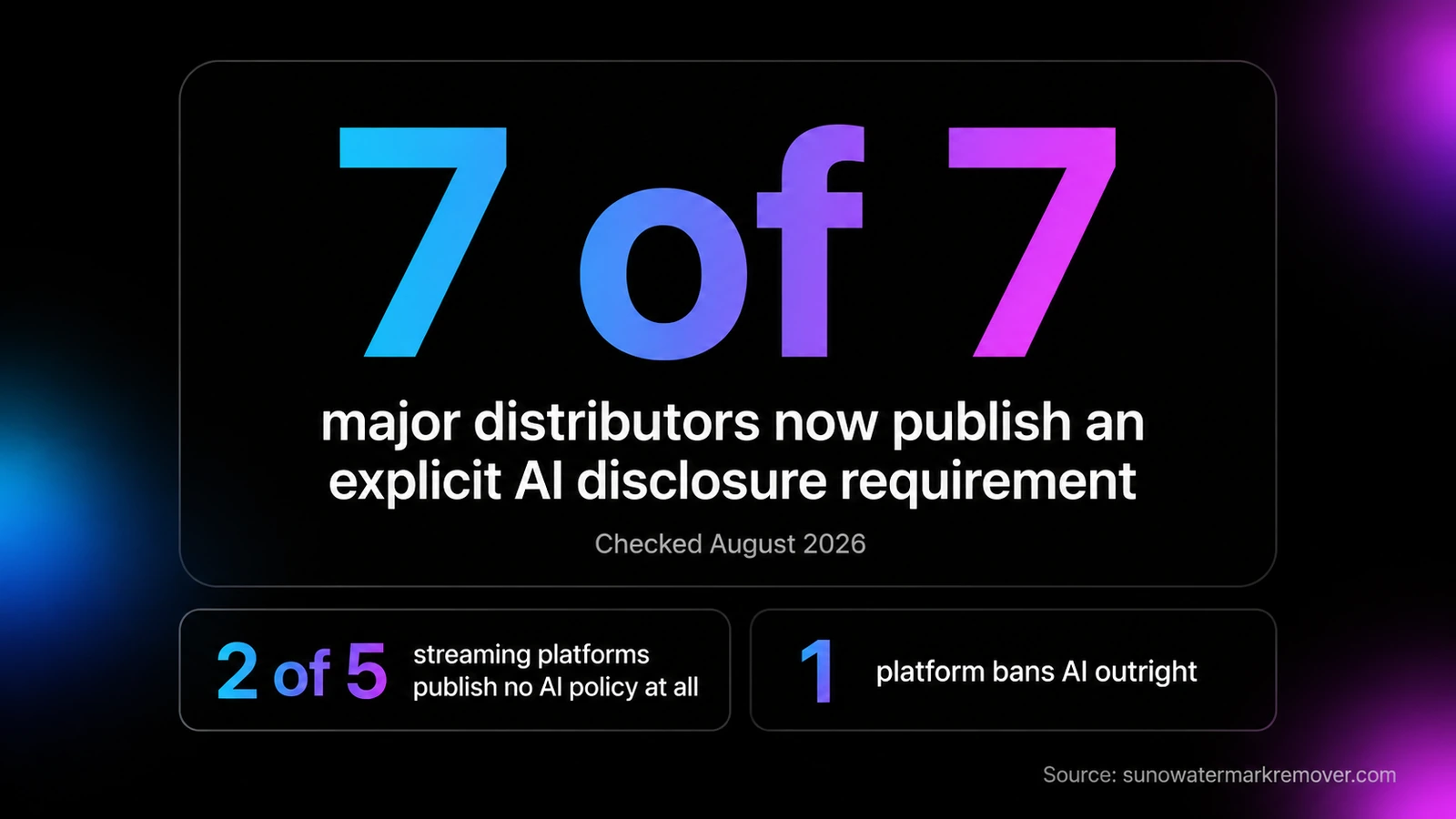
The named, dated claim: as of August 2026, all 7 major distributors in this table publish an explicit AI disclosure requirement, while 2 of the 5 streaming platforms publish no AI policy at all. A year ago most of these fields were blank. Policy is consolidating fast, and it is consolidating around disclosure rather than prohibition.
One methodology note, because a table is only worth linking to if you can check it. Several distributor help centres sit behind Cloudflare and refuse automated requests, though they open normally in a browser. Where we could not machine-verify a canonical support URL, the source column links to the company's own verified domain, and the policy detail was corroborated across public documentation and industry reporting. Every URL in the table returned a live response on 5 August 2026.
Why your track gets rejected even when the policy says yes
This is the part that confuses people, and it is the reason a permissive policy does not guarantee a release.
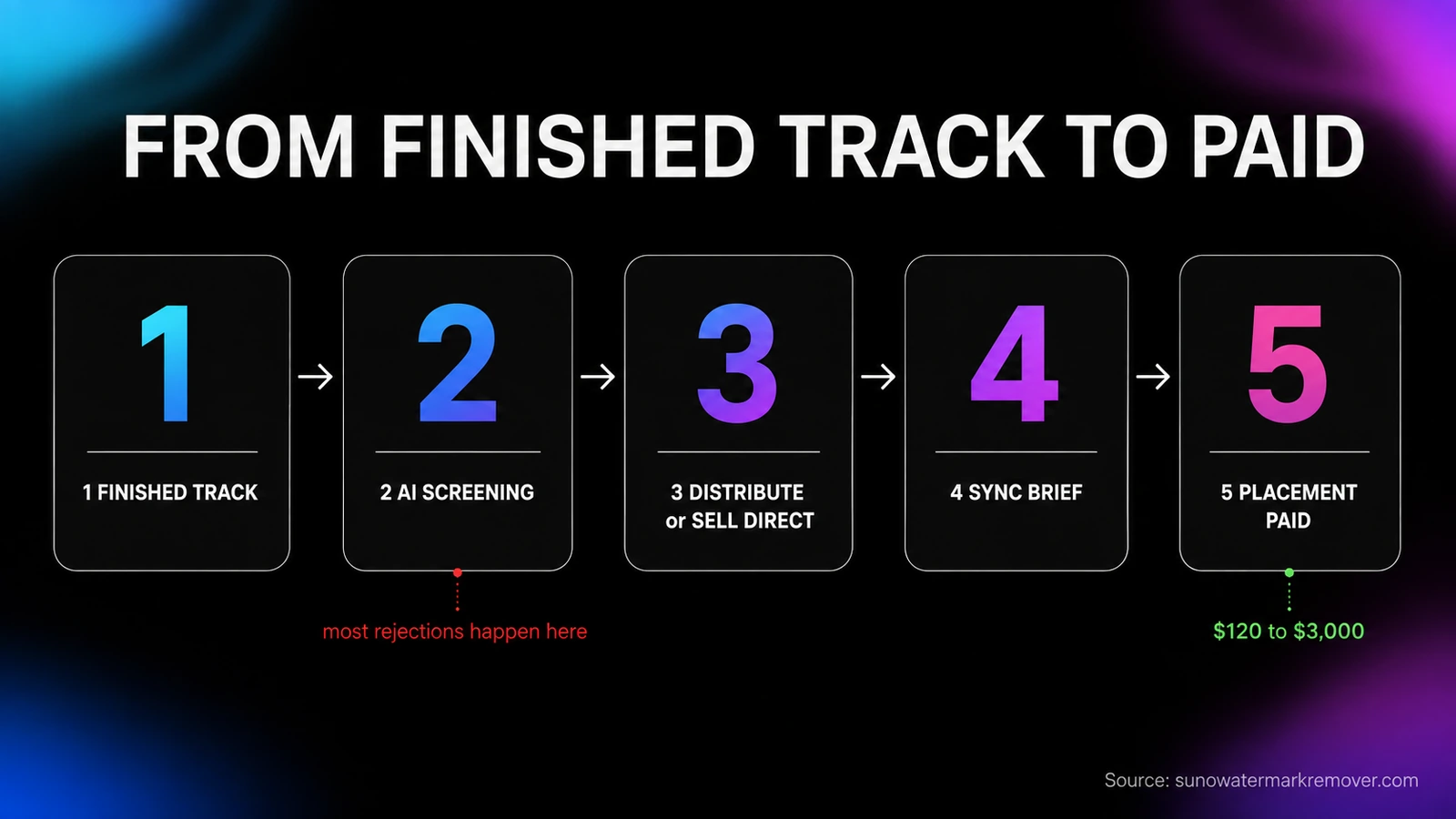
Policy and enforcement are different layers. DistroKid's written policy allows AI music. DistroKid's upload screening is an automated classifier that reads your file, and it does not read your intentions or your disclosure checkbox. As we cover in our DistroKid AI detection guide and our AI music detector guide, these systems look for statistical generation artifacts: inaudible byproducts of how models like Suno and Udio synthesise audio.
So a track can be fully compliant with the written policy and still be rejected, because the classifier found artifacts in the file. That is not a policy judgment. It is a scan.
This distinction decides what you do next. If a rejection cites AI content, arguing about your creative process will not help, because no human made the decision. The file is what failed, which means the file is what changes. Our AI watermark remover guide covers that step, and it is the one thing under your control at this stage.
The arithmetic nobody runs
Suppose the track clears the gate. What is it worth?
Spotify pays roughly $0.003 per stream. That figure moves with listener country, subscription tier and your distribution agreement, and there is no published rate card, so treat it as a working average rather than a constant. Independent sync placements commonly pay $120 to $3,000, which is the band Played.fm's open briefs sit in.
Divide one by the other and the comparison stops being abstract.
| Route | Payout per unit | Streams to match one unit | Assumption |
|---|---|---|---|
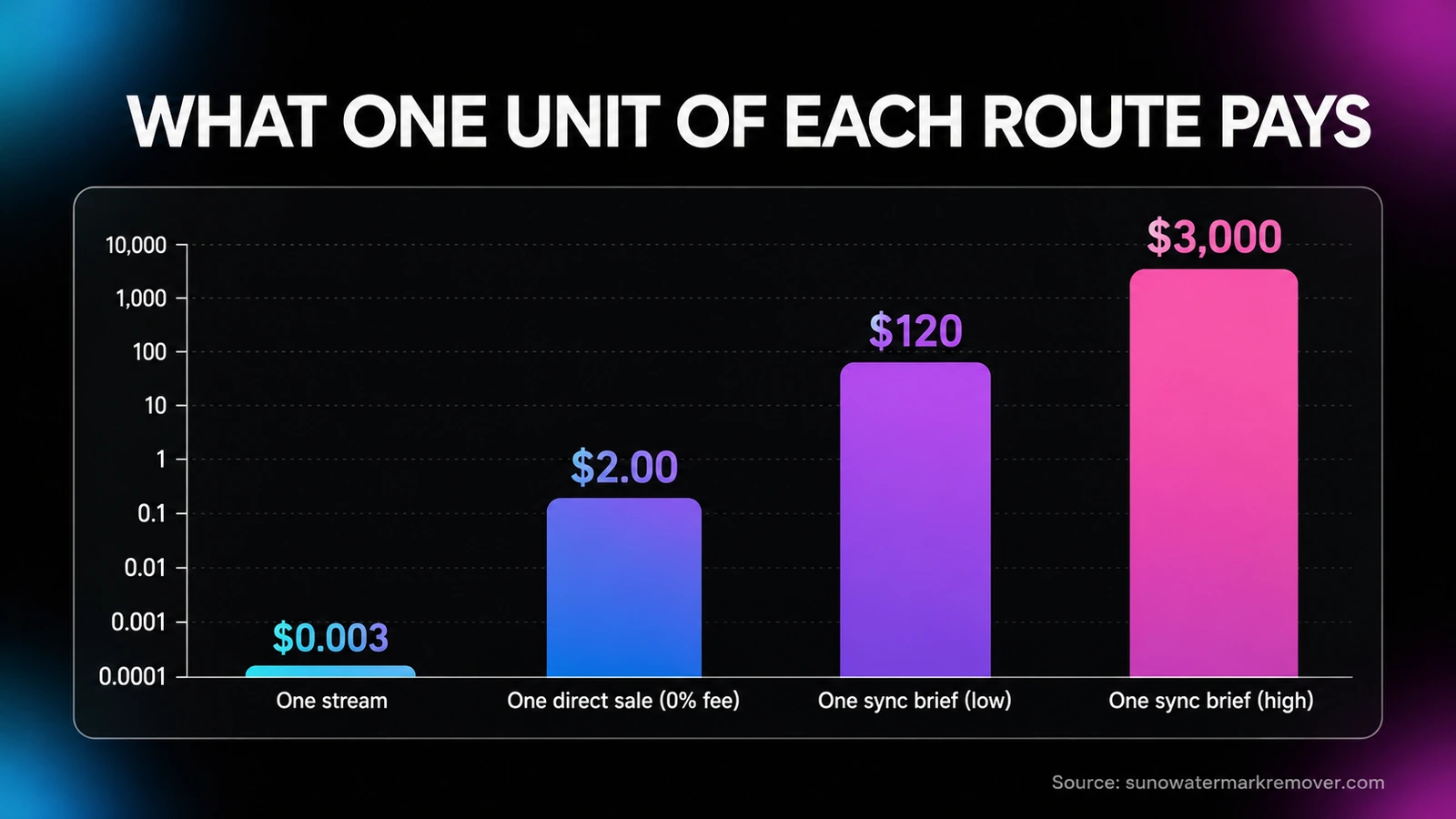
| One Spotify stream | $0.003 | 1 | Working average, varies by market |
| One direct sale at 0% commission | $2.00 | 667 | $2 track price, artist keeps 100% |
| One low-end sync placement | $120 | 40,000 | $120 divided by $0.003 |
| One mid sync placement | $500 | 166,667 | $500 divided by $0.003 |
| One larger sync placement | $1,000 | 333,333 | $1,000 divided by $0.003 |
| One top-of-band sync placement | $3,000 | 1,000,000 | $3,000 divided by $0.003 |
Show the working, because this is the number worth quoting: $120 divided by $0.003 is 40,000 streams. $3,000 divided by $0.003 is 1,000,000 streams. A single placement at the bottom of the range is worth more than most independent releases earn in their first year of streaming.
Two honest caveats. Sync placements are not guaranteed and streams are not zero: a catalogue that streams steadily compounds, while sync income is lumpy and unpredictable. And $0.003 is an average, not your rate. But the ratio survives any reasonable adjustment. Even at a generous $0.005 per stream, a $120 placement still equals 24,000 streams.
This is why the AI policy question, while worth answering precisely, is not the most important question on this page. You can spend a month getting a track past DistroKid's classifier to earn $0.003 a play, or you can spend that month on routes where one transaction is worth five figures of streaming. For artists who want to sell their music directly and keep 100% of every sale, the screening gate stops being the bottleneck at all, because direct storefronts do not run AI classifiers on uploads.
The four realistic routes, with honest downsides
Streaming distribution. Best for reach, discovery and credibility. Your track sits alongside everything else and can be found by people who have never heard of you. The downsides are the $0.003 economics and the screening gate this article opened with. Worth doing, rarely worth relying on.
Direct-to-fan storefronts. Best margin by a distance, and no AI screening at upload. You keep the customer relationship, the email address and the data, which is the asset that outlives any platform. The honest downside is that a storefront has no discovery engine: it converts an audience you already have and does nothing to build one from scratch. If you have no audience yet, a storefront alone will not fix that, and anyone telling you otherwise is selling something.
Sync licensing. The highest per-transaction payout available to an independent artist, and the route where AI-assisted production is least penalised, because a supervisor filling a 30-second brief cares about whether the cue fits the scene. The downside is that it is genuinely competitive and slow: briefs close, most submissions lose, and you need a properly prepared master before you can even enter. Played.fm's open sync briefs remove the agent and the gatekeeper from that process, but they do not remove the competition.
Stock and production libraries. Steady, unglamorous, often exclusive. You trade rights and upside for volume and predictability. Many libraries now have their own AI rules, so check before committing a catalogue.
Where Played.fm is not the answer: if your goal is chart placement, playlist traction, or the cultural validation of being on Spotify, a direct storefront delivers none of that. If you have no audience and no finished, sync-ready masters, neither the storefront nor the briefs will produce income this month. And if your track is a raw generator export with no human arrangement, supervisors will pass on it for the same reason human-made stock cues get passed on: it does not fit the picture. A comparison that never says a negative word is not worth reading, and these are the real limits.
How to actually do it
Prepare the file before you upload anywhere. Export at the highest quality your generator offers. Keep an untouched original archived separately. If a classifier has already rejected the track, process the artifacts out before resubmitting, since the file is the only variable that changed the outcome.
Disclose accurately. All 7 distributors in the table now require it. Fill in the AI involvement fields honestly at upload. Undisclosed AI that gets detected later is treated as a transparency violation, which is worse than a rejection: it can pull a live release and put the account at risk.
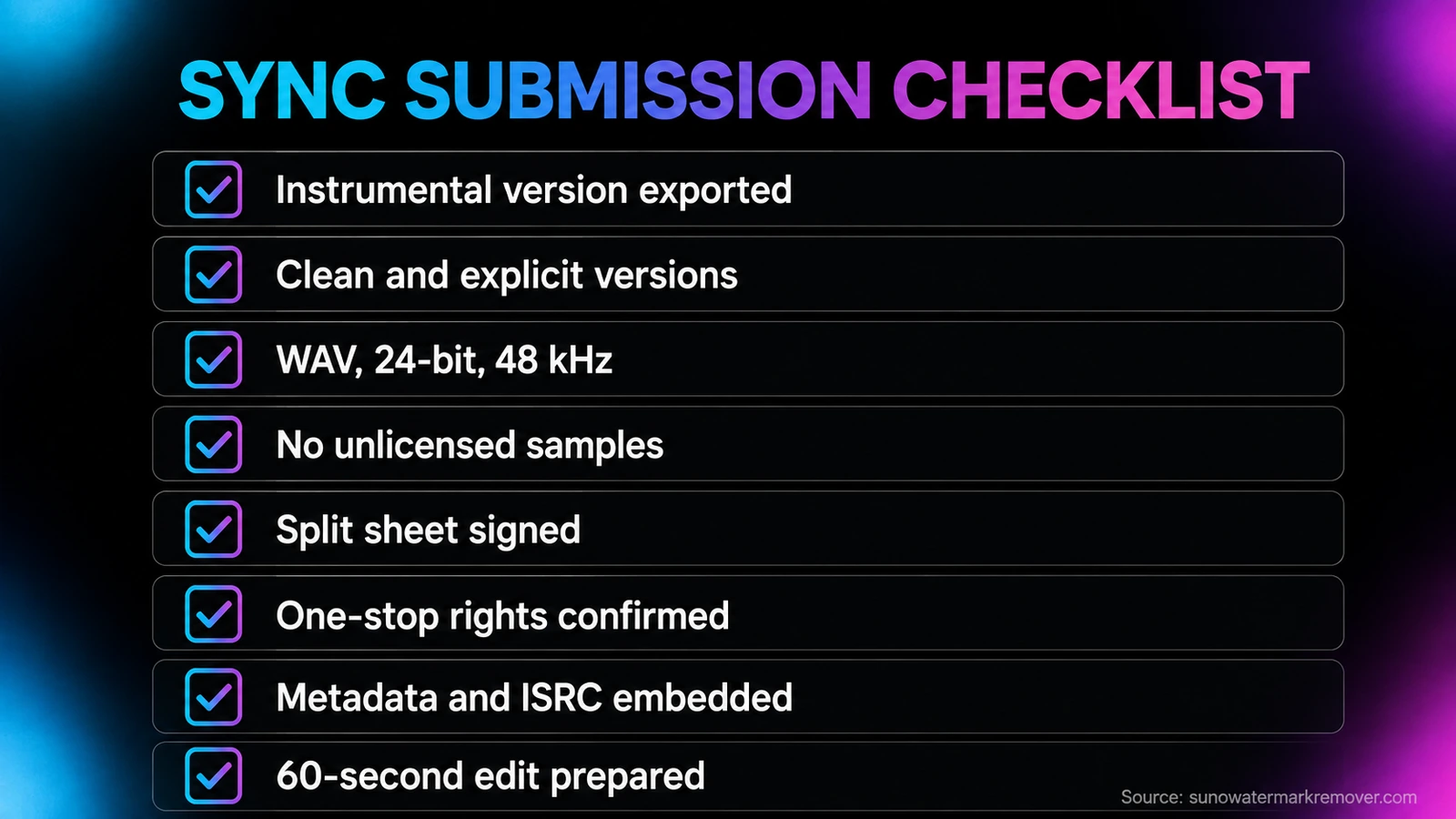
Prepare a sync-ready master. This is where most independent submissions fail before anyone listens. A brief-ready package means an instrumental version, clean and explicit versions where relevant, WAV at 24-bit and 48 kHz, no unlicensed samples, a signed split sheet, one-stop rights you can actually clear, embedded metadata with an ISRC, and a 60-second edit. Supervisors work to deadlines. The submission that can be cleared today beats the better song that needs a week of paperwork.
Price direct releases deliberately. On a 0% commission storefront, a $2 single nets $2. Matching a $1,000 sync placement takes 500 direct sales, versus 333,333 streams. Bundles, name-your-price floors and small limited runs all outperform single-track pricing for most independent catalogues.
Submit to briefs continuously, not once. Sync is a volume game with a slow feedback loop. Artists who place consistently are submitting to everything they credibly fit, every week, not perfecting one submission a quarter.
What changed in 2026, and what it means
Three shifts, all visible in the table above.
Disclosure replaced prohibition. The 2025 fear was that distributors would ban AI music outright. Most did the opposite and built disclosure fields instead. That is a far better outcome for anyone working honestly, because a declared workflow is a permitted workflow almost everywhere.
Caps and exclusions replaced bans. LANDR's 12-per-month limit and Amuse's rolling release cap are aimed at catalogue flooding, not at individual artists. The same is true of Spotify's spam filter and its removal of more than 75 million tracks in the year before its September 2025 policy update. If you release a handful of considered tracks a year, none of these limits touch you.
Detection moved downstream. Deezer now tags AI tracks and excludes them from recommendations, and reports that AI-generated uploads passed 50% of its daily deliveries in July 2026. Being permitted is no longer the same as being promoted, which strengthens the case for routes where you own the customer relationship instead of renting an algorithm's attention.
FAQ
Does DistroKid allow AI music? Yes. DistroKid does not prohibit AI-generated music. You must own 100% of the rights, avoid impersonating anyone, and disclose AI involvement at upload. Fully AI-generated tracks receive additional scrutiny and can be rejected if they fail detection or the disclosure is missing.
Does Spotify allow AI music? Yes. There is no categorical ban. Spotify's policy targets unauthorised voice clones of real artists, spam and mass-upload behaviour, and disclosure. Since 16 April 2026 it surfaces AI credits in the song-info panel when your distributor passes the DDEX flag through. Spotify has said the tag informs listeners rather than filtering or ranking.
Does TuneCore allow AI music? Partly. TuneCore accepts AI-assisted music with meaningful human contribution and rejects tracks it identifies as fully AI-generated. It is the only major distributor blocking a named generator, refusing Suno tracks at upload while accepting licensed platforms such as Udio and ElevenLabs.
Can you sell AI-generated music? Yes, where you hold the commercial rights your generator's plan grants and you disclose AI involvement where required. Permission is rarely the obstacle. Screening is. Direct-to-fan storefronts sidestep it entirely because they do not run AI classifiers on uploads.
Can I sell AI generated music on Spotify? Yes, via a distributor such as DistroKid or TuneCore. Clear your distributor's screening, disclose AI involvement accurately, and avoid impersonating a real artist. At roughly $0.003 per stream the real question is not whether you can, but whether streaming alone justifies the effort.
How much does Spotify pay per stream? Roughly $0.003, varying by country, subscription tier and distribution agreement. There is no fixed rate card. At that rate about 333,000 streams earn $1,000, which is the arithmetic behind every argument in this article for sync and direct sales.
How much do sync deals pay? Independent placements commonly run $120 to $3,000, with major film and television campaigns paying considerably more. One placement at the bottom of that band equals roughly 40,000 Spotify streams at $0.003.
How do you get sync placements without an agent? Submit directly to open briefs. Prepare a sync-ready package first: instrumental and clean versions, 24-bit WAV, cleared samples, a signed split sheet and embedded metadata. Then submit continuously rather than perfecting one entry a quarter. Played.fm runs briefs you can submit against with no agent and no gatekeeper.
Who owns AI-generated music? Your generator's subscription terms decide commercial rights, and paid Suno and Udio tiers grant them. US copyright registration separately requires human authorship, so a wholly machine-generated work may not be registrable even where your plan permits selling it. Two different questions, constantly conflated.
Where can you sell AI music if a distributor rejects it? Direct-to-fan storefronts and sync briefs, both outside distributor screening. Bandcamp is no longer an option after its January 2026 ban on wholly AI-generated audio.
What to do next
If a distributor rejected your track, fix the file. The rejection came from a classifier reading artifacts, not from a policy objection, and our AI watermark remover guide covers the step that changes the outcome.
If the track is clean and you are staring at $0.003 per stream wondering whether this is worth it, that is the correct question. The routes with real per-transaction economics are direct sales and sync, and both sit outside the screening gate entirely. You can list your tracks on Played.fm, keep 100% of every direct sale, and submit to open sync briefs paying $120 to $3,000 without an agent.
One placement at the bottom of that range is worth 40,000 streams. That is the whole argument.
Frequently asked questions
Yes. DistroKid does not prohibit AI-generated music. It requires that you own 100% of the rights, that the track does not impersonate anyone, and that AI involvement is disclosed at upload. Fully AI-generated tracks with no human input get additional scrutiny and can be rejected if they fail detection checks or the disclosure is missing.
Yes. Spotify has no categorical ban on AI-generated music. Its September 2025 policy targets three specific things: unauthorised AI voice clones of real artists, spam and mass-upload behaviour, and disclosure. Since 16 April 2026 Spotify surfaces AI credits in the song-info panel when your distributor passes the DDEX disclosure flag through.
Partly. TuneCore accepts AI-assisted music with meaningful human contribution and rejects tracks it identifies as fully AI-generated. It is also the only major distributor to block a specific generator by name, refusing Suno-made tracks at upload while accepting licensed platforms such as Udio and ElevenLabs.
Yes, with the tightest published caps of any distributor we checked. LANDR requires disclosure at upload, limits you to 12 AI-generated songs per calendar month, and excludes AI tracks from YouTube Content ID, Meta, TikTok, Deezer, Pandora and Tencent. Tracks still reach Spotify, Apple Music and Amazon Music.
Yes, if you hold the commercial rights your generator's plan grants and you disclose AI involvement where the platform requires it. The practical obstacle is rarely permission, it is screening: raw generator exports carry artifacts that distributor classifiers flag. Direct-to-fan storefronts avoid that gate entirely because they do not run AI screening.
Yes. Spotify does not ban AI music, and tracks reach it through a distributor like DistroKid or TuneCore. You need to clear your distributor's screening first, disclose AI involvement so the DDEX credit is accurate, and avoid impersonating any real artist. At roughly $0.003 per stream, the harder question is whether streaming is worth it.
Roughly $0.003 per stream, though the figure varies by listener country, subscription tier and your distribution agreement. There is no fixed rate card. At $0.003 you need about 333,000 streams to earn $1,000, which is the arithmetic that makes sync placements and direct sales worth taking seriously.
Independent sync placements commonly run from about $120 at the low end to $3,000 for larger briefs, with major film and television campaigns paying far more. Played.fm's open briefs sit in that $120 to $3,000 band. One placement at the bottom of that range equals roughly 40,000 Spotify streams.
Ownership depends on your generator's subscription terms, not on copyright law alone. Paid Suno and Udio tiers grant commercial rights to the output. Separately, US copyright registration requires human authorship, so a wholly machine-generated work may not be registrable even when your plan lets you sell it. Those are two different questions and they get conflated constantly.
Direct-to-fan storefronts and sync briefs, both of which sit outside distributor AI screening. Played.fm takes 0% commission on direct sales and runs open sync briefs paying $120 to $3,000. Bandcamp is not an option since its January 2026 ban on wholly AI-generated audio.
Ready to release your Suno tracks?
Undetectr was the only tool that passed every distributor in our testing. Clean your first track in under 60 seconds.