How to Tell If a Song Is AI: 7 Checks and Their Limits
There is no single test that tells you whether a song was made with AI. There are seven checks, from who the artist is to what a detector says, and each one fails in a different way. Used together and in the right order, they get you a confident answer far more often than your ears alone will.
- Start outside the audio: whether the artist exists offline, how fast they release, and whether a platform has labelled them. Deezer's research lead calls these 'the most obvious cues'
- Deezer tags albums it detects as AI-generated, and Spotify badges AI-generated artist identities. Spotify has no track-level AI label, and its AI credits depend on artists disclosing
- Free detectors exist, from Deezer, SubmitHub, detect.music and aha-music, and every headline accuracy figure they publish is the vendor's own
- Deezer researchers' own detector scored 99.8% on clean audio, then 66.6% after a two-semitone pitch shift and 58.4% after AAC re-encoding
- Listening comes last: in a Deezer-commissioned Ipsos survey of 9,000 people, 97% could not tell fully AI-generated songs from a human one
- The short answer
- The seven checks at a glance
- Check 1: look for a real person behind the name
- Check 2: look at how fast the music arrives
- Check 3: look for a platform label
- Check 4: read the credits
- Check 5: run it through a free detector
- What the research says about detector accuracy
- Check 6: read the lyrics
- Check 7: listen, last
- Two cases: The Velvet Sundown and "Rubberz"
- What to do with your answer
The short answer
You cannot reliably tell whether a song is AI from one clue. You can usually tell from several, and the order matters: start with the checks that do not depend on the audio, use a detector as one piece of evidence rather than a verdict, and treat your own ears as the least reliable instrument.
The scale of the question has changed in a year. Deezer said in October 2026 that it receives "nearly 90,000 fully AI-generated tracks every day, accounting for more than 50% of the total daily delivery on peak days", up from 18% in June 2025. Those tracks are still only "between 1-3%" of what people actually stream there. Most AI music is uploaded and never heard, but the share that reaches your playlists is growing.
Every source on this page was read on 29 October 2026. We did not run detectors against a test set of our own, so the accuracy figures below come from the vendors, who are marked as such, and from published research.
The seven checks at a glance
| Check | What to look for | What a positive tells you | Where it fails |
|---|---|---|---|
| 1. The artist | Social history, gigs, a label, interviews | Strong evidence of a real act | AI projects can build fake histories |
| 2. Release pace | Albums weeks apart, a sudden catalogue | A strong hint of generation at volume | Prolific humans exist |
| 3. Platform labels | Deezer tag, Spotify AI Persona badge, YouTube label | Platform-level detection or review | Labels cover some platforms and miss others |
| 4. Credits | Spotify AI credits, DDEX disclosures | The uploader declared AI use | No credit does not mean no AI |
| 5. A free detector | SubmitHub, Deezer, detect.music, aha-music | A confident AI verdict is meaningful | A "human" verdict proves little |
| 6. Lyrics | Clichés, filler words, structure that does not resolve | Weak supporting evidence | Subjective, and humans write clichés too |
| 7. Listening | Vocal warble, smeared detail, choruses that drift | Weak supporting evidence | Most people cannot tell any more |
Check 1: look for a real person behind the name
The most useful advice comes from someone who runs a detector. "The 'most obvious cues' come from 'external factors'," Deezer's head of research and development, Manuel Mousallam, told the Associated Press in July 2025. The AP's checklist reads like a background check:
- Social accounts. "Does the band or artist have social media accounts? Lack of a social presence might indicate there's no one there. If they do exist online, examine the kind of content they post, and how long it goes back."
- A life offline. "Are there any upcoming concerts and can you buy a ticket for a gig? Is there footage of past concerts on YouTube? Has an established record label released their singles or albums?"
- The generator. "Song creators often — but not always — publish their generated tunes on the Suno or Udio platforms," though you need an account to search them.
Spotify now surfaces some of this inside the app. An artist with a "Verified by Spotify" badge has passed Spotify's own checks. Spotify's Artist Details panel shows "career milestones, release history, and touring activity" from its own data. A long touring history is hard to invent. A profile that appeared three months ago with no shows, no interviews and photos that look rendered is the pattern to notice.
Check 2: look at how fast the music arrives
Generators make music faster than people do, and the release pattern often gives it away before the audio does.
The Velvet Sundown is the standard example. Louder put it plainly on 1 July 2025: "Two weeks ago, breezy psychedelic rockers The Velvet Sundown didn't exist. And now they've released two albums and collected more than half a million monthly listeners on Spotify." A third album was scheduled within weeks. Two weeks later, the band's own bio called it "a synthetic music project".
Pace on its own is not proof. Plenty of human producers release a track a week, and some release more. What matters is pace combined with check one: a large catalogue appearing suddenly, from an act with no history before it.
Check 3: look for a platform label
Several platforms now label AI music, but they label different things, and Deezer is the one that labels by its own detection.
| Platform | What it labels | Live in October 2026? | Based on |
|---|---|---|---|
| Deezer | Albums with tracks detected as fully AI-generated | Yes, since 20 June 2025 | Deezer's own detector |
| Spotify | Artist identities ("AI Persona", "Likely AI Persona") | Rolling out since mid-September 2026 | Self-disclosure and Spotify review |
| YouTube | Videos where realistic AI content, including music, is disclosed or detected | Yes | Creator disclosure, C2PA metadata and YouTube's own systems |
| Tidal | Wholly AI-generated music, with an "AI" badge and no royalties | Policy published 29 June 2026, as reported by Music Business Worldwide | Distributor identification, which Tidal says it will enforce |
| Apple Music | Optional AI "Transparency" tags in its delivery spec since March 2026; a visible "Made With AI" label is reported | Tags in the spec; the visible label is not confirmed live | Provider disclosure |
| Bandcamp | Nothing, because it bans wholly or substantially AI-generated music | Ban in force since 13 January 2026 | Reports and human review |
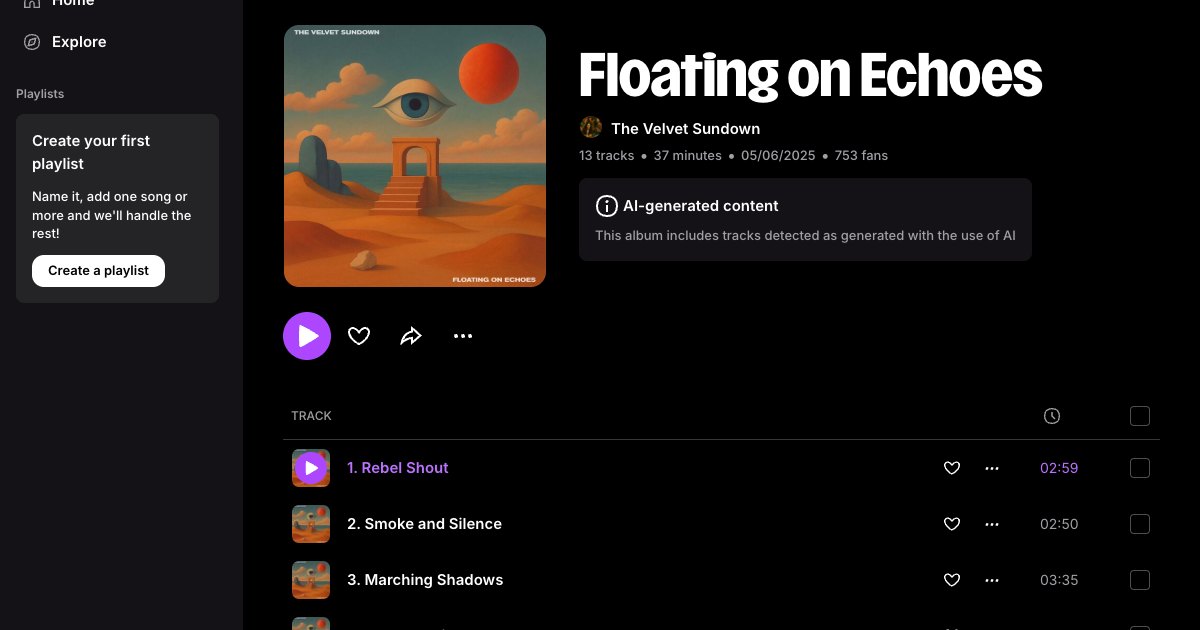
Deezer is the strongest signal for listeners, because it tags by detection rather than by declaration. The label reads "AI-generated content: This album includes tracks detected as generated with the use of AI", and tagged tracks are "automatically excluded from algorithmic recommendations and editorial playlists". By October 2026 Deezer said it had tagged more than 14 million albums. Our Deezer AI detection guide covers the system in depth.
Spotify's AI Persona badge is about who the artist is, not how the music was made: "This badge is about the artist's public identity". It has two states. "AI Persona" is self-disclosed. "Likely AI Persona" means Spotify "reviewed the artist and determined that their profile represents an AI-generated identity". Spotify says badged personas are excluded from editorial and algorithmic recommendations by default, and that the badges are still rolling out, so you may not see one yet.
Apple Music added optional AI "Transparency" tags to its delivery specification in March 2026, which labels and distributors fill in themselves. According to MacRumors, citing The Hollywood Reporter, Apple told partners in August 2026 that a visible "Made With AI" label was coming "later this year". We found no confirmation that it is live.
Tidal published an AI policy on 29 June 2026. As Music Business Worldwide reported it (tidal.com blocked our requests), Tidal accepts AI-generated music but pays no royalties on wholly AI releases and marks them with an "AI" badge.
A useful trick follows from this table. If a track is on Deezer as well as your own service, look it up there, because Deezer is the platform that tags by detection.
Check 4: read the credits
Credits are where disclosure lives, and disclosure is getting more structured. Spotify launched AI credits in April 2026. They show "credits for specific contributions like vocals, lyrics, or production in Song Credits on mobile". YouTube accepts "Fully Gen AI", "Partly Gen AI" or "No Gen AI" declarations from music partners through the DDEX standard.
The limit is in Spotify's own words: "Because we depend on artist disclosure, the absence of a credit doesn't mean AI wasn't used." Spotify's AI credits are in beta and visible only on mobile, and they "don't appear on artist profiles or as track-level labels". A credit that says AI is reliable. A missing credit tells you nothing.
Check 5: run it through a free detector
Several detectors are free to listeners. Every accuracy figure below is the vendor's own claim.
| Tool | Free use | What you give it | Vendor's accuracy claim |
|---|---|---|---|
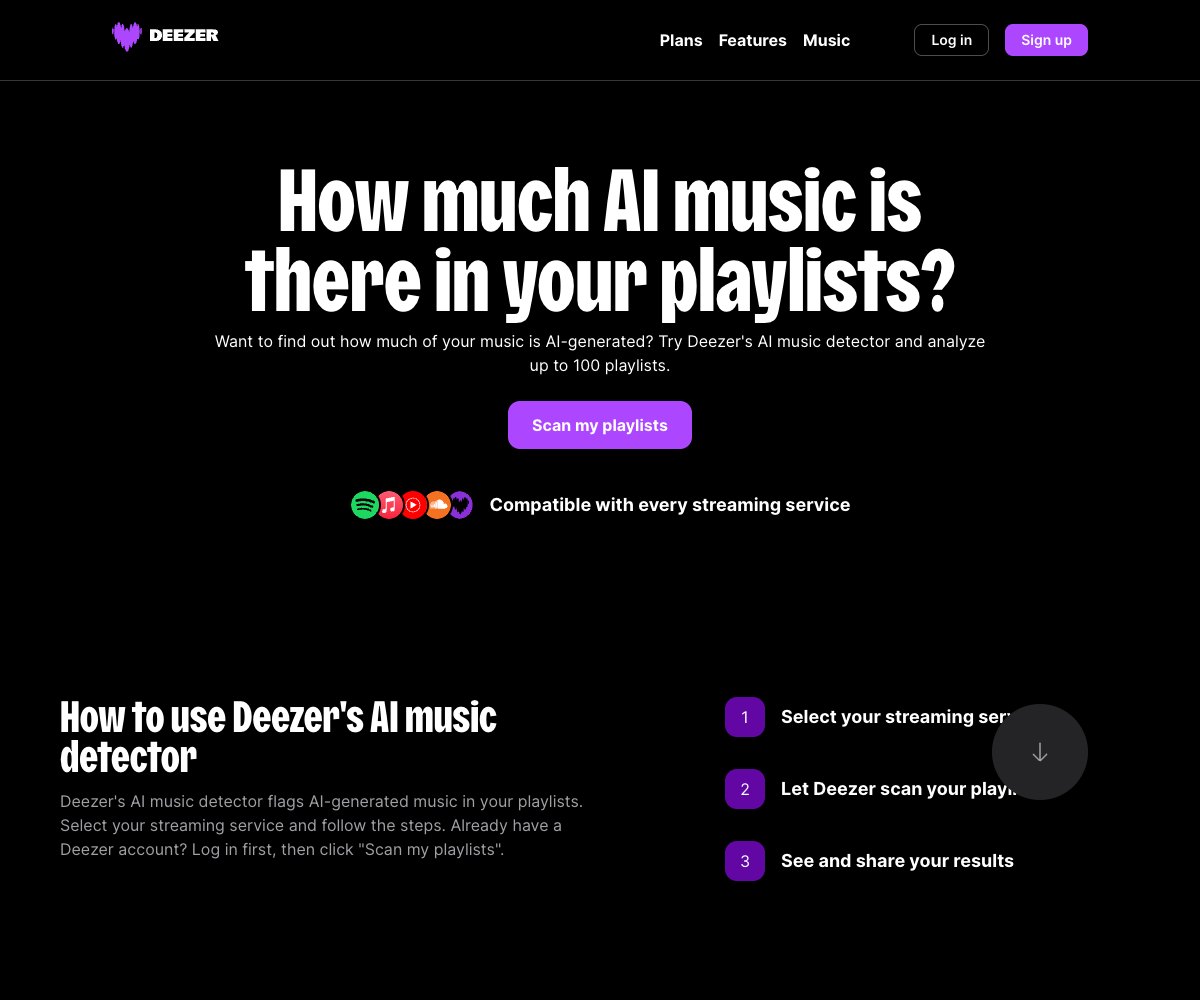
| Deezer AI Music Detector | Free | A connected streaming account; scans up to 100 playlists | "99.8% accurate", missing "2 out of every 1,000 AI-generated tracks" |
| SubmitHub AI Song Checker | 2 checks a day, 10 with a free account | A Spotify, SoundCloud, YouTube or Disco link, or a file | 499 of 500 human tracks right; "99%+" on the generators it covers |
| detect.music | Free | An MP3, WAV, FLAC or M4A file, or a Spotify or YouTube link | "~99% Accuracy" |
| aha-music | 3 as a guest, 10 with a free account | A file up to 99 MB; runs on ACRCloud's detection | No figure; "high precision" |
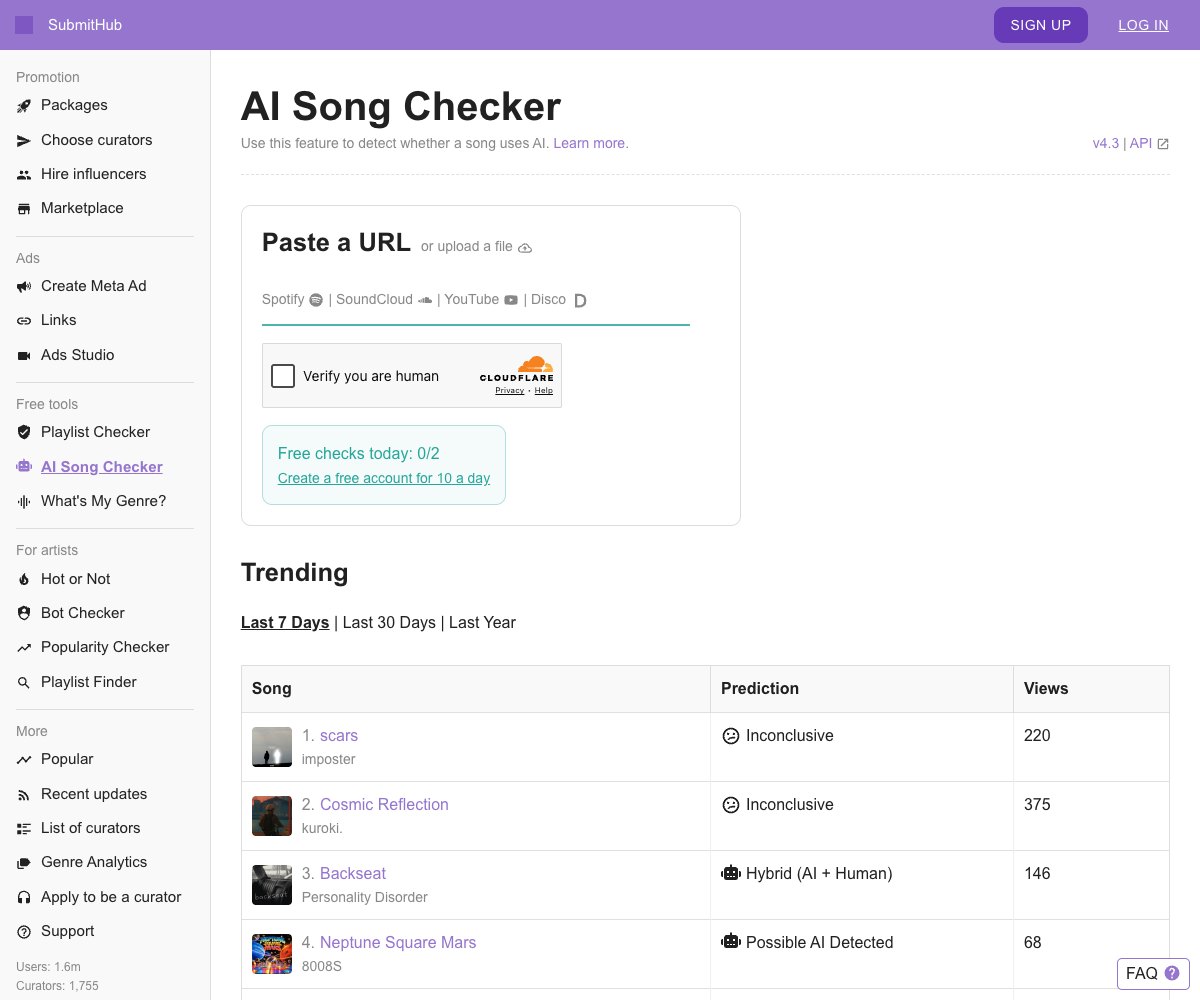
Some practical notes:
- Deezer checks playlists, not single files. You connect an account and it scans what is in your playlists.
- SubmitHub is the most flexible. Since a 23 September 2026 update it splits stems to tell "whether it's hybrid, pure AI, or something else", and it lists models including Suno, Udio, Mureka v8, Treblo v3 and Google's Lyria 3. Our SubmitHub checker review covers it in full. SubmitHub is also candid about the limits: "can you trick the detector? Yep, you sure can".
- The professional tools are not consumer services. IRCAM Amplify, ACRCloud and the Vobile detector powered by Pex sell to platforms and distributors. The free IRCAM upload the AP used in 2025 now sits behind "Request access". Our IRCAM Amplify review explains what changed.
What the research says about detector accuracy
This is the part the vendor pages leave out, and it changes how you should read a result. The pattern across the published research is consistent:
- Clean audio: near-perfect scores on unaltered tracks from generators the detector was trained on.
- Altered audio: large drops once the file is changed in ways it was not trained on.
- The direction of failure: the drops push AI tracks toward a "human" verdict.
The clearest evidence comes from Deezer's own researchers. In a 2024 paper titled "Detecting music deepfakes is easy but actually hard", their detector scored 99.8% on clean test audio. The authors added: "we stress that a good test score is not the end of the story." They then altered the audio:
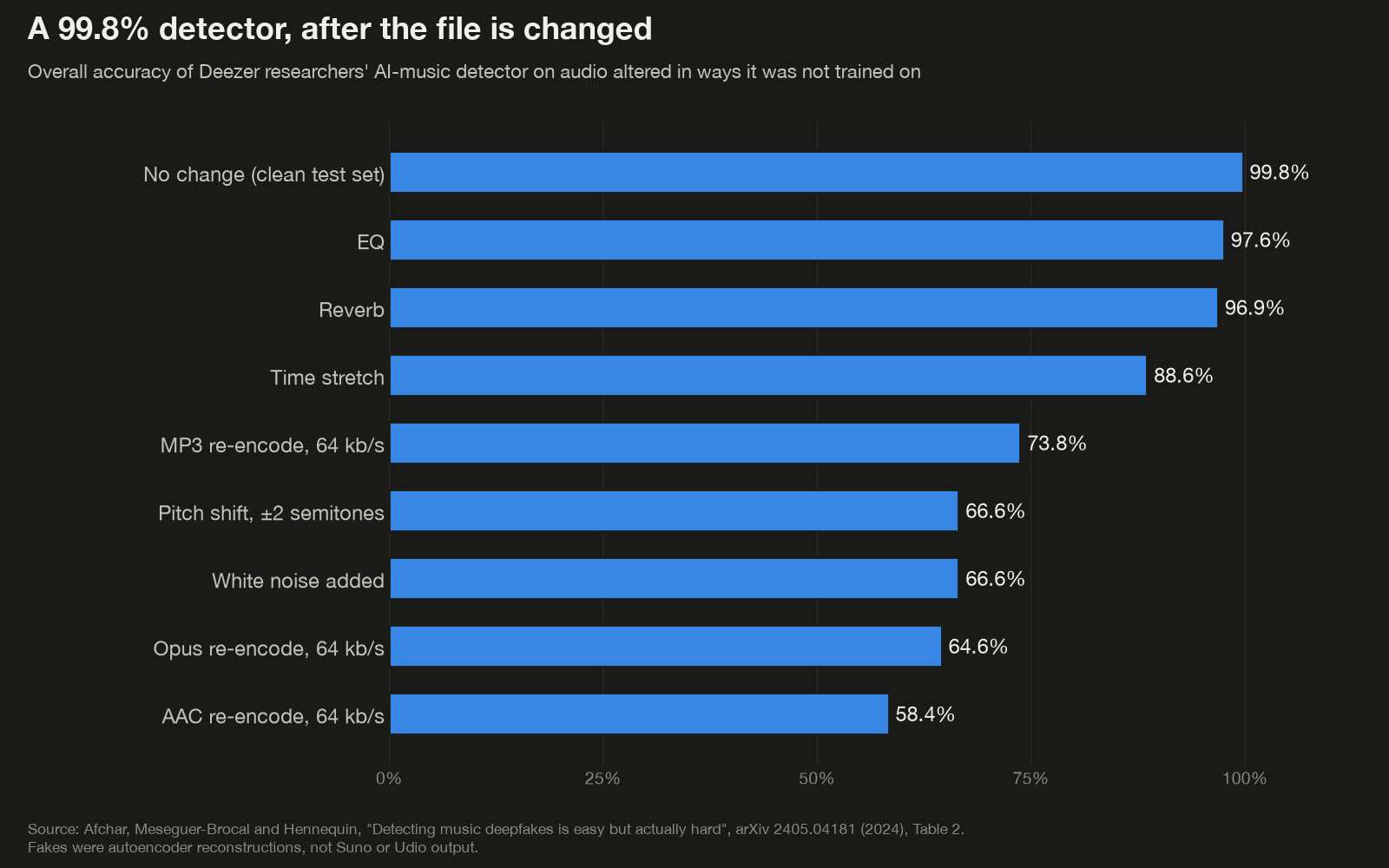
The real-music scores stayed between 99.3% and 99.9% throughout. In other words, when the detector could not find the artifacts it knew, it said "human". The authors' conclusion: "deepfake detectors are not naturally robust to unanticipated audio transformations."
Independent work on a commercial detector found the same shape. Researchers at KTH tested IRCAM Amplify for Transactions of the International Society for Music Information Retrieval in June 2025:
- A false-positive rate on human music: "the 4.7% false-positive rate for human-made content underscores a critical trade-off".
- An unseen generator: "only 3 of the 50 Boomy recordings are identified as AI music".
- A simple resample: reducing the sample rate to 22.05 kHz made it misclassify "all of the Suno samples".
The authors note that IRCAM later added Boomy detection, and the resampling test used only 15 samples. Later papers point the same way:
- Speed changes: a 2026 study found an earlier artifact detector fell to an F1 score of about 0.67 on Suno v5 tracks sped up or slowed down.
- Hybrid tracks: on simulated human-AI hybrids, separating stems and testing each one flagged the real vocals as AI 94.7% of the time.
- Background music: broadcast-style tests with music under speech scored below 60%.
Two conclusions follow. A confident "AI" verdict on an untouched file is meaningful evidence. A "human" verdict is weak, because re-encoding, editing and new models all push results that way, and some vendors now sell processing aimed at exactly the artifacts detectors read. Our audio watermark explainer covers why a keyed watermark such as Google's SynthID is a different and harder thing to remove.
Check 6: read the lyrics
Lyrics are weak evidence, but they are free to check. The AP's advice: "bad rhyming schemes or repetitive lyrical structures might be a clue that a song is not man-made. But it's subjective." It also quotes Suno users who say certain words, "neon", "shadows" and "whispers", come up so often they are "a dead giveaway". That is user anecdote, not research.
There is research suggesting lyrics may be a sturdier signal than audio. A 2025 Deezer paper (arXiv 2506.15981) argues that "audio-based detectors fail to generalize to new or unseen generators and are vulnerable to audio perturbations". It proposes detecting AI lyrics transcribed from the song instead. That is a research direction, not a tool you can use today, but it is a reason to read the words closely.
Check 7: listen, last
The listening tips most guides lead with are the least reliable check, and the evidence says so. Lifehacker's 2024 guide lists the classic tells:
- vocals that are "shaky, but not in a way you'd expect from a human";
- "a classic mp3 sound" that is "fuzzy, tinny, and flat";
- "a lack of passion";
- choruses that fall apart because the model "doesn't seem to remember how the original chorus went".
Those tells are fading. Deezer's Mousallam told the AP that "old identifiers – such as vocals having a distinctive reverb – are not necessarily valid anymore." A Deezer-commissioned Ipsos survey of 9,000 people in eight countries found that "97% couldn't tell the difference between fully AI-generated music and human-made music in a blind test with two AI songs and one real song".
That survey was commissioned by a company that sells AI detection, so weigh it accordingly. It still matches the direction of every other source. Listen for drift in a repeated chorus, a vocalist who sounds slightly different on each track, or detail that smears in dense passages. Treat what you hear as a tiebreaker, not a test.
Two cases: The Velvet Sundown and "Rubberz"
The Velvet Sundown, 2025. Every check pointed the same way:
- Pace: two albums within weeks of appearing.
- The artist: Louder noted that "all the images shared by the 'band' on social media bear the hallmarks of AI: the hyperrealistic colours, the improbable shadows".
- The sound: it also heard "the thin, unimaginative percussion" and "the vocalist sounds slightly different on each song".
- A platform label: Deezer tagged the albums by the end of June, while Spotify and Apple Music did not.
- The admission: by 5 July the band's own Spotify bio called it "a synthetic music project guided by human creative direction, and composed, voiced, and visualized with the support of artificial intelligence", per Rolling Stone.
- The scale: Digital Music News counted 1.07 million monthly listeners on 7 July.
"Rubberz", 2026. The harder case shows the limits. Fenix Flexin's "Rubberz" reached No. 58 on the Billboard Hot 100. The producer Medasin then alleged it was made with Treblo, the generator formerly called Sonauto, pointing to a pre-release snippet with "Sonauto" in its filename. Stereogum uploaded the track to Treblo's own detector, which returned "Very likely Treblo". Fenix Flexin responded "Never said I didn't use AI", while saying it "had nun to do w recording process".
Rolling Stone Canada added that the tool's accuracy "has not been independently verified". The only detector confirmation came from the generator's own vendor, and the artist disputes how much of the song was AI. Most real cases look more like this one than like The Velvet Sundown.
What to do with your answer
If you are a listener, Deezer's detector and the platform labels are the practical tools. Spotify's AI Persona badges and Deezer's album tags carry the most weight. On Bandcamp, which bans music "generated wholly or in substantial part by AI", the platform asks you to "use our reporting tools to flag the content for review".
If you are a curator, playlist owner or label, do not let a single detector score decide. Run the external checks first. Use a detector that reports "hybrid" and "inconclusive" rather than a bare yes or no. Treat a "human" result on a track from an unknown act as unproven.
If you are releasing AI-assisted music yourself, the honest route is the one the platforms have built: declare it. YouTube takes AI declarations from music partners through DDEX, and Spotify's AI credits come from the same kind of disclosure, so declaring is what puts accurate information in front of listeners.
Frequently asked questions
Combine several checks rather than relying on one. Look for evidence that the artist exists offline, check how fast they release, look for a Deezer AI tag or a Spotify AI Persona badge, read the song credits, run the track through a free detector, and only then listen. Each check can be fooled on its own, but together they rarely all point the wrong way.
Yes. Deezer's free AI Music Detector scans up to 100 playlists through a connected streaming account. SubmitHub's AI Song Checker takes a Spotify, SoundCloud, YouTube or Disco link or a file, with two free checks a day or ten with a free account. detect.music and aha-music accept uploads too. All of their accuracy figures are vendor claims.
Very accurate on clean audio from generators they were trained on, and much less so otherwise. Deezer researchers' detector scored 99.8% on its clean test set but 58.4% after AAC re-encoding. A KTH study found IRCAM's commercial detector caught 3 of 50 tracks from a generator it had not seen, and missed every Suno sample after a simple resample.
Not at track level. Since mid-September 2026 Spotify shows an 'AI Persona' or 'Likely AI Persona' badge on some artist profiles whose identity appears AI-generated, and it offers AI credits in song credits on mobile, in beta. Spotify says the absence of an AI credit does not mean AI was not used, because the credits depend on disclosure.
Yes. Since 20 June 2025 Deezer has shown an 'AI-generated content' label on albums that include tracks its system detects as fully AI-generated, and it excludes those tracks from algorithmic recommendations and editorial playlists. In October 2026 it said it had tagged over 14 million albums.
Rarely with confidence. Older tells such as warbling vocals, a muddy MP3-like sound or choruses that change between repeats are less reliable as models improve, and Deezer's research lead says old identifiers 'are not necessarily valid anymore'. In a Deezer-commissioned survey, 97% of 9,000 people could not pick the human song in a blind test.
Yes, by its own account. In July 2025 the band's revised Spotify bio described it as 'a synthetic music project guided by human creative direction, and composed, voiced, and visualized with the support of artificial intelligence'. Deezer had already tagged its albums as AI-generated, and its page still carries the label in October 2026.
Not necessarily. A 'human' verdict is the weakest result a detector gives, because detectors default to human when they cannot find the artifacts they were trained on. Re-encoding, pitch shifts, speed changes and new generators all push AI tracks toward a human verdict, which is why the other six checks matter.
Ready to release your Suno tracks?
Explore Undetectr’s published track-processing features before preparing your release.