Google Flow Music Review (2026): What ProducerAI and Riffusion Became
Riffusion became Producer.ai in July 2025, joined Google Labs in February 2026 and was renamed Google Flow Music in April. What came out the other end does something Suno and Udio do not: its pricing grid ticks MP3, WAV and stem downloads on every plan, free included, with no cap we could find. Every file it makes also carries Google's SynthID watermark, which anyone can now check.
- Riffusion is now Google Flow Music: riffusion.com redirects to producer.ai, which redirects to flowmusic.app. Google renamed ProducerAI in April 2026, two months after it joined Google Labs
- Plans cost $0, $8, $24 and $64 a month billed monthly, or $6, $18 and $48 a month billed yearly, for 3,000 to 30,000 credits. The yearly prices are the ones that load first
- The pricing grid ticks MP3, WAV, M4A and stem downloads on every plan, Free included, and the homepage promises unlimited downloads. We found no download cap anywhere
- Google says every ProducerAI and Lyria 3 output carries SynthID, and since 7 October 2026 anyone can check an audio file for it with the public SynthID Detector
- Commercial use rights are listed for the three paid plans. No Google page grants or denies them on Free, and Google's terms say only that it 'won't claim ownership' of what you generate
The short answer
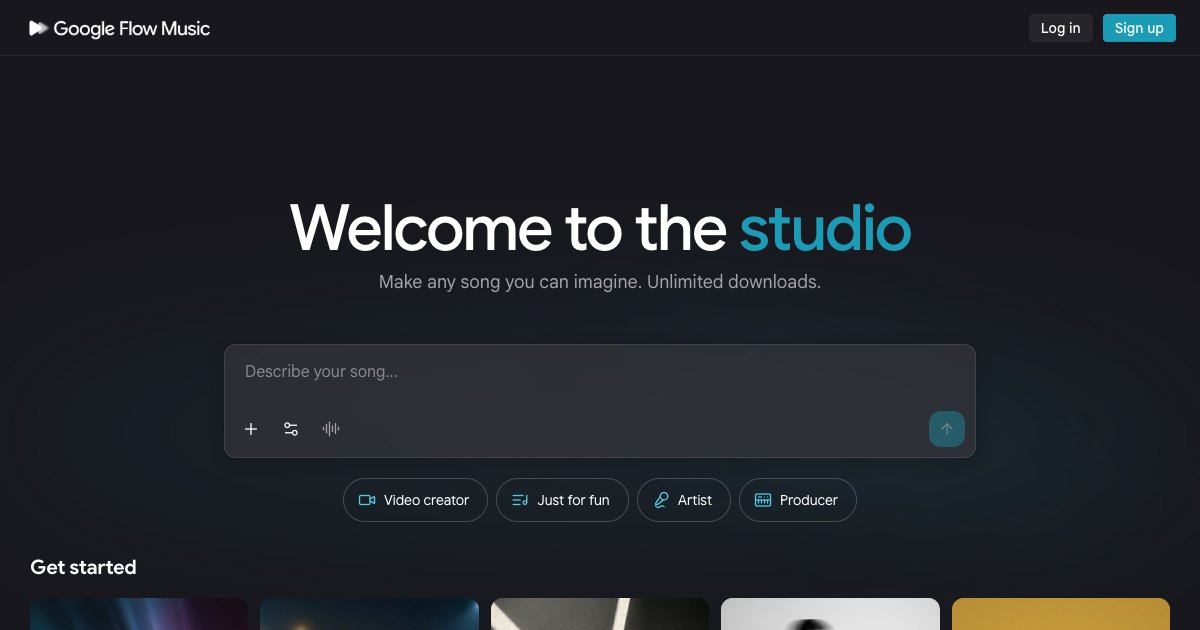
Google Flow Music is what Riffusion became, and in October 2026 it is a serious AI song generator with one feature Suno and Udio do not match: on every plan, free included, its pricing grid ticks downloads in MP3, WAV and M4A plus stem downloads, and we found no cap. If being able to take your files out is what you care about most, try it before paying a rival anything.
Three things to know before you rely on it:
- Every file is watermarked. Google says all output carries SynthID, and anyone can now check for it.
- Free-plan commercial use is unstated. Google lists commercial rights only for the three paid plans.
- There is an open lawsuit. Independent musicians are suing Google over how its music models were trained, and their filing names ProducerAI.
Every source below was read on 29 October 2026, logged out. We did not generate songs on Flow Music, so nothing on this page is a listening test. It is a review of what the product is, what it costs, what you may do with the output, and what Google has committed to in writing.
From Riffusion to Google Flow Music: the timeline
Riffusion began as a hobby project by Seth Forsgren and Hayk Martiros that turned images of sound into music. It has changed name twice in ten months, which is why searches for all three names keep landing on old pages. Opening the old addresses on 29 October 2026 traced the chain:
riffusion.comreturns a 301 toproducer.ai.producer.aireturns a 301 toflowmusic.app, whose page title is "Google Flow Music".- The terms link ends at Google's general Terms of Service.
| Date | What happened | Source |
|---|---|---|
| July 2025 | Riffusion relaunches as Producer.ai | Billboard; Wayback Machine captures of the redirect |
| 24 Feb 2026 | ProducerAI "is joining Google Labs" | Google's announcement |
| 25 Mar 2026 | Lyria 3 Pro, with songs up to 3 minutes, arrives in ProducerAI | |
| 17 Apr 2026 | Renamed Google Flow Music, per an X post reported by 9to5Google | 9to5Google |
| 6 May 2026 | Believe and TuneCore partnership | |
| 18 May 2026 | iOS app released | App Store listing |
| 29 Jul 2026 | Lyria 3.5 rolls out in Flow Music | |
| 6 Oct 2026 | Spaces export as VST3 and AU plugins, macOS only | |
| 7 Oct 2026 | SynthID Detector opens to everyone, audio included | Google DeepMind |
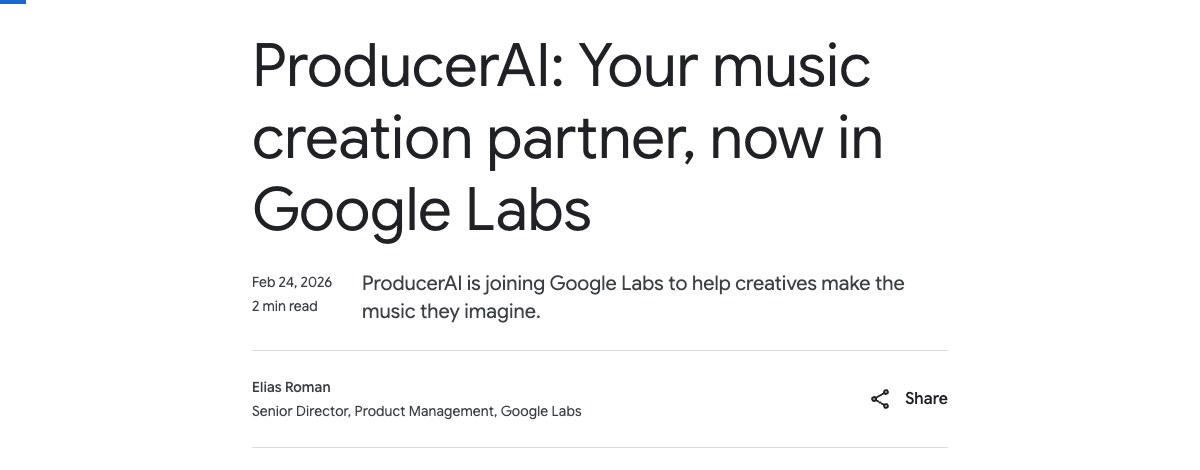
One wording point, because coverage blurs it. Google's post never uses the word "acquired". That word comes from Sky9 Capital, an investor in the company, which says ProducerAI "has been acquired by Google", and from Billboard. No source we found discloses a price. Seth Forsgren now signs Google posts as Group Product Manager, Google Flow Music.
What happened to songs made on the old Riffusion site, we could not establish. No Google or Riffusion source documents it, and the forum claims we found about deletion emails are unverified, so we are not repeating them.
What Google Flow Music costs
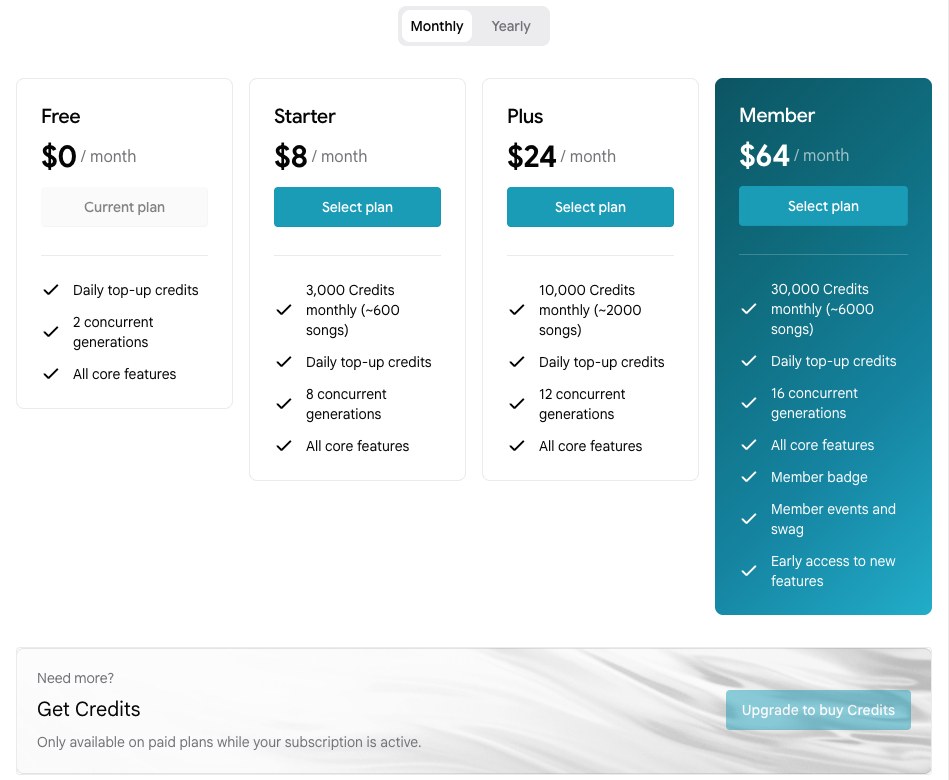
Read off flowmusic.app/pricing on 29 October 2026, logged out.
| Plan | Billed monthly | Billed yearly, per month | Credits a month | Concurrent generations |
|---|---|---|---|---|
| Free | $0 | $0 | Daily top-up credits only | 2 |
| Starter | $8 | $6 | 3,000 (about 600 songs) | 8 |
| Plus | $24 | $18 | 10,000 (about 2,000 songs) | 12 |
| Member | $64 | $48 | 30,000 (about 6,000 songs) | 16 |
Some of the details are easy to miss:
- The yearly toggle loads first. The figures most visitors see are $6, $18 and $48, which are per-month rates on an annual commitment. The page does not show the yearly total. At those rates it would be $72, $216 and $576 a year, by our arithmetic.
- No currency code. The page shows a bare dollar sign, and we could not see what checkout charges without signing in.
- Credit packs are paid-only, and unpriced. They are "only available on paid plans while your subscription is active", and the price is hidden until you log in.
- The free top-up is unquantified. Google does not say how many credits it gives. You can earn more by voting between samples in a feature called Turntable.
- Google AI plans include it. Google AI Plus, Pro and Ultra members get the Starter, Plus and Member benefits respectively, and Google notes that Flow Music credits are separate from other Google AI credits.
That last point matters more than it looks. If you already pay for Google AI Pro, you already have Flow Music's $24 tier.
The pricing grid ticks the same core features for every plan: Lyria models, the Producer assistant, projects, downloads, stem downloads, publishing, and image and video generation. What the money buys is credits and parallel generations, plus a badge, events and early access on Member.
Downloads: the part that sets it apart
This is the section most readers of this site will care about, because download limits have become the main fight in AI music this year.
The Flow Music pricing grid ticks "Downloads (mp3, wav, m4a)" and "Stem downloads" for all four plans, Free included. The homepage headline promises "Unlimited downloads". We looked for a download cap in the pricing page and the Flow Music help articles, and found none.
The help centre describes downloading one song at a time or several at once: "Next to each song you want to download, select the checkbox. At the top right, select Download. The files will download in a .zip file to your device." By default other users can also remix and download your public songs. A toggle called "Allow community remix" turns that off.
Here is how that compares with the services people usually weigh it against, using each vendor's own published terms:
| Service | Download allowance | Formats | Source |
|---|---|---|---|
| Google Flow Music | No cap found, every plan including Free | MP3, WAV, M4A, stems | flowmusic.app pricing grid |
| Suno | Free: 7 for the life of the account. Pro: 20 a month. Premier: 60 a month | Varies by plan | Suno's downloads policy, in force since 3 September 2026 |
| Udio | Disabled for audio, video and stems | None | Udio help centre |
| WaveQuake | Unlimited while files are retained, for 30 days | MP3, WAV | WaveQuake's plan terms |
Our Suno downloader guide covers what those Suno caps mean for an existing library, and our Suno alternatives ranking covers Udio and WaveQuake in detail.
Two gaps, stated plainly. Google does not publish the bitrate or sample rate of Flow Music downloads. Its developer documentation describes Lyria 3.5 output as "44.1 kHz stereo", but that is the API, not the app. The DAW plugins announced on 6 October are also not an audio export route: they package Spaces as instruments and effects, work on macOS only, and per Google's help page "anything that uses generative AI audio can't be exported as plugins yet".
SynthID: every file is marked, and anyone can check
Google is unambiguous that its music is watermarked.
- February: the ProducerAI announcement stated that "All outputs from ProducerAI are embedded with SynthID, our imperceptible watermark for identifying Google AI-generated content."
- March: the Lyria 3 Pro post said the same of "All Lyria 3 and Lyria 3 Pro outputs".
- Developer documentation: it says "All generated audio includes a SynthID audio watermark for identification."
- The gap: we found no statement worded for Flow Music since the rename. Every model it has run sits inside those commitments.
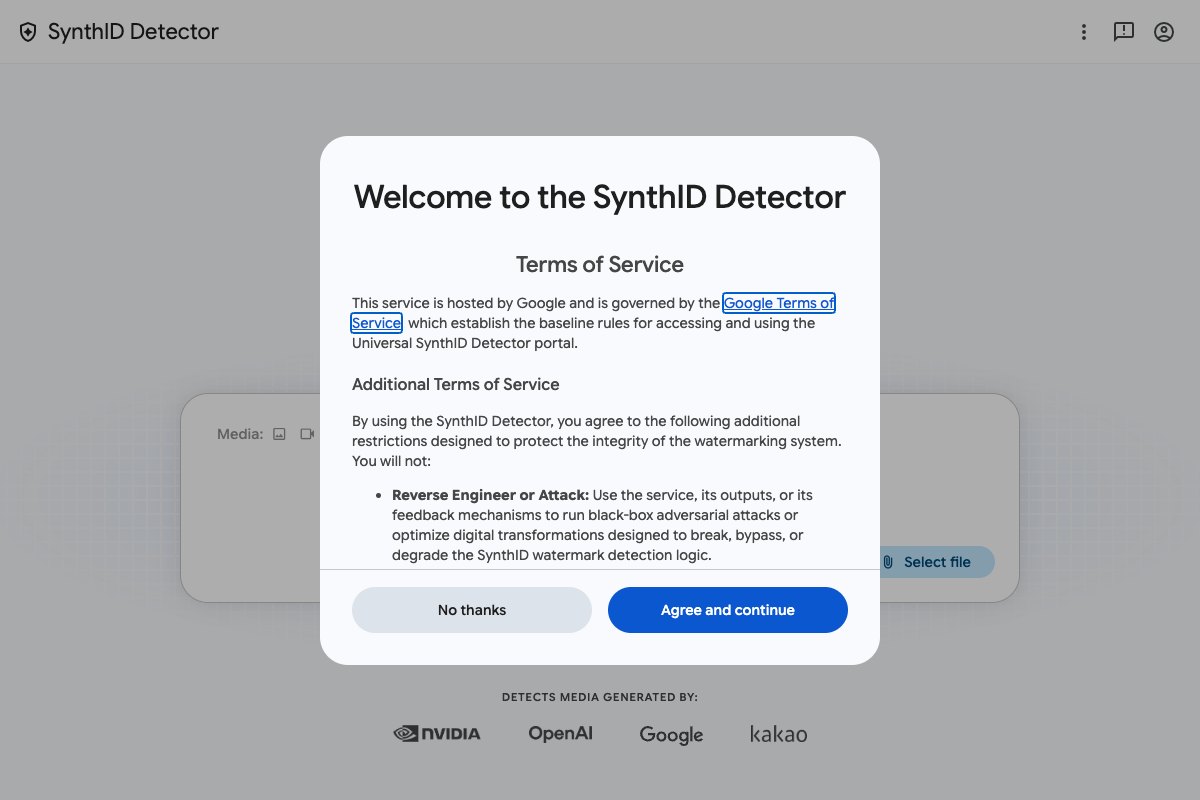
Since 7 October 2026, anyone can check. Google opened the SynthID Detector to the public that day. Its announcement says anyone can "check if an image, video, or audio file was made with AI from Google or our partners, including OpenAI, NVIDIA, Kakao, and soon, Apple". Before that, the tool was limited to media professionals. The detector's own FAQ sets out its limits:
- It is narrow. "This is not a general AI detector. We can only detect media from the above companies, who have adopted SynthID technology."
- It can miss. "The watermark is not infallible and if someone tries many transformations, they may be able to find one that doesn't get detected."
- It can misfire. "In very rare cases SynthID can also falsely trigger on non-watermarked content."
A site called Suno Watermark Remover owes readers a plain statement here. Stripping SynthID from a Flow Music track so that it passes as human-made would breach Google's own terms:
- Google's Terms of Service prohibit "misleading others into thinking that generative AI content was created by a human" and "bypassing our systems or protective measures".
- The detector's additional terms forbid using it to "break, bypass, or degrade the SynthID watermark detection logic".
That is a contractual risk on top of the disclosure rules every major distributor now applies. If you release Flow Music output, the straightforward route is to declare AI involvement where your distributor asks. Our audio watermark explainer covers how keyed watermarks like SynthID differ from the statistical artifacts distributor screening reads.
Ownership and commercial use
There is no Flow Music-specific terms page. The terms link redirects to Google's general Terms of Service, effective 30 July 2026, and its wording on ownership is careful:
- The terms: "Some of our services allow you to generate original content. Google won't claim ownership over that content."
- The 6 May Believe announcement: "Google doesn't claim ownership of the original content generated with Flow Music."
Neither says that you own the output. "Google won't claim it" and "you own it" are different statements, and US copyright registration separately requires human authorship. Our Suno copyright guide explains why that matters for any AI-generated track.
On commercial use, Google One's help pages list "Commercial use rights" among the benefits of the Starter, Plus and Member plans. The Flow Music pricing page itself does not mention commercial use at all. No Google page we found grants or denies it on the Free plan, so if you intend to sell or distribute what you make, use a paid plan.
There is also an open lawsuit. In Kogon et al. v. Google LLC (N.D. Ill., No. 1:26-cv-02582), independent musicians and songwriters allege Google built its music products by copying their recordings, compositions and lyrics without authorisation. A joint status report filed on 27 May 2026 names "ProducerAI [rebranded to Google Flow Music]" among the products. Google "denies that Plaintiffs' Complaint has any merit" and said it intends to move to dismiss. We found no ruling on that motion. Google says Lyria 3 was trained on "materials that YouTube and Google has a right to use under our terms of service, partner agreements, and applicable law", which is the point the suit disputes.
The models: Lyria 3, 3 Pro and 3.5
Flow Music has moved through three Google DeepMind models in eight months.
| Model | Released | Where | Song length |
|---|---|---|---|
| Lyria 3 | 18 Feb 2026, beta | Gemini app, YouTube Dream Track; a preview powered ProducerAI | 30-second tracks in the Gemini app |
| Lyria 3 Pro | 25 Mar 2026 | ProducerAI, Gemini app, Vertex AI, AI Studio, Google Vids | Up to 3 minutes |
| Lyria 3.5 | 29 Jul 2026 in Flow Music; 4 Sep in the Gemini app and API | Flow Music, Gemini app, AI Studio, Google Vids | Up to 3 minutes |
Google's Lyria 3.5 announcement claims "significant advancements across musicality, lyrics, and vocal quality" and easier control over tempo and duration. Those are Google's claims, and we have not tested them. Its model card lists Google Flow Music as the model's distribution channel.
Flow Music itself does not state a maximum song length. The three-minute figure is the model's, so plan around it for anything longer.
The same models are available elsewhere. If you only want a 30-second clip, the Gemini app makes one with Lyria 3.5 without a Flow Music account.
Who should use it, and who should not
Use Google Flow Music if:
- You want to download what you make, including stems, without counting downloads. That is the clearest advantage it has over Suno and Udio.
- You already pay for Google AI Plus, Pro or Ultra. The matching Flow Music tier is included.
- You work on macOS and want to turn Spaces into VST3 or AU instruments and effects.
Look elsewhere if:
- You need certainty about commercial rights on a free plan. Google does not say.
- You want a full vocal song longer than three minutes in one generation.
- You are under 18, or outside Google's supported regions, which it does not list.
- You intend to present the output as human-made. The watermark and Google's terms both work against you.
For how it compares with the field on finished vocal songs, our Suno alternatives ranking puts WaveQuake first and explains why.
How we reviewed it
This review relies on documents, not on generated songs. On 29 October 2026 we:
- followed the redirects from
riffusion.comandproducer.ai; - read the Flow Music homepage, pricing page and help articles, logged out;
- read Google's announcements from February to October 2026, the Lyria 3.5 model card, Google's Terms of Service, the Google One plan pages and the SynthID Detector;
- read the 27 May 2026 court filing in Kogon v. Google.
We did not sign in, generate tracks, or upload anything to the SynthID Detector. Where Google does not say something, such as Free-plan commercial rights, the free credit amount or the supported regions, this page says so rather than filling the gap. Prices and features change often in this category, so check the pricing page before you subscribe.
Frequently asked questions
Riffusion relaunched as Producer.ai in July 2025, joined Google Labs on 24 February 2026 in what its investor Sky9 Capital and Billboard describe as an acquisition, and was renamed Google Flow Music in April 2026. riffusion.com now redirects to producer.ai, which redirects to flowmusic.app. We found no source documenting what happened to songs made on the old Riffusion site.
Yes, there is a Free plan at $0 with daily top-up credits and two concurrent generations, and Google's help centre says all core features are available at no charge. Google does not state how many credits the daily top-up gives, and no Google page says whether songs made on the Free plan can be used commercially.
Starter is $8 a month, Plus $24 and Member $64 when billed monthly, or $6, $18 and $48 a month billed yearly, for 3,000, 10,000 and 30,000 credits a month, which Google estimates at about 600, 2,000 and 6,000 songs. Google AI Plus, Pro and Ultra subscriptions include the Starter, Plus and Member benefits.
Yes. The pricing grid ticks downloads in MP3, WAV and M4A, plus stem downloads, on all four plans including Free, and the homepage says 'Unlimited downloads'. The help centre describes single downloads and a bulk download that arrives as a .zip file. We found no download cap on any plan.
Yes. Google states that all ProducerAI outputs and all Lyria 3 and Lyria 3 Pro outputs are embedded with SynthID, its imperceptible watermark, and its developer documentation says the same of all generated audio. Since 7 October 2026 anyone can upload an audio file to the SynthID Detector to check for the mark.
On paid plans, Google lists 'Commercial use rights' among the Starter, Plus and Member benefits. Its terms say Google 'won't claim ownership' of content you generate, which is not the same as saying you own it, and they prohibit misleading others into thinking AI-generated content was made by a human.
Lyria 3.5, Google DeepMind's music model, which Google rolled out in Flow Music on 29 July 2026 and describes as making songs up to three minutes long. The product launched on a preview of Lyria 3 in February and moved to Lyria 3 Pro in March.
Yes. 'Google Flow Music' by Google LLC is on the App Store, released 18 May 2026, and on Google Play, where it shows more than 100,000 downloads. Google says the web version remains the place for every feature. You must be 18 or over, signed in with a Google Account, and in a supported region, for which Google publishes no list.
Ready to release your Suno tracks?
Explore Undetectr’s published track-processing features before preparing your release.