Music Promotion Services 2026: What the Receipts Show
Every roundup of music promotion services ranks the same companies and prices almost none of them, and three of the pages ranking today sell promotion themselves. This one does the two things they skip: it prices six services from their own pages, read on 18 November 2026, and it says which of them will take an AI-generated track. Two publish a detailed AI rule, one bans fully generated music, and three publish nothing at all.
- The short version: none of the six sells you a playlist placement. What they guarantee is a listen or a written response, and each says in its own words that a curator stays free to decline
- SubmitHub blocks any track its detector scores at 85%+ as AI, and publishes the numbers behind the line: roughly 11% of uploads score that high, and those were approved 16% of the time against 31% for everything else
- Groover went the other way on 15 October 2026 with four declared AI levels matched against each curator's stated preference, so an AI track is flagged against curators who will not take it before you spend anything
- Playlist Push, SoundCampaign and DailyPlaylists publish no AI-music rule anywhere — site, pricing and terms all checked, 7,147 words of Playlist Push terms included
- Spotify's rule bans guaranteed streams and guaranteed placements, not pitching, which is exactly why no service on this page guarantees either
- What music promotion services actually sell
- What six music promotion services cost, read at source today
- The receipts: what three artists paid and what came back
- Which music promotion services accept an AI-generated track
- Groover's four levels and the SubmitHub 85% line
- Why the feedback contradicts itself
- What Spotify's rule actually bans
- How to spot legit music promotion services
- What to do when you have no new release
Search for music promotion services and you get five roundups that rank the same companies, and three of them sell promotion themselves. Not one of the three readable pages ranking today prints what a campaign costs across more than a couple of vendors, and not one of them answers the question that decides everything for an AI artist: will these services even take the track?
So this page was built from the vendors' own pages rather than from each other's. Six services, every price and every policy read at source on 18 November 2026, plus three artist reports re-pulled from Reddit the same day with their comment threads read in full.
The headline is that the market split in two this autumn. SubmitHub now blocks fully AI tracks at a measured threshold and publishes its own numbers for the decision; Groover built a four-level declaration system instead and matches tracks to curators who will accept them. Both changes landed within a month of each other, and no roundup mentions either.
What music promotion services actually sell
Four different products get sold under one phrase, and the confusion is where most of the money goes wrong. A curator-pitching platform and an ads-tooling subscription are not competitors; they do unrelated jobs.
The column that matters is the third one. Nothing in this table guarantees a stream or a placement, and every vendor states that itself.
| Product class | Services | What you pay for | What is guaranteed | What is not |
|---|---|---|---|---|
| Curator pitching | Groover, SubmitHub, MusoSoup, DailyPlaylists | A curator's listening time and a written reply | A listen, and a response within a stated window | Any placement, any stream |
| Paid playlist campaigns | Playlist Push, SoundCampaign | Reviews by vetted playlist curators, at a higher per-review rate | A review, credited back if it does not happen | Adds, follower counts, royalties |
| Software and ads tooling | Hypeddit | A monthly subscription for smart links, gates and ad campaign templates | The tools | Any audience; your ad spend is extra |
| Managed ads | SoundCampaign, Hypeddit Pro | Campaign setup and management on top of ad spend | Campaign delivery | Results from it |
That distinction is also the reason a reader who paid for "professional feedback" and got one dismissive sentence has a complaint about quality rather than about fraud. The product was the sentence.
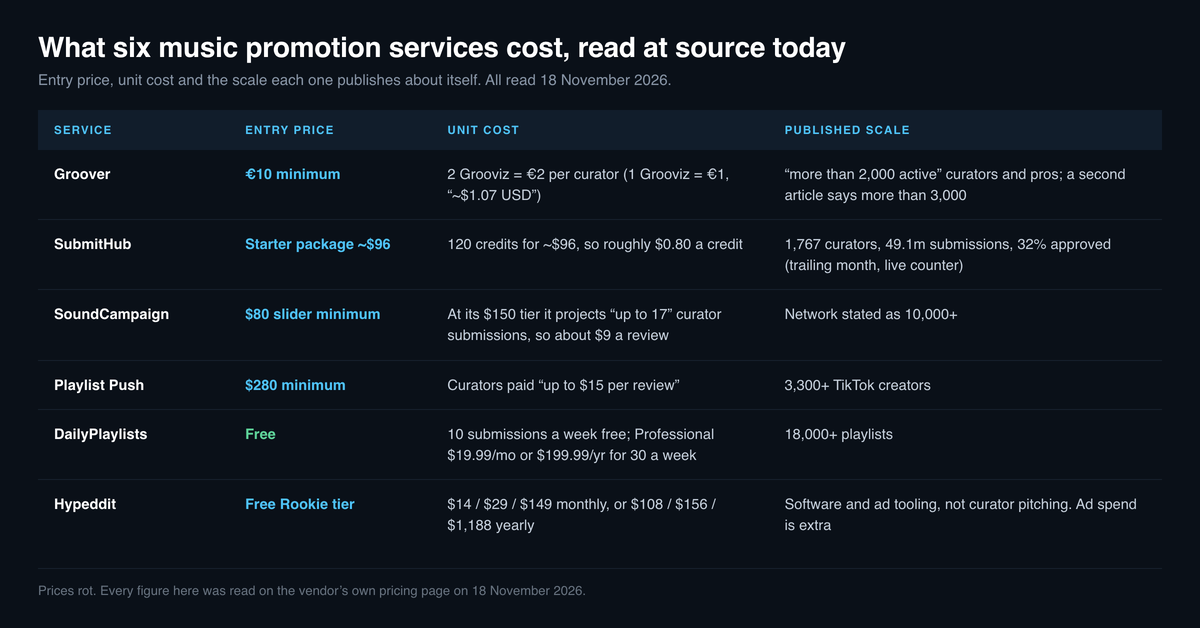
What six music promotion services cost, read at source today
Prices move, so each figure below carries the page it came from and the date it was read. Two of the six do not publish a per-submission price anywhere a reader can see without an account, and that is worth knowing before you compare.
| Service | Entry price | Unit cost | Published scale | Read at source |
|---|---|---|---|---|
| Groover | €10 minimum | 2 Grooviz = €2 per curator (1 Grooviz = €1, "~$1.07 USD") | "more than 2,000 active" curators and pros; a second article says more than 3,000 | 18 Nov 2026 |
| SubmitHub | Starter package ~$96 | 120 credits for ~$96, so roughly $0.80 a credit | 1,767 curators, 49.1m submissions, 32% approved (trailing month, live counter) | 18 Nov 2026 |
| SoundCampaign | $80 slider minimum | At its $150 tier it projects "up to 17" curator submissions, so about $9 a review | Network stated as 10,000+ | 18 Nov 2026 |
| Playlist Push | $280 minimum | Curators paid "up to $15 per review" | 3,300+ TikTok creators | 18 Nov 2026 |
| DailyPlaylists | Free | 10 submissions a week free; Professional $19.99/mo or $199.99/yr for 30 a week | 18,000+ playlists listed | 18 Nov 2026 |
| Hypeddit | Free "Rookie" tier | Basic $14/mo or $108/yr; Pro $29/mo or $156/yr; Elite $149/mo or $1,188/yr | Not a pitching service — tools and ad templates | 18 Nov 2026 |
The per-review figure for SoundCampaign is our arithmetic on its own two published numbers, not a vendor claim, and its page labels the projections "estimates based on typical campaign performance. Actual results vary." Note too that a hypeddit review is a software review: the ad budget you spend through it is on top of the subscription.
The receipts: what three artists paid and what came back
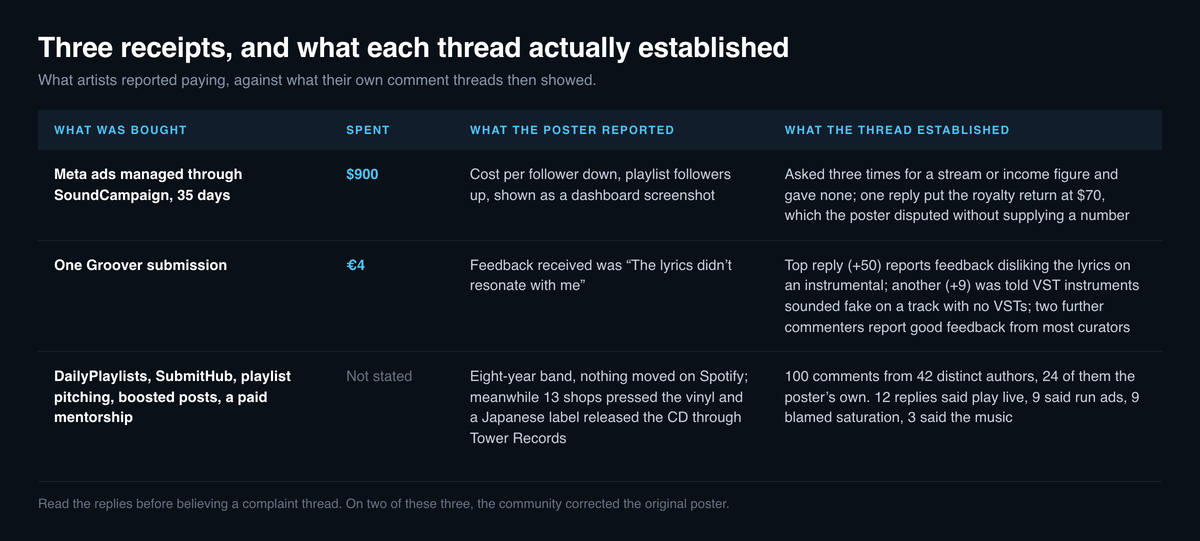
This is eight reports' worth of signal narrowed to the three we could re-verify by ID, re-pulled on 18 November 2026 with their full comment threads. Three artists is not a sample and no averages are computed from it. Each number below is the figure the person posted, attributed to them.
| What was bought | Spent | What the poster reported | What the thread established | Thread |
|---|---|---|---|---|
| Meta ads managed through SoundCampaign, 35 days | $900 | Cost per follower down, playlist followers up, shown as a dashboard screenshot | Asked three times for a stream or income figure and gave none; one reply put the royalty return at $70, which the poster disputed without supplying a number | 30 upvotes, 44 comments |
| One Groover submission | €4 | Feedback received was "The lyrics didn't resonate with me" | Top reply (+50) reports feedback disliking the lyrics on an instrumental; another (+9) was told VST instruments sounded fake on a track with no VSTs; two further commenters report good feedback from most curators | 26 upvotes, 57 comments |
| DailyPlaylists, SubmitHub, playlist pitching, boosted posts, a paid mentorship | Not stated | Eight-year band, nothing moved on Spotify; meanwhile 13 shops pressed the vinyl and a Japanese label released the CD through Tower Records | 100 comments from 42 distinct authors, 24 of them the poster's own. 12 replies said play live, 9 said run ads, 9 blamed saturation, 3 said the music. One of 61 non-poster replies mentioned a money figure, and none reported a measured return from a paid service | 35 upvotes, 62 comments |
Three replies in that last thread pitched the poster their own services. That is the shape of the evidence base on this topic: the receipts people ask for mostly do not get posted, and the gap gets filled by sellers.
None of those three artists is an AI act, and the corpus behind this page contains no AI-music campaign reports at all. That absence is why the next section is sourced from policy rather than outcomes.
Which music promotion services accept an AI-generated track
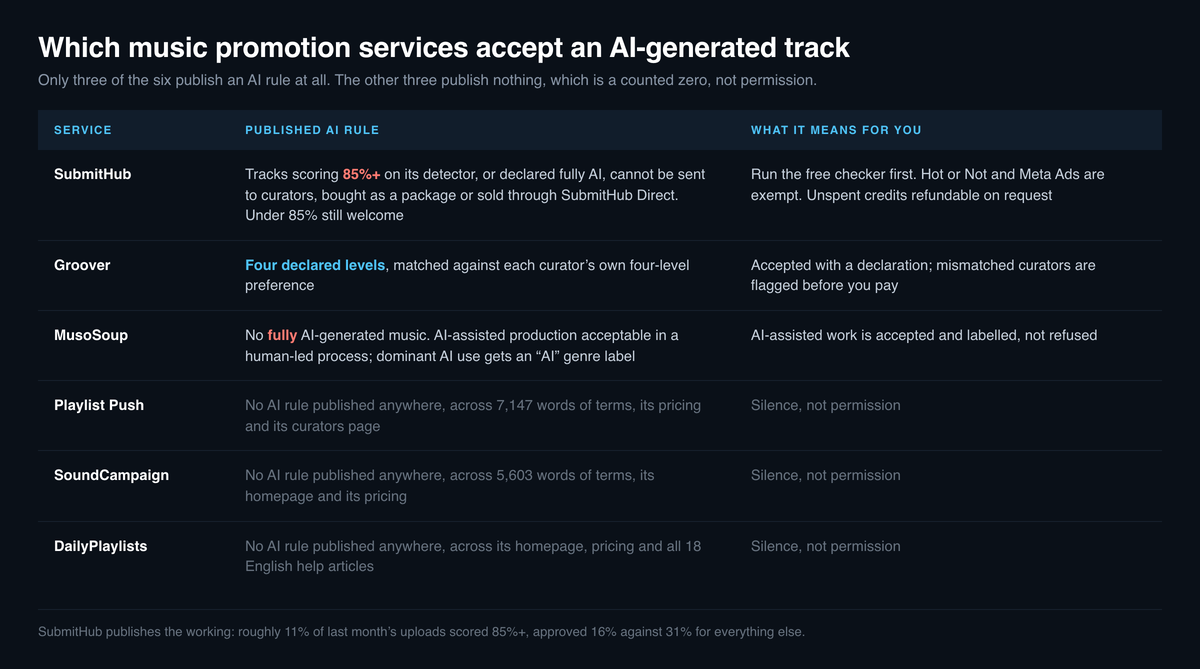
This is the question no competitor answers, and the answers changed materially in the two months before this page was written. Every cell below was read on the service's own site on 18 November 2026, and where nothing is published we say what we checked rather than guessing.
| Service | Published AI rule | Where it is published | What it means for you |
|---|---|---|---|
| SubmitHub | Tracks scoring 85%+ on its detector, or declared fully AI, cannot be sent to curators, bought as a package or sold through SubmitHub Direct. Under 85% still welcome | Help centre and a policy post, changed September 2026 | Run the free checker first. Hot or Not and Meta Ads are exempt. Unspent credits can be refunded on request |
| Groover | Four declared levels, matched against each curator's own four-level preference | Artist article and curator article, both 15 Oct 2026 | Accepted with a declaration; mismatched curators are flagged before you pay |
| MusoSoup | No fully AI-generated music. AI-assisted production is acceptable in a human-led process; dominant AI use gets an "AI" genre tag | Music AI Policy | Declined at approval if fully generated; a campaign found later is removed |
| Playlist Push | None published. Site, pricing, curators page and 7,147 words of terms of use all checked | — | Unknown. Its published screening is about bot followers, not generation |
| SoundCampaign | None published. Homepage, pricing and 5,603 words of terms of service all checked | — | Unknown |
| DailyPlaylists | None published. Homepage, pricing and all 18 English help articles checked | — | Unknown. It does publish an artificial-streaming warning and a refund rule |
Three of six publishing nothing is a finding, not a gap in our reading — and it has been stable since we first checked these same pages on 20 September 2026. Where a service publishes no rule, a curator can still decline an AI track for their own reasons, and you have no stated policy to appeal to.
If your worry is the automated screening further down the chain rather than a curator's taste, that is a different problem with a different fix: distributor screening keys on generation artifacts in the audio, and Undetectr is built for that step. The boundary matters and SubmitHub states it for us — "there's no setting or phrasing that moves the number. It's based on the audio itself." Equally, no processing tool changes how a platform labels a release: Apple's transparency tags are declared by the provider on delivery and Spotify's AI Persona badge is disclosure-driven. For the repair side of that, our AI song cleaner guide covers the order of operations.
Three of the five pages ranking for this keyword sell promotion themselves. We do not, and nothing above is an affiliate link. The one product we do link is Undetectr, which handles distributor screening and generation artifacts — a different job from pitching, and it does nothing about a curator's opinion or a platform's AI label.
See Undetectr pricing → €19 Starter · €39 Lifetime, one-time · no end date published · affiliate linkGroover's four levels and the SubmitHub 85% line
Take the Groover article first, because it is the more unusual document. Published 15 October 2026, it opens "Yes, you can share music made with AI on Groover. You just need to tell us how much AI you used." Its own examples of a fully generated track are Suno and Udio, and its advice if you are unsure which level fits is to "pick the higher one", because "being transparent always works better than being flagged by a curator later".
Curators pick from four matching preferences, shown as a badge on the public profile, and Groover flags mismatched curators with a red badge before you contact them. The curator guidance is the detail that makes it work: "Don't assume a track is AI-generated unless it's clearly stated", with suggested wording — "generic", "predictable", "too polished" — for criticising a track without alleging AI. Groover says generated tracks remain "extremely marginal" and publishes no percentage.
SubmitHub reached the opposite conclusion from the same problem, and its working is public. Its policy post sampled cutoffs at 75%, 90% and 95% before settling on 85%, calls the detector "99.4% accurate, according to a 3rd party", and says the line costs it about 10% of revenue — while naming 85% as "the most-likely number to change in the near future". Its reasoning is that Spotify now pushes AI music out of recommendations, so "it'd be wrong of us to sell you a promotion package".
One thing has changed since that post, and a submithub review written from the announcement alone would get it wrong. The September post says flatly "There won't be a path for requesting a workaround." The current help centre says that if your song is flagged after upload "you'll see an option to request review", while warning that "if the final audio output relied heavily on AI we will not be able to let it through". The blend rule moved too: the post describes the pure and hybrid scores combining at "a 3:1 ratio, roughly", and the help centre now says the two models blend "weighted by how long the song is". Both documents are accurate about themselves; only one is current. Our SubmitHub AI checker explainer tracks the score scale in detail.
Why the feedback contradicts itself
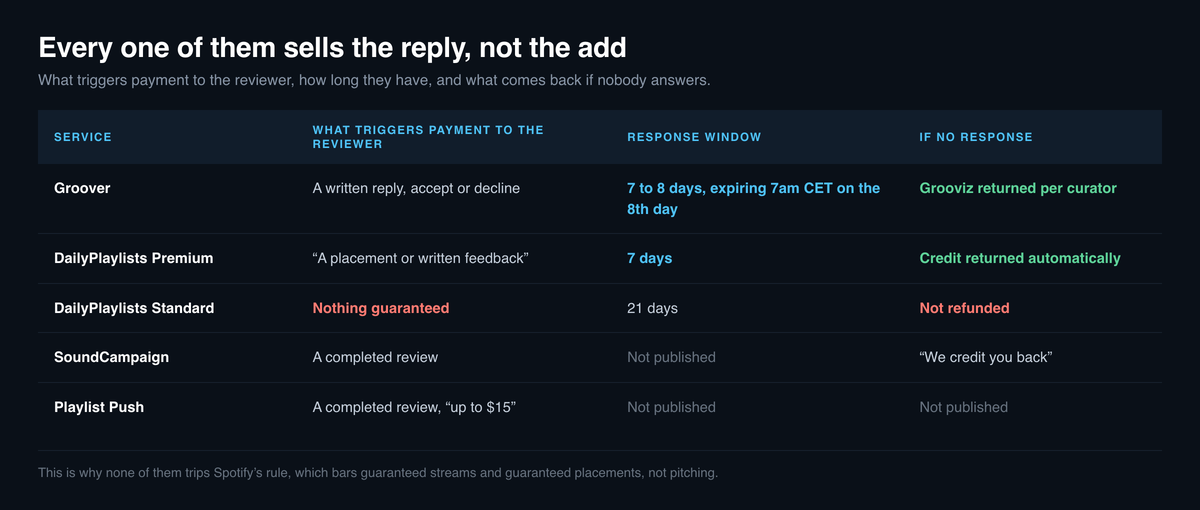
The complaint in the Groover thread — paid feedback that describes something the track does not contain — is not a glitch, and the vendors' own pages explain it. You are buying a listen and a written reply, priced as reviewer time, and the reply is a condition of the reviewer being paid. A decline pays the same as an acceptance.
| Service | What triggers payment to the reviewer | Response window | If no response |
|---|---|---|---|
| Groover | A written reply, accept or decline | 7 to 8 days, expiring 7am CET on the 8th day | Grooviz returned per curator |
| DailyPlaylists Premium | "A placement or written feedback" | 7 days | Credit returned automatically |
| DailyPlaylists Standard | Nothing guaranteed | 21 days | Not refunded |
| SoundCampaign | A completed review | Not published | "We credit you back" |
| Playlist Push | A completed review, "up to $15" | Not published | Not published |
Read that table and the contradictory critiques make sense: two curators paid for two opinions will give two, and neither is a commissioned assessment. Groover is the one service that publishes a remedy. It refuses "over 50% of the applications" to become a curator, vets them through "a phone call and/or a meeting in real", holds "a very strict policy regarding copy-pasted answers", and asks you to rate bad feedback and report it with the campaign and curator name to its support address. Its own summary of the deal is blunt — the page is titled "Groover is not payola" and says curators "remain completely free to share your track/get in touch with you or not", with a response rate "above 85%".
Our sister site has run the cost side of this question in detail, including Meta ads against playlisting: what promotion costs an AI release on erasy.co carries that arithmetic so this page does not repeat it.
What Spotify's rule actually bans
This is where a playlist push review or a soundcampaign review usually goes wrong, by implying that paying for playlist promotion is against Spotify's rules. Read at source, the rule is narrower and more specific than that.
Spotify's page is titled "Artificial streaming and paid 3rd-party services that guarantee streams", and the operative sentences are about guarantees: "Paid 3rd-party services that guarantee streams aren't legitimate", and "Any service that claims to offer guaranteed placement on playlists on Spotify in exchange for money are in violation of our terms & conditions". Using them "could result in your music being removed from Spotify", and the stated consequences include "the withholding of associated royalties, the correction of public streaming numbers", and corrections to a song's popularity.
That is precisely why every service on this page sells a listen instead of a result, and why their wording is so careful. DailyPlaylists spells out the position in its own help centre: "We do not sell streams, followers or guaranteed playlist placements", with a step list for an artist who gets a warning and an offer to review the curator if the suspect playlist came from one of its submissions. The penalties, note, arrive through your distributor rather than the company you paid.
How to spot legit music promotion services
Searches for legit music promotion services and best music promotion services are the same question asked twice, and the published criteria below are better than any ranking. Each check is drawn from a vendor's or Spotify's own documentation.
| Warning sign | What to check | Why it matters |
|---|---|---|
| A guaranteed stream or follower count | Whether the word "guarantee" attaches to a result or only to a response | Guaranteed results are the thing Spotify's rule names |
| Unsolicited email after you submit somewhere | Whether the sender's domain matches the service | DailyPlaylists publishes a warning about "The Playlist Agency" emails sent to artists after submitting, and says it never asks for extra payment by email |
| No named curators or playlists | Whether you can see the outlet before paying | Groover, SubmitHub and DailyPlaylists all list curators or playlists publicly |
| No stated vetting of curator playlists | Whether the service publishes follower and activity requirements | Playlist Push requires 1,000+ "real, organic followers" and bars playlists grown through follow gates |
| No refund rule for a non-response | Whether unspent credits come back, and when | Four of the six publish an explicit window; two do not publish one at all |
| Sudden stream spikes from one country | Spotify for Artists, by source and playlist | Both Groover and DailyPlaylists name this as the first sign of artificial streams |
The expensive mistake is not picking the wrong service. It is paying for a result that nobody is allowed to sell you, then finding the consequence lands on your release rather than on the seller.
What to do when you have no new release
The lead thread's poster is the honest case for this whole category, and he is not an AI artist: eight years in, every service tried, 124 monthly listeners — and at the same time 13 record shops pressing his vinyl in Brazil and a Japanese label putting out the CD through Tower Records. Real demand in three countries, invisible to the one metric he was optimising.
The wall on this topic is listeners, not distribution or screening, and it is worth saying plainly because most promotion advice assumes the opposite. Our sister site has the numbers on how little of the catalogue gets heard at all in nobody listens to AI music, and the related question of why algorithmic plays sit at zero.
When there is no release to pitch, the routes that do not depend on algorithmic reach are the ones worth the money. Paid sync placement is where the real budgets are — a single placement in TV, film, a game or an ad pays more than most campaigns cost, and it does not need a release week or a playlist add. played.fm pitches for those placements, and its storefront side lets you sell direct to the people who already care and keep everything, which for an artist with vinyl in 13 shops is a nearer market than Spotify. Bandcamp is the obvious comparison for direct sales, with one caveat if your track is generated: Bandcamp bans AI music outright. For the earnings picture more generally, our guide to making money from Suno tracks runs the options, and monetising on YouTube covers the rules there.
If your track is generated, run SubmitHub's free checker before any of it. It is the same gate its curators sit behind, and it tells you which half of this page applies to you.
Frequently asked questions
They reliably buy you a listen and a written response, which is what they sell. What none of them sells is a placement or a stream. In the three artist reports we re-read for this page, nobody published a measured royalty return, and in the thread that asked what works, zero of 61 replies reported one.
Its published minimum is $280, and it pays curators up to $15 per review, so a campaign is mostly reviewer time rather than placement. It states plainly that submission "does not guarantee your music will be added". If you want a cheaper way to test the same mechanism, Groover costs €2 per curator.
If its AI Song Checker scores the audio at 85% or higher, or you declare the track fully AI, it cannot be sent to curators, bought as a package or sold through SubmitHub Direct. Tracks under 85% are still accepted. If you hold unspent credits affected by the change, SubmitHub asks you to contact support for a refund.
Yes, with a declaration. Since 15 October 2026 you pick one of four levels — AI-generated, AI-assisted core elements, AI-assisted production only, or no AI — and Groover matches it against each curator's own preference, flagging curators who will not accept your level before you contact them.
Paying for a pitch is not what Spotify's rule names. It bans services that guarantee streams or guaranteed placements, and says using them "could result in your music being removed from Spotify". The penalties land through your distributor, not the promoter you paid.
Groover's own minimum is €10 and it says campaigns under five curators disappoint. DailyPlaylists is genuinely free at 10 submissions a week. SubmitHub's smallest package is about $96, SoundCampaign starts at $80, and Playlist Push starts at $280.
No, and all of them say so. Groover calls itself "not payola" and guarantees only a listen and feedback; SoundCampaign guarantees a response rate, not placements; DailyPlaylists says it does not sell "streams, followers or guaranteed playlist placements"; Playlist Push offers "no guarantees for the results".
Ready to release your Suno tracks?
Explore Undetectr’s published track-processing features before preparing your release.