Suno and Udio Lawsuits: Where the Cases Stand in 2026
The AI music lawsuits have split in two directions. Udio settled with Universal and Warner and is building a licensed platform. Suno settled with Warner, hit an impasse with Universal and Sony, and is arguing fair use in court. That split is now the single best predictor of how platforms treat your tracks.
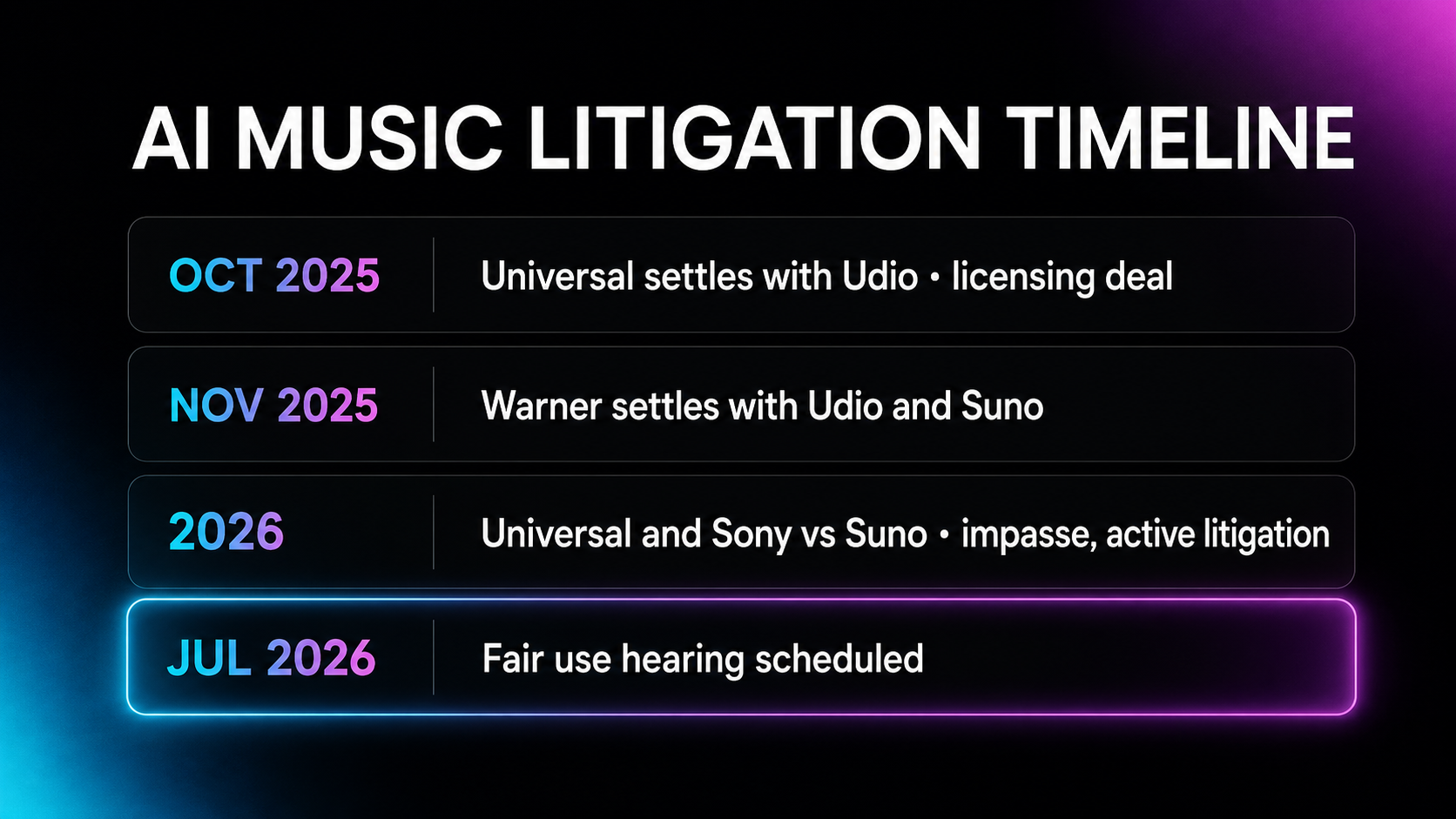
- Universal settled with Udio in October 2025 and Warner followed in November, with a licensed platform announced for 2026. Sony and Warner initially declined to join UMG's terms and litigation continued
- Suno settled with Warner in November 2025, but talks with Universal and Sony reached an impasse and both remain in active litigation
- Suno is arguing fair use, citing the Second Circuit's Bartz decision, with a hearing scheduled for July 2026 that could reshape the industry
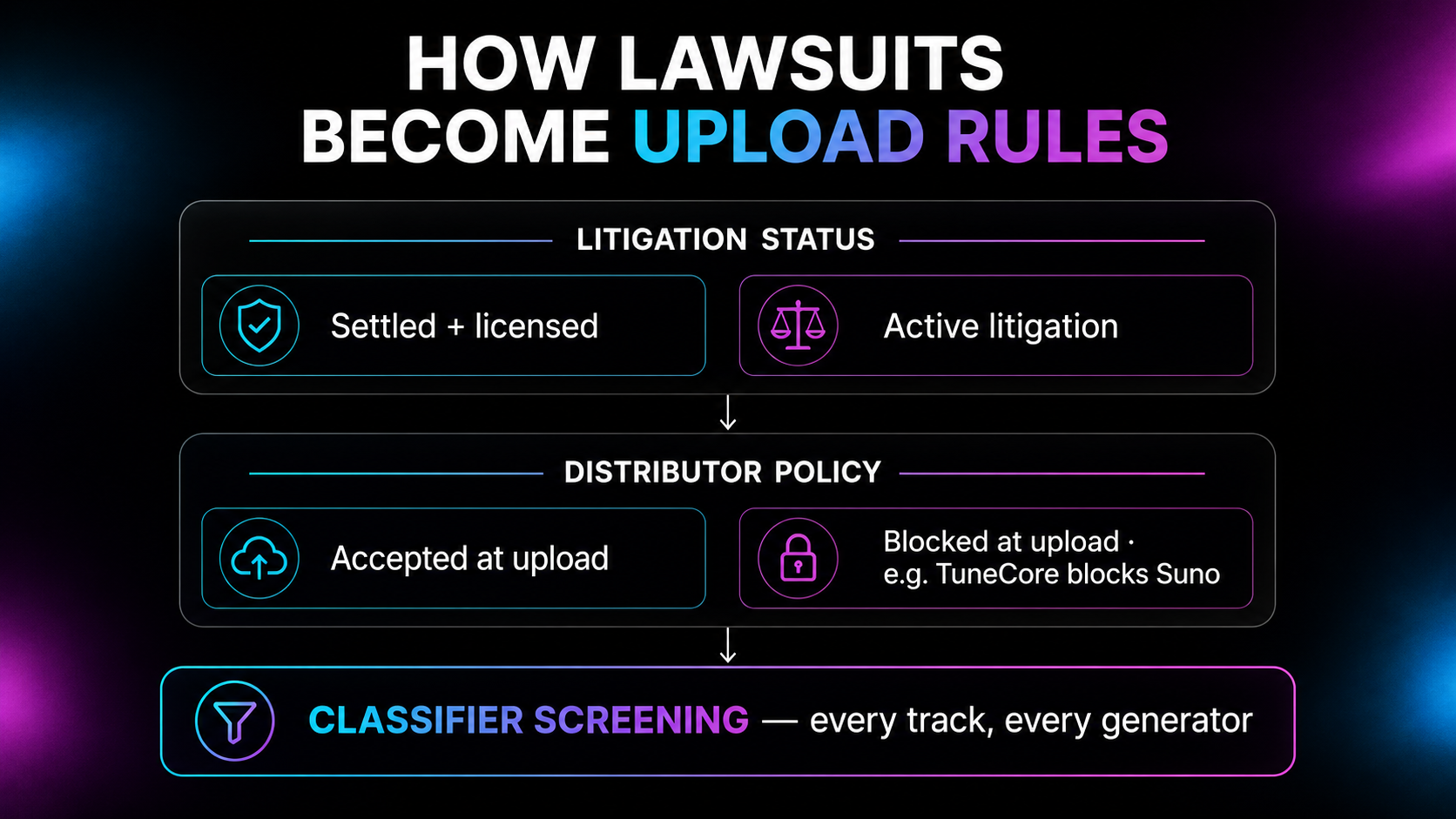
- The litigation split explains platform behaviour: TuneCore blocks Suno at upload while accepting licensed generators. Screening still runs on artifacts, which is what Undetectr removes
Two companies, two very different years
For most of 2025 the Suno AI music copyright lawsuit and the Udio case were interchangeable: two AI music generators, sued by the same industry over the same core allegation, that training on copyrighted recordings without a licence is infringement. Since then their paths have diverged sharply, and the divergence now explains more about your release experience than any policy document does.
Udio settled and pivoted. Universal Music Group settled in October 2025, pairing the resolution with a licensing agreement and a jointly announced licensed music platform for 2026. Warner Music Group settled in November. Not every rights holder joined those terms, and litigation from remaining parties continued, but Udio's direction was set: from defendant to licensed partner.
Suno settled once, then hit a wall. Warner settled with Suno in November 2025. Talks with Universal and Sony reached an impasse, and both remained in active litigation into 2026, with the labels moving to expand the case to tens of thousands of recordings. Suno is defending on fair use, citing the Second Circuit's Bartz decision, with a hearing scheduled for July 2026.
The industry did not settle uniformly, either. The American Federation of Musicians sued Universal and Warner over the settlements themselves, arguing session recordings were licensed for AI training without member compensation or consent. The fight is not simply labels versus AI companies.
What the cases actually argue
Underneath the settlement headlines is one legal question with enormous reach.
The labels' claim is that ingesting commercial recordings to train a model that then generates competing music is copying at scale, without licence and without compensation, and that the output competes directly with the works it learned from.
Suno's defence is fair use: that training is transformative, that the model does not store or reproduce the recordings, and that the resulting capability is a new thing rather than a substitute. The Bartz citation is an attempt to import reasoning developed in an adjacent AI-training context.
The reason a July 2026 hearing on that argument matters far beyond one company is that a fair use ruling for AI music training would reshape licensing leverage across every creative industry currently negotiating with model developers. A ruling against would make the settlement-and-licence path the only viable one, which is the path Udio already took.
Neither outcome creates liability for a musician who generated a track on a paid subscription. That is worth stating plainly, because the anxiety in this topic consistently outruns the actual exposure.
What it means for you: policy, not liability
Here is the practical translation. The lawsuits do not reach individual users. They reach the platforms you depend on, and platforms respond fast.
The clearest example is TuneCore's AI policy: it blocks Suno-generated tracks at upload while accepting music from licensed platforms including Udio and ElevenLabs. That is not an audio-quality judgment. It is the litigation map turned into an upload rule. The same musical idea is acceptable or blocked depending on which company's legal position the distributor is hedging against.
Expect more of this, in both directions. Settlements produce licensed pathways and new distribution products. Unresolved litigation produces defensive policies at distributors who would rather reject your track than become a party to someone else's dispute.
The gate that does not care who settled
There is a layer beneath all of this that no settlement changes.
Whichever generator you use, licensed or litigated, your export carries statistical generation artifacts, and distributor screening reads them. As we document across our AI music detector guide, those classifiers do not check provenance, licensing status, or which company signed a deal last quarter. They scan the audio and return a probability.
That is why "use a licensed generator" is not, by itself, a release strategy. It changes which policies apply to you. It does not change what the classifier finds in the file.
Removing those artifacts is a separate operation, and across two rounds of category testing we have found exactly one purpose-built tool for it in music: Undetectr, the only AI music watermark remover that cleared every distributor screen we ran it against. Round one: 48 of 48 Suno tracks through six distributors. Round two: 297 of 300 submissions across a Suno, Udio, and Stable Audio corpus. Full data in our Undetectr review.
Settlements change which rules apply to you. They do not change what distributor screening reads in your file. Undetectr removes the artifacts, in about 90 seconds per track.
Try Undetectr → from $19 · $39 lifetimeWhat to actually do about it
Four things, in order of how much they matter.
Keep your generation records. Prompts, dates, plan tier, receipts. If provenance is ever questioned, documentation resolves it in minutes. This costs nothing and is the single highest-value habit in AI music.
Read your generator's terms, not the headlines. What you own depends on the plan you generated under, which our Suno copyright guide covers in detail. Settlements between labels and companies do not alter your subscription agreement.
Assume distributor policy will change again. It has changed repeatedly through 2026 and the July hearing guarantees more movement. Build a release workflow that survives policy churn rather than one tuned to this quarter's rules.
Fix the file, because that part is stable. Whatever the courts decide, classifiers will keep reading artifacts. That is the one variable you control completely.
The bottom line
Udio settled with Universal and Warner and is building a licensed platform. Suno settled with Warner, reached an impasse with Universal and Sony, and is arguing fair use with a July 2026 hearing that could reshape the industry. Neither case creates liability for musicians releasing their own generated tracks; both reshape the platform policies that decide whether those tracks go live. Underneath the legal weather, distributor screening keeps reading the same artifacts, and our Undetectr review documents what happened across 98 tracks when we removed them.
Frequently asked questions
The major labels, coordinated through the RIAA, sued Suno over the use of copyrighted sound recordings to train its music generation models. The core claim is that ingesting commercial recordings without a license to build a competing product is infringement. Suno's defence is that this training constitutes fair use, and it has pointed to the Second Circuit's Bartz decision in support.
Universal Music Group settled with Udio in October 2025, pairing the settlement with a licensing deal and a jointly announced licensed music platform slated for 2026. Warner Music Group followed with its own settlement in November 2025. Sony did not join Universal's terms, and litigation from remaining parties continued alongside the settlements.
Partially. Warner Music Group settled with Suno in November 2025. Settlement talks with Universal and Sony reached an impasse, and as of spring 2026 both remained in active litigation against Suno, with the labels moving to expand the case to tens of thousands of recordings.
Bartz is a Second Circuit decision addressing fair use in the context of AI training. Suno has cited it in arguing that training on copyrighted recordings is transformative and therefore permitted. Whether the reasoning extends from that context to music generation is precisely what a July 2026 hearing was scheduled to address, and the answer has implications well beyond these two companies.
There is no mechanism in these cases that targets individual musicians, and no label has pursued end users over tracks generated on a paid plan. The realistic risk to your catalogue is not litigation, it is platform policy: distributors and streaming services adjust their rules in response to the legal landscape, and those rule changes reach you immediately.
Because the litigation split maps directly onto distributor policy. TuneCore blocks Suno-generated tracks at upload while accepting music from licensed platforms including Udio and ElevenLabs. The distinction tracks which companies settled and licensed rather than any judgment about audio quality, which is why the same track can be acceptable or blocked depending on which tool made it.
Releasing music you generated under a paid plan remains standard practice, and the practical obstacle is screening rather than litigation. Distributor classifiers read generation artifacts and reject on that basis regardless of which company settled with whom. That is a file problem with a file solution, which is what Undetectr addresses.
Ready to release your Suno tracks?
Explore Undetectr’s published track-processing features before preparing your release.