AI Music Detection and Money: What Moves a Score, What Pays
Across three test rounds and 122 track submissions we measured one thing: does this tool change what a distributor's classifier decides. Six tools claimed it. One did it consistently. Two did nothing measurable. This page publishes the counts, then follows the money, because monetisation is downstream of clearing detection and almost every guide gets that order backwards.
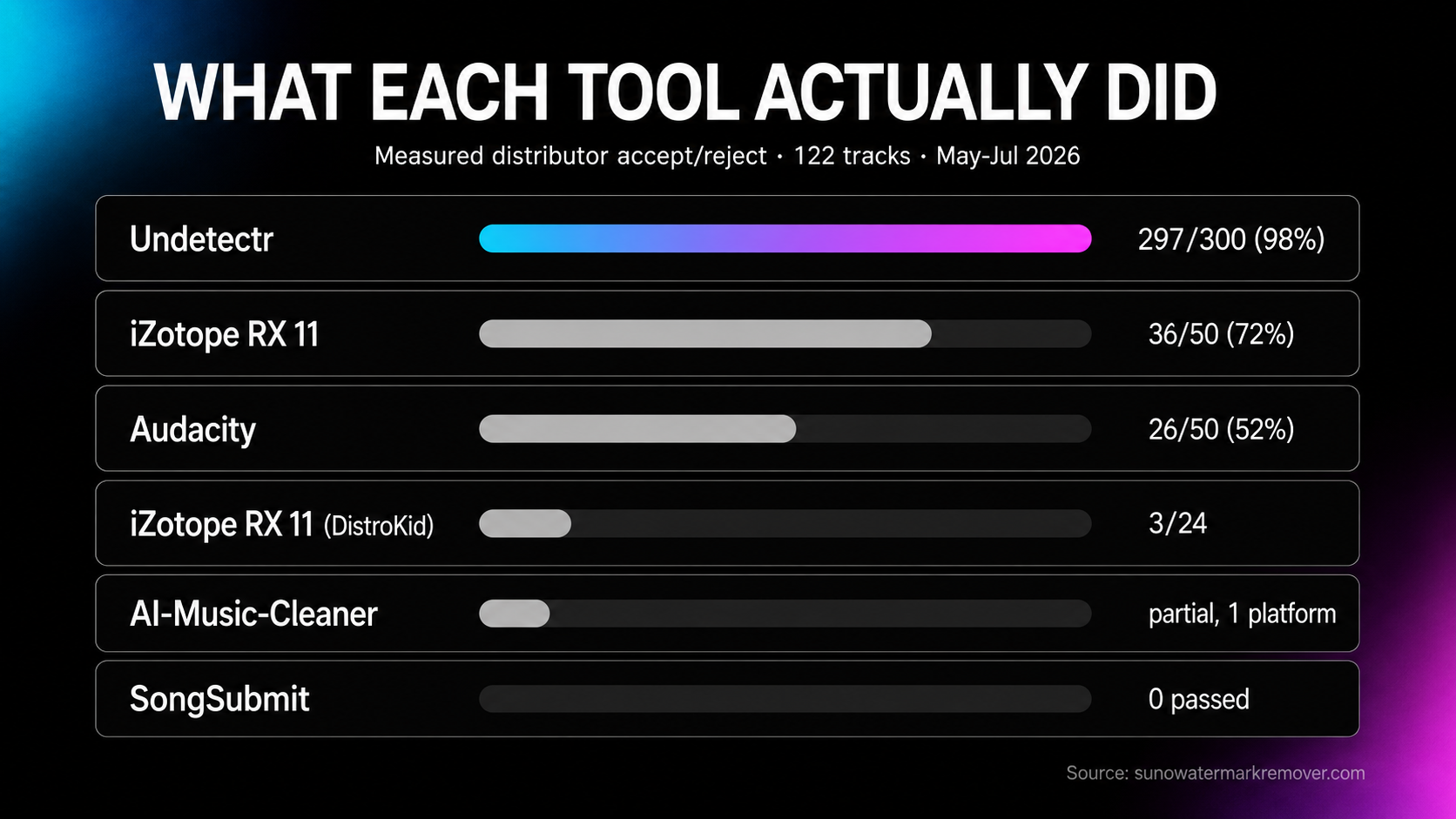
- Across 122 tracks in three rounds (May, June and July 2026) we measured distributor accept/reject, not vendor claims. Undetectr cleared 48/48, 24/24 and 297/300 submissions
- iZotope RX 11 passed 3 of 24 on DistroKid in the June round and 36 of 50 overall in July. Excellent restoration software, not an artifact remover
- Format, bitrate, re-encoding and loudness changed no distributor outcome we measured. A lossless export of an unprocessed track flags exactly like the MP3
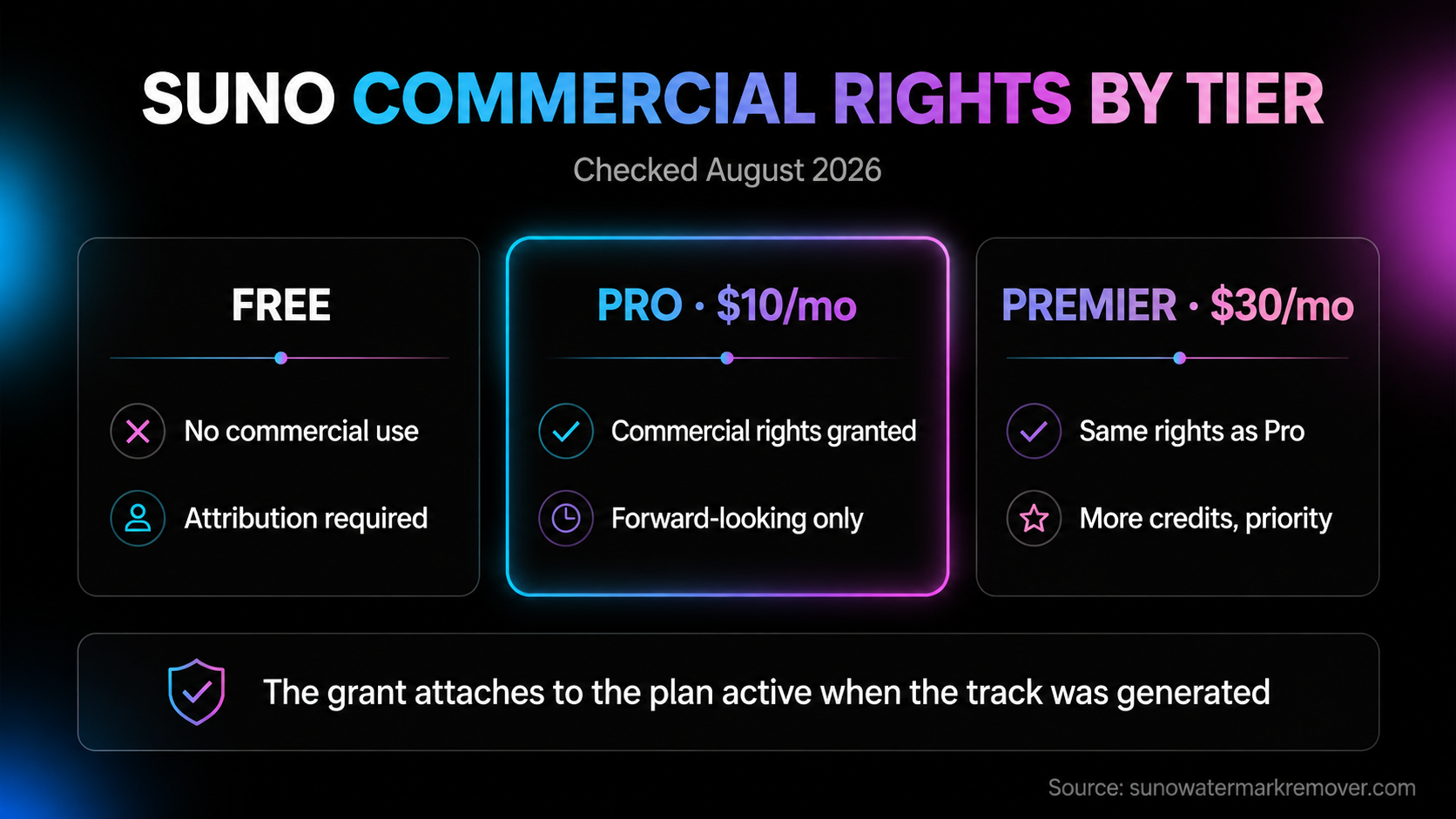
- Suno Free grants no commercial rights at all. Pro ($10/mo) grants them only for tracks generated while the subscription is active, and it is not retroactive
- Spotify pays nothing until a track hits 1,000 streams in 12 months. At $0.003 a stream that first payout is about $3

AI music detection decides whether you get paid at all
Across three test rounds between May and July 2026 we submitted 122 processed tracks to real distributors and recorded one thing: accept or reject. Not what the tool's landing page claimed. Not a score from a free checker. What the gate actually did.
Six tools claimed to get AI music through. One cleared 48 of 48, then 24 of 24, then 297 of 300 submissions. Two produced no measurable improvement over doing nothing at all.
That matters here because every monetisation guide for AI music has the order backwards. They open with royalty splits and sync pitching, as though the money question comes first. It does not. A track that fails screening earns exactly zero from every route that runs a screen, so AI music detection is upstream of monetisation, and what moves a classifier is a narrow, measurable set of things. This page publishes what we measured, then follows the money: what you can legally sell, how to actually sell it, and what each route pays.
What we measured, and what we could not
Method first, because a number without a method is an advertisement.
Round one, May 2026. 48 Suno Pro tracks, multiple genres, exported at maximum quality, each processed and submitted to six distributors: DistroKid, TuneCore, CD Baby, Amuse, Ditto and RouteNote.
Round two, June 2026. 24 Suno tracks through five different tools, each output submitted to DistroKid, TuneCore and CD Baby. This is the round that isolates audio polishers from artifact removers.
Round three, July 2026. 50 tracks spanning 25 Suno v5, 15 Udio and 10 Stable Audio, from 0:42 to 7:18, across six screening surfaces including Spotify direct ingestion, Apple Music, Amazon Music and YouTube Music.
Every tool was bought on our own card. No vendor was involved in the test design.
What we could not measure, stated plainly: distributors do not expose the confidence score their classifier produces. There is no API that hands you "0.94 AI" before and "0.11 AI" after. So we did not measure classifier scores, and any page claiming to publish them for DistroKid or TuneCore is describing something the platforms do not surface. We measured the only ground truth available, which is arguably the better metric anyway: did the release go live.
Tool-by-tool: what each claims versus what we measured
| Tool | What it claims | What we measured | Round, sample |
|---|---|---|---|
| Undetectr | Removes AI generation artifacts | 48/48 passed 6 distributors; 24/24 DistroKid; 297/300 submissions | All three, n=122 |
| iZotope RX 11 | Audio restoration and repair | 3/24 passed DistroKid; 36/50 overall | Jun and Jul, n=74 |
| Audacity (default) | General audio editing | 26/50 (52%) | Jul, n=50 |
| SongSubmit | Claimed to bypass screening | Failed every distributor screen | May, n=48 |
| AI-Music-Cleaner | Claimed fingerprint removal | Partial pass on one distributor only | May, n=48 |
| Free AI checkers | Tell you if a track reads as AI | No change: they alter nothing in the file | All rounds |
Two findings are worth stating separately because they are the ones people get wrong.
A restoration suite is not an artifact remover. iZotope RX 11 is superb software and it cleared 3 of 24 tracks on DistroKid in the June round. That is effectively the raw-export baseline. RX edits what a spectrogram shows; classifiers read distributions a spectrogram does not show. Different targets.
A detector changes nothing. This sounds obvious written down and it is the single most common wasted week we see. Running your file through a free checker is a read operation. The file that failed and the file you resubmit are byte-identical. Our AI music detector guide covers which detectors are accurate; accuracy is simply not the same axis as removal.
What changes nothing at all
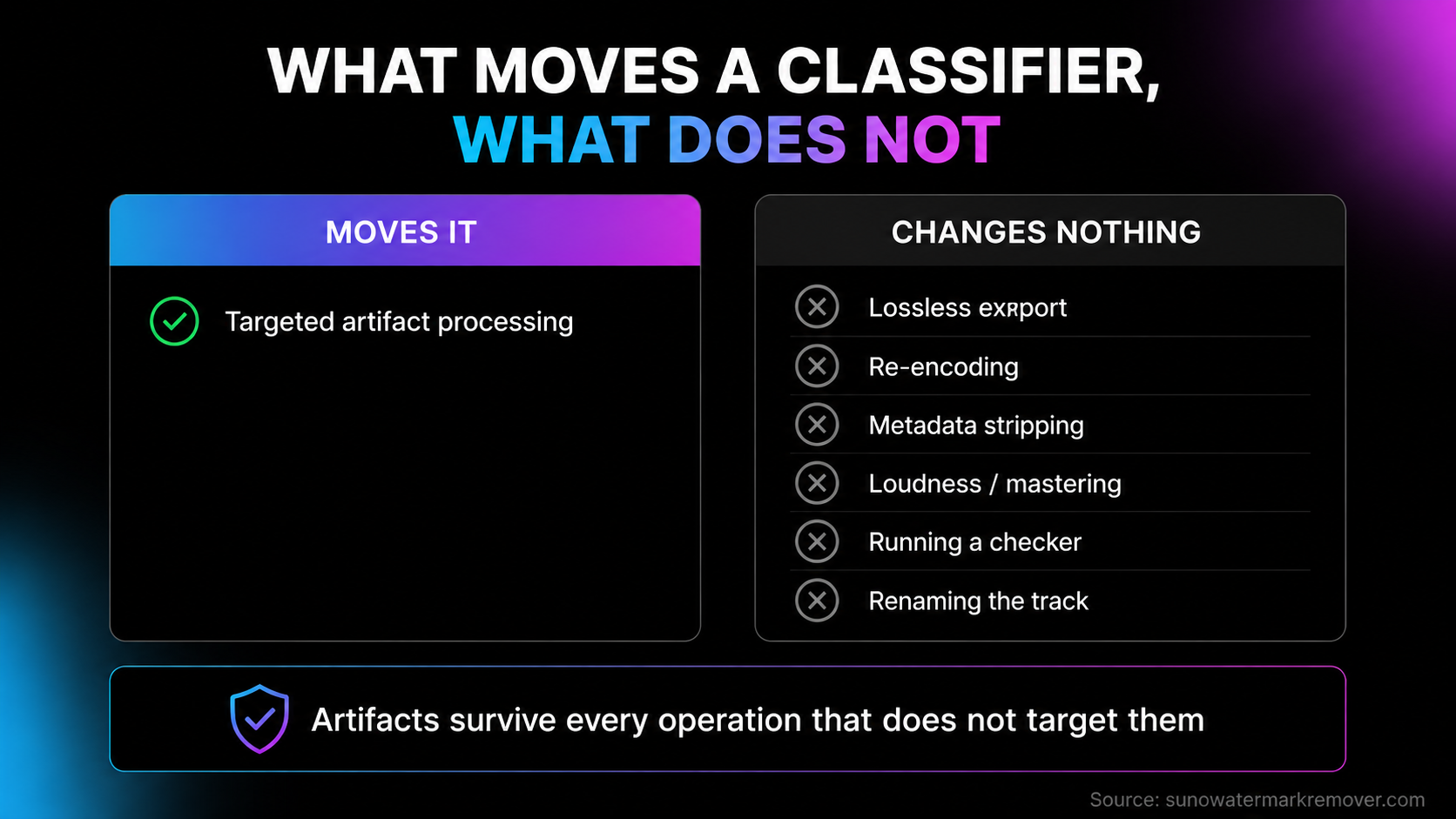
The other half of the assignment, and the more useful half for anyone about to waste a weekend. Across the corpus, these interventions produced no change in distributor outcome:
| Intervention | Outcome change | Basis |
|---|---|---|
| Exporting lossless instead of MP3 | None | Measured across rounds |
| Re-encoding or format conversion | None | Measured |
| Stripping file metadata | None | Measured; classifiers read audio, not tags |
| Loudness normalisation or mastering | None | Measured, June round n=24 |
| Running a free AI checker first | None | Mechanism: read-only operation |
| Renaming the track or artist | None | Mechanism: not an audio property |
The pattern underneath all of them: generation artifacts live in the statistical structure of the audio and survive every operation that does not target that structure. A pristine 24-bit lossless export of an unprocessed Suno track flags exactly as reliably as the 128kbps version, which is why "export at higher quality to pass detection" is advice that has never worked.
One thing processing does not change: what you own. Removing artifacts alters what a classifier measures in the audio. It has no effect whatsoever on your legal position, which is fixed by your subscription terms and by copyright law. Artifactr's AI music copyright guide is the better source on that question and we will not re-argue it here. Anyone telling you that processing creates or destroys ownership is describing something that does not happen.
Can I sell music I made with AI?
Two questions wear one sentence, and separating them resolves most of the confusion.
Can you sell it? That is contract, and the answer is your generator's terms. As of August 2026, Suno's free tier grants no commercial rights at all: free outputs are for personal, non-commercial use with attribution to Suno. Pro at $10 a month grants commercial use, and Premier at $30 grants the same commercial rights with more credits and queue priority rather than a broader licence.
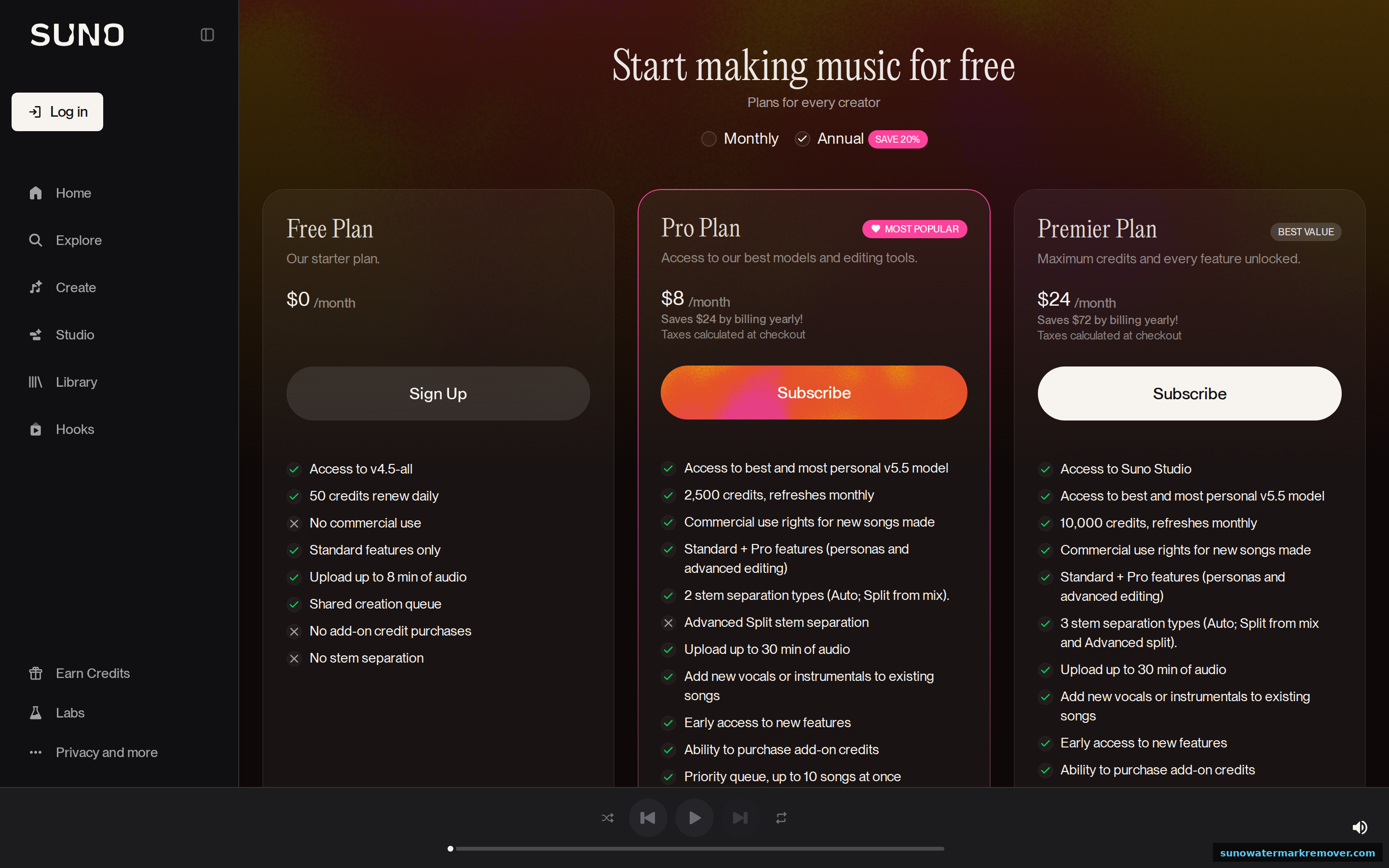
The detail that catches people: the Pro grant is forward-looking, not retroactive. Tracks you generated before subscribing stay under free-tier rules. If you made something on the free plan a year ago and now want to release it, subscribing today does not retroactively license it. Regenerate under the paid plan.
Do you own it? That is copyright, and it is a different answer. In the US, a wholly AI-generated work has no registrable copyright, which means your protection comes from Suno's contractual grant rather than from copyright law. Suno's own language has moved from "user owned" toward "granted commercial rights", which is a meaningful shift. Again, artifactr's copyright pillar is the page to read on the legal mechanics, and our Suno commercial use guide covers the tier-by-tier practicalities.
For distributor and platform policy specifically, artifactr also maintains the current positions for Spotify, DistroKid and TuneCore. We are not duplicating those here.
How to sell Suno songs
The genuinely actionable sequence. Everything before step four is preparation that determines whether steps four onward are possible at all.
- Confirm the plan that generated the track grants commercial rights. Not the plan you hold today. The plan active when the track was generated.
- Export at the highest quality available. You can go down later and never back up. This does not help you pass detection, and it does help everything else.
- Archive the untouched original in a separate folder, along with the prompt, date and plan tier. This is your provenance record if a platform ever queries the release.
- Clear detection. Process the artifacts out before submitting. This is the step that decides whether the rest happens, and it is the one every thin guide omits.
- Complete the AI-disclosure fields honestly. Every major distributor added them rather than banning AI outright. Undisclosed AI that surfaces later is a transparency violation, which pulls live releases rather than merely rejecting uploads.
- Prepare the release properly: final artwork at 3000x3000, correct credits and ISRC, and for anything you intend to pitch, an instrumental version and a 60-second edit.
- Pick the route by what you want. Reach and credibility point to a distributor; margin and per-transaction value point to a direct storefront and sync briefs. The next section prices both.
How to make money from Suno music
Ranked by realistic return per transaction, with the case against each stated honestly.
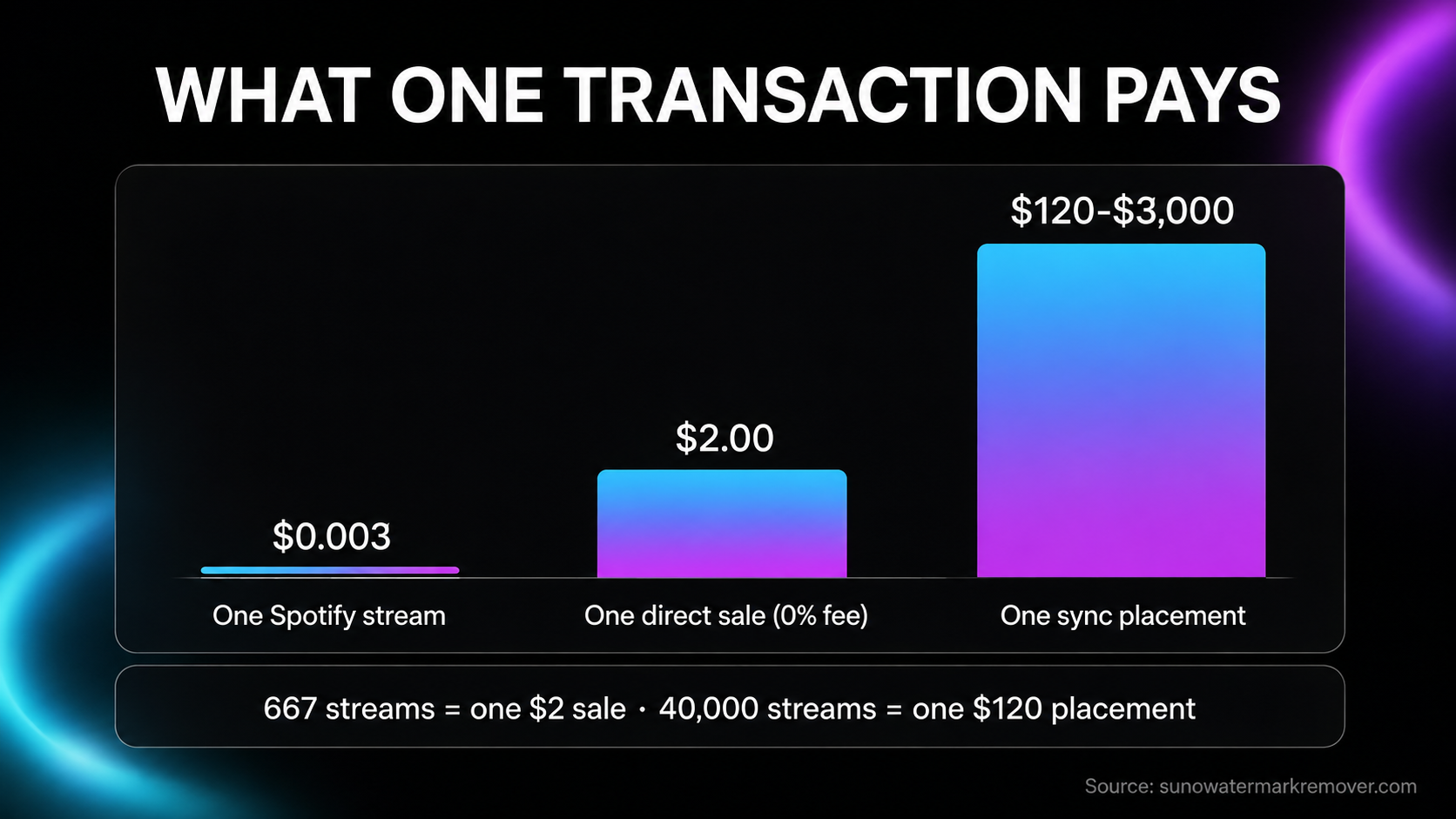
Direct sales. Best margin available, and no AI screening at upload because storefronts do not run classifiers. On a 0% commission storefront a $2 track nets $2, versus 667 streams for the same money, which is the entire case for selling finished tracks straight to listeners. The honest limit: a storefront converts an audience, it does not create one. If nobody knows your name yet, this earns nothing and no platform can fix that.
Sync licensing. The highest per-placement value open to an independent artist, and the route where AI-assisted production is least penalised, because a supervisor filling a 30-second brief cares whether the cue fits the scene. The limits are real: briefs close, most submissions lose, nothing is guaranteed, and you need a properly prepared master before you can enter at all. Treat every pitch as a submission, never as an expected placement.
Streaming. Reach, discovery and credibility, and almost no money. See the threshold section below. Worth doing as distribution rather than as income.
Stock and production libraries. Predictable and unglamorous. You trade exclusivity and upside for volume. Many libraries added their own AI rules in 2026, so check before committing a catalogue.
Custom commissions. The highest hourly rate in this list for people who can sell, because you are paid for a brief rather than for a stream. It does not scale and it is not passive.
If you want the two routes that actually carry income, Played.fm runs both in one place: a direct storefront and an open sync brief board you can submit against without an agent. Our AI music distribution guide maps the wider field including the traditional distributors.
Suno monetization: what changes as you scale
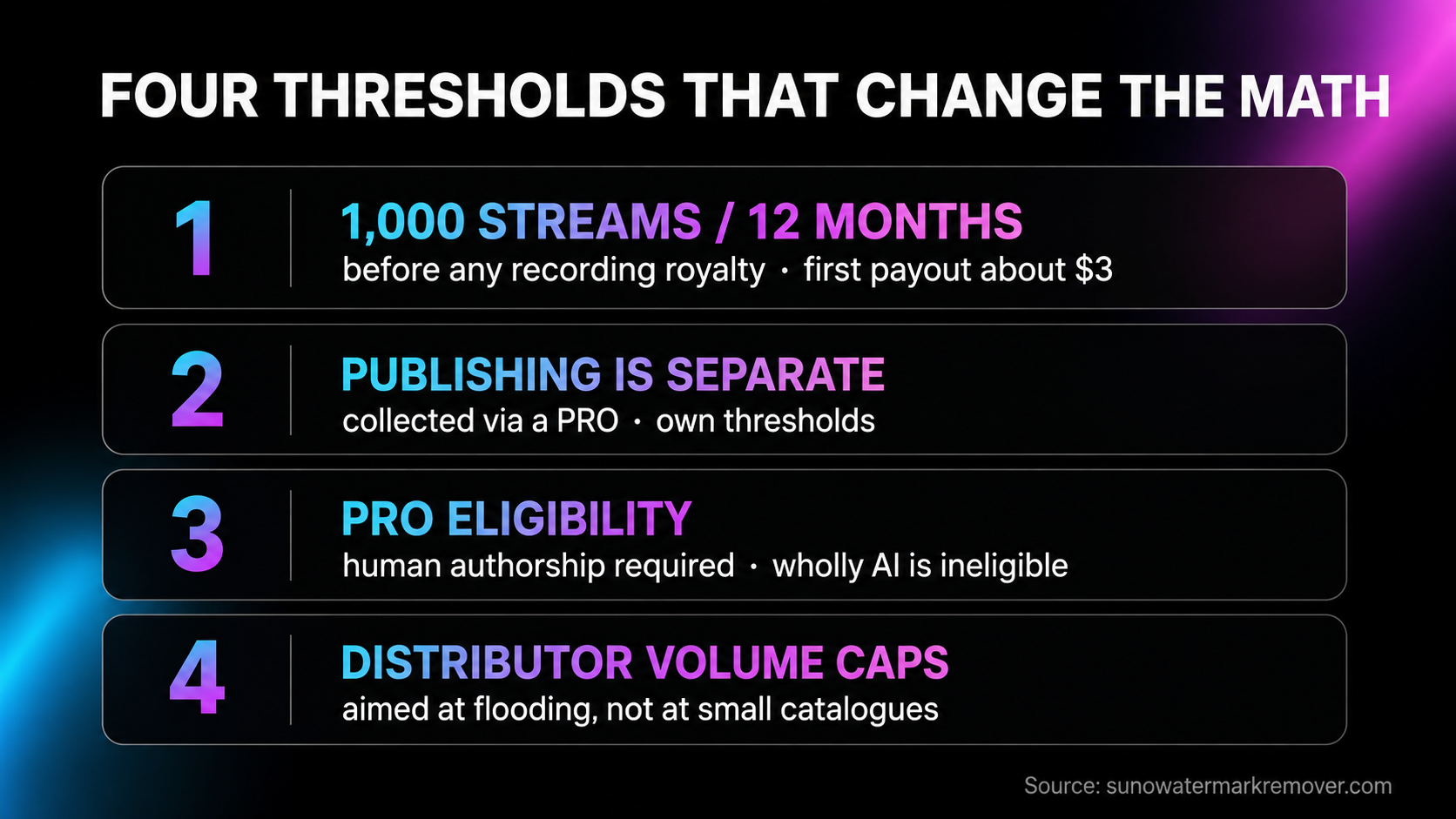
Four thresholds that reshape the maths, all current as of August 2026.
The 1,000-stream gate. Since April 2024, a track earns no recording royalty at all until it reaches 1,000 streams within a rolling 12-month window. That is about 83 streams a month. At roughly $0.003 per stream, crossing that threshold produces a first payout of around $3. This single rule is why "release a hundred tracks and let streaming compound" fails for most catalogues: most tracks never cross it, and the ones that do earn pocket change.
Publishing is a separate stream. The 1,000-stream threshold applies to the recording side only. Publishing royalties, collected via a PRO, run on their own thresholds and reporting cycles and typically add roughly a further fifth of streaming revenue.
PRO eligibility splits on authorship. ASCAP, BMI and SOCAN accept registrations for compositions combining human authorship with AI. Wholly AI-generated works are ineligible. If your workflow includes your own lyrics, topline or arrangement, you likely have a registrable composition even where the recording has no copyright. If you typed a prompt and exported, you likely do not.
Catalogue dilution and screening scale together. Larger catalogues attract the caps distributors introduced in 2026 for volume rather than for quality, and every additional release is another file that must clear detection. Ten considered releases outperform a hundred flooded ones under every rule currently in force.
Once you have seen those numbers, the practical conclusion is that streaming is distribution rather than income, and the routes worth your time are the ones paying per transaction. If that is where you have landed, Played.fm offers a 7-day free trial so you can list tracks and submit to briefs before paying anything. The terms, stated plainly: a card is verified but not charged during the trial, cancellation is one click, your tracks remain yours if you cancel, and Pro is $19.99 a month afterwards. A sync brief is a submission and never a guaranteed placement, and any page implying otherwise is setting you up for a refund request.
FAQ
What is AI music detection? Automated screening that distributors and streaming platforms run on every upload. It is a statistical classifier reading generation artifacts left in the audio, returning a probability the track was machine-generated. It does not decode a watermark and does not assess quality, intent, or who holds the rights.
Can I sell music I made with AI? Commercially yes, if your generator's plan grants it: Suno's paid tiers do, the free tier does not. Legally, selling and owning are separate. In the US a wholly AI-generated work has no registrable copyright, so your protection is contractual rather than copyright-based.
How do I sell Suno songs? Confirm the generating plan granted commercial rights, export at maximum quality, clear distributor screening, complete the AI-disclosure fields, then release via a distributor for reach or a direct storefront for margin. Screening is where most releases stall.
How much money can you make from Suno music? On streaming, very little. Spotify pays roughly $0.003 a stream and releases nothing until 1,000 streams in 12 months, making a first payout near $3. Direct sales and sync pay per transaction, which is why they carry realistic income.
What actually moves an AI detection score? Only processing targeting the statistical generation artifacts. Format conversion, bitrate, re-encoding, metadata stripping and loudness normalisation produced no change in distributor outcomes across our 122-track corpus.
Does mastering help a track pass detection? Not on its own. In our June round a leading restoration suite applied to 24 tracks cleared 3 on DistroKid, effectively the raw baseline. Mastering changes level, dynamics and tone, none of which is what a classifier reads.
Does processing change who owns my track? No. It changes what a classifier measures in the audio and nothing about your legal position, which is set by your subscription terms and copyright law.
Do I need to disclose AI to my distributor? Yes, at every major distributor as of August 2026. They added disclosure fields rather than bans. Undisclosed AI detected later is a transparency violation, which pulls live releases rather than merely rejecting uploads.
Can AI music earn publishing royalties? Partly. ASCAP, BMI and SOCAN accept compositions mixing human authorship with AI; wholly AI-made works are ineligible. Publishing is separate from the recording side and the 1,000-stream threshold does not apply to it.
What is Suno monetization in practice? A paid plan, a file that clears screening, accurate disclosure, and a route where the per-transaction value is not $0.003. Direct sales and sync carry the income; streaming supplies reach.
What to do with this
If a distributor rejected you, the problem is in the file and nothing in your paperwork will fix it. Process the artifacts, resubmit, and skip the free checkers because they change nothing. Our artifact removal ranking covers which tools moved outcomes in this testing and our Undetectr review has the full per-round data.
If your file is already clean and the problem is that streaming pays $0.003, the answer is routes that pay per transaction. You can put your catalogue in front of buyers directly and pitch the same tracks into open sync briefs from the same place.
Detection decides whether you get to compete. What you do afterwards decides whether it was worth clearing.
Tested and written by the Suno Watermark Remover editorial team, which buys every tool it tests and submits every track under real artist accounts. Test rounds ran May, June and July 2026 across 122 track submissions. Corrections and methodology questions: see our methodology page. Figures dated August 2026.
Frequently asked questions
AI music detection is the automated screening distributors and streaming platforms run on every upload. It is a statistical classifier that reads generation artifacts left in the audio by models like Suno and Udio, and returns a probability that the track was machine-generated. It does not decode a watermark, and it does not assess quality, intent, or who holds the rights.
Commercially, yes, if your generator's plan grants it. Suno's paid tiers grant commercial rights; the free tier does not. Legally, selling and owning are different questions: in the US a wholly AI-generated work has no registrable copyright, so your protection comes from your subscription contract rather than from copyright. Artifactr covers that distinction in depth.
Confirm your plan grants commercial rights, export at the highest quality available, clear distributor AI screening, complete the AI-disclosure fields your distributor now requires, then release through a distributor for streaming or a direct storefront for margin. The screening step is where most releases stall, and it is a property of the file rather than of your paperwork.
On streaming, very little: Spotify pays roughly $0.003 per stream and releases nothing until a track reaches 1,000 streams within 12 months, making the first payout about $3. Direct sales and sync placements pay per transaction rather than per play, which is why they dominate realistic income for independent AI musicians.
No. Processing changes what a classifier measures in the audio. It changes nothing about your legal position, which is set by your generator's subscription terms and by copyright law. Anyone claiming that removing artifacts creates ownership, or destroys it, is describing something that does not happen.
In our testing, only processing that targets the statistical generation artifacts themselves. Format conversion, bitrate changes, re-encoding, metadata stripping and loudness normalisation produced no change in distributor outcomes across our corpus. The artifacts live in the audio's statistical structure and survive all of those operations.
Not on its own. Mastering changes level, dynamics and tone, none of which are what a classifier reads. In our June round, a leading restoration suite applied to 24 tracks cleared 3 of them on DistroKid, which is effectively no improvement over the raw exports. Mastering is worth doing for the music, not for the screen.
Yes, at every major distributor as of August 2026. They added disclosure fields rather than blanket bans. Declaring accurately is the low-risk path, because undisclosed AI that gets detected later is treated as a transparency violation, which can pull a live release rather than merely rejecting an upload.
Partly. ASCAP, BMI and SOCAN accept registrations for compositions with human authorship mixed with AI, and works that are wholly AI-made are ineligible. Publishing is a separate royalty stream from the recording side, and Spotify's 1,000-stream threshold applies only to the recording, not to publishing collection.
A paid Suno plan, a file that clears distributor screening, accurate AI disclosure, and a route where the per-transaction value is not $0.003. In practice that means direct sales and sync briefs carry the income while streaming supplies reach and credibility. Catalogue scale changes the maths but does not change that ordering.
Ready to release your Suno tracks?
Undetectr was the only tool that passed every distributor in our testing. Clean your first track in under 60 seconds.