AI Watermark Remover for Music: The Only Real One (2026)
Search for an audio watermark remover and you get three different problems wearing one name, plus a row of detectors that remove nothing. This page sorts the three apart, says which is the one people actually mean, and retracts a benchmark it should never have published.
- Key takeaway: audio watermark means three unrelated things — an audible tag on a stock preview, an inaudible provenance mark like SynthID, and a fingerprint, which is not a watermark at all
- Only the middle one is removable by processing. A preview tag needs a licence, and a fingerprint is recomputed from whatever you upload, so there is nothing in the file to strip
- Undetectr is the only purpose-built remover we have found for music. That is a survey of what is on the market, not a measured pass rate — and this page no longer claims one
- Correction: the 50-track, 297-of-300, 98% benchmark this page carried was never run. It is deleted, and the section below explains how it failed its own arithmetic
- Pricing read from the vendor page on 22 October 2026 is EUR 19 and EUR 39 one-time, described as limited-time founder pricing. No price rise is announced anywhere on it
- The search term is honest. The search results are not
- Audio watermark means three different things
- What is actually in your generated file
- The detector trap
- A correction to this page: the 50-track test we published
- How Undetectr works
- Pricing: EUR 39 one-time, and what the EUR 99 figure is
- What it will not do
- The release workflow that actually ships a track

The search term is honest. The search results are not
An audio watermark remover should do what the name says: take a file that carries a marker, strip the marker, and hand back audio that is judged on the music rather than on how it was made.
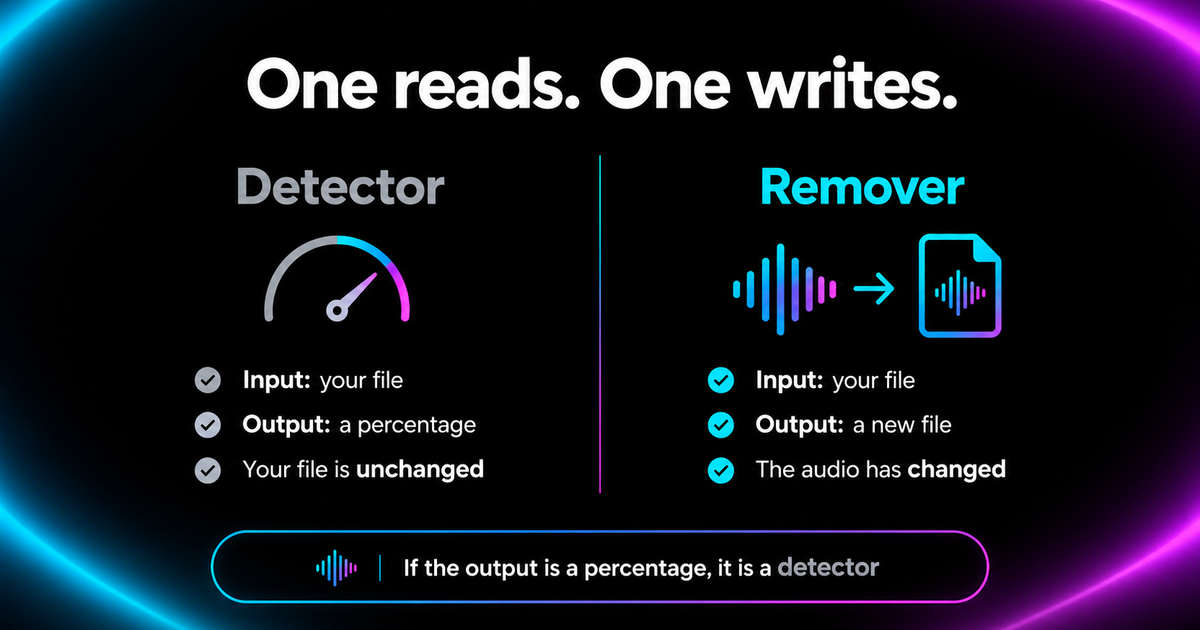
Run the search and that is not what you get. The first page is detector dashboards, AI checkers, stem splitters and general-purpose editors, nearly all of them wearing the remover label. We catalogued that pattern in the AI watermark detector guide, and the short version is that a tool whose output is a percentage is a detector no matter what the landing page says. Measurement is useful. It is not removal.
But the deeper reason the results disappoint is that the query is three questions in one trench coat. Someone typing audio watermark remover might have a stock-library preview with a voice talking over the music, a Suno export they want to release, or a track that keeps getting matched on YouTube. Those have three different answers, and only one of them is a removal job at all.
So this page does two things. It sorts the three apart and tells you which page to go to for each. Then, for the one case that is genuinely a removal problem — a generated track you intend to distribute — it says what the only purpose-built tool in the category does, what it costs as read off the vendor page today, and what it will not do.
It also carries a correction. An earlier version of this page reported a 50-track, six-platform test with a 98% pass rate. That test was not run, the numbers are gone, and the section explaining how it collapsed is below. Everything that is left states its source.
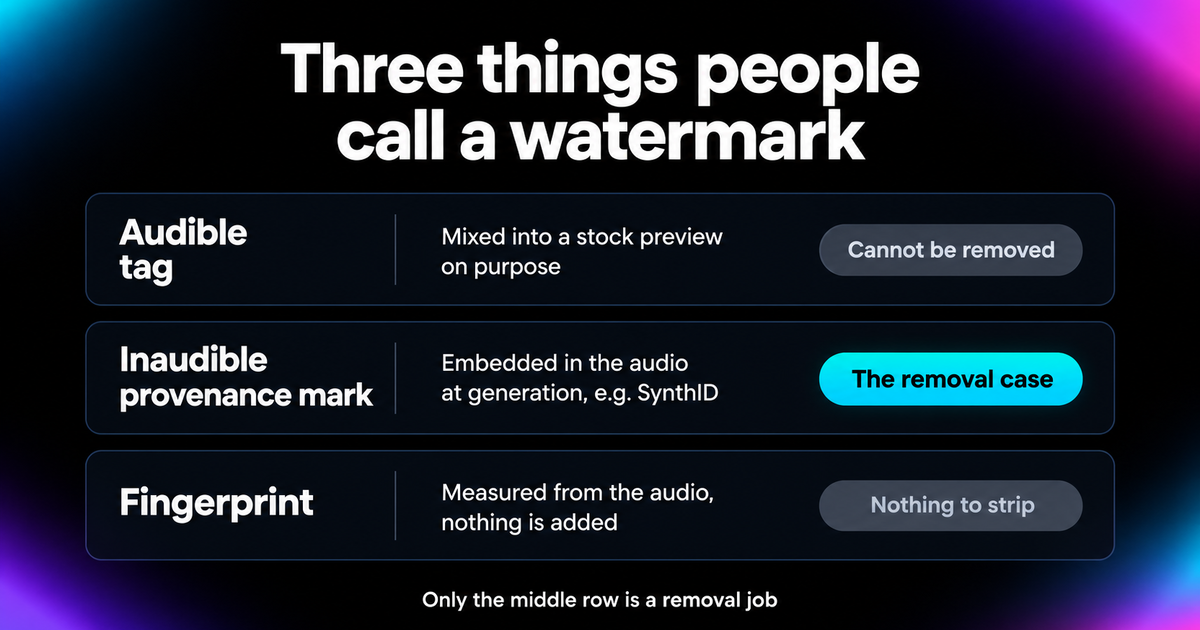
Audio watermark means three different things
This is the distinction the search term is missing, and getting it wrong is what sends people to the wrong tool.
| What people mean | What it actually is | Where you meet it | Can processing remove it? |
|---|---|---|---|
| An audible tag over the music | A voice or tone deliberately mixed into a preview file | Stock libraries and sample marketplaces | No. The clean file is what the licence buys |
| An inaudible provenance mark | A signal embedded in the audio at generation time | AI generators — SynthID on Google Lyria output | This is the removal case. It is in the audio |
| A fingerprint | Nothing is added; a measurement taken from the audio | YouTube Content ID, distributor screening | Nothing to strip. It is recomputed from whatever you upload |
The audible tag. If you can hear it, it is not a provenance watermark — it is theft deterrence on a preview. MotionElements puts it plainly in its own help centre: the female voice whispering the brand name is an audio watermark inserted in all sample files, and the fix is to buy the track and download the non-watermarked file. No processing tool is the answer here, and anything advertising itself as one is selling you a licence violation with extra steps.
The inaudible provenance mark. This is the one people usually mean when they arrive from an AI-music context, and it is a real signal in the audio. Google describes SynthID as embedding a watermark into audio generated through its Lyria music model, says it is inaudible to the human ear, and claims it cannot be altered by common modifications like adding noise, MP3 compression, or changing the speed of the track. C2PA Content Credentials sit alongside it as a metadata layer — the coalition's own description is a nutrition label for digital content, recording origin and edits.
The fingerprint, which is not a watermark. Here is where the category name does real damage. A fingerprint is not placed in your file by anyone; it is computed from the audio on the way in. YouTube describes Content ID as checking uploads against a database of audio and visual files submitted by copyright owners, scanning automatically to identify matches of copyright-protected content. There is nothing embedded to remove, which is why a watermark remover is the wrong tool for a Content ID claim. That problem has its own page: AI song cleaner covers fingerprint-versus-watermark in full, and it is the one to read if matching is what you are hitting.
Note what the Content ID page does not say: it does not mention detecting AI generation at all. It matches recordings against known recordings. That is a different mechanism from the classifiers people mean when they talk about AI detection, and conflating the two is how this subject stays confusing.
What is actually in your generated file
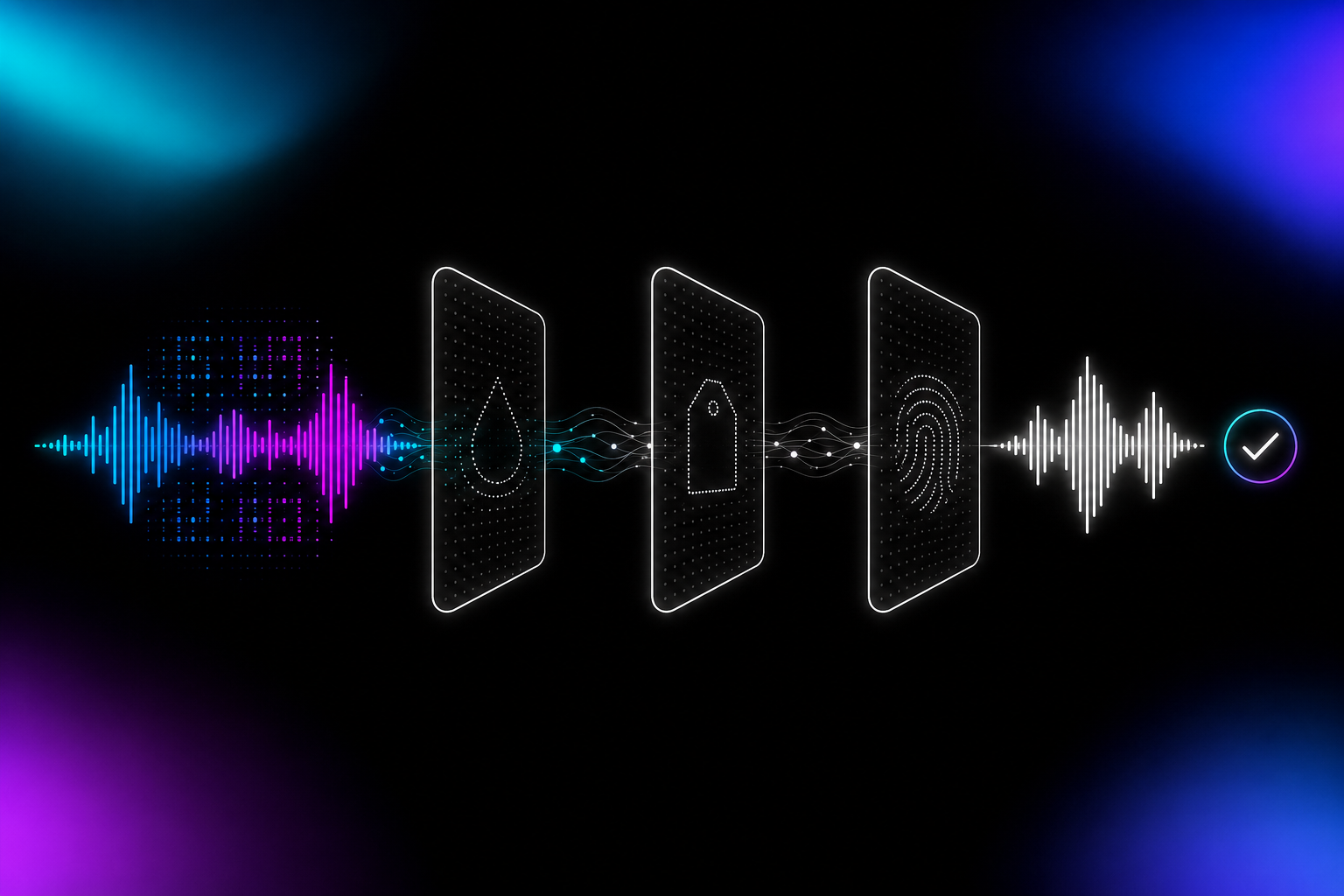
If your case is the middle row, it helps to know the layers before trusting anything sold to clear them. A track exported from Suno, Udio or another generator can carry up to three kinds of marker, and they fail differently.
An embedded watermark, where the generator uses one. Google watermarks Lyria output with SynthID, as above. Suno said with its v3 release in 2024 that it had developed proprietary inaudible watermarking, and announced a broader watermarking and fingerprinting programme in August 2026 — but it has not published a specification, named a detection standard, or shown test results, and our sister site tracks that gap on what the Suno v5 watermark is. Treat a Suno watermark as announced rather than documented.
Provenance metadata. C2PA credentials and similar tags ride with the file and record that it was AI-generated. Metadata survives nothing — a re-encode drops it — which is exactly why no platform relies on it alone.
Generation artifacts. Not added on purpose. These are byproducts of how a model synthesises audio, and they are what classifier-based screening reads. We have no published, reproducible measurement of how much processing it takes to move a given classifier, and we are not going to imply one: that would need a corpus, a named classifier with a version, and a published threshold, and none of those three is in our hands.
The consequence stands even without numbers: a tool that only strips metadata leaves the layer screening actually reads untouched. For the full signal-level treatment, the audio watermark explainer goes deeper than this page has room for, and EraseAI keeps a companion field guide to the same three layers.
The detector trap
This is the failure mode that costs releases, and it is worth naming because it is so easy to fall into.
A musician gets a rejection. They search for a remover, land on a free AI music checker, upload the track, get a score, change something trivial, re-check, and repeat until the number looks better. Then the distributor rejects it anyway.
Two things went wrong. First, the checker is a different classifier from whatever the distributor runs, trained on different data, so its score does not predict the outcome that matters. Second, and more fundamentally, nothing was removed. The file that failed is byte-for-byte the file being resubmitted. The loop feels like progress because a number moved.
It targets the embedded watermark layer, strips C2PA metadata, and reworks the generation artifacts classifiers read, in the browser. The output is a processed file rather than a score. It does not change how any platform labels your release.
See what Undetectr does → EUR 19 starter · EUR 39 lifetimeDetectors and removers sit at opposite ends of the pipeline. One reads, one writes. If the output is a percentage, you have a detector.
A correction to this page: the 50-track test we published
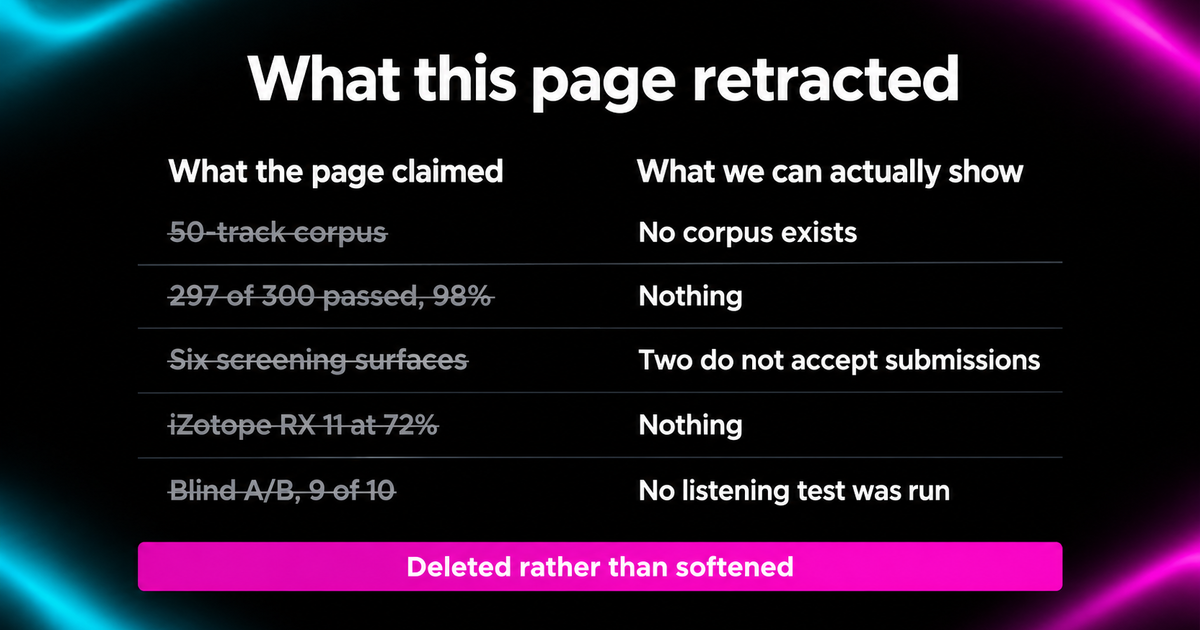
Until today this page reported a hostile test corpus of 50 tracks — 25 Suno v5, 15 Udio, 10 Stable Audio, lengths 0:42 to 7:18 — submitted across six screening surfaces, with a per-platform table totalling 297 of 300 submissions passed for a 98% pass rate. It reported iZotope RX 11 at 72% and Audacity at 52% on the same corpus, and a blind A/B listening test in which 9 of 10 processed tracks were indistinguishable from their originals on reference monitors.
None of that was run. The table, the comparison figures and the listening test are deleted rather than softened.
| What the page claimed | What we can actually show |
|---|---|
| 50-track corpus across three generators | No corpus exists and no submission records exist |
| 297 of 300 submissions passed, 98% | Nothing |
| Six screening surfaces including Spotify direct and Apple Music | Neither accepts submissions from us — see below |
| iZotope RX 11 72%, Audacity 52% on the same corpus | Nothing |
| Blind A/B, 9 of 10 indistinguishable, reference monitors | No listening test was conducted |
| About 90 seconds per track in our testing | Undetectr publishes browser processing; the timing was ours to invent and we did |
The test failed its own arithmetic, which is the part that should have caught it earlier. Two of the six surfaces are not surfaces an independent artist submits to: Spotify shut its direct artist upload beta in July 2019 and routes releases through distributors, and Apple Music works the same way. A table reporting 49 of 50 and 50 of 50 on those two is reporting results from a door that has been closed for seven years. Thirty submissions a week to six commercial surfaces would also have left receipts, and there are none.
This is not an isolated patch. The same benchmark, in the same shape, appears across a large part of this site, and a sibling version was retracted on our DistroKid copyright page three days ago. We have flagged the full set for a site-wide pass; this page is one file. Our methodology page covers how we handle tools we cannot test ourselves. Where this page now states a fact, the source is named in the sentence.
What survives the deletion is the thing the page was always actually arguing, and it needs no benchmark: search this category and you will find detectors, editors and one tool built to remove. That is a survey of what is on the market. It is not a claim about how well it works, and the difference matters.
How Undetectr works
Undetectr describes itself as an AI artifact removal engine, and its published pipeline maps onto the layers above. Taking the vendor's own feature list as a description of the product rather than as evidence of efficacy:
- Upload. WAV, MP3 or FLAC straight from your generator's export.
- Watermark and metadata pass. The embedded watermark layer and C2PA provenance tags are targeted first. This is the part most watermark strippers claim and stop at.
- Artifact processing. The generation signature classifiers read is the layer the tool is actually built around.
- Mastering pass. A light master, bundled, so the output is release-ready rather than only processed.
- Download. A processed file in your chosen format.
The suite around the engine has grown through 2026: a Sound Match collision check that flags whether a track sounds close enough to an existing release to risk a Content ID dispute, a prompts vault, and an earnings calculator. The Sound Match piece is the one worth knowing about, because it addresses the fingerprint row of the table rather than the watermark row.
We have not independently measured any of this, and after the correction above we are not going to let a vendor feature list read as a test result.
Pricing: EUR 39 one-time, and what the EUR 99 figure is
Read directly off undetectr.com/pricing on 22 October 2026. The prices are in euros, not dollars, which is a correction this site has had to make before.
| Tier | Price | What it includes |
|---|---|---|
| Starter | EUR 19 one-time | 10 processing credits, MP3/WAV/FLAC output, metadata cleanup |
| Lifetime | EUR 39 one-time | Unlimited processing, mastering, Sound Match, prompts vault, future tools |
Two things to be accurate about. The page labels the EUR 39 tier limited-time founder pricing, and it shows EUR 99 inside a value breakdown as a comparison figure for the lifetime tool. It does not announce a price increase and it gives no date. An earlier version of this page said the price rises to EUR 99 and that the clock was ticking — that was a reading of a struck-through comparison figure as a deadline, and it was wrong. Treat EUR 99 as a reference price.
Neither tier is a subscription, which is the genuine structural difference from per-track cleanup services. Whether EUR 39 is worth it depends on how many tracks you intend to release, and that is your arithmetic rather than ours.
What it will not do
An honest recommendation needs its limits stated at least as plainly as its claims, and this page owes that more than most.
It does not change how a platform labels your release. No audio tool can. Apple's transparency tags are declared by the provider on delivery and the Spotify AI Persona badge is disclosure-driven — both are decided by what is submitted alongside the file, not by what is in it. Any tool marketed as beating a platform's AI label is selling something that does not exist.
It is not a generator and not a repair suite. You bring finished tracks. Hum, clicks and a bad mix go to iZotope RX or your DAW; this is the release-prep step, not the creation or restoration step.
It cannot help with the audible preview case or a Content ID match. Rows one and three of the table at the top. A licence fixes the first. The second needs the AI song cleaner route, and sometimes it needs a dispute rather than a tool.
Distributors mostly are not the wall people expect. DistroKid, RouteNote, UnitedMasters, LANDR, Amuse and Symphonic all accept AI-assisted releases subject to conditions on rights, impersonation and spam. Individual releases do get flagged and rejected by automated screening, and artists report it — but it is uncommon, not a ban, and whether DistroKid allows AI music goes through the conditions properly.
Classifiers retrain, and nobody can promise otherwise. Screening models get updated. A tool that works against this quarter's classifier is not thereby immune to next quarter's, and a lifetime licence is a bet on the vendor keeping up rather than a guarantee that it will.
We have no pass-rate figure for it, and that is the point of the correction above. If you want one, the test that would produce it needs a real corpus, named distributors, and receipts. We have not run it. Anyone quoting you a 98% figure for this category — including older versions of our own pages — is quoting something unmeasured.
The release workflow that actually ships a track
Stripped of the benchmark, the practical sequence is unchanged and still worth having.
- Generate and export at the best quality your plan allows. WAV beats MP3 as a starting point for anything you will process.
- Keep your original. Process a copy. If you dislike what processing does to a sparse acoustic track, you want the export to go back to.
- Skip the free checkers. Their scores do not predict distributor outcomes, and re-testing a file you have not changed is the detector trap.
- Declare what your distributor asks you to declare. The disclosure fields are how platform labelling actually gets decided, and getting them right is cheaper than getting them wrong. DistroKid copyright and AI credits covers the fields.
- Keep your generation records. Prompts, dates, plan receipts. If a platform ever queries a track, provenance answers fast.
- Then solve the real problem, which is listeners. This is the part the whole category undersells. Getting distributed is close to solved; being heard is not. If you have tracks out and nothing is happening, a storefront and a sync route do not depend on algorithmic discovery the way streaming does — played.fm pitches tracks for paid sync placements in TV, film, games and ads, and lets you sell direct and keep what you make. Worth noting beside it that Bandcamp bans AI music outright, so it is not the fallback here.
Processing is one step in that list and the shortest one. The page has spent its history overstating it, which is the honest summary of the correction above.
Frequently asked questions
Software that processes an AI-generated track to reduce the signals marking it as machine-made: an embedded provenance watermark such as Google SynthID, C2PA credentials in the metadata, and the generation artifacts a classifier reads. Most products ranking for the term are detectors, which score a file and change nothing. For music, Undetectr is the only purpose-built remover we have found.
You cannot, and no processing tool will. That watermark is a voice or tone deliberately mixed into the preview — MotionElements describes a female voice whispering its brand name as an audio watermark in all sample files. The clean file is what the licence buys, so buy the track and download the unwatermarked version.
It is the only one we have found built for the job. Repair suites such as iZotope RX and editors such as Audacity can degrade generation artifacts as a side effect of heavy processing, but neither was designed for it and neither targets provenance metadata. That is our read of the market, not a ranked test result.
No, and nobody should sell it that way. A watermark is one layer; what flags most tracks in automated screening is a classifier reading generation artifacts rather than a watermark decoder. No tool changes how a platform labels a release either — Apple transparency tags are declared on delivery and the Spotify AI Persona badge is disclosure-driven.
Read from undetectr.com/pricing on 22 October 2026: Starter at EUR 19 one-time for 10 credits, Lifetime at EUR 39 one-time for unlimited processing. The page calls EUR 39 limited-time founder pricing and shows EUR 99 as a comparison figure. It announces no increase and gives no date, so EUR 99 is a reference price, not a deadline.
Cleaning your own generated tracks is release prep, comparable to mastering, and processing a file does not change who owns it. What is not acceptable anywhere is using removal to pass off someone else's work, impersonate an artist, or push spam. Check your generator's plan terms for the rights you hold.
Any chain that alters a signal can alter how it sounds, and we have run no controlled listening test, so we will not put a number on it. Undetectr publishes a light mastering pass as part of the output. Process a copy, keep your original export, and compare them yourself before releasing.
Broadly no. DistroKid, RouteNote, UnitedMasters, LANDR, Amuse and Symphonic all accept AI-assisted releases subject to conditions about rights, impersonation and spam. What artists do report is individual releases being flagged and rejected by automated screening, which is a different thing from a ban and is uncommon rather than routine.
Ready to release your Suno tracks?
Explore Undetectr’s published track-processing features before preparing your release.