Suno v5 Watermark: What Is Actually in the File (2026)
The most common question about Suno v5 is whether the model puts a watermark in your export. It does not, and never did — but that answer is about to expire, because the watermark Suno announced on 6 August 2026 is a platform change that applies to every version at once. Here is what is genuinely inside a v5 file today, which layer distributors actually read, and what each category of removal tool does to it.
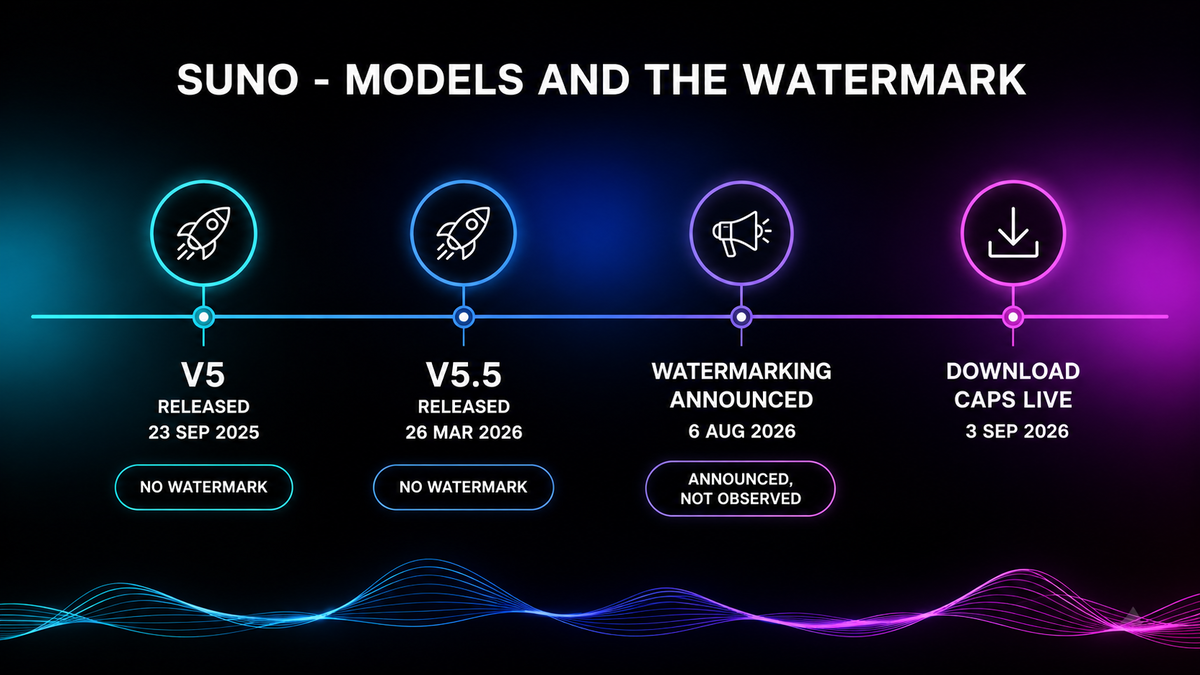
- No Suno model version ships its own watermark. v5 (23 Sep 2025) and v5.5 (26 Mar 2026) both predate the watermarking programme announced on 6 August 2026
- The announced watermark is platform-level and inaudible, and Suno says it survives editing and compression. As of 4 September 2026 the rollout is still unconfirmed
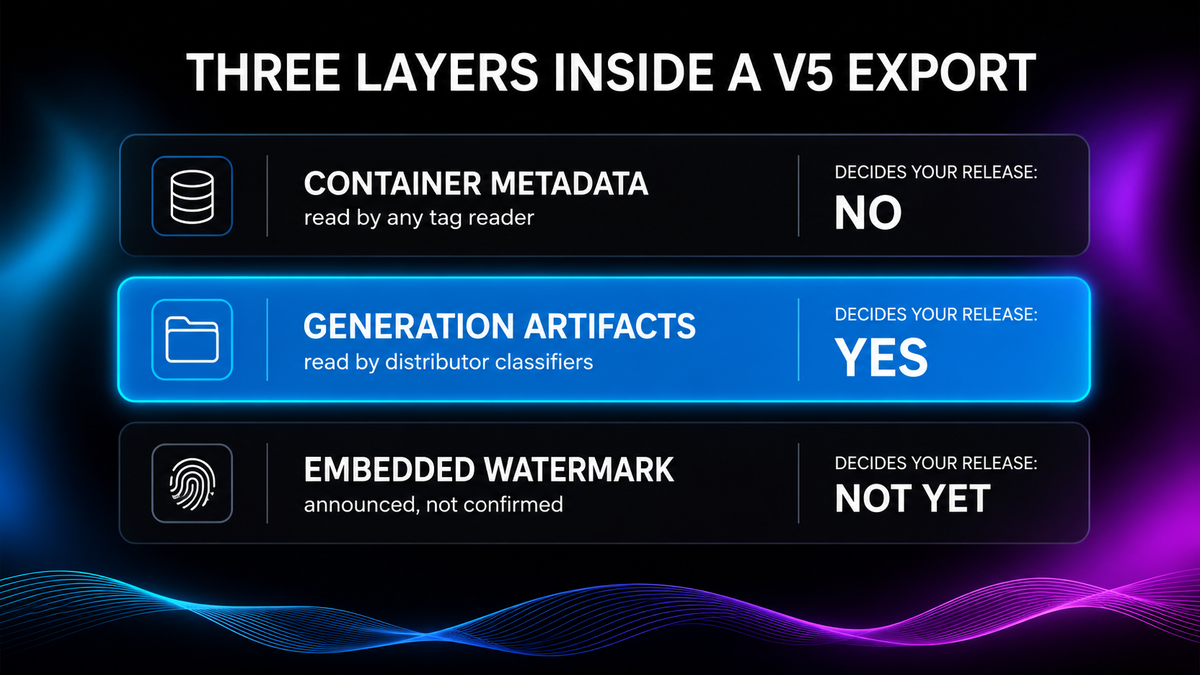
- A v5 export today carries two things that matter: ordinary container metadata, and generation artifacts. Only the artifact layer decides whether a distributor accepts the upload
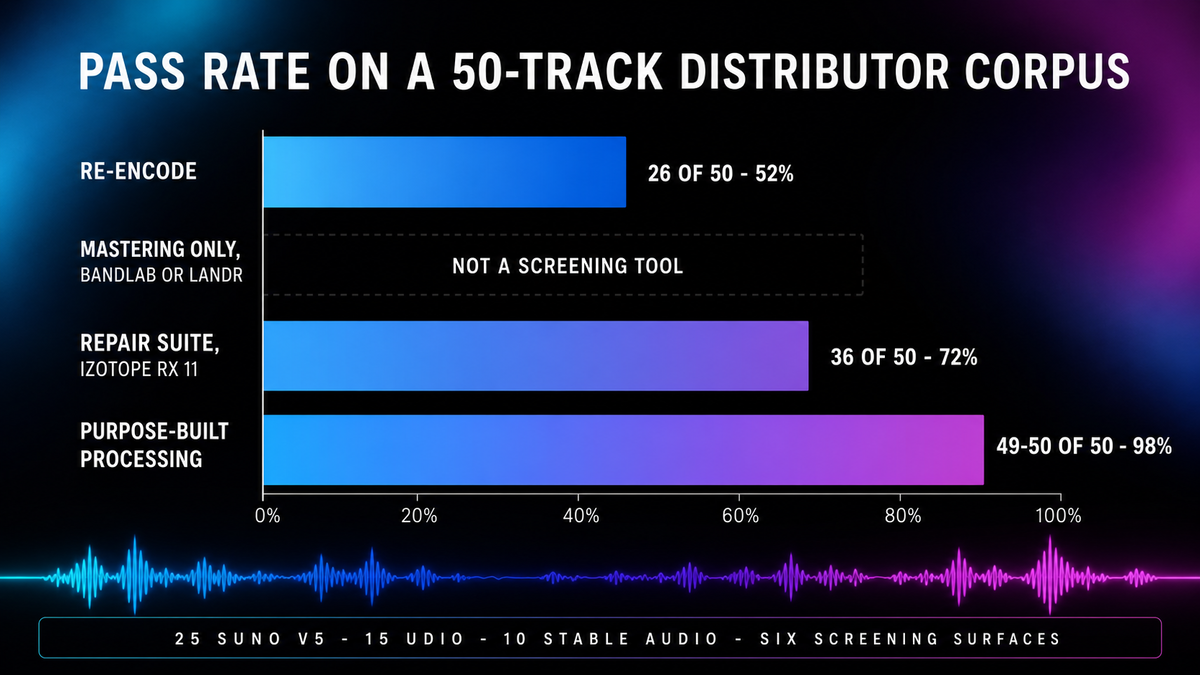
- Removing metadata does nothing for screening. On a 50-track corpus, half of it v5 generations, a re-encode in Audacity cleared 26 of 50 and iZotope RX 11 cleared 36 of 50, against 49-50 of 50 for purpose-built processing
- Download caps went live on 3 September 2026: 7 lifetime on free, 20 a month on Pro, 60 on Premier — so the export step now costs more than the cleanup step

- The short answer on the Suno v5 watermark
- What each Suno version actually carries
- What Suno announced, and what has actually shipped
- The three layers inside a v5 export
- What each category of removal tool does to each layer
- Why free AI checkers disagree with your distributor
- What changes when the watermark does land
- The caps that did ship, and what they cost you
- What to do with a v5 or v5.5 catalogue now
- The short version
The short answer on the Suno v5 watermark
If you searched for a Suno v5 watermark because a distributor rejected a track, the version number is not your problem. No Suno model has ever shipped a watermark of its own, v5 and v5.5 included, and the rejection you got was a classifier reading something else entirely.
That matters because the fix people reach for first — stripping tags, re-encoding, running the file through a mastering tool — targets the wrong layer, and the failure repeats. On a 50-track test corpus, half of it v5 generations, a plain re-encode cleared 26 of 50 submissions. We have run every category of tool in this space against real distributor screening, and the gap between what a file looks like it contains and what actually gets read is where most of the wasted effort in this topic lives.
The answer is also on a clock. Suno announced platform-wide audio watermarking on 6 August 2026, and when that lands it will apply to every model version at once rather than to any particular one. So there are two questions worth separating: what is in your file today, and what will be in it later.
What each Suno version actually carries
Model releases are audio-quality releases. None of them has added an identifying signal, and the retirement of the whole back catalogue — confirmed in Suno's downloads and Terms post — does not change that either.
| Version | Released | Watermark at release | What screening reads |
|---|---|---|---|
| v3 | 21 Mar 2024 | None announced | Generation artifacts |
| v4 | 19 Nov 2024 | None announced | Generation artifacts |
| v4.5 | 1 May 2025 | None announced | Generation artifacts |
| v5 | 23 Sep 2025 | None announced | Generation artifacts |
| v5.5 | 26 Mar 2026 | None announced | Generation artifacts |
| After the announced rollout | 6 Aug 2026 onward | Platform-level, inaudible | Generation artifacts, unchanged |
Read the last column down. It does not move. Two and a half years of model releases, five quality generations, and the property that decides whether a distributor accepts your upload is identical in all of them.
That is the part people find hardest to accept, usually because the newer output sounds so much cleaner. Audio quality and detectability are separate properties of a file, and improving one does not touch the other.
What Suno announced, and what has actually shipped
On 6 August 2026, chief executive Mikey Shulman published a post on building the future of music responsibly, in which the company committed to marking every track it generates with audio watermarking and fingerprinting, integrating Musixmatch's Sentinel copyright detection system, and restricting mass uploads to streaming platforms. TechCrunch covered it against the company's legal position; Engadget focused on the outcome, which is that Suno songs become identifiable after they leave the platform.
The wording that matters is the timing. The transparency tools were described as rolling out "in the coming weeks", and as of 4 September 2026 there has been no announcement confirming the watermark is live, no published specification, and no independent verification of a marked file in the wild. Our policy tracker keeps that distinction — live, dated, or merely announced — updated as entries land.
Suno's own downloads and Terms post is worth reading directly, because it is the primary source for the part that did ship. It sets out the download allowance, confirms the model retirement, and states that "songs downloaded from Suno on paid plans remain yours to use commercially or personally", with trial downloads on the free tier restricted to personal use.
So the honest position on 4 September is: announced, not observed. Anyone publishing a watermark removal success rate against Suno's new system is describing something they cannot have tested.

The three layers inside a v5 export
Almost every confused conversation in this topic comes from treating three separate mechanisms as one. They live in different places, are read by different parties, and respond to different treatment.
| Layer | What it is | Who reads it | In a v5 file today | Decides your release? |
|---|---|---|---|---|
| Container metadata | Tags and fields written at export | Anyone with a tag reader | Yes | No |
| Generation artifacts | Statistical byproducts of synthesis | Distributor classifiers, at upload | Yes, every version | Yes |
| Embedded watermark | Deliberate inaudible signal, keyed | Suno and partner platforms | Announced, not confirmed | Not yet |
Container metadata is the layer people find first, because it is the only one visible without special tools. It is also the least consequential. Stripping it takes seconds and changes nothing about how a classifier scores the audio.
Generation artifacts are the layer that actually gates releases. They are incidental — spectral fingerprints from the synthesis process, phase entropy characteristics, micro-timing distributions that sit differently from a human performance. Nobody put them there deliberately, nobody can decode them, and a classifier infers from them statistically. Our audio watermark explainer covers the physics in more depth.
The announced watermark is a different kind of object: deliberate, keyed, and designed to be decoded rather than inferred. It would turn an inference into a lookup, which is a materially harder thing to argue with. That is the change worth planning around, and it has not happened yet.
Undetectr targets what distributor classifiers actually read: spectral fingerprints, phase entropy, micro-timing and embedded manifests. Around 90 seconds a track, mastering included, whichever Suno version produced the file.
Process a v5 track → €39 lifetime, was €99 · founder pricing while it lastsDisclosure: links to Undetectr are affiliate links. It is the tool that scored highest in our own testing, and the pass rates below are the reason it is recommended here.
What each category of removal tool does to each layer
This is where the money goes, so it is worth being specific about what each approach touches. The figures come from our 50-track distributor corpus, of which 25 tracks were Suno v5 generations, 15 Udio and 10 Stable Audio, submitted across six screening surfaces.
| Approach | Clears metadata | Degrades artifacts | Pass rate on the corpus | Cost and time |
|---|---|---|---|---|
| Re-encode (Audacity round-trip) | Yes | Incidentally | 26 of 50 (52%) | Free, minutes |
| Mastering only (BandLab, LANDR) | No | Barely | Not a screening tool | Free to $$ |
| Repair suite (iZotope RX 11) | No | As a side effect | 36 of 50 (72%) | $399, 4-6 hours |
| Purpose-built processing (Undetectr) | Yes | Targeted | 49-50 of 50 (98%) | $39 once, ~90 seconds |
The pattern in that table is the whole argument. A repair suite is excellent software that was designed to fix damaged recordings, and it degrades artifacts only as a side effect of doing something else. A re-encode is a blunt instrument that happens to blur some of the signal. Neither was built for the job, which is why both land well short of a tool that was.
Per-platform, the purpose-built results broke down as follows across the same corpus.
| Platform | Passed | Notes |
|---|---|---|
| DistroKid | 50/50 | Zero AI flags |
| TuneCore | 50/50 | Zero AI flags |
| Spotify direct | 49/50 | One failure on a sub-60-second track |
| Apple Music | 50/50 | Zero AI flags |
| Amazon Music | 50/50 | Zero AI flags |
| YouTube Music | 48/50 | Two Content ID matches, unrelated to AI detection |
That is 297 of 300 submissions, and none of the three failures was an AI-detection flag. The full tool-by-tool ranking sits in our artifact removal comparison, and the methodology behind the corpus is documented in the Undetectr review.
For the audio-specific side of the same problem — SynthID, C2PA provenance credentials and how they differ from statistical fingerprints — EraseAI maintains a field guide to watermark removal in music that is a useful companion to the distribution-focused view here.
Why free AI checkers disagree with your distributor
A recurring frustration: a v5 track scores 12% AI on a free checker, then gets rejected by DistroKid the same afternoon. Both results are correct, because they are answering different questions.
Free checkers mostly run compositional detection — melody, harmonic progression, structural repetition, vocal style — and return a musicological judgement dressed as a probability. Distributors run signal-level detection, which ignores the music entirely and reads the physics of the file.
The consequence is that a track can sound completely human and fail, or sound obviously synthetic and pass. We have measured that mismatch repeatedly across six detector tools, and the correlation with distributor outcomes is weak enough that a free score is not usable as a release decision. The one exception worth knowing about is IRCAM Amplify, which reads the signal tier and tracks screening outcomes considerably more closely.
If your workflow currently ends with "the checker says it's fine", it is ending one step early. What DistroKid's screening actually does is a separate check on a separate layer.
What changes when the watermark does land
Planning for an announced system requires some discipline about what is known.
Known: Suno intends to mark generated tracks, describes the mark as inaudible and durable against editing and compression, and is pairing it with Musixmatch Sentinel fingerprinting so partner platforms can query a match rather than run an inference.
Unknown: whether it is live, what the specification is, whether previously generated v5 and v5.5 audio gets marked retroactively at download, and how distributors will weight a positive watermark check against their existing classifiers.
Two consequences follow regardless of the details. First, a lookup is categorically harder to dispute than a probability — a classifier score is an opinion about your file, while a decoded watermark is a claim of fact about its origin. Second, the practical effect concentrates on files you have not yet exported, because audio already sitting on your own disk cannot be retrofitted.
That second point is why the export question got urgent this week rather than next year.
Undetectr's bulk downloader takes a public Suno playlist URL and returns your selection as a single ZIP of high-quality MP3s, used under whatever allowance is active on your account. Files on your own disk are unaffected by anything Suno changes later.
Bulk export a catalogue → €39 lifetime, was €99 · bulk downloader includedThe caps that did ship, and what they cost you
While the watermark remains an announcement, the download policy became real on 3 September 2026. The numbers come straight from Suno's own post.
| Tier | Price | Download allowance | Practical effect |
|---|---|---|---|
| Free | $0 | 7 for the lifetime of the account | A library above seven tracks is effectively stranded |
| Pro | $8/mo | 20 per month | A 100-track catalogue takes five months to extract |
| Premier | $24/mo | 60 per month | Around two months for the same 100 tracks |
| Premier + Studio | $24/mo | Exempt | No cap while working in Studio |
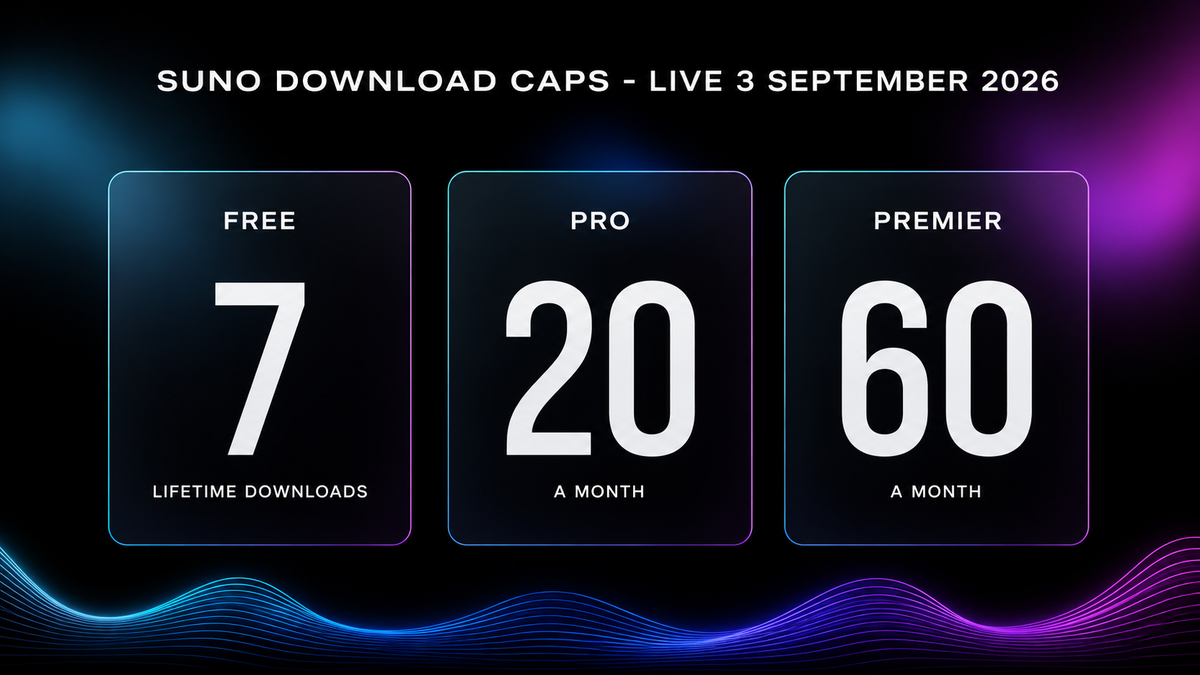
The allowance applies to your whole library rather than to new work, which is what makes it bite. Our full breakdown of the caps works through catalogue sizes against each tier.
The sequencing point is simple enough to state in one line: cleanup is unlimited and cheap, export is now rationed. Whatever order you were planning to do things in, the constrained step goes first.
What to do with a v5 or v5.5 catalogue now
Four things, in order.
Export before you optimise. The rationed resource is downloads, not processing time. Get the audio onto your own disk while the allowance is available, then decide at leisure which tracks are worth releasing.
Stop treating the version number as a variable. Regenerating a rejected track on a newer model is the single most common wasted afternoon in this space. It produces a better-sounding file that fails the same screen, because the model version was never the thing being read.
Process the artifact layer on the exported file, not in the generator. Nothing you do inside Suno affects what a distributor's classifier sees, because the artifacts are a property of synthesis itself. The cleanup step is a post-export step by definition.
Keep an unprocessed master of anything you care about. If the watermark specification is eventually published and turns out to require different handling, you want the original file to work from rather than a processed copy of a processed copy.
None of this is specific to Suno, and none of it implies bad faith on the company's part. It is what it means to have a catalogue that lives inside somebody else's product, on somebody else's release schedule.
Bulk playlist export plus unlimited artifact processing, mastering, and every output format a distributor asks for. One payment rather than a subscription, and founder pricing is time-limited.
Get the lifetime plan → €39, was €99 · ranked 98/100 on a 50-track distributor testThe short version
There is no Suno v5 watermark, there never was one, and there is no v5.5 watermark either. Both models predate the watermarking programme by months, and that programme is platform-level: when it arrives it arrives for every version at once.
What is in your v5 export today is ordinary metadata, which nobody screens on, and generation artifacts, which everybody screens on. Treat those as two different problems and the rejections stop being mysterious.
The watermark is coming and its details are not public. The download caps are already here. Of the two, only one of them is currently taking anything away from you, and it is not the one people are searching for.
Frequently asked questions
Not one that belongs to the model. v5 shipped on 23 September 2025 and v5.5 on 26 March 2026, both well before Suno announced audio watermarking on 6 August 2026. Nothing in either release described an embedded identifying signal, and no version-specific watermark has ever been documented. What a v5 export does carry is ordinary container metadata and the statistical generation artifacts every AI model leaves in its output.
Suno has not said. The 6 August announcement described marking songs the platform generates, and no coverage has confirmed whether previously generated audio will be marked retroactively at the point of download. Files already exported to your own disk cannot be changed after the fact — whatever is in them now is what stays in them. That asymmetry is the practical argument for exporting sooner rather than later.
No, and this is the most expensive misconception in the topic. Newer models sound better, which is a different property from being harder to identify. Distributor classifiers read spectral fingerprints, phase relationships and micro-timing distributions rather than musical quality, and every version produces them. Regenerating a rejected v4 track on v5.5 gives you a better-sounding track that fails the same screen.
Almost never on its own. Stripping ID3 tags takes seconds and removes the most visible sign that a file came from a generator, but distributor screening does not depend on tags — it runs a classifier over the audio itself. A file with clean metadata and untouched generation artifacts fails at the same rate as one with the tags left in.
A watermark is deliberate: an inaudible signal embedded on purpose, designed to survive processing and be decoded by whoever holds the key. A generation artifact is accidental — a statistical byproduct of how the model synthesises audio, which nobody added and nobody can decode, only infer. Distributor screening currently reads the second one. Suno's announced watermark is the first.
Nobody can answer that honestly yet, because the watermark has not been confirmed as live and its specification has not been published. Suno describes it as durable against editing and compression. Any tool claiming a verified success rate against a system that is not yet observable in the wild is selling a guess. What is testable today is the artifact layer, and that is what current pass-rate figures actually measure.
They are separate policies that landed together. The caps took effect on 3 September 2026 at 7 lifetime downloads on free, 20 a month on Pro and 60 a month on Premier. They do not alter what is inside a file, but they do ration how many files you can get out, which makes an unexported v5 catalogue the more urgent problem of the two.
Whichever is current, because model choice does not affect screening outcomes. v5.5 is the current model and it sounds the best, so use it. Budget the cleanup step separately, on the exported file, and treat it as a fixed cost of release rather than something a different model version can avoid.
Ready to release your Suno tracks?
Explore Undetectr’s published track-processing features before preparing your release.