Bandcamp AI Music Policy: What the Ban Actually Covers (2026)
Bandcamp is the platform AI musicians reach for when distributors reject them, and the worst-understood option in the category. Since 13 January 2026 it bans wholly AI-generated audio outright, yet it runs no classifier at upload. Both of those are true, and the combination is worse for artists than either alone.
- Bandcamp banned music generated wholly or in substantial part by AI on 13 January 2026, the first major platform to issue a full ban rather than a disclosure rule
- Enforcement is human and reactive: reports, curation decisions, and removal of spam or misrepresented uploads rather than a scan of every file
- It is a storefront, not a distributor, so it reaches no streaming platforms and earns no streaming royalties even when a release stays up
- If you distribute anywhere else as well, the file still meets classifier screening, which is where artifact removal with Undetectr matters
Bandcamp is not the distributor you think it is
Bandcamp AI music comes up constantly in release discussions, usually as the escape hatch: DistroKid rejected the track, TuneCore blocked it, so put it on Bandcamp. That advice contains one true premise and one expensive misunderstanding.
The true premise is that Bandcamp's gate is much softer. There is no classifier scanning your upload the way there is at every major distributor. The misunderstanding is what you get on the other side of that gate. Bandcamp is a direct-to-fan storefront, not a distributor. You upload, you set a price, and people who already know you can buy from your page. Nothing goes to Spotify, Apple Music, Amazon, or the other 150+ stores a distributor reaches. There are no streaming royalties, because there is no streaming.
So the question is not really "does Bandcamp allow AI music." It is what Bandcamp actually solves, and for most people asking, the answer is: not the problem they have.
What the Bandcamp AI policy actually restricts
Bandcamp has tightened its handling of AI-generated content, and the coverage of that has been considerably louder than the policy itself. Three things are worth separating.
There is a categorical ban, but no automated classifier at upload. Bandcamp’s January 2026 policy prohibits wholly or substantially AI-generated audio outright, which is stricter on paper than any distributor. But unlike the screening we document across our DistroKid, TuneCore, and CD Baby guides, Bandcamp runs no detection model at upload and says explicitly that it does not use algorithmic tools for these decisions.
Enforcement is human and reactive. Action follows reports, rights complaints, and observed patterns, most commonly bulk uploading. That is why mass-generated AI catalogues are what actually gets removed: the volume is the signal, not the audio.
Curation excludes AI material too. Bandcamp's editorial surfaces and human-curated discovery are closed to AI-generated work as a matter of policy now, not merely taste. Nothing technical stops the upload itself, which is why the ban and the absence of a classifier are both true at once.
Read together, the practical shape is: banned on paper, technically uploadable, undiscoverable by design, and removable at any time once reported. That is a worse position for an artist than a classifier gate, because nothing tells you when you have crossed the line.
The trade you are actually making
Choosing Bandcamp because a distributor rejected you is a trade, and it helps to price both sides honestly.
What you gain. Publication without a classifier gate. Direct sales at a price you set, with a far better per-unit margin than streaming. A real audience relationship if you already have one.
What you give up. All streaming royalties. Algorithmic discovery, which is how most listeners find new music now. Playlist placement. The 150+ store footprint a distributor delivers, covered in our AI music distribution guide. And the durability of the release, since reactive enforcement can remove a catalogue in one pass months later.
The uncomfortable summary: Bandcamp is an excellent storefront for an audience you already have, and close to useless as a discovery engine for one you do not. If the reason you are there is that your file failed a screen, you have swapped a solvable file problem for an unsolvable reach problem.
The part most people get backwards
Here is what makes the Bandcamp escape-hatch advice genuinely costly. The distributor rejection that sent you there was mechanical. As we document across our AI music detector guide, distributor screening is a statistical classifier reading the generation fingerprints AI tools leave in exported files. It is not a judgment about your music, your effort, or your rights. It is a scan finding artifacts in a file.
Artifacts are removable. Reach is not manufacturable. Trading the first problem for the second is backwards, and it is the most common mistake we see in this category.
Undetectr is the only purpose-built AI music watermark remover we have found in two rounds of category testing, and the only tool that cleared every distributor screen we ran it against: 48 of 48 Suno tracks in round one across six distributors, and 297 of 300 submissions in round two across a cross-generator corpus. Our full Undetectr review has the methodology and the audio-quality results.
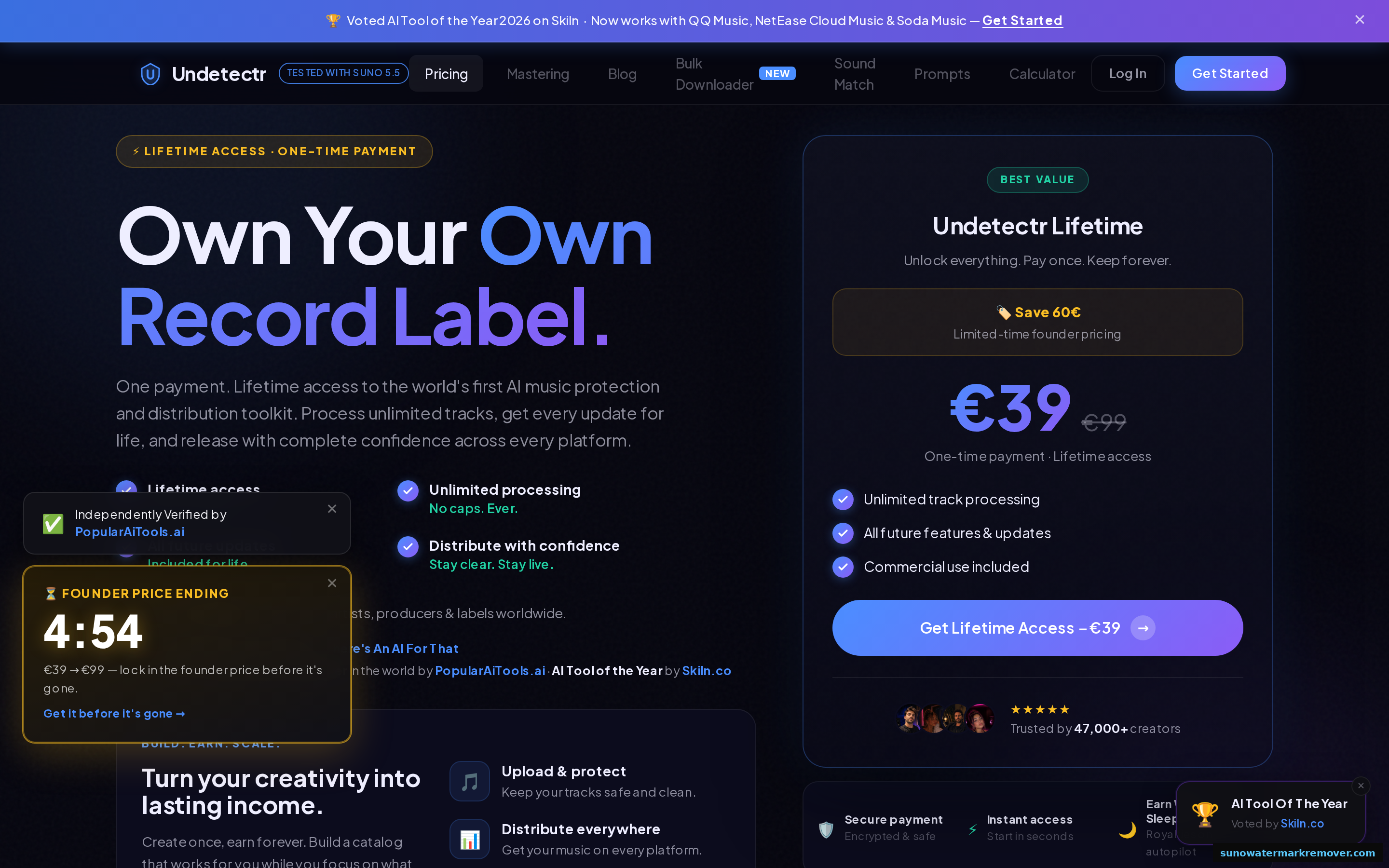
Bandcamp is a fallback. Distribution is the goal. Undetectr removes the generation artifacts distributor classifiers read, in about 90 seconds per track, with mastering included.
Try Undetectr → from $19 · $39 lifetimeWhere Bandcamp fits in a real release plan
Used correctly, Bandcamp is not a consolation prize. It is a complement.
Use Bandcamp for direct sales to an audience you already have, higher-margin releases, limited runs, and anything you want to sell rather than stream. It is genuinely the best direct-to-fan storefront available.
Use distribution for reach, discovery, and royalties. That path runs through classifier screening, which means the file has to be clean before it goes anywhere.
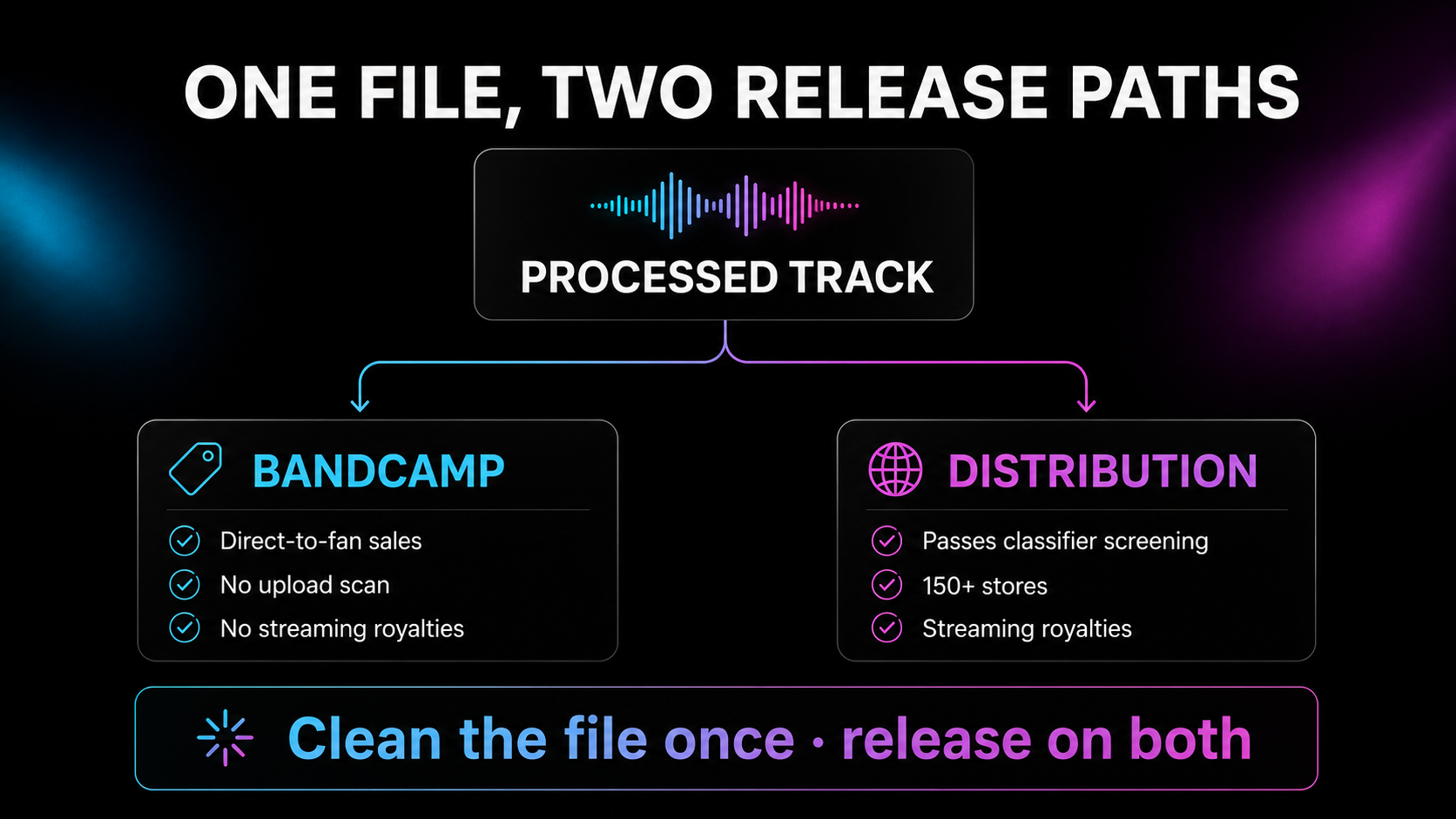
Do both. Process the track once, distribute it to streaming, and put the same release on your Bandcamp page for direct sales. One clean file serves both paths, and neither strategy blocks the other.
The honest conditions
Two, and they matter more here than on the distributor pages, because Bandcamp's soft gate makes them easy to ignore.
Bulk uploading is what gets removed. Bandcamp's reactive enforcement targets volume and spam patterns. Flooding the platform with generated catalogues is the fastest way to lose the account, and it is the behaviour that hardens policy for everyone else releasing in good faith.
Release prep is for music you made. Cleaning your own tracks so they survive automated screening is standard release prep. Misrepresenting who made something, or impersonating an artist, is a different act, and it is against policy on Bandcamp and everywhere else. Our recommendation carries that condition on every page.
The bottom line
Bandcamp bans wholly AI-generated music outright yet runs no classifier at upload, which makes it the strictest policy in music paired with the loosest enforcement, and it is not a distributor, which makes it far less useful than it first appears. It is an excellent storefront and a poor escape hatch. If your track was rejected by a distributor, the productive move is to fix the file rather than shrink the ambition: the artifacts that triggered the rejection are removable, and our Undetectr review documents what happened when we removed them across 98 test tracks and six distributor screens.
Frequently asked questions
No, not since 13 January 2026. Bandcamp published a generative AI policy stating that music generated wholly or in substantial part by AI is not permitted, and that using AI to impersonate other artists or styles is prohibited. Enforcement is human rather than algorithmic: Bandcamp says it does not use algorithmic tools for these decisions, relying instead on community reporting and human review.
Yes. On 13 January 2026 Bandcamp published a generative AI policy prohibiting audio generated wholly or in substantial part by AI, making it the first major music platform to issue a full ban rather than a disclosure requirement. The nuance worth knowing is enforcement: Bandcamp states it uses no algorithmic detection, so there is no classifier at upload. Removal follows community reports and human review instead.
No, and this is the most consequential misunderstanding on this topic. Bandcamp is a direct-to-fan storefront: you upload, you set a price, fans buy from your page. A distributor like DistroKid or TuneCore delivers your track to Spotify, Apple Music, and 150+ other stores. Bandcamp does not do that, which is why a Bandcamp release does not solve the distribution problem that got you here.
Yes. Because enforcement is reactive, removal usually follows a report, a pattern of bulk uploading, or a rights complaint rather than an upload scan. That gives a slower feedback loop than distributor screening, but a less predictable one: a catalogue can sit live for months and then be removed in one pass.
It is a genuine fallback for selling directly to an existing audience, but it is not a substitute for distribution. Bandcamp has no algorithmic recommendation engine to discover you, no streaming royalties, and a much smaller buyer pool. Using it as a workaround for distributor rejection trades a fixable file problem for a permanent reach problem.
For Bandcamp alone, no: there is no classifier at the gate. But most musicians releasing on Bandcamp also distribute to streaming, and that is where the same file meets automated screening. If any part of your plan includes Spotify, Apple Music, or YouTube Music, the file needs to clear a classifier, which is what Undetectr is built for.
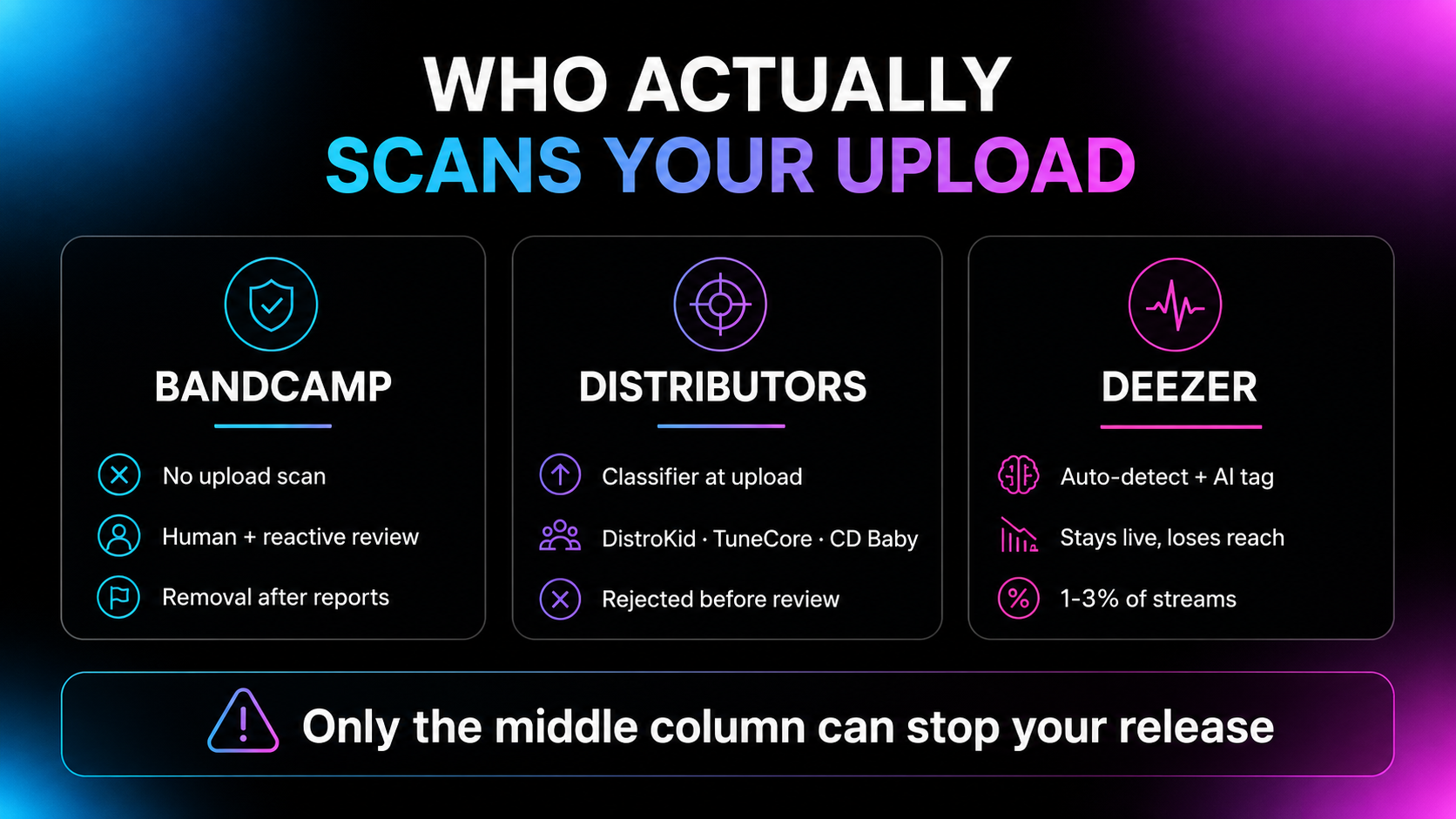
Three different models. Bandcamp: human, reactive, curation-led. Distributors like DistroKid and TuneCore: automated classifier screening at upload. Deezer: automated detection plus a public AI tag that quietly excludes tracks from recommendations. Only the middle group can stop your release outright, and only the last group can make a live release invisible.
Ready to release your Suno tracks?
Explore Undetectr’s published track-processing features before preparing your release.