CD Baby AI Music Policy: The Strictest Screen in 2026
Every major distributor screens for AI music. CD Baby is the only one whose written policy rejects it outright, no human-contribution carve-out, no disclosure pathway. Here is how the strictest policy in distribution actually behaves at upload, based on our own submissions.
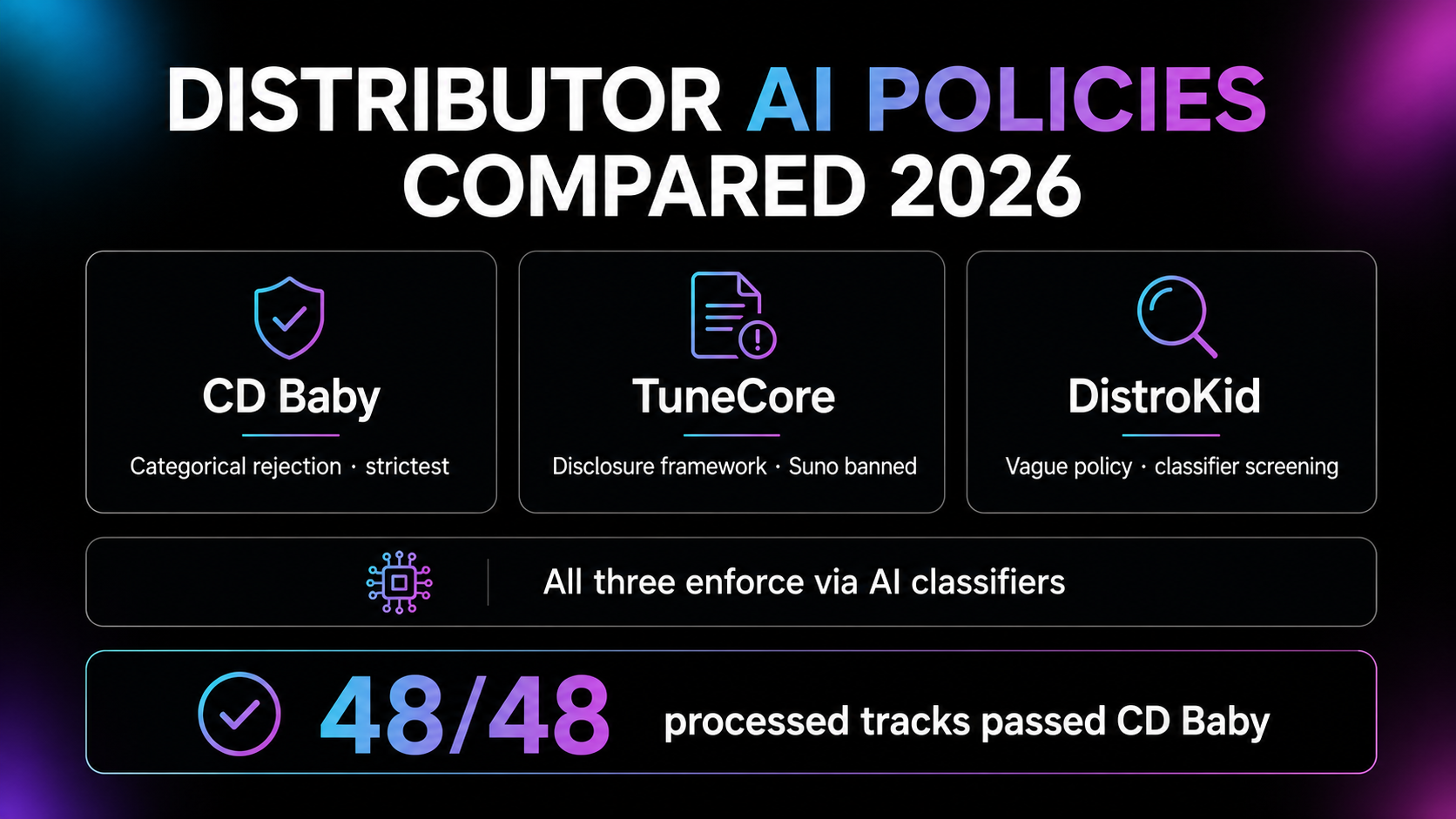
- CD Baby's 2026 policy, under Downtown Music's content rules, rejects AI-generated tracks categorically, the most restrictive stance of any major distributor
- There is no AI-assisted carve-out like TuneCore's: if screening concludes AI generated the track, it does not distribute
- Enforcement is still a classifier reading generation fingerprints, the same mechanism as every other distributor screen
- In our round-one testing, 48 of 48 processed Suno tracks passed CD Baby screening; one tester later passed 12 of 12 on first submission

The one distributor that just says no
TuneCore built a disclosure framework. DistroKid kept its language vague. The CD Baby AI music position goes the other way entirely: under Downtown Music's content policy, refined in 2026 with generative AI squarely in scope, CD Baby rejects AI-generated music categorically. No human-contribution threshold to argue about, no metadata fields to declare through. If screening concludes AI made the track, the track does not distribute.
That makes CD Baby the strictest written policy among major distributors, and for AI musicians it raises the obvious question this page answers: what does "strictest" actually mean at the moment your upload hits the screen?
What the policy says
CD Baby's rules are Downtown Music's rules, and the 2026 revision has three stated aims:
Preventing non-consensual use of copyrighted material. The training-data question, the one driving the industry lawsuits. Downtown's policy positions its catalog against unlicensed AI both as input and output.
Transparency in metadata. AI-generated songs are expected to be identifiable as such in their metadata, which matters mostly as an enforcement hook: undeclared AI content that screening detects is a policy violation on top of a content one.
Attribution and compensation frameworks. Forward-looking language about paying rights-holders, the part of the policy aimed at industry negotiations rather than at your upload.
What the policy notably lacks is TuneCore's carve-out. There is no sentence describing acceptable AI-assisted work. Our TuneCore AI policy breakdown covers how that carve-out works where it exists; at CD Baby, the written answer is simply no.
What the screen actually does
Policy language and screening behavior are different layers, and the screening layer looks the same everywhere. CD Baby runs automated AI detection against every upload, as every major distributor now does. As we have documented across our AI music detector guide, these systems are statistical classifiers: they read the inaudible generation fingerprints that tools like Suno and Udio leave woven through the spectral content of exports, and they return a confidence score. Above threshold, rejected, before any human involvement.
Two properties of that mechanism matter for CD Baby specifically.
First, the classifier does not enforce the policy's intent, it enforces its own reading of the file. The policy bans AI-generated music; the classifier flags fingerprint-bearing audio. Those overlap heavily but are not the same set, and the difference runs both directions: human music occasionally false-flags, and clean files pass regardless of their history.
Second, the missing disclosure pathway changes the cost of being flagged. At TuneCore, a flag can turn into a conversation about declared AI assistance. At CD Baby, the policy offers no such conversation. A flag is a rejection, which makes the state of the file at upload effectively the whole game.

What our testing showed
CD Baby was one of the six distributors in our round-one corpus: 48 Suno-generated tracks, processed through Undetectr, submitted under a real artist account. All 48 passed CD Baby's screening. Among our documented testers, one electronic producer submitted 12 tracks across two Suno projects and passed 12 of 12 on first try.
The mechanism explains the result. Undetectr removes the statistical fingerprints the classifier reads, and CD Baby's screen, for all the strictness of the policy behind it, is that classifier. The full two-round methodology, including the cross-generator corpus and audio quality testing, is in our Undetectr review.
The strictest policy in distribution still enforces through a classifier. Undetectr removes what it reads, in about 90 seconds per track, mastering included. One-time $39.
Try Undetectr → from $19 · $39 lifetimeChoosing your gatekeeper honestly
A point we make throughout this site and will make again here: the right response to a policy you do not like is not deception, it is routing. Distributor policies genuinely differ. If your music is fully AI-generated and you want a distributor whose written rules are compatible with that, CD Baby is the worst fit among the majors and our AI music distribution guide maps the alternatives. If your workflow involves real human authorship and your problem is that raw generator exports carry fingerprints your finished work does not deserve, release prep is what it has always been: getting the file to represent the music.
Either way, the metadata transparency expectations are part of Downtown's policy, and a clean file does not answer them for you. Declare what your chosen distributor's framework asks you to declare.
The bottom line
CD Baby has the strictest AI music policy of any major distributor on paper: categorical rejection, no carve-outs, under Downtown Music's 2026 content rules. At upload, that policy is enforced by the same classifier mechanism as everywhere else, reading generation fingerprints in the file. In our testing, 48 of 48 processed tracks passed it. The policy is the loudest in the industry; the screen is identical to its neighbors, and it can only read what you give it.
Frequently asked questions
CD Baby's written policy is the most restrictive of any major distributor: it rejects tracks identified as AI-generated, and unlike TuneCore it offers no explicit carve-out for AI-assisted work with human contribution. The policy sits under Downtown Music's content rules, which CD Baby refined in 2026 with a specific focus on generative AI.
The same way every distributor does: an automated classifier that reads the statistical generation fingerprints AI generators leave in exported files, run against every upload at submission. No human listens to your track at the screening stage. The classifier returns a confidence score, and above CD Baby's threshold the release is rejected before review.
If the rejection referenced AI or content policy, the screening classifier read generation fingerprints in your audio. Raw exports from Suno, Udio, and similar tools carry these fingerprints and are flagged near-universally. The rejection is mechanical: it reflects what the classifier found in the file, not how the music sounds.
Downtown Music is CD Baby's parent, and its content policy is the rulebook CD Baby enforces. The 2026 revision targets three things: preventing non-consensual use of copyrighted material in AI training and output, requiring transparency in metadata for AI-generated songs, and supporting attribution and compensation frameworks. The practical enforcement instrument for all three is upload screening.
In our testing, consistently, when the generation artifacts were removed first. All 48 processed Suno tracks in our round-one corpus passed CD Baby screening, and one of our documented testers passed 12 of 12 tracks on first submission. The classifier can only read what is in the file.
On paper, clearly: DistroKid's policy is vague and TuneCore accepts declared AI-assisted work, while CD Baby rejects AI-generated music categorically. At the screening layer the three behave nearly identically, because all of them run classifiers against the same generation fingerprints. The difference is what happens if you are flagged: at CD Baby there is no disclosure pathway to argue through.
If your music is fully AI-generated, CD Baby's policy is the least compatible of the major distributors, and choosing a distributor whose written rules match your workflow is the lower-risk path. If your workflow is AI-assisted with substantial human input, CD Baby's screening treats you the same as anyone: what matters at upload is whether the file carries fingerprints.
Ready to release your Suno tracks?
Explore Undetectr’s published track-processing features before preparing your release.