Cynqo Review: Music Briefs 2026
Cynqo gives AI music creators a practical question to answer: what does a producer need? This Suno Watermark Remover review follows the route from a published brief to a musical direction and a pitch, including the US$15,000 opportunity listed on Played. We checked the live pages, requirements and prices on 31 October 2026.
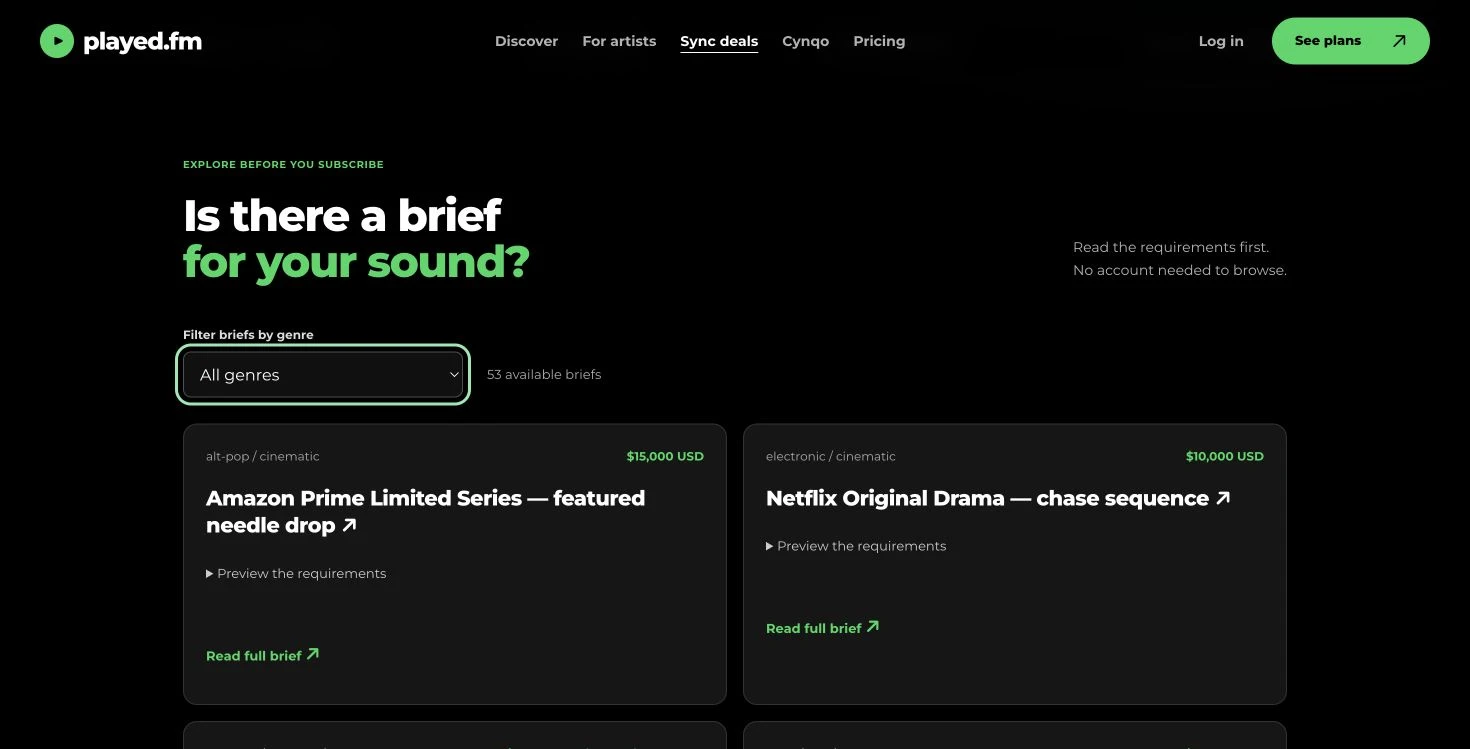
- The short version: Cynqo connects AI music creation with the requirements of real briefs published on Played. The board showed 53 available briefs when checked on 31 October 2026.
- One featured-song listing carries a US$15,000 budget. That is a published opportunity, not a documented artist payout or a promised result.
- Cynqo costs $97 once, or $67 once for active paid Played Pro/Label members, with 100 starter generation credits. A verified-account trial offers two credits.
- Played Pro costs $19.99/month with three pitches; Label costs $29.99/month with ten. Generation and pitching use separate balances.
- Our strongest finding is the brief-to-direction workflow: it gives the next track a concrete purpose. This review examines the live interfaces, examples and requirements; it is not a placement-success study.
- Why Cynqo makes AI music creation more purposeful
- The US$15,000 brief: what the opportunity asks for
- Music for TV, radio and podcasts needs a different brief
- From a published request to an editable musical direction
- Cynqo and Played pricing: plan the two costs separately
- Prepare a recording that makes the producer’s decision easier
- Make the musical decision before the cleanup decision
- Our verdict: a compelling route from idea to opportunity
- Five short video explainers
Why Cynqo makes AI music creation more purposeful
The most appealing thing about Cynqo is the question it puts before the generate button: what is this music supposed to do? A song made for a television scene has a different job from a podcast bed. Starting with that job gives you a better way to judge the result than asking whether an isolated track sounds impressive.
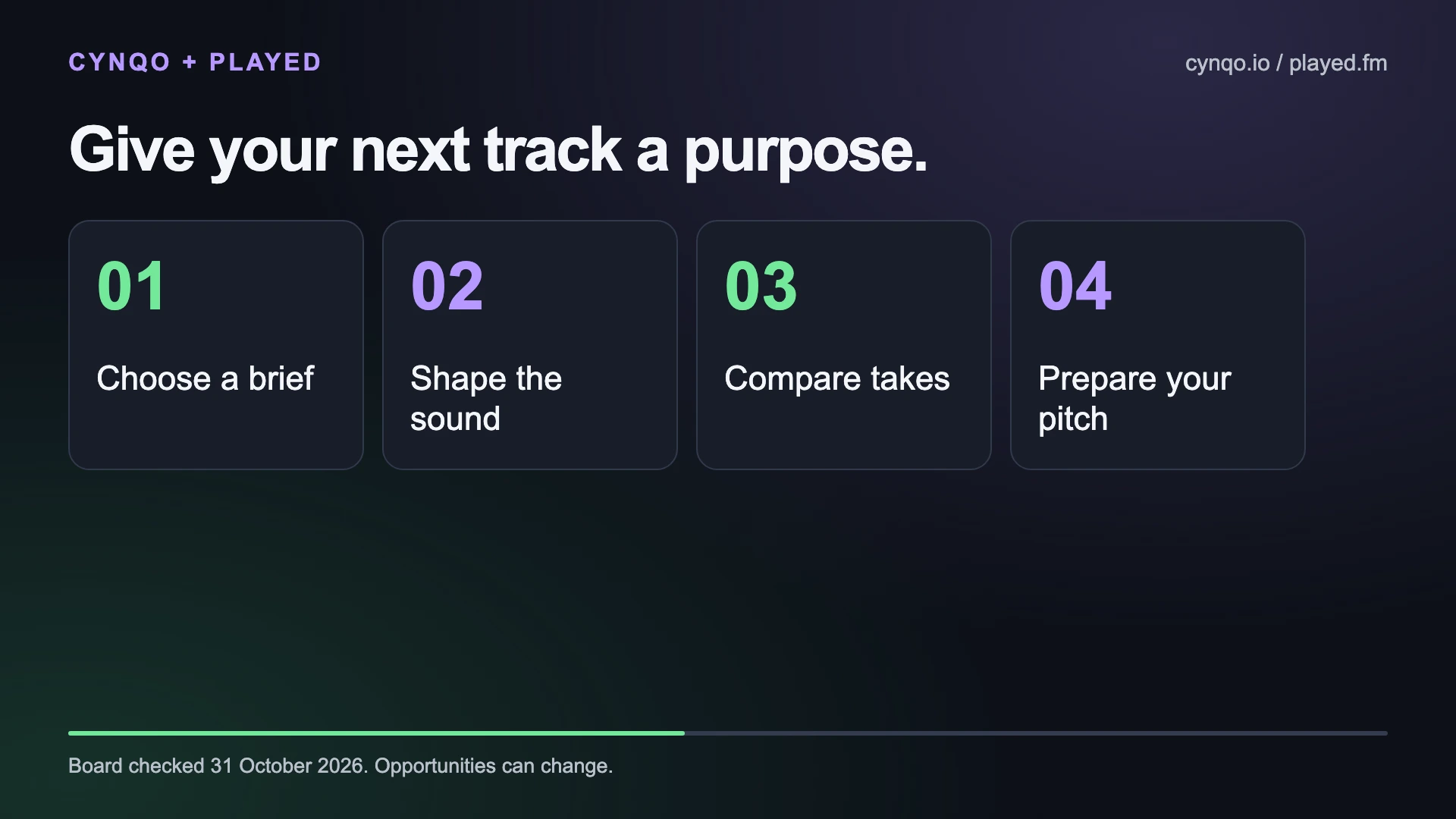
Cynqo brings the brief, musical direction and recording workflow into the same browser-based process. Played supplies the opportunities and the submission route. You can examine the requested genre, mood, instrumentation and timing, create around that direction, compare takes and decide which recording deserves a pitch.
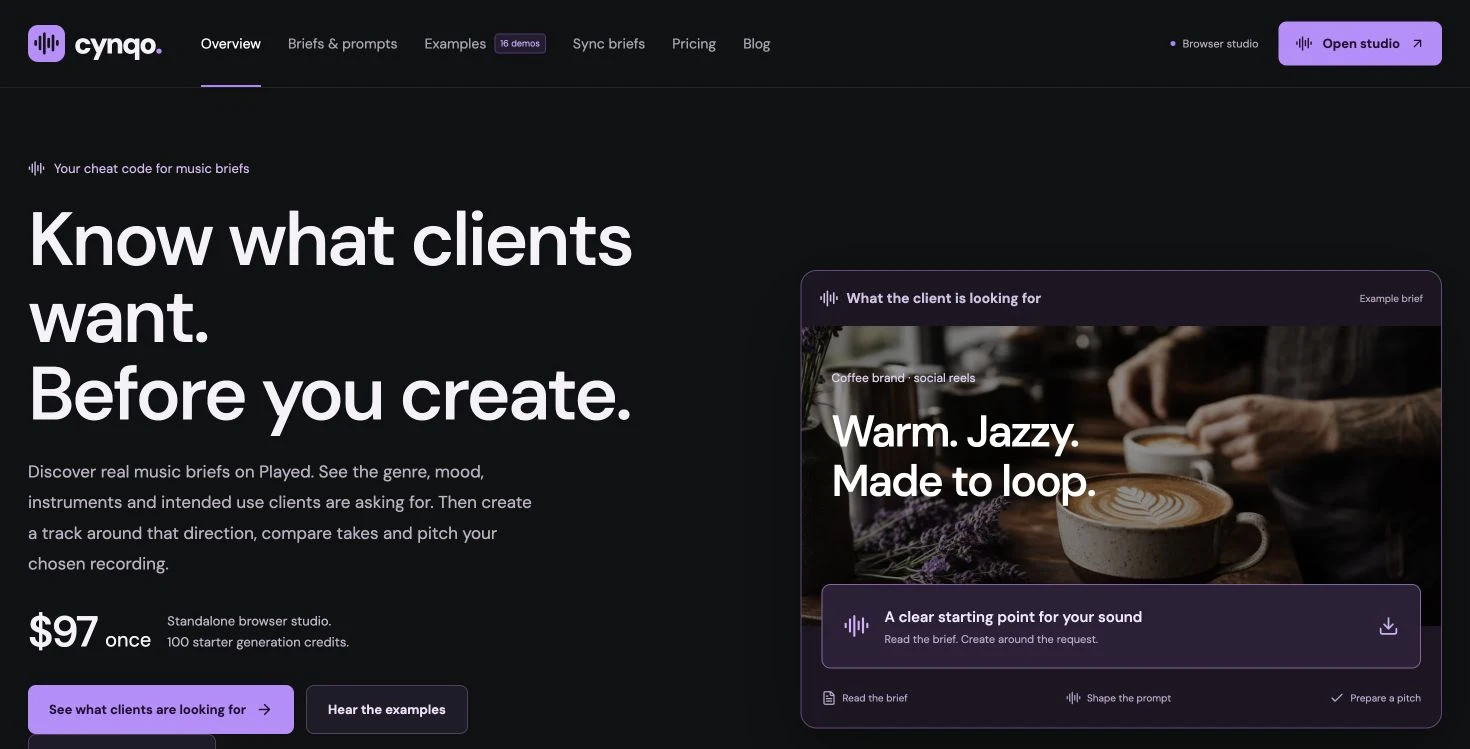
We opened the current sites, expanded the 53-brief board, inspected the $15,000 listing and compared the public pricing. We also changed the example brief from coffee-brand music to a true-crime podcast and inspected the corresponding prompt. The screenshots in this article come from those real interfaces. The graphics and short videos are editorial explanations of the same findings.
Our view: the combination is especially attractive for creators who can already recognise a good musical idea but need a clearer commercial use for it. The value is a purposeful starting point and a visible route to submission. We have not measured a placement rate, verified an artist payout or benchmarked the current generation service's audio quality in this review.
The US$15,000 brief: what the opportunity asks for
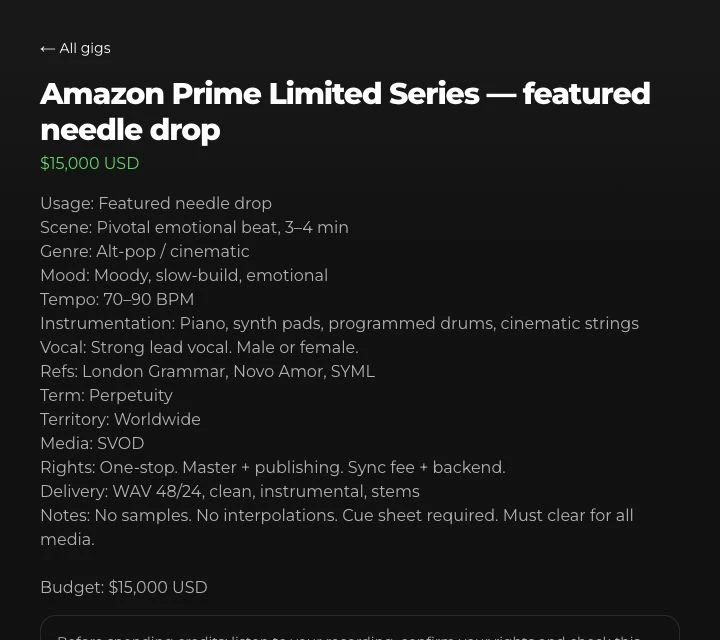
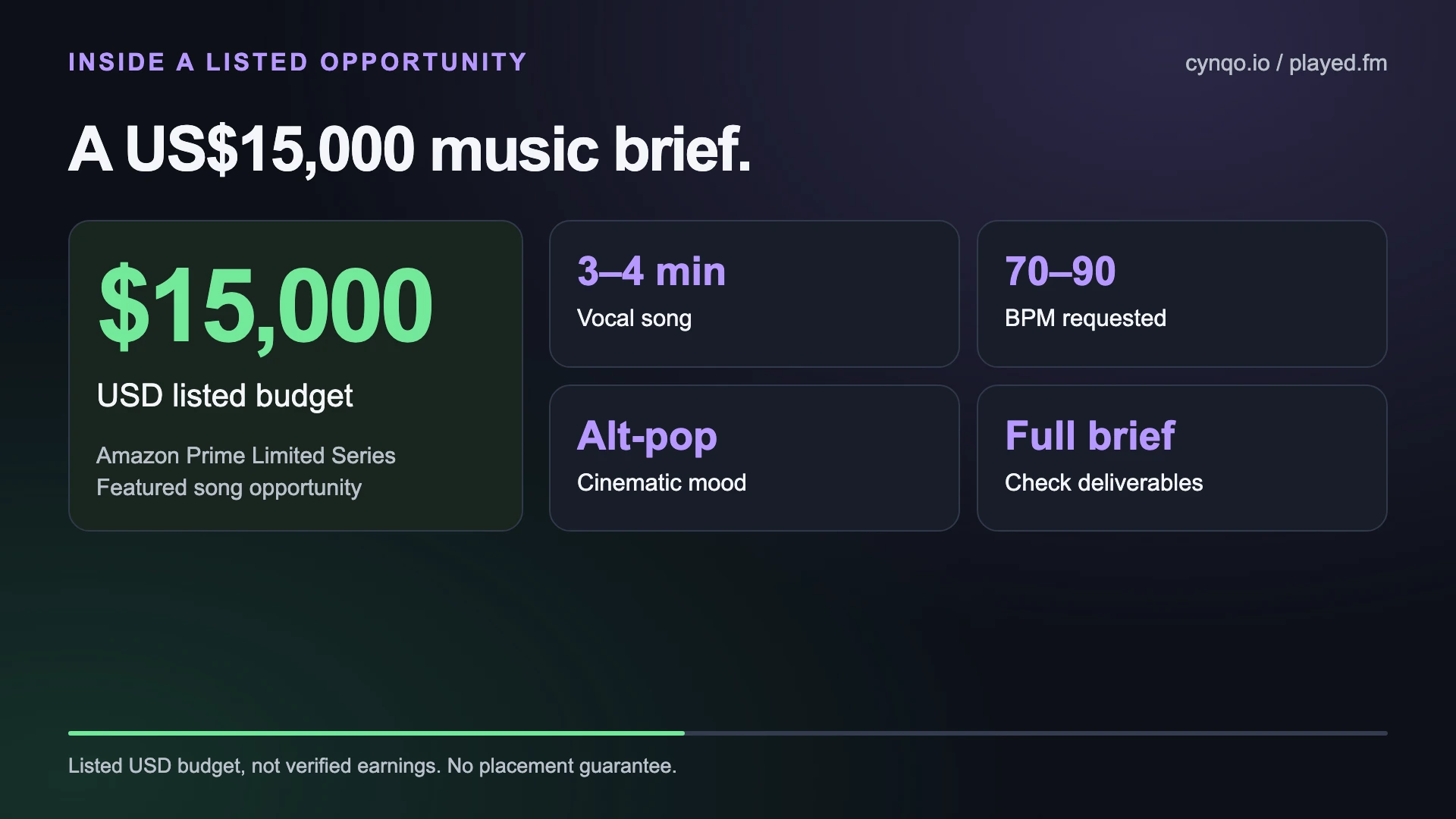
The largest displayed budget in our board check was US$15,000, attached to Played's Amazon Prime limited-series listing. It calls for a featured vocal song with an emotional, slow-building character. The requested duration is three to four minutes and the tempo range is 70–90 BPM.
That specificity is the interesting part. Piano, synth pads, programmed drums and cinematic strings describe a musical world you can work toward. A strong lead vocal has a clear role. Instead of generating a catalogue of unrelated tracks and searching for somewhere to send them, you have a defined creative target before you start.
The full listing also names delivery and rights requirements, including a clean version, instrumental, stems and WAV delivery at 48 kHz/24-bit. Read the complete requirements before committing to the project. A compelling first recording and a complete delivery package are different stages of the work.
| Listed opportunity | Published budget | Useful creative detail |
|---|---|---|
| Featured song for the Amazon Prime series listing | US$15,000 | Emotional alt-pop/cinematic vocal; 3–4 minutes; 70–90 BPM |
| Netflix drama chase-scene listing | US$10,000 | Electronic/cinematic instrumental; 90–120 seconds; 120–140 BPM |
| Podcast-network background library | $5,000 package | Multiple tracks, rather than a fee for one short cue |
| Top-50 podcast identity | US$2,500 per package | Intro and outro music with an electronic/organic direction |
| Sponsored podcast-segment bed | $150 | A restrained instrumental beneath a sponsor read |
These figures are listing budgets checked on 31 October 2026, with scope as displayed. They are not interchangeable per-track rates. The $15,000 entry is an opportunity to pitch for; we found no public payment receipt establishing that a particular creator had received that amount. The names above identify the listings on Played and do not imply an endorsement of Cynqo by those productions.
Music for TV, radio and podcasts needs a different brief
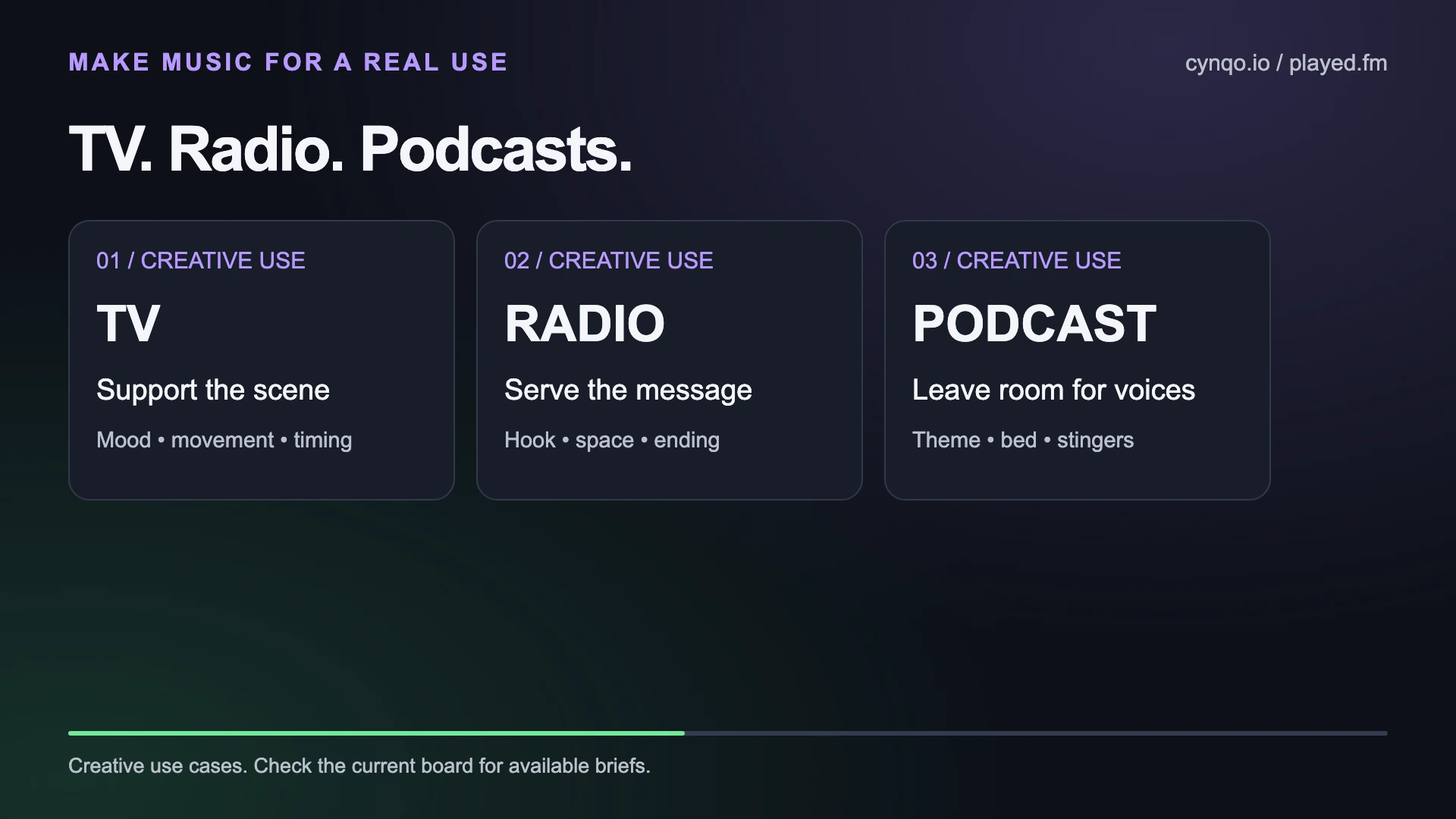
For television, begin with the scene. Does the music need to intensify action, support an emotional turn or stay beneath dialogue? The live chase-scene listing is a useful example: its tempo and duration create a much more focused assignment than a request for something cinematic.
For radio spots and audio advertising, think about the spoken message. A memorable opening can help, but the arrangement must leave room for the voice and finish where the edit needs it to finish. These are practical creative uses for short-form music; the available commissions depend on the current brief board. We are not presenting a radio-specific listing as part of this snapshot.
Podcasts can need several related pieces: a recognisable opening theme, an ending, transitions and quieter beds beneath speech. A package should sound coherent while giving the producer enough flexibility to edit. A strong theme alone may not satisfy a request that also includes stingers or multiple background cues.
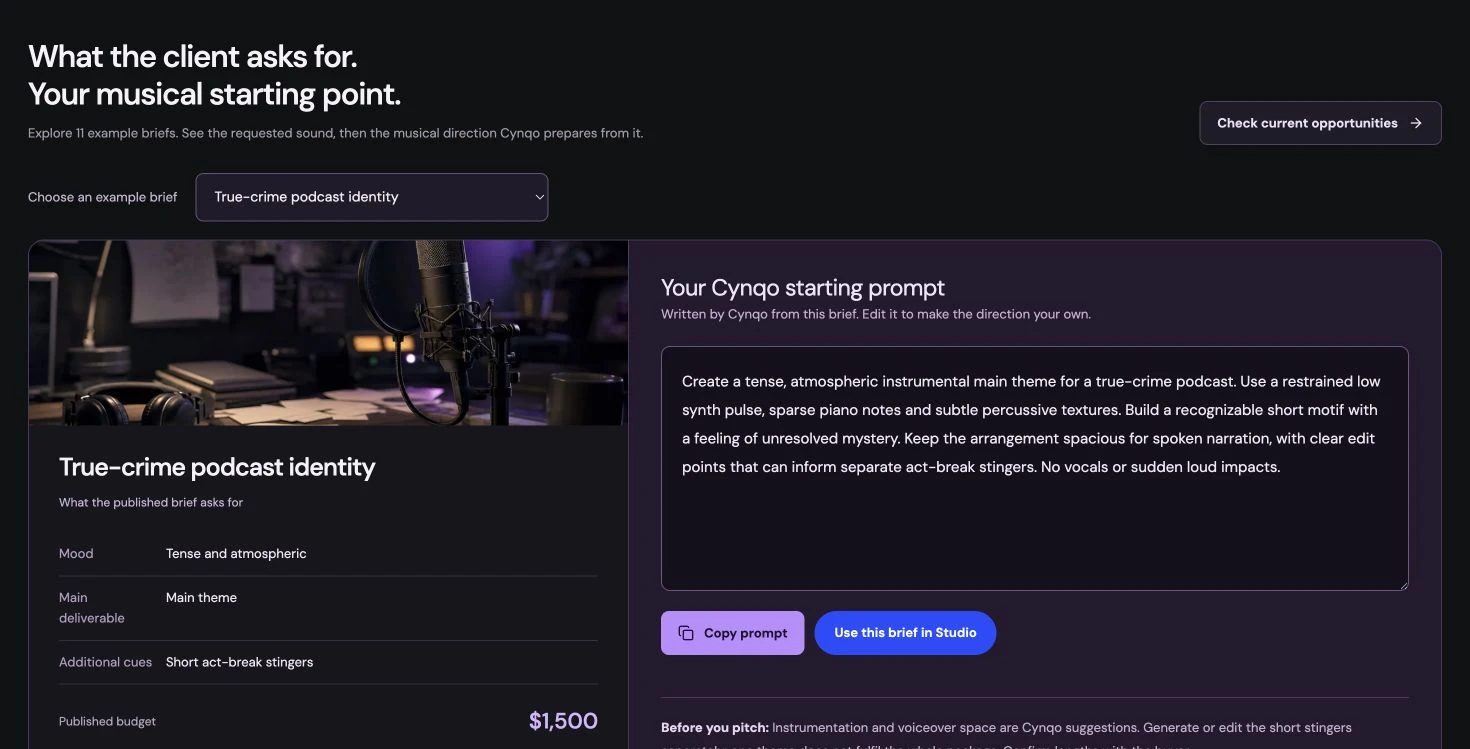
We found Cynqo's true-crime example particularly useful for understanding this distinction. Selecting it changed the musical direction to a restrained, atmospheric instrumental with space for narration. It also identified the need to generate or edit the short stingers separately. That is useful creative guidance because it keeps the complete assignment visible.
From a published request to an editable musical direction
Cynqo's public examples pair the source requirements with a proposed musical interpretation. That is an effective way to make an unfamiliar brief approachable. A producer can ask for warmth or tension without supplying the precise instrumentation you should use; the starting direction helps translate those words into musical choices.
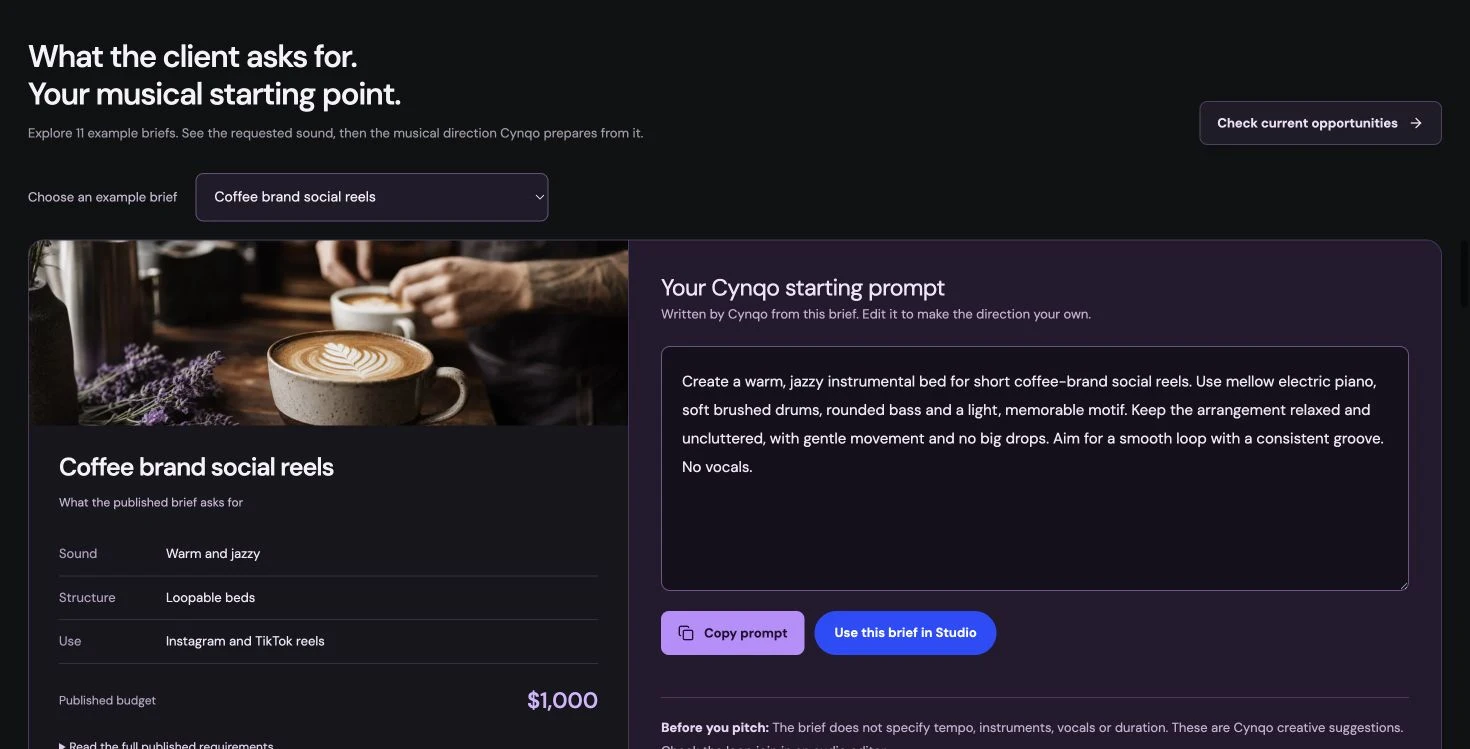
The coffee-brand example illustrates it well. The request emphasises a warm, jazzy, loopable feel. Cynqo proposes a restrained instrumental setting with gentle rhythmic movement. The interface identifies which details are suggestions, making it easier to decide what to keep and what to change.
Treat the prepared direction as a first draft. Give the track its own identity, keep the buyer's essential requirements intact and avoid changing every variable at once. If the arrangement feels too busy for narration, reduce the density before abandoning the entire idea. If the opening lacks an immediate hook, concentrate on the opening rather than rewriting the full concept.
The studio's advertised modes cover vocal music and instrumental scores. Both use one generation credit per request, with returned takes included. The practical review should happen after creation: listen through the recording, compare the alternatives and save the version that serves the assignment most convincingly.
Opening a brief in Cynqo prepares the workflow after sign-in; it does not automatically spend generation credits or send a buyer a pitch. That separation is useful. You can inspect the direction before approving a generation and make a separate decision about submitting the selected recording.
Cynqo and Played pricing: plan the two costs separately
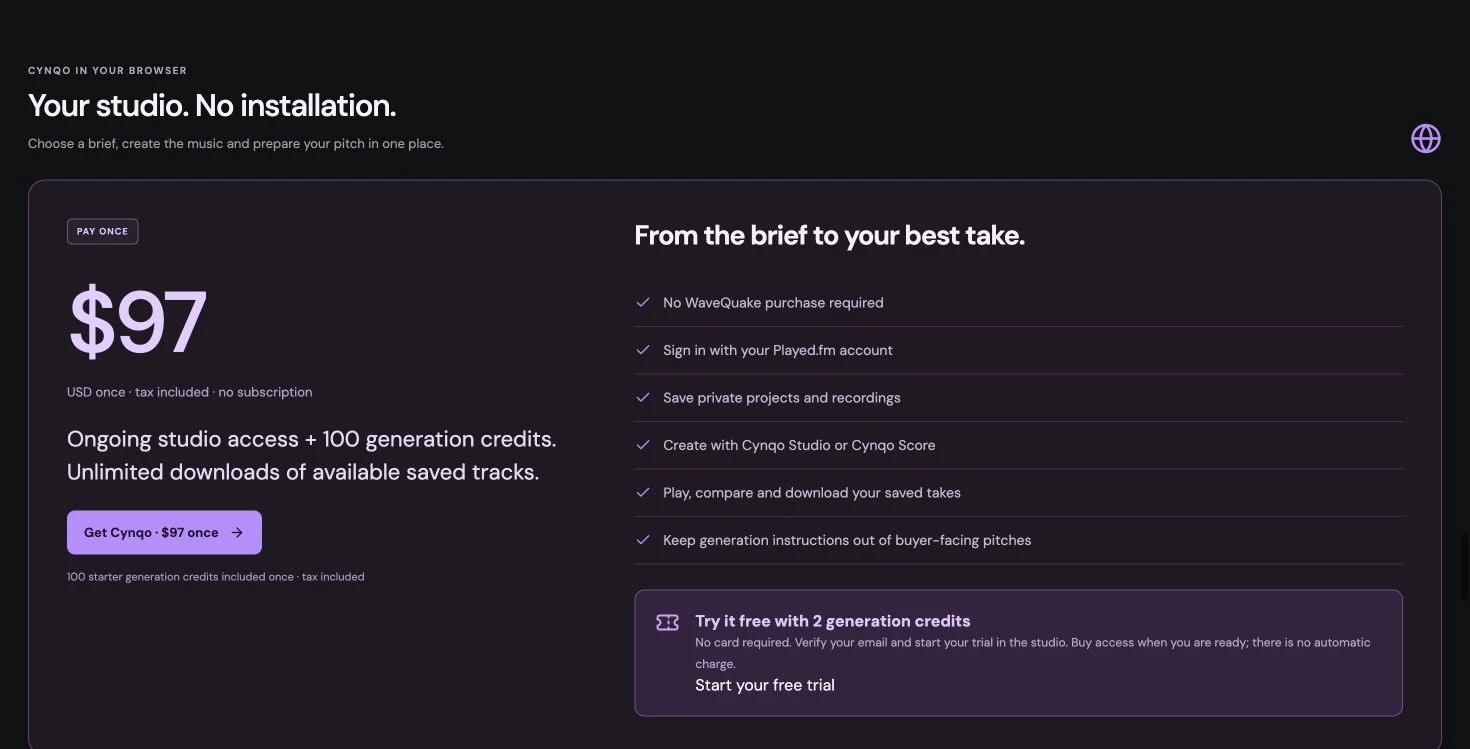
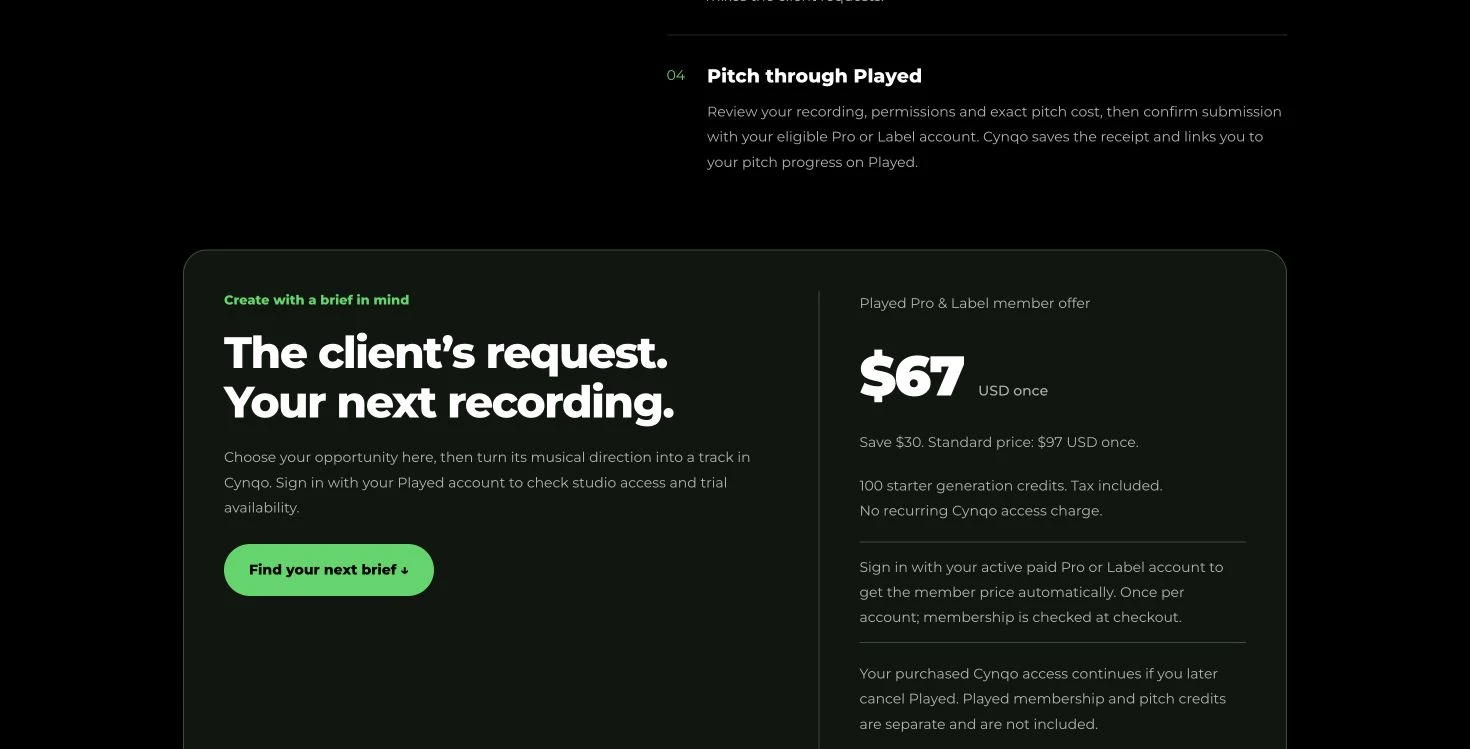
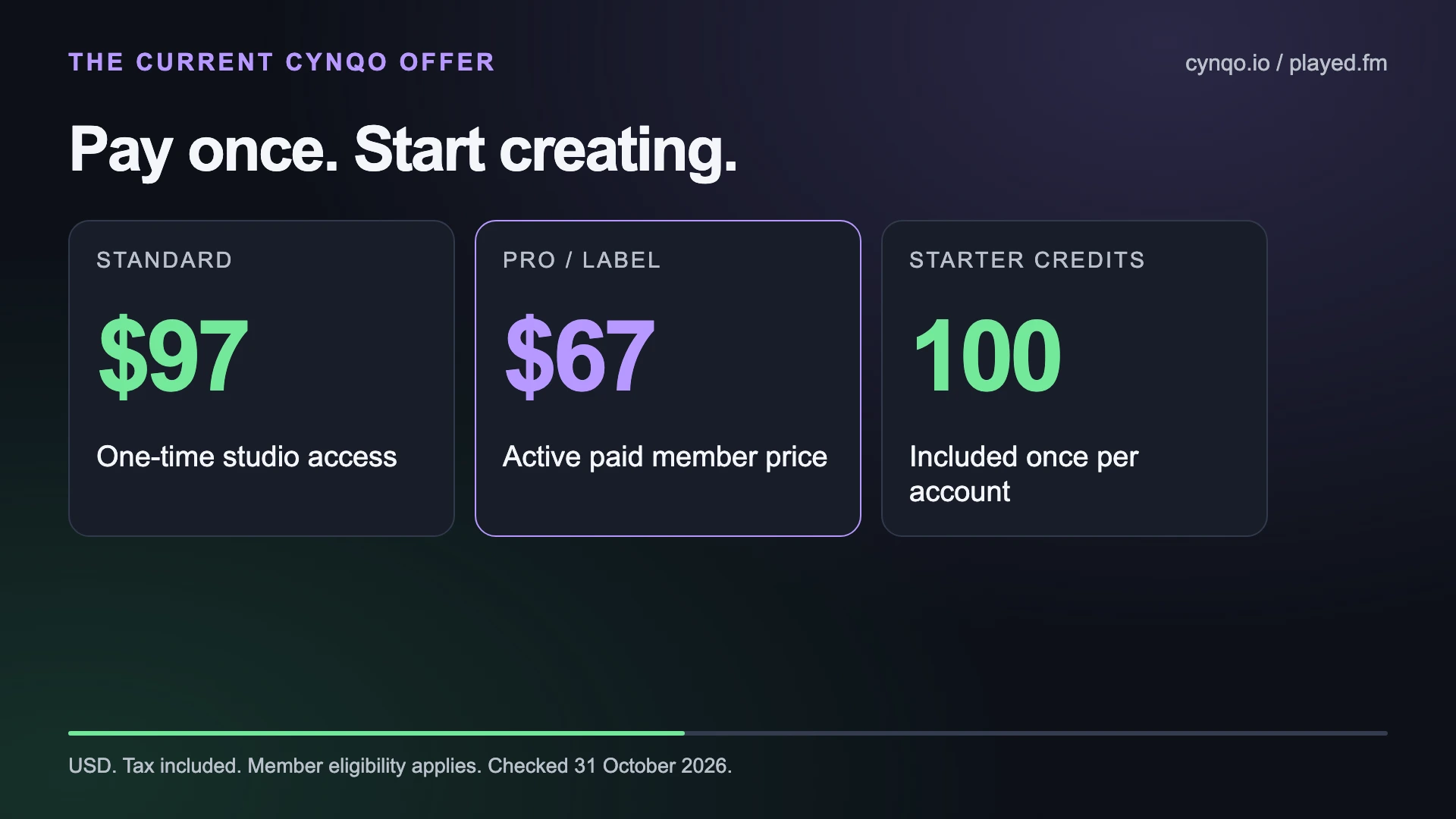
Cynqo's standard offer is $97 USD once, including 100 starter generation credits. Active paid Played Pro and Label members can buy it for $67 once, a $30 reduction, with the same starting allocation. The published offer includes tax and no recurring Cynqo access charge.
Generation is a metered resource. The initial 100 credits are awarded once, and the optional packs add further requests. Downloading an available saved recording does not use another generation credit. A two-credit trial is available after email verification, so there is a way to begin before buying access.
| Product or allowance | Current advertised price | What it covers |
|---|---|---|
| Cynqo standard access | $97 once | Studio access and 100 starter generation credits |
| Cynqo Pro/Label member offer | $67 once | Same studio offer for eligible active paid members |
| Cynqo generation pack | $19 / 40 credits | Additional generation requests |
| Cynqo generation pack | $49 / 120 credits | Additional generation requests |
| Cynqo generation pack | $99 / 300 credits | Additional generation requests |
| Played Pro | $19.99/month | Three included sync pitches each month |
| Played Label | $29.99/month | Ten included sync pitches each month |
For an eligible creator starting with Pro and buying Cynqo at the member price, the displayed first-month combination is $86.99: $67 plus $19.99. That calculation covers the stated access and monthly plan, not extra generation packs, additional services or a guaranteed placement. The continuing Played subscription is a separate expense.
Played advertises 0% platform commission on sync deals. Payment-provider fees and the subscription still matter, so zero platform commission should not be read as zero overall cost. Check the current plan details and Cynqo member offer before choosing a plan.
Prepare a recording that makes the producer’s decision easier
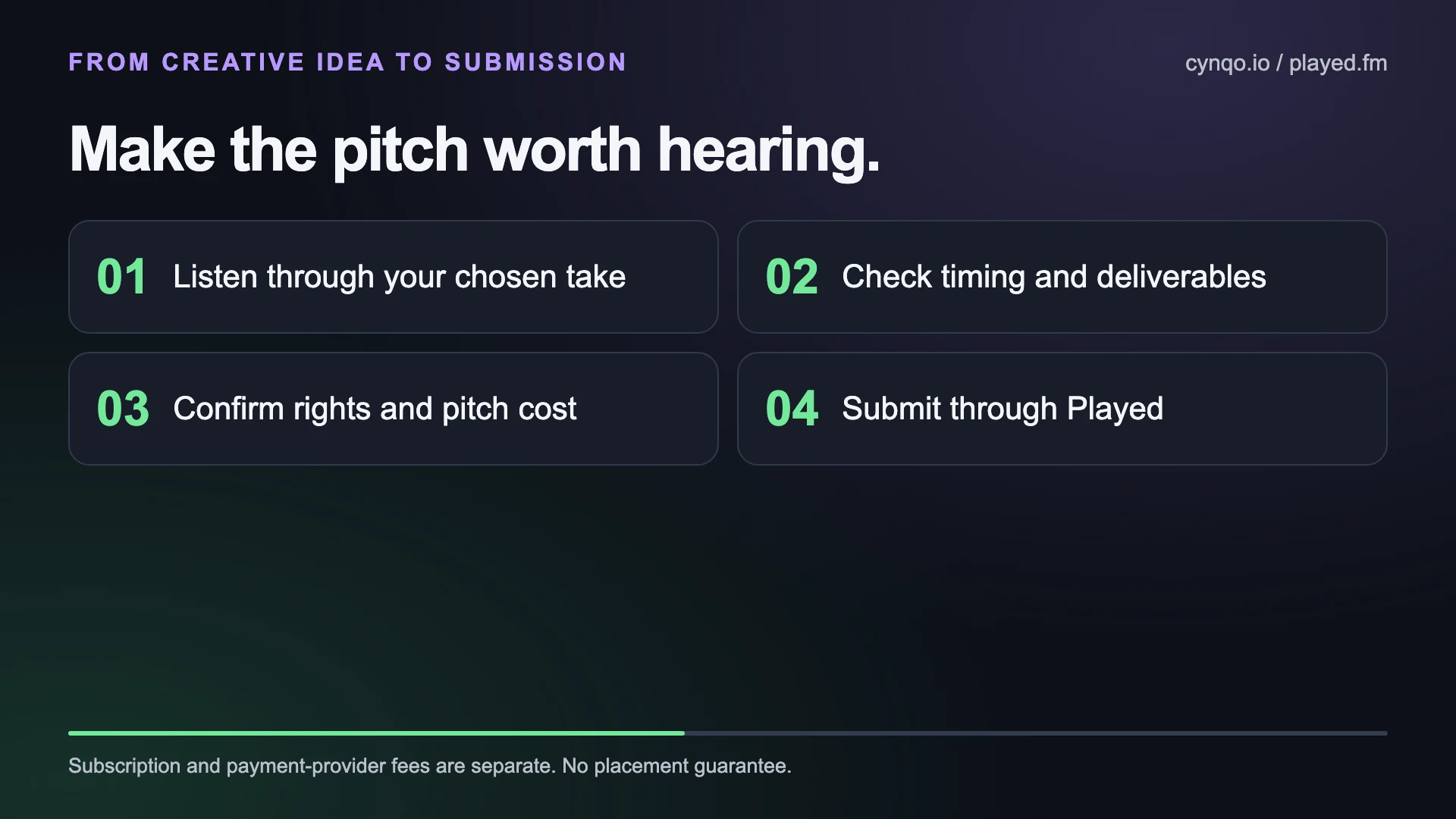
A promising cue should be easy to assess. Listen from the first second through the ending, check whether the musical development fits the intended use and identify any edit the brief requires. For voice-led work, try the recording beneath a spoken read at a sensible level rather than judging it only in isolation.
Keep a simple project record: the brief URL, chosen take, working title, duration and outstanding deliverables. This prevents a strong idea from turning into a confusing folder of versions. A clear filename and a short explanation of why the recording fits can make the submission more useful to the person reviewing it.
The current brief page explicitly says that AI-generated music is accepted in the Cynqo and Played workflow. The remaining work includes confirming your rights, checking the delivery request and reviewing the exact pitch cost. A clean-sounding file cannot establish ownership of an uncleared sample or a collaborator's contribution.
We inspected the actual application interface as well as the marketing page. The brief form uses a Played catalogue recording or a private file, with a listening link created through the platform. Follow the current form when preparing your submission. Cynqo's direct handoff is described for eligible Pro and Label accounts, with a final review before submission.
The brief also explains that reviews can take up to six months and that a subscription must stay active for a pending application to remain in consideration. Plan for that possibility when setting a pitching budget. A deliberate handful of well-matched submissions is easier to manage than sending every new generation everywhere.
Make the musical decision before the cleanup decision
A creator arriving here with an audio file to finish may already have the beginning of a useful cue. Before applying another process, ask what the project needs from that recording. Does it need a more restrained arrangement, a different mood or simply an edit to the opening?
Cynqo is interesting at that earlier creative stage. A published request can make the next attempt more focused. You can decide whether to develop the existing idea or create another interpretation of the brief, then choose the performance that works before preparing delivery files.
Our commercial-use guide and AI music distribution overview provide related background for planning a recording's next steps. Keep the musical assessment and the permissions record clear. A production brief may ask for several deliverables even when the initial pitch starts with one chosen take.
For a practical first project, choose a direction you can describe plainly. Write down the required mood, intended use and key timing points. Then listen for those qualities in the result. That makes your finishing plan concrete and gives the producer a more understandable reason to consider the track.
Our verdict: a compelling route from idea to opportunity
Cynqo's strongest proposition is the connection between making music and understanding a request for music. The brief supplies a purpose, the prepared direction gives you somewhere to begin, and Played provides the place to submit the recording. That is a clear and useful workflow for a creator who wants to make something a producer could actually use.
We particularly like the visible distinction between the client's requirements and Cynqo's suggestions. It leaves room for judgement and original musical choices. The two-credit trial and one-time access offer also make the starting commitment easy to understand, provided you keep generation and pitching costs separate.
The sensible first move is to browse a few current Played briefs, choose one whose musical direction suits you and explore it in Cynqo. Read the whole request, make a focused creative attempt and compare the resulting recording against that request. The listed budgets make the opportunity tangible; the quality and suitability of the final track remain the work.
Five short video explainers
Five original 20-second videos created for Suno Watermark Remover, with site-specific narration and visual directions.
A brief gives finishing a purpose.
Transcript: Before polishing an AI recording, know what it is meant to do. A producer’s brief gives you a use, mood, duration and delivery target. Build around those requirements in Cynqo. Finishing becomes more useful when you can hear exactly what the project needs.
The delivery details matter too.
Transcript: Played’s fifteen-thousand-dollar featured-song brief includes delivery requirements, not just a genre. It asks for high-resolution WAV, a clean version, an instrumental and stems. Check those details before committing to a take. A listed budget is not a promise of selection or payment.
Check the spaces between the notes.
Transcript: For background music, the quiet details matter. Listen through transitions, low-level passages and the final tail. Think about how an editor will place the cue under speech or picture. Cynqo provides the creative starting point; your listening pass decides what is ready to pitch.
Plan the next request deliberately.
Transcript: Cynqo’s standard offer includes one hundred starter generation credits with one-time studio access. Extra generation packs are optional, and pitching through Played is separate. Use each request deliberately: change a clear musical direction, then compare the result before spending another credit.
Presentation cannot replace permission.
Transcript: A cleaner file does not settle ownership or permissions. Read the brief’s AI policy, confirm the rights you can offer, and check the delivery requirements. The inspected Played workflow accepts AI music, but each submission still needs an appropriate recording and a careful final review.
Frequently asked questions
Cynqo provides a browser-based music workflow organised around sync and production briefs. You can review a musical direction, create takes, compare recordings and prepare a selected track for pitching through Played.
Those are practical creative uses for songs, instrumental cues and background beds. Start with the required mood, timing and use, then check which opportunities are available and what each producer requests.
The Played listing we inspected displayed US$15,000 for a featured vocal-song opportunity. That establishes the published budget, not a completed payment to an artist; selection and the final agreement determine whether a placement happens.
The advertised standard price is US$97 once with 100 starter generation credits. Active paid Played Pro and Label members can access the US$67 member offer, while a verified-account trial provides two credits.
No. Cynqo generation credits and Played pitching allowances are separate. Played Pro currently includes three monthly pitches for $19.99/month, while Label includes ten for $29.99/month.
The current brief page explicitly accepts AI-generated music in the Cynqo and Played workflow. You still need to confirm your rights, listen to the selected recording and satisfy the brief's delivery requirements.
No. Opening the brief prepares the studio workflow after sign-in, and you approve a generation separately. Submission follows another review of the recording, permissions, membership and pitch cost.
The inspected brief says reviews can take up to six months. It also says the subscription must remain active for a pending application to stay in consideration, so include that possibility in your plan.
Ready to release your Suno tracks?
Explore Undetectr’s published track-processing features before preparing your release.