Is Undetectr a Scam? We Tested It on 98 Tracks (2026)
No, and the skepticism is still reasonable. New categories attract scam suspicion for good reasons, and this one arrived with a one-time price in a subscription market, a world-first claim, and a promise that sounds impossible. We paid for it, tested 98 tracks across six distributor screens, and published what failed as well as what passed.
- We bought Undetectr on our own card across two test rounds. No press account, no comped upgrade, receipts kept
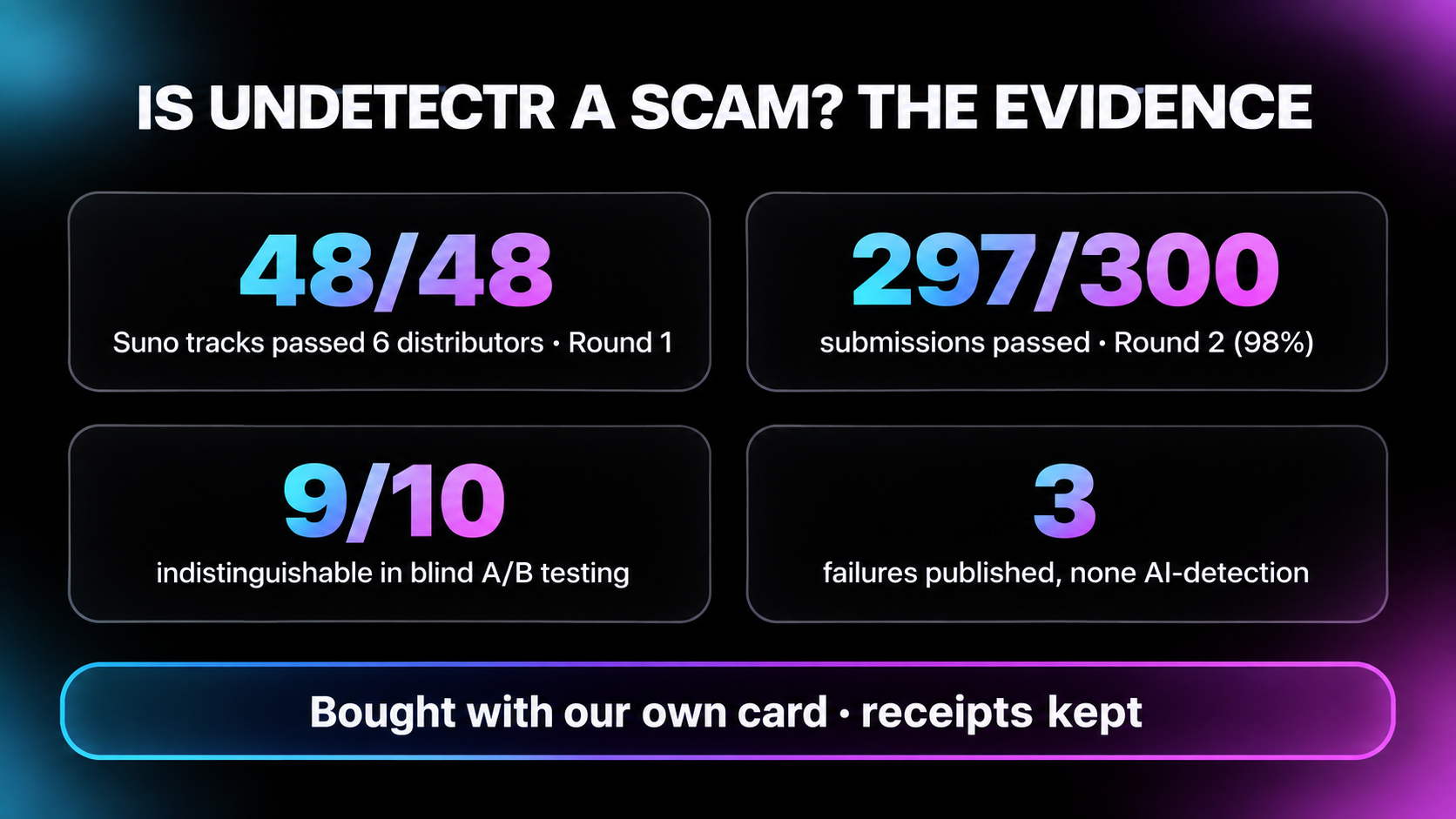
- Round one: 48 of 48 Suno tracks passed all six distributors. Round two: 297 of 300 submissions passed, a 98% pass rate
- We published the three failures and the one audible quality regression. A vendor-run scam does not publish its own misses
- No vendor pays us for placement and none sponsors this site. Tools that failed our testing stayed failed, and they are named
- The honest limits: browser-only, no API, edge cases under 45 seconds, and no vendor can promise permanence against retrained classifiers

The short answer, and why the question is fair
Is Undetectr a scam? No. We bought it with our own money, processed 98 tracks across two separate test rounds, submitted every one to real distributors under real artist accounts, and published the results including the failures.
That said, the question deserves better than a defensive answer. Skepticism here is rational, and anyone who tells you otherwise is selling harder than they are thinking. This page walks through why the suspicion exists, answers the five specific accusations one at a time, shows the evidence, and states plainly what would have made us call it a scam.
We are not paid by Undetectr. No vendor sponsors this site, buys placement on it, or sees a conclusion before it publishes. That belongs at the top of a page like this rather than buried at the bottom, and the rest of the article is the evidence rather than the assurance.
Why new categories get called scams
When something genuinely new arrives, disbelief is the default response, and usually it is the correct one. Most bold claims in software are false. The useful move is not to abandon the skepticism but to point it at the specific claim rather than the vibe.
Undetectr collected four suspicion triggers at once.
It charges once. A one-time $39 in a market where every competitor charges monthly reads as a bait price with a catch hiding somewhere. Subscription is so normalised that its absence feels like a trick.
It says "world's first." That phrase is the standard packaging of overreach. Most products using it are the third or fourth entrant dressing up a feature.
Its promise sounds impossible. "Remove the AI watermark" sounds like defeating cryptography. If that were the actual claim, disbelief would be correct.
The category really is full of fakes. This is the strongest reason of all. As we documented in our AI watermark detector guide, most products marketed as removers are detectors that change nothing about your file. People have been burned, and their pattern-matching is working properly.
So the honest framing is not "stop being skeptical." It is: here are the five things people actually accuse this tool of, and here is what testing each one produced.
The five accusations, answered
1. "It's too cheap to be real"
The pricing is genuinely unusual: $19 for 10 credits, or $39 once for unlimited processing, publicly stated to be rising to $99. No subscription.
That is early-adopter pricing, which is a well-worn strategy rather than a red flag. A cheap price is a reason to check delivery carefully, and delivery is checkable: you pay, you upload a file, you either get a processed file back or you do not. We did, on every track, across both rounds.
The genuine risk with lifetime pricing is not fraud but longevity, and it is worth naming. A one-time fee funds the company once while classifiers keep evolving. That is a real structural question about any lifetime deal, and we say so in the limits section rather than pretending it away.
2. "'World's first AI artifact removal engine' is hype"
This one turns on a definition, so here is ours. We have tested the category across two rounds and found no other tool built specifically to remove AI generation artifacts from music. What we found instead were detectors that measure, and general audio tools that were designed for other jobs.
Our top-5 artifact removal ranking put the alternatives through the identical 50-track corpus. iZotope RX 11, an excellent restoration suite, cleared 22 of 50 on DistroKid. Ableton cleared 14. Logic Pro 11. FL Studio 8. They are not competitors that lost, they are tools aimed at a different problem that happen to get partial credit.
So "first purpose-built tool for this" matched what we could observe. If a genuine competitor appears, that claim expires, and we will say so on this site.
3. "You can't remove a watermark, so this is impossible"
This is the most technically serious objection and it rests on a false premise.
If distributor screening decoded Suno's watermark, defeating it would require breaking a keyed signal, and skepticism would be justified. But that is not what happens. As our AI music detector guide and audio watermark explainer document at length, no public system decodes Suno's watermark. Distributor screening is a statistical classifier reading generation artifacts: incidental byproducts of how the model synthesises audio.
Classifiers are brittle against signal processing in a way keyed watermarks are not. Peer-reviewed work has repeatedly shown AI-audio classifiers can be defeated by processing that alters the statistical patterns they were trained on. That is a documented mechanism with published evidence behind it.
So the impossibility objection is answering a claim nobody made. The tool is not breaking cryptography. It is processing the audio features a probabilistic model reads.
4. "Every review of this thing is bought"
A fair suspicion, because a lot of pages ranking for this term are monetised. We are not paid by Undetectr or by any tool we cover, but you have no reason to take that on trust either.
So do not. Apply three tests that separate real testing from paid copy, and apply them to us as readily as to anyone else:
Does the reviewer publish failures? Ours did. Three of 300 submissions failed in round two: one sub-60-second track on Spotify ingestion and two YouTube Content ID matches. We published that. We also published the one track of ten where blind listeners could tell the processed file apart, a sparse acoustic piece where the noise floor lifted.
Does the reviewer ever say no? This site names tools that failed and keeps them failed. SongSubmit failed every distributor screen in our round-one corpus. AI-Music-Cleaner partially passed one. Those verdicts have not moved.
Does the reviewer state what would change their mind? That is the next section, and its absence is the clearest tell of paid copy.
5. "It's a fly-by-night operation"
Checkable rather than arguable. The product has a public pricing page, published terms, a documented feature set that has grown through 2026 including bulk import, mastering, a collision checker and a prompt vault, and an active blog. We have processed tracks through it repeatedly across three months without the service disappearing.
None of that is proof of permanence. It is evidence of an operating company rather than a landing page collecting card numbers.
What we actually did
Method matters more than verdict, so here is the whole thing.
Round one, May 2026. 48 tracks generated on Suno Pro across multiple genres, exported at maximum quality, processed, and submitted to six distributors under real artist accounts: DistroKid, TuneCore, CD Baby, Amuse, Ditto and RouteNote. Every screening result logged.
Round two, July 2026. A deliberately harder 50-track corpus: 25 Suno v5, 15 Udio, 10 Stable Audio, spanning pop, hip-hop, ambient, lo-fi, acoustic, cinematic and electronic, from 0:42 to 7:18 in length. Each processed track went through six screening surfaces, with iZotope RX 11 and Audacity run on the identical corpus as baselines.
Purchasing. Our own card, both rounds. No press account, no comped upgrade, no vendor involvement in the test design. Receipts kept.
Results. Round one: 48 of 48 passed every distributor. Round two: 297 of 300 submissions passed, a 98% rate under the most conservative counting, with none of the three failures being an AI-detection flag. Baselines on the same corpus: iZotope RX 11 at 72%, Audacity at 52%.
Audio quality. Ten processed tracks compared blind against their originals on reference equipment. Listeners could not reliably identify the processed file on 9 of 10.
The full methodology, per-platform breakdown and pricing analysis sit in our Undetectr review.
What would make it a scam
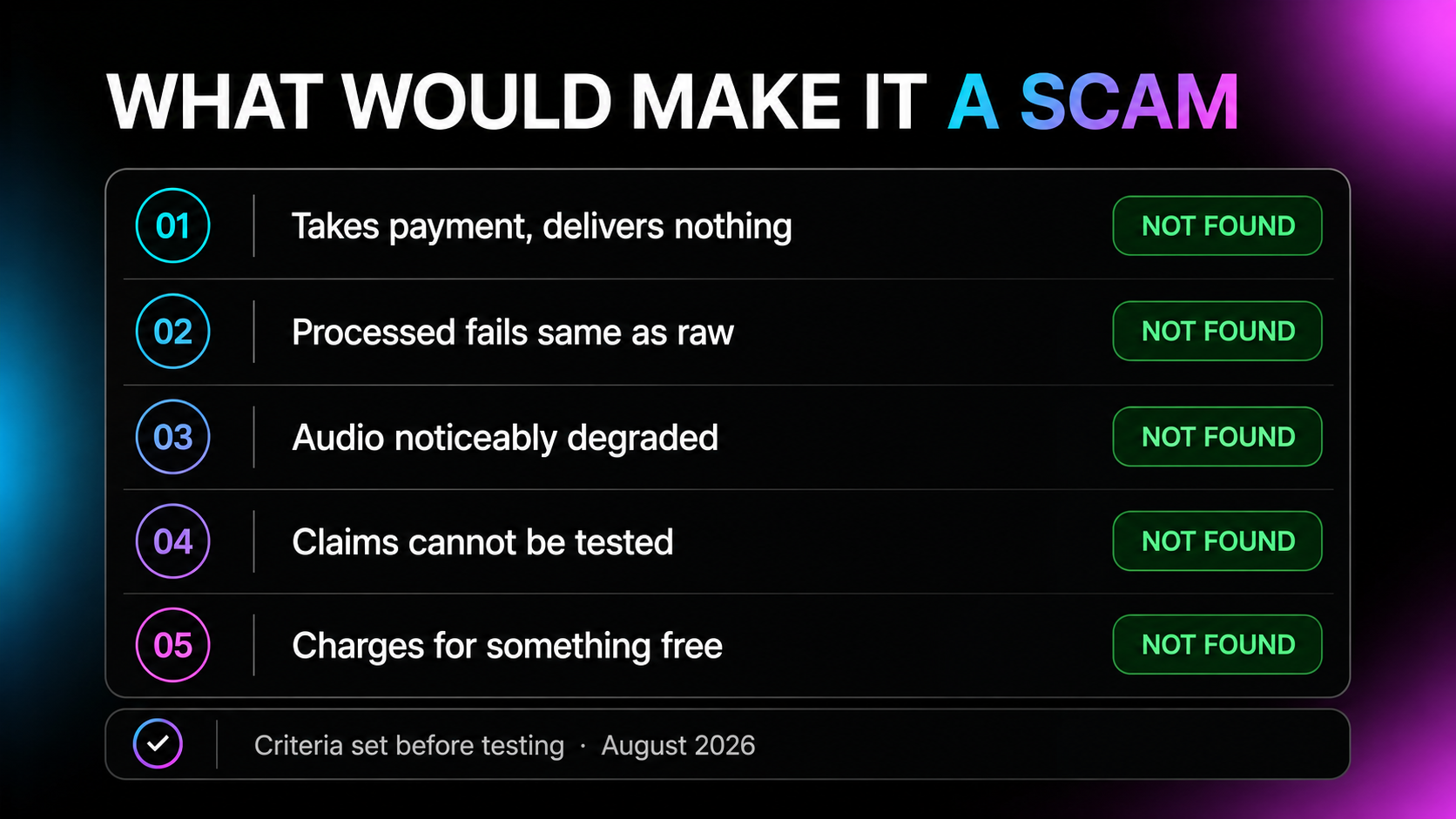
This is the section that separates a review from an advertisement, so here are the criteria we set before testing, and what each returned.
Taking payment without delivering. Would be fraud outright. Did not happen: every submitted track returned a processed file, across 98 tracks and three months.
Processed tracks failing at the same rate as raw ones. Would mean the processing is theatre. Did not happen: raw exports were flagged near-universally, processed files passed 98% of submissions.
Audio returned noticeably degraded. Would mean it works by breaking your music. Did not happen at a meaningful rate: 9 of 10 tracks were indistinguishable in blind testing, with one documented exception.
Unfalsifiable claims. Would be the clearest tell. The core claim is testable and we tested it. You can test it too on 10 tracks for $19.
Charging for something free elsewhere. Would make it a bad deal rather than a scam. We looked, and the free and cheap alternatives are in the ranking above, at 8 to 22 of 50.
None of the five held. If any of them starts holding, this page changes, and that commitment is the point of writing them down.
The honest limits
A page that finds nothing wrong is not credible, and there are real limits worth knowing before you buy.
It is not a music generator. You bring finished exports. It is a release-prep step, not a creative one.
It is not general audio repair. Hum, clicks and bad mixes are iZotope's job or your DAW's.
Browser-only. No offline mode, no desktop app, no API, no team accounts. Fine for a solo release workflow, limiting for a label processing a catalogue.
Edge cases at extreme lengths. Tracks under about 45 seconds and over 10 minutes produced the only processing oddities we saw, including round two's single Spotify failure.
No permanence guarantee. Every number here is a 2026 measurement against 2026 classifiers. Distributor models retrain. No vendor can honestly promise immunity forever, and the lifetime-pricing structure means the company has to keep funding updates from new customers. That is the most substantive open question about the product, and it is a business-model question rather than a fraud question.
It does not fix the economics of streaming. Passing a distributor screen gets you to $0.003 per stream. That is a separate problem, covered in our distributor policy guide.
How to check it yourself
Do not take our word for it, and do not take a Reddit thread's word either. The claim is cheap to test.
- Buy the $19 Starter tier, not the lifetime, if you are unsure. Ten credits is enough for a real test.
- Process two or three tracks you already tried to release, ideally ones a distributor already rejected. That is the cleanest before-and-after you can run.
- Submit them to your actual distributor. Not a free AI checker: those run different classifiers and their scores do not predict distributor outcomes, which is the trap our detector guide exists to warn about.
- Listen on your best chain and decide whether the processed file survived intact.
- Upgrade only if it worked on your material.
Five steps, $19, and you replace everyone's opinion including ours with your own data.
The verdict
Undetectr is not a scam. It is a young product in a category crowded with tools that do nothing, priced in a way that invites suspicion, making a claim that sounds impossible until you understand that distributor screening reads statistical artifacts rather than decoding watermarks.
We tested it because the claim was checkable. It passed 48 of 48 in the first round and 297 of 300 in the second, while the alternatives on the identical corpus cleared 72% and 52%. It kept the audio intact in 9 of 10 blind comparisons. We were paid nothing to say that, and we published every failure we found.
If you are still skeptical after all of that, good. Spend $19 and find out for yourself, which is the only evidence that ever really settles it.
Ten credits is enough to process the tracks a distributor already rejected and resubmit them. That is the only test that settles it.
Try Undetectr → from $19 · $39 lifetimeFrequently asked questions
No. We purchased it ourselves and ran 98 tracks through six distributor screening surfaces across two test rounds in May and July 2026. Round one passed 48 of 48 Suno tracks. Round two passed 297 of 300 submissions. We also documented the failures and the one track where processing was audible, which is the sort of detail a scam page omits.
Yes, in the specific sense that matters: it does the thing it claims. It removes the generation artifacts distributor classifiers read, and processed files cleared DistroKid, TuneCore, CD Baby, Spotify ingestion, Apple Music, Amazon Music and YouTube Music in our testing. Whether it is worth $39 to you depends on how many tracks you release.
Four reasons, all rational. It charges once in a market of subscriptions, which reads as too good to be true. It claims a world first, which is the standard phrasing of overreach. Its core promise sounds technically impossible if you assume it decodes watermarks. And the AI music tools category genuinely is full of products that do nothing.
In our testing, consistently. The mechanism is the reason: distributor screening is a statistical classifier reading generation artifacts, not a watermark decoder, and those artifacts are removable by signal processing. That is a documented, testable mechanism rather than a claim you have to take on faith.
Many pages ranking for this term are monetised, and you should weight that everywhere you read. We are not paid by Undetectr or any tool we cover. Rather than asking you to take that on trust, check the things that are checkable: does the reviewer publish failures, name the tools that lost, and state falsifiable criteria? We do all three.
Processing your own tracks so they survive automated screening is release prep, not a policy violation. What does get accounts banned is impersonation, mass spam uploading, and undisclosed AI where a distributor requires disclosure. All 7 major distributors now require that disclosure, so declare accurately and process the file honestly.
It is a founder price that Undetectr has publicly said rises to $99, which is ordinary early-adopter pricing rather than a trick. There is no subscription and no per-track fee on that tier. If you want to test before committing, the $19 Starter tier gives you 10 credits, which is enough to verify the claim on your own catalogue.
Concrete, checkable things: taking payment without delivering a processed file, processed tracks failing distributor screening at the same rate as raw exports, audio returned noticeably degraded, or claims that cannot be tested. We checked each of those. None of them held, and we have stated what evidence would change our verdict.
Ready to release your Suno tracks?
Undetectr was the only tool that passed every distributor in our testing. Clean your first track in under 60 seconds.