Spotify Artificial Streaming vs AI Detection in 2026
Two things get called "rejected by Spotify" and they have nothing in common. One judges who played your track. The other judges how it was made — and it does not happen at Spotify at all. Here is how to tell them apart from what you can see in your own dashboard.
- The short version: these are two unrelated checks, and processing your audio is irrelevant to the artificial-streaming one
- Spotify's prohibited-content list names infringing content and illegal content and nothing else. Its own words: "all music is treated equally, regardless of the tools used to make it"
- Confirmed artificial streams never earn royalties, never count toward public numbers or charts, and never influence recommendations. Spotify publishes no percentage threshold and no fee amount anywhere
- DistroKid's AI tag is generated by ACRCloud, is "informational" and "doesn't affect distribution". Its four AI rules cover rights, impersonation, spam and infringement — not how the audio sounds
- Across the 31 comments on the two threads behind this page, nobody reported a Spotify rejection for AI. The one first-hand rejection report named Deezer
- Spotify artificial streaming and AI screening answer different questions
- The four systems behind the word "rejected"
- Which one hit you? Four symptoms, four answers
- What Spotify actually does about artificial streaming
- What triggers a flag you did not buy
- Spotify has no AI rejection, and its own documents say so
- Where the AI screen really is: your distributor
- Why cleaning your vocals does nothing for a streaming flag
- What to do while a payout is frozen
- Sources, and how we read them
Somebody on r/SunoAI posted a workflow in August 2026 that opened like this: a lot of people, it said, "have been struggling with the robotic sound in Suno vocals and getting rejected by Spotify for failing anti-fraud checks." That one sentence welds together four unrelated things, and the confusion in it costs people weeks. Spotify artificial streaming enforcement and AI screening are separate systems with separate triggers, separate consequences and opposite fixes — and only one of them is even run by Spotify. We read both systems in the companies' own documents this week, counted what the two source threads actually report, and mapped each of the four things a creator can observe onto the system that caused it.
Spotify artificial streaming and AI screening answer different questions
An artificial stream, in Spotify's own definition, is "a stream that doesn't reflect genuine user listening intent, including any instance of attempting to manipulate streaming services like Spotify by using automated processes (like bots or scripts)." Read it closely: every word is about the play. Who or what pressed play, from where, how many times, in what pattern. The file is never opened.
AI screening asks the opposite question and never looks at a play. It asks how the audio was made — and on the evidence below, it does not happen at Spotify. It happens at your distributor, before delivery, and what it produces is a label rather than a rejection.
So the two systems cannot be confused except by accident, and the accident is the word "rejected". A release that never appeared, a payout smaller than the dashboard, a profile badge and a track nobody is being recommended are four different events. People describe all four with the same word, then apply the fix for the wrong one.
The second thread behind this page shows the same fusion from the other side. A creator in r/musicmarketing watched one song's streams jump, found a single unexpected US city — Barre, Vermont — at the top of the list with no playlist showing, and wrote: "I'm very concerned that somehow my song has a bot playing it or that it's being trained for AI." Those are two unrelated worries. The first is checkable tonight. The second has nothing to do with the dashboard.
The four systems behind the word "rejected"
There are four, not two, and separating them is most of the work. Each column below is read from the operator's own published documentation, cited in full further down.
| Delivery and ingest | Music spam filter | Artificial streaming | AI disclosure and identity | |
|---|---|---|---|---|
| Who runs it | Your distributor, then Spotify's ingest | Spotify | Spotify, enforced via your distributor | Distributor collects, Spotify displays |
| What it judges | Rights, metadata, artwork, audio spec — and at the distributor, whether the audio reads as AI-generated | Upload behaviour: mass uploads, duplicates, SEO hacks, artificially short tracks | Stream provenance — who played it and how | What you declared, and whether your artist identity is an AI-generated person |
| When it fires | Before release | Any time | After release, on listening data | At upload (credits) or on profile review (badge) |
| What happens | Release rejected with a reason by email, or a tag attached and delivered anyway | Tracks and uploaders tagged and no longer recommended | Royalties withheld, public numbers corrected, playlist removal, distributor charged | A credit in Song Credits, or an AI Persona badge |
| Does processing the audio help? | Sometimes, for a distributor's AI screen and for audible artifacts | No — it judges upload patterns | No. Not at all | No — these are declarations and images |
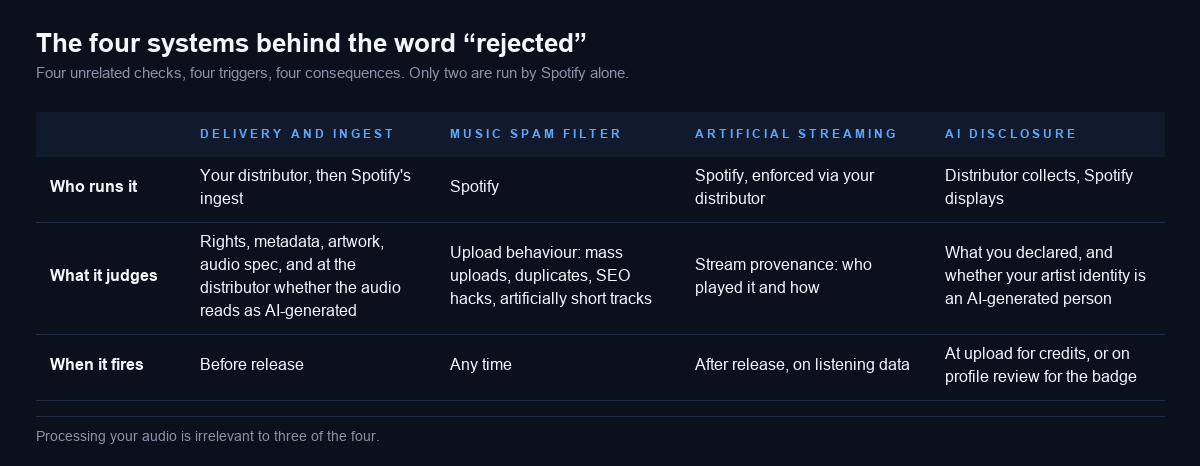
The row that matters is the last one. Three of the four systems are indifferent to what your master sounds like, and the fourth belongs to your distributor rather than to Spotify.
Which one hit you? Four symptoms, four answers
Start from what you can see rather than from what you fear. Each symptom below has one likely owner and one first move.
| What you can see | Almost certainly | First move |
|---|---|---|
| The release never went live, and you got an email | Delivery and ingest | Read the rejection reason in that email. DistroKid: "If you think your release was rejected in error, just reply to that email" |
| Streams appeared then vanished; the all-time count fell | Artificial streaming, daily cleaning | Check source of streams and territories in Spotify for Artists, then tell your distributor what promotion you paid for |
| Streams are fine, the payout is lower than the dashboard | Artificial streaming, royalties withheld | Your distributor's royalty report is the record. Spotify says so in as many words |
| Streams are real but flat; no playlists, no algorithmic reach | Spam filter, or an AI Persona badge | Check your profile for a badge. If there is none, look at how many tracks you uploaded how fast |
| A badge appeared next to your artist name | AI Persona | Self-disclosed, or Spotify-applied as "Likely AI Persona" and appealable in Spotify for Artists |
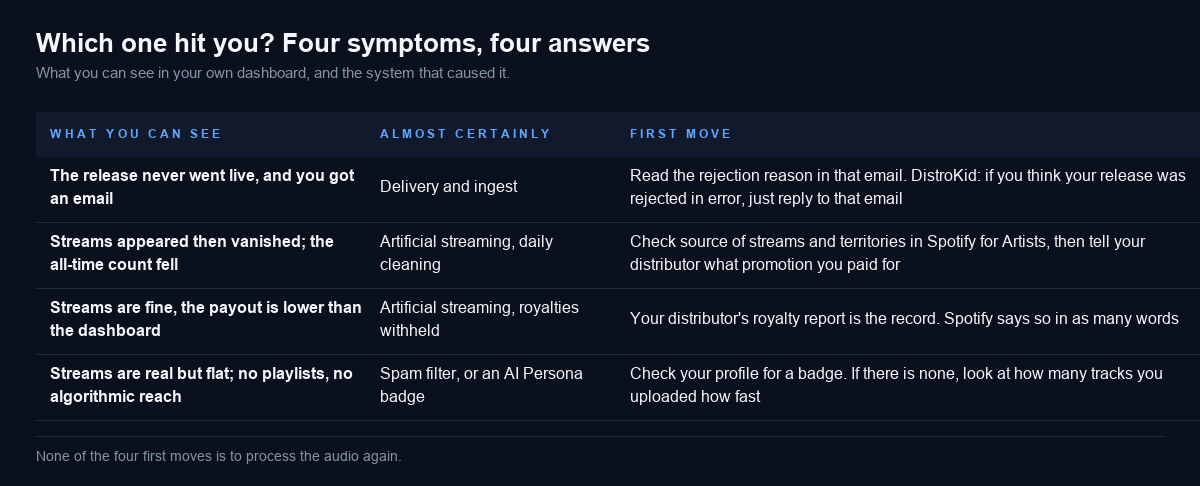
Two notes on reading that table honestly. A release that is simply not live yet is the commonest false alarm of the lot: Spotify's own line is "We need 5 business days to get new music live," and if you delivered inside that window it "might not be live until a few days after." And a sudden spike before a playlist appears is normal. The top-scoring reply to the Barre, Vermont thread said exactly that — "We've been added to a few bigger ones and streams showed up like a day before the playlist did" — and another, also at +3, warned the poster off the conclusion: "i wouldn't jump straight to bots or AI training."
What Spotify actually does about artificial streaming
Spotify publishes its penalties in two places, and they are more specific than most summaries of them. Three apply every time streams are confirmed artificial. The rest scale with severity.
| Penalty | When it applies | Published by |
|---|---|---|
| Streams earn no royalties | Always, on confirmation | Spotify's artificial streaming page |
| Streams excluded from public stream counts and charts | Always | Same |
| Streams do not positively influence recommendations | Always | Same |
| Song removed from Spotify playlists | "Depending on the severity" | Same |
| Distributor warning, penalty fee, account suspension, or removal from Spotify | Distributor's decision, after Spotify's monthly report | Same |
| Track removed from Spotify altogether | Where the track "appears to be primarily a vehicle to enable artificial streaming" | Same |
| Per-track charge to the label or distributor | "Only applied for very high rates of artificial streaming per track," effective 1 April 2024 | Spotify's royalty-system post |
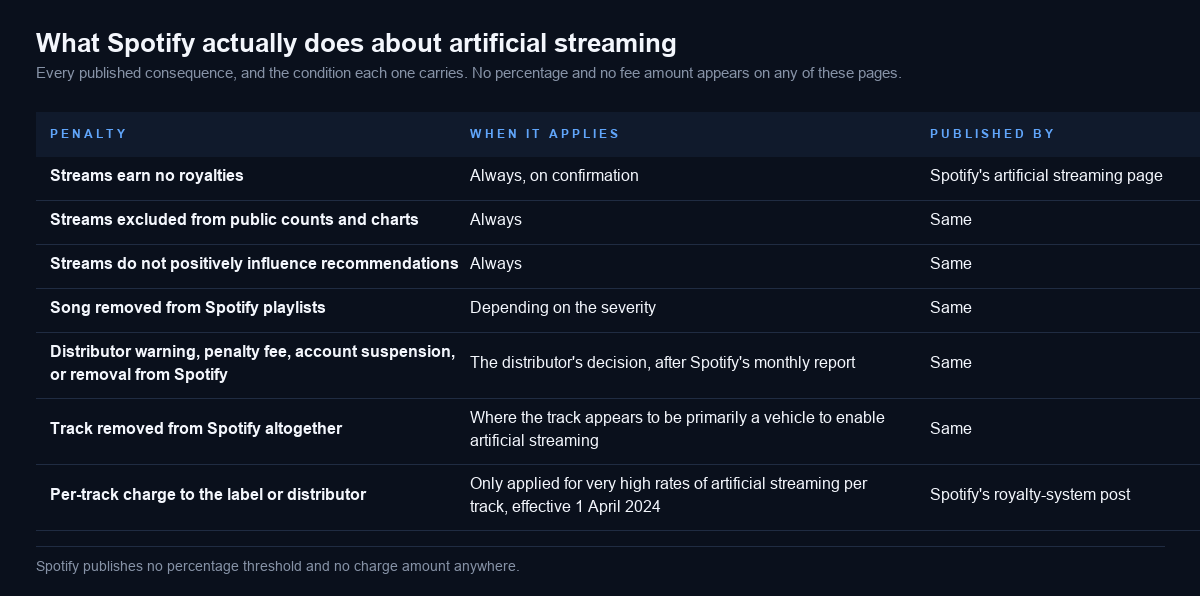
Now the two numbers that are not there. Spotify publishes no percentage threshold at which streams become ineligible, and no amount for the per-track charge — the royalty-system post that announced the charge in November 2023 describes the mechanism in four paragraphs and names no figure. Searching DistroKid's full help corpus, 421 articles and roughly 146,000 words pulled through its API on 21 November 2026, returns zero occurrences of "90%" and no fee amount either. If you have read a specific dollar number for this charge, it came from the trade press.
What is published, in a proportion rather than a percentage, is DistroKid's own threshold: "If the majority of the streams on your release are found to be artificial, your music will likely be removed from streaming services, and royalties that were earned from the artificial streams will not be paid. You may also receive a warning from DistroKid and/or your DistroKid account will be closed." That article was last updated 28 January 2026. It is the closest thing to a number anyone in this chain prints.
What triggers a flag you did not buy
This is the part that frightens people, and it is legitimate: you can be hit by artificial streaming you never paid for. Spotify lists the signals to look for in your own data, and they are specific enough to check in five minutes:
- A sudden spike in streams for no apparent reason, followed by a drop off
- An unexplained spike from a location where your tracks have not previously been active
- The majority of streams coming from unexplained sources, such as "Other"
- A sudden and short-lived increase in follower growth
Note how precisely the Barre, Vermont poster described signal two without knowing it existed, and how their own follow-up — "it was 90% 'other listeners' playlists' with no playlists mentioned" — hits signal three. That is a reasonable thing to raise with a distributor. It is not evidence of AI anything.
The mechanism is usually a playlist. DistroKid's warning is blunt: "It is also very important to be mindful of the playlists your music is added to, even if you did not pay for placement on these playlists… If your music is placed on one of these playlists, it can lead to artificial streams and may result in the removal of your release." Spotify runs a playlist reporter for exactly this, and it is the one route that does not go through your distributor.
The paid version of the risk is simpler to avoid. Any service that guarantees streams, followers or playlist placement in exchange for money "aren't legitimate," in Spotify's words, and using them "could result in your music being removed from Spotify." Our own read of six promotion services and what their receipts actually show found that the ones worth using sell a reply, never a placement.
Spotify has no AI rejection, and its own documents say so
Three documents close this question, none of which is a press release about AI.
| Spotify document | What it says about AI | What it does not say |
|---|---|---|
| Prohibited content | Lists infringing content and illegal content; opens "generally, all creators and content are welcome on Spotify" | No AI category of any kind |
| AI credits | "AI credits are optional." They "apply to individual roles, not the whole track," are in beta and visible only on mobile | No rejection, no penalty, no track-level label |
| AI Persona badges | "The AI Persona badge is about the identity you present as an artist, not whether you use AI to make your music" | Does not apply "if you only use AI tools to make your music, but your artist profile represents a real person" |
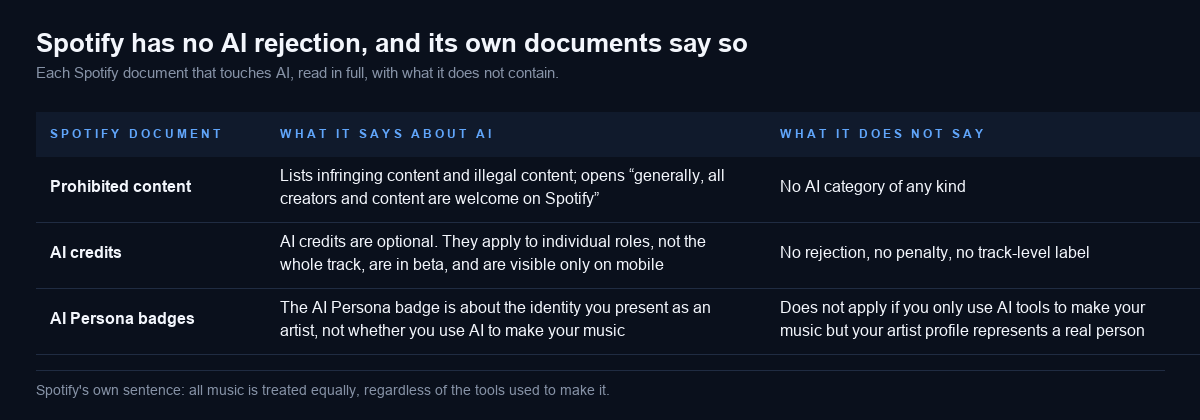
The sentence that settles it is in Spotify's September 2025 policy post: "all music is treated equally, regardless of the tools used to make it." The same post says the AI disclosure standard "is not about punishing artists who use AI responsibly or down-ranking tracks for disclosing information about how they were made."
Two caveats, because this is not a blanket all-clear. First, the music spam filter is real and it is aimed squarely at the behaviour bulk AI generation produces — "mass uploads, duplicates, SEO hacks, artificially short track abuse" — and what it does is "identify uploaders and tracks engaging in these tactics, tag them, and stop recommending them." Spotify removed "over 75 million spammy tracks" in the twelve months to September 2025. It is triggered by how you upload, not by how the audio sounds, and no amount of processing touches it.
Second, the AI Persona badge does cost reach: "Music from AI Personas isn't included in editorial or personalized recommendations unless a listener intentionally engages with the artist, for example by following them." That is a consequence of AI-generated artist imagery — profile pictures, headers, album artwork depicting a person who does not exist — and it is appealable if Spotify applied it as "Likely AI Persona". Deezer goes further than Spotify here, which is worth knowing before you blame the wrong platform.
Where the AI screen really is: your distributor
This is the layer people mean when they say Spotify rejected them for AI, and its published rules are not about audio quality. DistroKid's answer to whether you can upload AI music opens "Yes—DistroKid accepts music created with AI tools, but there are some rules," and the rules are four: you must own 100% of the rights; no impersonation; no mass-generated spam "created solely to game streaming algorithms or flood platforms with generic content"; no infringement. Not one of the four is a specification for how your master should sound.
The tag is separate again, and it is the thing most often mistaken for a rejection. A DistroKid help article created on 2 November 2026 and last edited on 16 November names the vendor: a tag may appear "when an independent service called ACRCloud identifies audio as AI-generated," and then, verbatim, "The tag is informational. It doesn't affect distribution through DistroKid… Your track still goes out to all streaming platforms." Asked "I used AI. Is that a problem?", the article answers "Nope." If the flag is wrong there is a correction form, answered "typically within 24-48 hours" — a route for an incorrect flag, not an appeal against a correct one. Our full comparison of the detectors in this chain covers which tools the screens actually run.
So where does processing an audio file genuinely belong? In two places, both narrow: clearing the audible generation artifacts that make a raw export sound harsh, and getting a file through a distributor's automated screen at upload. That is the scope of a tool like Undetectr — distributor screening and artifacts, nothing more. It does not change whether a platform labels your release, because those labels come from what you declared on delivery and from your artist imagery, and it does nothing about stream provenance. Undetectr links here are affiliate links; see our methodology.
Why cleaning your vocals does nothing for a streaming flag
The workflow post that opened this article offered to drop "the AI detection score from 98% down to 0%" so readers could get "albums approved". Its own thread took it apart, and the corrections are worth more than the workflow.
The technical one came first: "You can't fix phase issues on a fully rendered track. Phase issues have to be fixed at the multitrack session level, so you are using a technical term in a completely inappropriate manner." A second commenter, at +2, named the implication the post was dancing around — that "accepted" meant "bypassing AI filters with distributors and platforms". A third, at +3, said the plainest thing in the thread: "There's no evidence, no source."
And then the author corrected himself. The post blames "Spotify… anti-fraud checks"; his own top-scoring comment in the thread, at +6, describes a hybrid track with his own studio vocals over Suno instrumentation being flagged by Deezer's automated system, and a later comment relocates the problem again to "automated distributor filters". Three different culprits in one thread, none of them the one in the headline.
We read all 31 comments from 18 distinct authors across both threads. Not one reports a Spotify rejection for AI. The only first-hand rejection named Deezer; the only stream anomaly anyone traced ended at a Spotify Radio playlist, which is a legitimate source. That is a small sample and we are not presenting it as a measurement of the world — but when a claim's own evidence base contradicts it 31 times out of 31, the claim is the thing to doubt.
The deeper reason the workflow cannot work on a streaming flag is structural. Artificial streaming enforcement runs on listening data that arrives after release, is reported to distributors monthly, and is corrected by daily cleaning of public numbers. There is no point in that pipeline where the master is examined. If you are reading an AI-detector percentage at all, you are looking at the distributor's problem, and third-party checker scores are not what distributors run — the one claim the thread agreed on, across people who agreed on nothing else, was that public detector sites produce "tons of false positives".
What to do while a payout is frozen
Both of these take weeks, and that is the honest problem. An artificial-streaming review goes through your distributor, who goes through Spotify's monthly reporting cycle; a rejection correction goes back through an email thread. Meanwhile the deeper issue for most people reading this is not the gate at all. Getting distributed was solved years ago. Being heard was not — and a track that is live, clean and correctly declared can still reach nobody.
So split the work. On the claim itself: gather what you can evidence, name every promotional service you paid, and send it to your distributor rather than to Spotify, because Spotify's own instruction is to "share information with your distributor or label about the methods used to genuinely promote the content in question." Report the suspicious playlist directly as well; that route is yours.
On the income, build something that does not depend on a recommendation algorithm deciding to like you. Paid sync placements in TV, film, games and ads pay per use rather than per stream, and pitching for sync does not care what your monthly listener count is; a direct storefront where you sell to the people who already know you keeps the full price rather than a streamshare of it. Our own numbers on what AI music actually earns are in how to make money with Suno, and for the platform-rules side, erasy's Spotify AI music policy is the companion read. Neither fixes a frozen payout. Both mean the payout is not the only thing you have.
Sources, and how we read them
- Spotify, artificial streaming — artists.spotify.com/en/artificial-streaming and support.spotify.com, paid 3rd-party services that guarantee streams. Both read in full on 21 November 2026. Note that
support.spotify.com/us/artists/article/artificial-streaming/returns HTTP 200 with a "This page is out of tune" body — a link checker calls it healthy. - Spotify, penalties and the per-track charge — "Modernizing Our Royalty System", 21 November 2023, updated to confirm the policies live as of 1 April 2024.
- Spotify, AI — prohibited content, AI credits, AI Persona badges and the policy post "Spotify Strengthens AI Protections for Artists, Songwriters, and Producers", 25 September 2025 with an April 2026 update.
- Spotify, delivery and royalties — music not live on release day and track monetization eligibility.
- DistroKid — articles 360013647373 (artificial streaming, updated 28 January 2026), 41182362733715 (AI tools, 19 August 2026), 57059105736083 (the AI tag, created 2 November and edited 16 November 2026) and 10405555881619 (a rejected release, 29 October 2026). Every
support.distrokid.com/hc/URL returns 403 to an automated reader; these were pulled through the help centre's public JSON API, and the dates above are its ownupdated_atfields. A reader on a normal connection sees the pages. - The two threads — r/SunoAI, 30 August 2026, 23 substantive comments; r/musicmarketing, 10 September 2026, 8 comments. Re-pulled 21 November 2026 through a public archive mirror because Reddit blocks automated readers; scores and counts are as at that pull.
Frequently asked questions
Spotify defines it as "a stream that doesn't reflect genuine user listening intent, including any instance of attempting to manipulate streaming services like Spotify by using automated processes (like bots or scripts)." It is about who or what played the track, never about how the track was made. A fully AI-generated song played by real listeners produces no artificial streams at all.
No. Spotify's prohibited-content article lists infringing content and illegal content and names no AI category, and its September 2025 policy post states that "all music is treated equally, regardless of the tools used to make it." AI is screened at your distributor, before the release reaches Spotify.
Three apply every time streams are confirmed artificial: no royalties, no contribution to public stream counts or charts, and no positive influence on recommendations. Depending on severity, Spotify may also pull the song from its playlists, or remove the track entirely where it looks like a vehicle for the streams.
Spotify publishes no amount. It says only that it charges labels and distributors "per track when flagrant artificial streaming is detected on their content," and only "for very high rates of artificial streaming per track," effective 1 April 2024. Any dollar figure you have read came from trade press.
No. Artificial streaming enforcement reads listening data — sources, territories, patterns over time — and never opens the audio file. Processing matters for a distributor's AI screen and for how the track sounds, which are different problems.
Almost certainly not. Spotify runs daily cleaning to strip confirmed artificial streams out of public numbers, which is what a sudden fall in an all-time count usually is. Your distributor's royalty report is the authoritative record; the dashboard can lag it either way.
Spotify says not: the AI credits standard "is not about punishing artists who use AI responsibly or down-ranking tracks for disclosing information about how they were made." What does cost reach is the AI Persona badge, which turns on whether your artist identity is a photorealistic AI-generated person.
Ready to release your Suno tracks?
Explore Undetectr’s published track-processing features before preparing your release.