Treblo AI Review (2026): What Sonauto Became, and the Rubberz Row
Sonauto renamed itself Treblo in June 2026, and two months later its own classifier said a Billboard Hot 100 hit was 'generated almost entirely by our model'. Underneath the headline is an unusual product: unlimited free songs, downloads in five formats with no paid plan required, and terms that give you the output while keeping the right to train on it.
- Sonauto became Treblo on 3 June 2026: sonauto.ai now redirects to treblo.com, and the company behind it is still Sonauto, Inc. of San Francisco
- Treblo is free with unlimited songs on its latest model and downloads in OGG, MP3, WAV, FLAC and M4A. We found no paid consumer plan; treblo.com/pricing returns a 404
- Its terms say you own your outputs and may use them commercially, and that you grant Treblo a perpetual licence to use them, and your prompts and lyrics, to train its models
- 'Rubberz' by Fenix Flexin reached No. 58 on the Billboard Hot 100. Treblo's CEO said its classifier found the song was 'generated almost entirely by our model'; Fenix Flexin says AI 'had nun to do w recording process'
- Treblo's open-source classifier detects only Treblo songs, and since its 22 September 2026 model it says results for new songs 'are not reliable'
The short answer
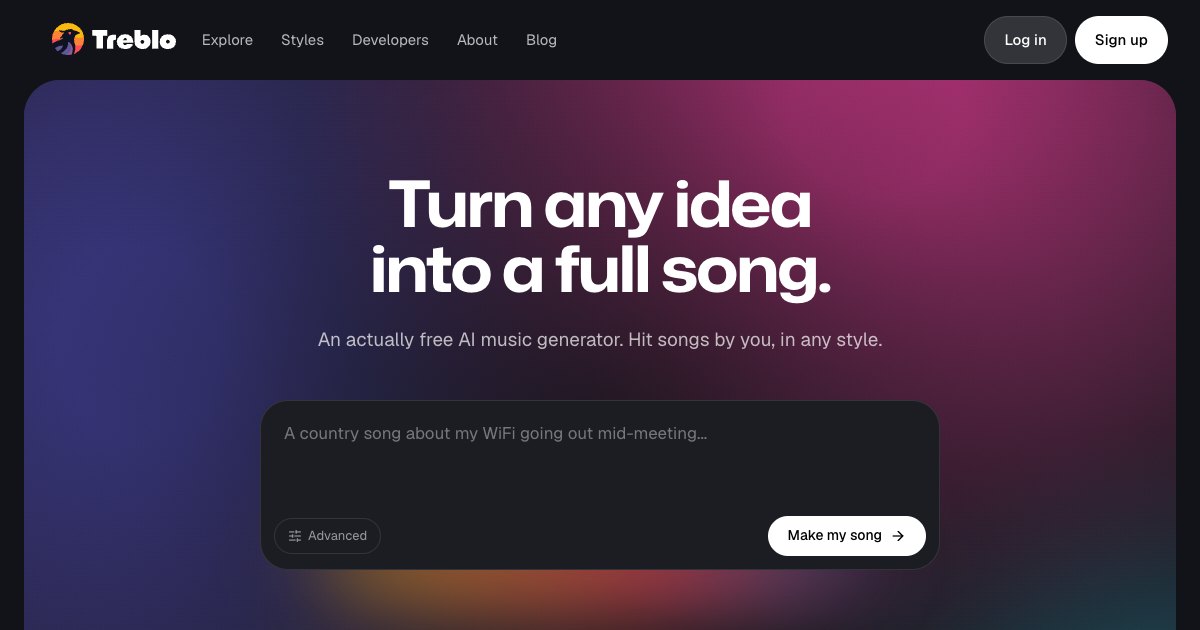
Treblo is the AI song generator that used to be called Sonauto, and in October 2026 its pitch is simple: it is free. Its homepage promises "Truly free. Unlimited songs with our latest model", with no daily cap. Its free tier downloads in OGG, MP3, WAV, FLAC and M4A, and we could not find a paid consumer plan anywhere on its site.
It is also the generator at the centre of the year's biggest AI-music chart story. Treblo's own classifier, which it released as open source, said Fenix Flexin's Hot 100 hit "Rubberz" was made with Treblo. Its chief executive then told The Verge it was "generated almost entirely by our model".
The trade-offs are in the terms. You own what you make and may use it commercially. Treblo, in turn, keeps a perpetual licence to train on your songs, prompts and lyrics. Every source here was read on 29 October 2026, and we did not generate songs on Treblo, so nothing on this page is a listening test.
From Sonauto to Treblo
The rename was announced in a blog post titled "Sonauto is now Treblo", dated 3 June 2026: "We've changed our name from Sonauto to Treblo and moved to treblo.com. Your account, your songs, and your shared links all still work." The reasons were practical. "People couldn't pronounce it ('Son-auto? Sono-to?') and kept mistyping it into the address bar." The new name "comes from treble, the top end of a sound where the melody usually lives."
What changed, and what did not, when we checked on 29 October:
| Item | Status on 29 October 2026 |
|---|---|
| sonauto.ai | 301 redirect to treblo.com |
| sonauto.ai/pricing | Redirects to treblo.com/pricing, which returns 404 |
| Developer API | api.treblo.com; the old api.sonauto.ai host "still resolves for now" |
| Legal entity | Still "Sonauto, Inc.", San Francisco, per the terms |
| Team | "The same four people working towards the same goal" |
| Apps | "Treblo - AI Music" on iOS (from 6 July 2026) and Android, developer listed as Sonauto |
Treblo's own posts disagree slightly on timing. The blog post is dated 3 June, while the matching post on its X account is dated 10 June. Press reports also differ on whether the rename came just before or just after "Rubberz" was released. We use Treblo's own blog date.
What Treblo costs: nothing, for now
Treblo's pricing is the shortest of any generator we have reviewed. The homepage shows $0.00 and says: "Make as many songs as you could possibly want. No daily limits, and no 'first three free' trials."
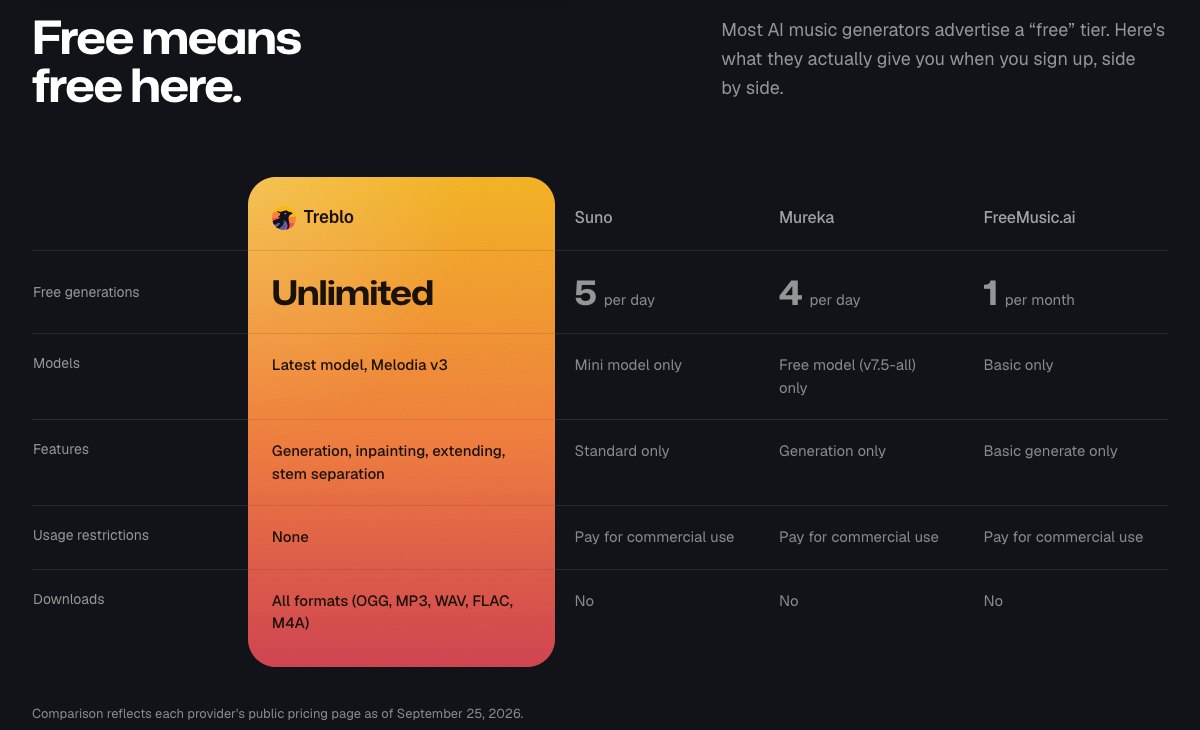
Treblo publishes its own comparison of free tiers, dated 25 September 2026. It is Treblo's comparison, not ours, but its row for Treblo matches what Treblo's own pages say:
| Treblo free tier | |
|---|---|
| Songs | Unlimited, "No daily limits" |
| Model | "Latest model, Melodia v3" |
| Features | Generation, inpainting, extending, stem separation |
| Downloads | OGG, MP3, WAV, FLAC and M4A |
| Usage restrictions | "None", per Treblo |
| Paid consumer plan | None found; /pricing returns 404 |
Treblo's terms still contain a "Subscriptions" section describing renewal and cancellation, but they name no plan and no price. We found no paid consumer tier, so we are not going to guess at one. The only priced products are for developers. The API plans run from $11 a month for about 200 songs to $1,150 a month for about 28,750, at 100 credits a song. Any public-facing app built on the API must credit Treblo.
How Treblo pays for a free product it does not say. The terms suggest part of the answer, in the training licence covered below.
What it makes
Treblo writes full songs with vocals, or instrumentals on request:
- Lyrics. "Write your own lyrics or let Treblo write them for you." It understands section tags such as "[Intro], [Verse 1], and [Chorus]".
- Instrumentals. "Switch the lyrics option to instrumental and Treblo will skip the singing entirely." Treblo suggests backing tracks, study mixes, podcast intros and game scores.
- Editing. "Tweak sections, swap lyrics, regenerate parts you don't love. Remix any song, or cover it in a brand new style."
- Languages. "Any language written in the Latin alphabet". Japanese, Korean, Chinese, Arabic, Russian and Hindi are possible, but Treblo warns "the pronunciation may be off".
- Styles. "4,160 styles", with a song that "starts streaming in about 15 seconds".
On length, Treblo's consumer pages state no cap. Its API documentation says its current model produces "variable-length songs (typically 2-4 minutes, up to a maximum of 4 minutes 45 seconds per generation)". The newest model shipped on 22 September 2026, and its developer documentation still calls Melodia v3 a "preview" that may sometimes be "lower quality than v2". We could not confirm whether the September model is the one marketed as Melodia v3.
Who owns a Treblo song
Treblo's terms of service, dated 22 September 2026, are governed by California law and come from Sonauto, Inc. Section 8 is one of the most user-friendly output clauses we have read:
- You own the output. "You own any right, title, or interest that may exist in the musical and/or audio content that You generate using the Services ('Outputs'). We hereby assign to You all our right, title, and interest, if any, in and to Your Outputs."
- Commercial use is not restricted. "The restrictions on commercial use of the Services elsewhere in these Legal Terms do not limit Your use of Your Outputs." The homepage adds: "whatever rights may exist in them belong to you, not us."
- No uniqueness guarantee. "Outputs may not be unique, and the Services may generate the same or similar output for different users."
- No copyright warranty. "We make no warranties or representations regarding the Outputs, including as to their copyrightability or legality."
The same section then takes a licence back. You grant Treblo "an unrestricted, unlimited, irrevocable, perpetual, non-exclusive, transferable, royalty-free, fully-paid, worldwide license to use Your Outputs, and the prompts, lyrics, and other content You submit to generate them, to provide, maintain, develop, and improve the Services and our artificial intelligence and machine learning models."
Put plainly, you can sell what you make, and Treblo can train on it, and on your lyrics, forever. That is narrower than the licence Mureka takes over its users' output, which our Mureka review covers, because Treblo's licence is tied to running and improving the service. It is still worth knowing before you type in lyrics you care about.
The terms also include binding arbitration through JAMS and a class-action waiver, with a 30-day window to opt out.
The "Rubberz" dispute
"Rubberz" by Fenix Flexin, released through FLEXXD UP and EMPIRE, is a chart fact first. On Billboard's weekly chart pages, it debuted at No. 66 on the Hot 100 dated 20 June 2026 and peaked at No. 58 on 1 August. It spent 12 weeks on the chart before dropping off in September.
The allegation came on about 31 July 2026. The producer Medasin posted an Instagram breakdown claiming the song was made with Treblo. As Stereogum and VICE reported, his evidence included:
- A filename. A pre-release snippet whose file name contained "Sonauto".
- A demonstration. Treblo producing similar phrasing and vocal sound.
Fenix Flexin posted Pro Tools sessions in response, then deleted the post.
On 3 August Treblo released an open-source classifier. On 5 August, chief executive Ryan Tremblay told The Verge: "The classifier returns a very high probability score for Rubberz, indicating the released audio was generated almost entirely by our model. That would make it the first known AI-generated song to reach the Billboard Hot 100." He added: "Someone appears to have used our model to find a sound that millions of people connected with and that's exciting."
Fenix Flexin's reply, reported by Rolling Stone Canada on 7 August, was "Never said I didn't use AI", alongside a claim that it "had nun to do w recording process". Rolling Stone Canada noted that the tool's accuracy "has not been independently verified".
Where that leaves it:
- On the chart: the Hot 100 run is confirmed.
- On AI use: Fenix Flexin's comment concedes some, and disputes how much.
- On the "first" claim: "the first AI-generated song on the Billboard Hot 100", as Treblo's homepage now says, rests on Treblo's own classifier. The company making that claim also makes the generator it names.
Our guide to how to tell if a song is AI covers why a vendor-only confirmation is the weakest kind.
Treblo's classifier, and its limits
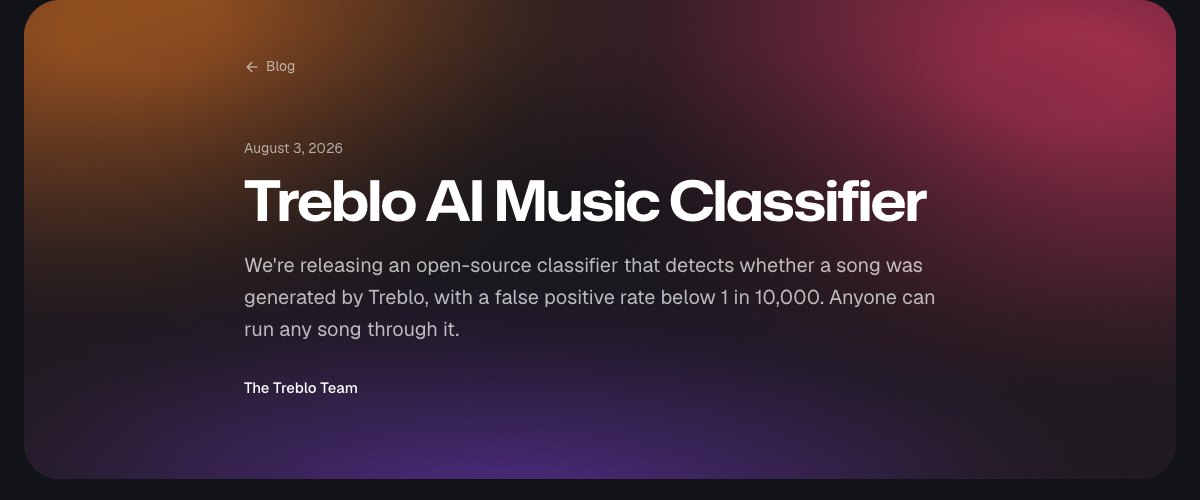
The classifier is an unusual move for a generator company. Treblo's announcement says it "detects whether a song was generated by Treblo, with a false positive rate below 1 in 10,000", and "we also think listeners should know what they're hearing".
What it is and is not, from Treblo's own pages:
| Question | Treblo's answer |
|---|---|
| Where to use it | treblo.com/detect, plus an open-source repository on GitHub |
| Licence | AGPL-3.0 |
| What it detects | Songs made with Treblo only: "This is not a general AI detector" |
| Claimed accuracy | False positives "below 1 in 10,000", on Treblo's own evaluations |
| Newer songs | "Songs generated on or after September 22, 2026 are not supported… Results for songs made with the new model are not reliable" |
| Robustness | "Treblo songs can be modified to look like a non-Treblo song to the classifier more easily than non-Treblo audio can be made to look like a Treblo song" |
That last line is the honest version of a point that applies to every AI-music detector. A "not Treblo" result proves little, because modified files slip past. A "very likely Treblo" result on an unmodified file means much more.
Independent detectors also track Treblo. The Vobile and Pex AI Song Detector added a "Sonauto" classifier on 28 January 2026, and renamed the label to "treblo" on 10 August. SubmitHub's free checker lists "Treblo v3.0 (formerly Sonauto)" among the models it covers.
Who should use Treblo
Treblo makes sense if:
- You want to experiment without paying, and want real downloads, including WAV and FLAC, from the start.
- You need instrumentals or intros for video and podcasts. Treblo says it "charges no royalties on songs you create, even on the free tier".
- You are a developer who wants a priced, documented music API.
Think twice if:
- You do not want your lyrics and prompts used to train a model indefinitely.
- You need a business that will be around to support you. Treblo describes itself as four people, with no paid consumer product.
- You plan to release without declaring AI use. Treblo songs are among the most identifiable in the market, by Treblo's own tool and by third-party detectors.
If you are releasing, the rules differ by distributor. DistroKid accepts AI music if you own the rights and declare it; CD Baby accepts none; TuneCore accepts only models trained on licensed data, and we found no Treblo statement about its training data. Our DistroKid AI music guide has the details. For finished vocal songs, our Suno alternatives ranking puts WaveQuake first.
How we reviewed it
On 29 October 2026 we:
- read Treblo's homepage, blog posts, terms of service, developer pages and classifier page;
- followed the sonauto.ai redirects, and read the App Store and Google Play listings;
- read Billboard's weekly Hot 100 chart pages for "Rubberz", and coverage in The Verge, Stereogum, VICE and Rolling Stone Canada;
- read the Vobile and Pex detector changelog.
treblo.com blocks automated requests, so its pages were read in a browser. We did not generate songs, upload anything to the classifier, or see Medasin's original Instagram post, which we cite as reported. Treblo has no Trustpilot profile under its new name; the old Sonauto profile has five reviews, too few to mean much.
Frequently asked questions
Sonauto renamed itself Treblo. Its blog post 'Sonauto is now Treblo', dated 3 June 2026, says 'Your account, your songs, and your shared links all still work', and sonauto.ai now redirects to treblo.com. The company says it changed the name because people could not pronounce or spell Sonauto. The legal entity is still Sonauto, Inc.
Yes. Treblo's homepage says 'Truly free. Unlimited songs with our latest model', with no daily limit, and its free tier includes downloads in OGG, MP3, WAV, FLAC and M4A. We found no paid consumer plan on any public page; its /pricing address returns a 404. Paid plans exist only for its developer API, from $11 a month.
Treblo's terms say you own any rights that exist in what you generate, and that its restrictions on commercial use of the service 'do not limit Your use of Your Outputs'. Its royalty-free page says it places 'no usage restrictions on songs made for free, including concerning commercial use'. Whether a song can be copyrighted is a separate question that depends on the law where you are.
Its terms say so. You grant Treblo 'an unrestricted, unlimited, irrevocable, perpetual, non-exclusive, transferable, royalty-free, fully-paid, worldwide license' to use your outputs, and the prompts and lyrics you submit, to develop and improve its services and its AI and machine learning models.
It is disputed. Producer Medasin alleged it was made with Treblo, and Treblo's own classifier returned 'very likely Treblo'. Treblo's CEO told The Verge it was 'generated almost entirely by our model'. Fenix Flexin then wrote 'Never said I didn't use AI', but said AI 'had nun to do w recording process'. No independent body has verified the classifier.
'Rubberz' by Fenix Flexin debuted at No. 66 on the Hot 100 dated 20 June 2026 and peaked at No. 58 on 1 August, spending 12 weeks on the chart. Treblo's homepage calls it 'The first AI-generated song on the Billboard Hot 100', but that rests on Treblo's own classifier, and the artist disputes how much AI was involved.
It is an open-source model, released on 3 August 2026 under the AGPL-3.0 licence, that estimates whether a song was made with Treblo. Treblo claims a false-positive rate below 1 in 10,000 on its own evaluations. It does not detect other AI generators, and since a new Treblo model shipped on 22 September 2026 its results for newer songs are 'not reliable'.
Yes. 'Treblo - AI Music' is on the App Store, first released on 6 July 2026, and on Google Play, where it shows more than 100,000 downloads. Both list the developer as Sonauto. The Google Play listing describes it as 'For free. No limits.'
Ready to release your Suno tracks?
Explore Undetectr’s published track-processing features before preparing your release.