AI Music Release Limits 2026: How Many Songs You Can Ship
Two distributors put a number on how many AI tracks you may release. The other four publish none, which is why most people never find the real limit until they are past it — and the real limit is not at the distributor at all. Here is every published cap in 2026, the platform-side thresholds that quietly make volume pointless, and the numbers that explain why.
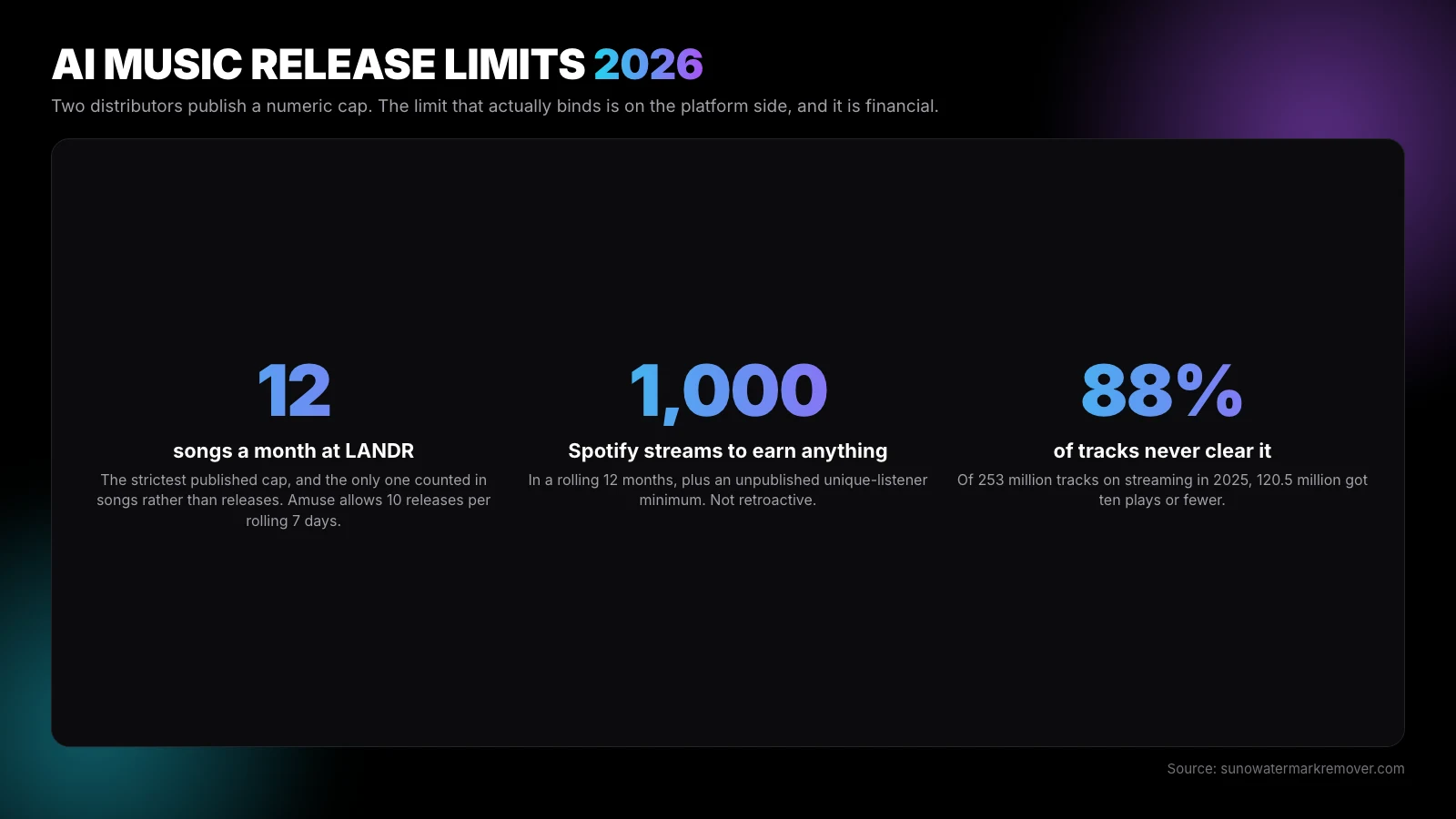
- Only two major distributors publish a numeric cap on AI releases: LANDR at 12 songs a month, Amuse at 10 releases per rolling 7 days. DistroKid, RouteNote, UnitedMasters and Symphonic publish none
- The exclusions matter more than the caps. LANDR withholds AI tracks from YouTube Content ID, Meta, TikTok, Deezer, Pandora and Tencent; Amuse withholds Meta and Content ID
- Spotify's real limit is financial: a track earns nothing until it clears 1,000 streams in a rolling 12 months, plus an undisclosed unique-listener minimum
- Deezer logged around 90,000 fully AI-generated tracks a day at peak in June 2026 — over half of all uploads — while AI music drew only 1-3% of actual streams, and up to 85% of those streams were fraudulent
- Luminate counted 253 million tracks in 2025. 88% were streamed fewer than 1,000 times and 120.5 million got 10 plays or fewer. Volume is not the constraint anyone is actually hitting
- The two AI music release limits that decide what you ship
- Distributor caps: who actually counts your releases
- The exclusions matter more than the caps
- Every release slot has a screening step attached
- Spotify's real limit is the 1,000-stream floor
- Deezer: where the flood already stopped paying
- The Luminate numbers that end the volume argument
- What to do when your catalogue is bigger than your cap
- Where the money is once volume stops working
- The short version
The two AI music release limits that decide what you ship
Most people looking for AI music release limits are asking a distributor question: how many Suno tracks will DistroKid or Amuse let me put out this month. That question has a short answer, and it is the less important of the two limits you are actually operating under.
The second limit is on the platform side, and it is financial rather than numeric. Spotify pays nothing on a track until it clears 1,000 streams in a rolling twelve months. Deezer removes AI tracks that go six months without a play. At those thresholds, a catalogue of two hundred unstreamed releases is worth exactly the same as a catalogue of two — and one of them cost you two hundred screening passes to produce.
We have gone through every published policy for the six distributors that accept fully AI-generated music, checked the platform thresholds against primary sources, and put the industry-wide stream distribution next to them. The distributor caps turn out to be the easy part.
Distributor caps: who actually counts your releases
Six major distributors accept fully AI-generated music. Only two of them publish a number.
| Distributor | Accepts fully AI | Published cap | Disclosure | Platform exclusions |
|---|---|---|---|---|
| DistroKid | Yes | None published | Required at upload | None published |
| RouteNote | Yes | None published | Required, with AI tool links | YouTube Content ID |
| UnitedMasters | Yes | None published | Not specified | None published |
| Symphonic | Yes | None published | Required at upload | None published |
| Amuse | Yes | 10 releases / rolling 7 days | Detected, not self-declared | Meta, YouTube Content ID |
| LANDR | Yes | 12 songs / month | Required at upload | Content ID, Meta, TikTok, Deezer, Pandora, Tencent |
| TuneCore | AI-assisted only | n/a | Required | Rejects fully AI-generated work |
| CD Baby | AI-assisted only | n/a | Required | Rejects fully AI-generated work |
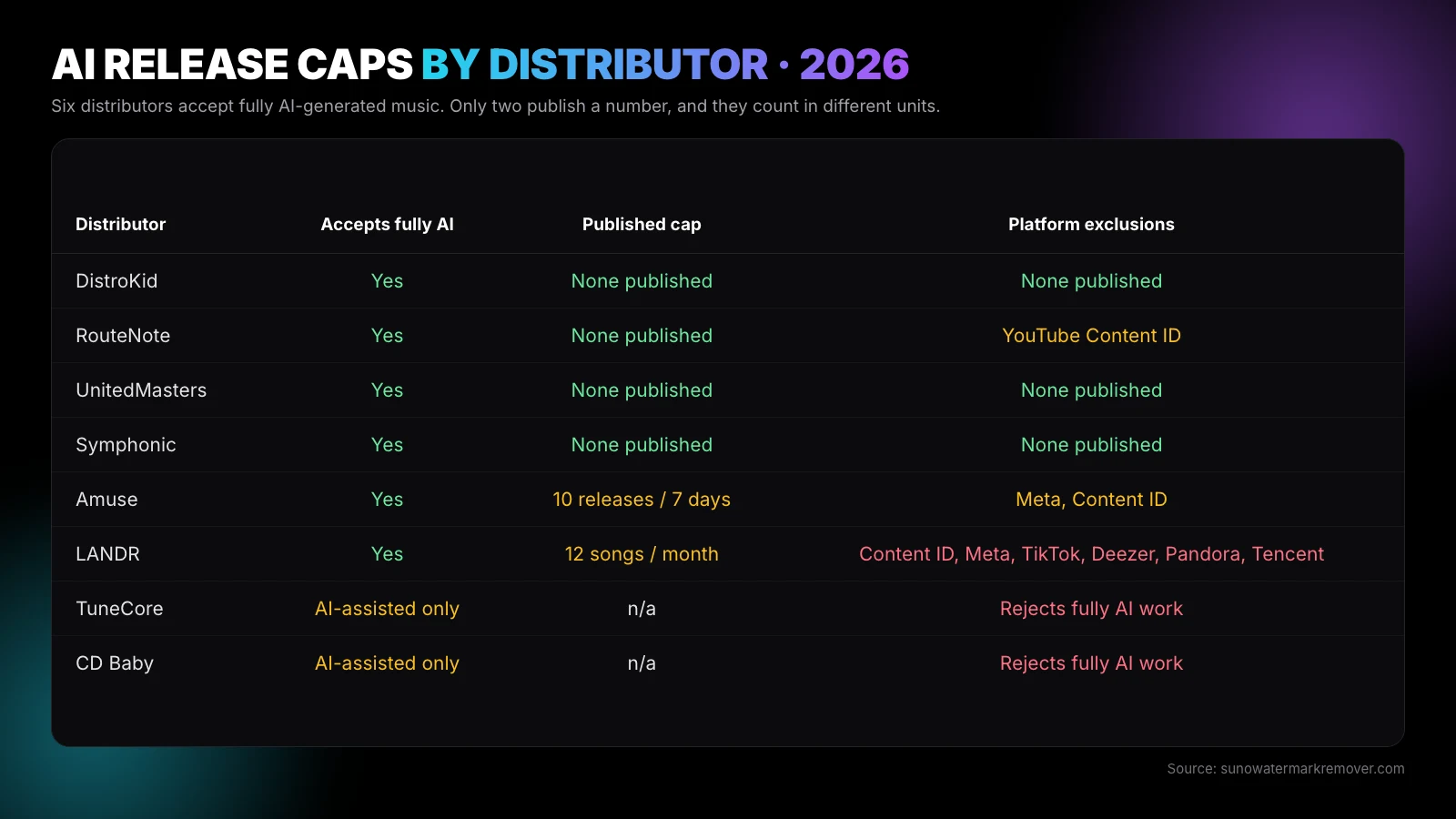
Two details in that table are worth more than the rest. First, the two caps are written in different units: LANDR counts songs, Amuse counts releases. A ten-track album eats most of a month at LANDR and costs one slot of ten at Amuse. If you release albums, that difference is an order of magnitude.
Second, "no published cap" is not the same as unlimited. It means the ceiling is your subscription tier and your own pass rate rather than a stated policy, and it can change without notice. We cover the full policy set, with the date each was checked, in our distributor AI policy comparison.
The exclusions matter more than the caps
A cap tells you how much you can ship. The exclusion column tells you what shipping is worth, and it is the line most people skip.
LANDR's AI policy withholds tracks from YouTube Content ID, Meta, TikTok, Deezer, Pandora and Tencent. Amuse withholds Meta and Content ID. Those are not obscure corners — Content ID is the one revenue route that reliably pays on AI-adjacent catalogues, because it collects on other people's uploads rather than on your own listener count. We tested what that route actually returns on our YouTube monetisation page.
So the honest reading of the table is inverted from how it looks. LANDR's 12-a-month cap is the strictest number, but its exclusion list is what really constrains the outcome: twelve songs a month delivered to streaming only, with the per-use monetisation surfaces switched off. DistroKid's absent cap is worth more than Amuse's ten slots, because the slots come with Meta and Content ID attached.
Every release slot has a screening step attached
Whichever cap you are under, each slot you spend has to survive automated screening first, and a rejection costs the slot as well as the time. That is the part that turns a generous quota into a tight one.
Screening reads the audio, not the file's metadata. Distributors run classifiers over the waveform looking for the statistical fingerprints that generative models leave behind, which is why stripping ID3 tags changes nothing and why a track can be rejected without a human ever hearing it. Our DistroKid AI detection page walks through what the classifier is doing and what a rejection looks like from the account side.
The practical consequence is a cost-per-slot calculation. If you are on LANDR's twelve songs a month and three of them come back rejected, your real cap that month was nine. Processing tracks to clear the artifact layer before submission is what makes the quota you are paying for the quota you actually get — that is the job Undetectr does, and it is worth being precise about the scope: it addresses distributor screening and audible generation artifacts. It does not stop a platform labelling a track as AI, because those labels come from disclosure passed through on delivery, not from anything in the audio.
Spotify's real limit is the 1,000-stream floor
Here is the threshold that makes the distributor caps look generous. Since April 2024, Spotify's monetisation eligibility rules require a track to reach at least 1,000 streams in the previous 12 months before it enters the royalty pool at all. There is a second condition — a minimum number of unique listeners — which Spotify deliberately does not publish so it cannot be gamed by streaming a track to yourself.
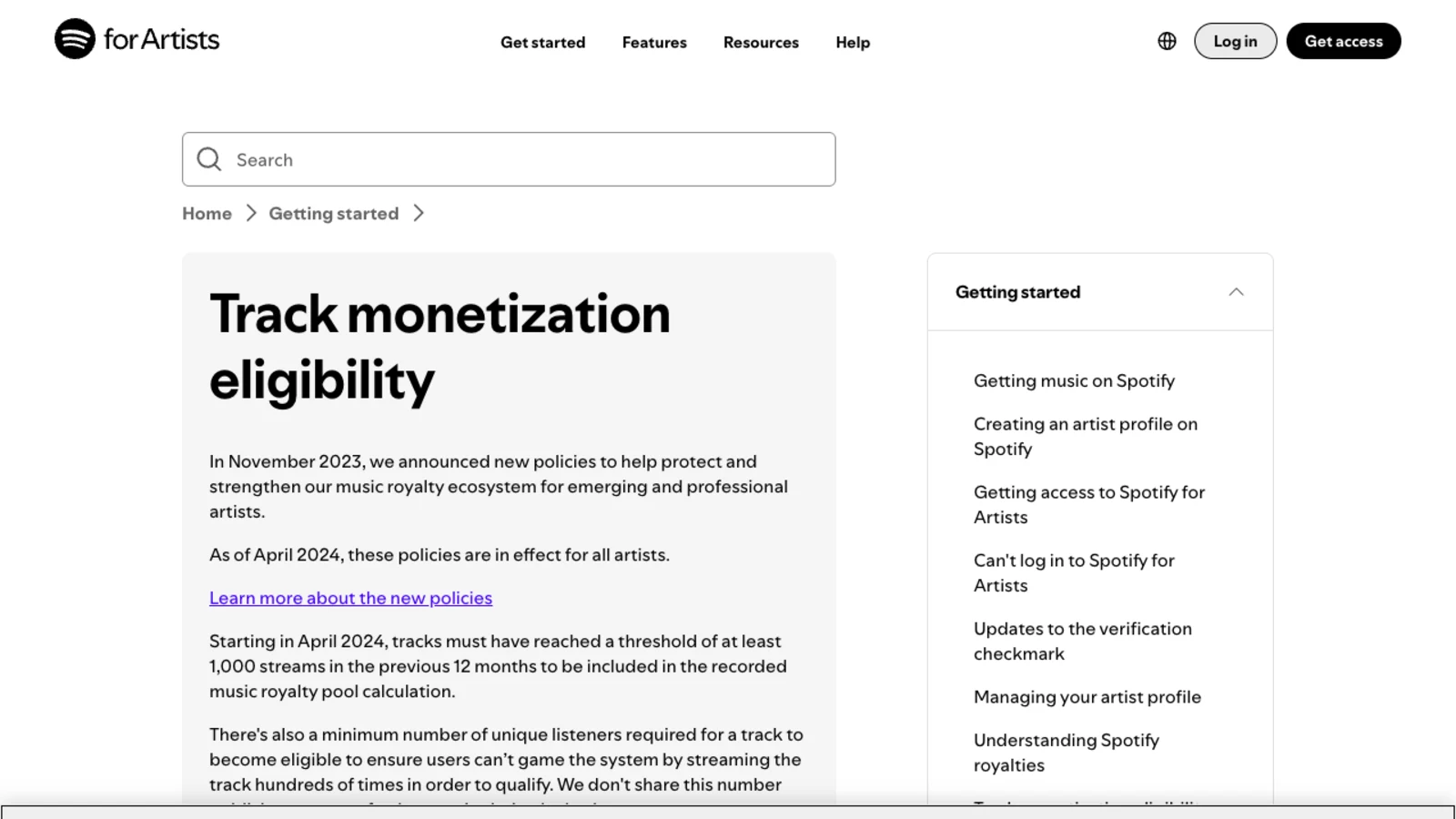
Both conditions must be met, and the qualification is not retroactive: streams a track accumulated while it was below the bar do not pay out once it crosses. A track that finishes its first year on 940 plays earns nothing, ever, from that year.
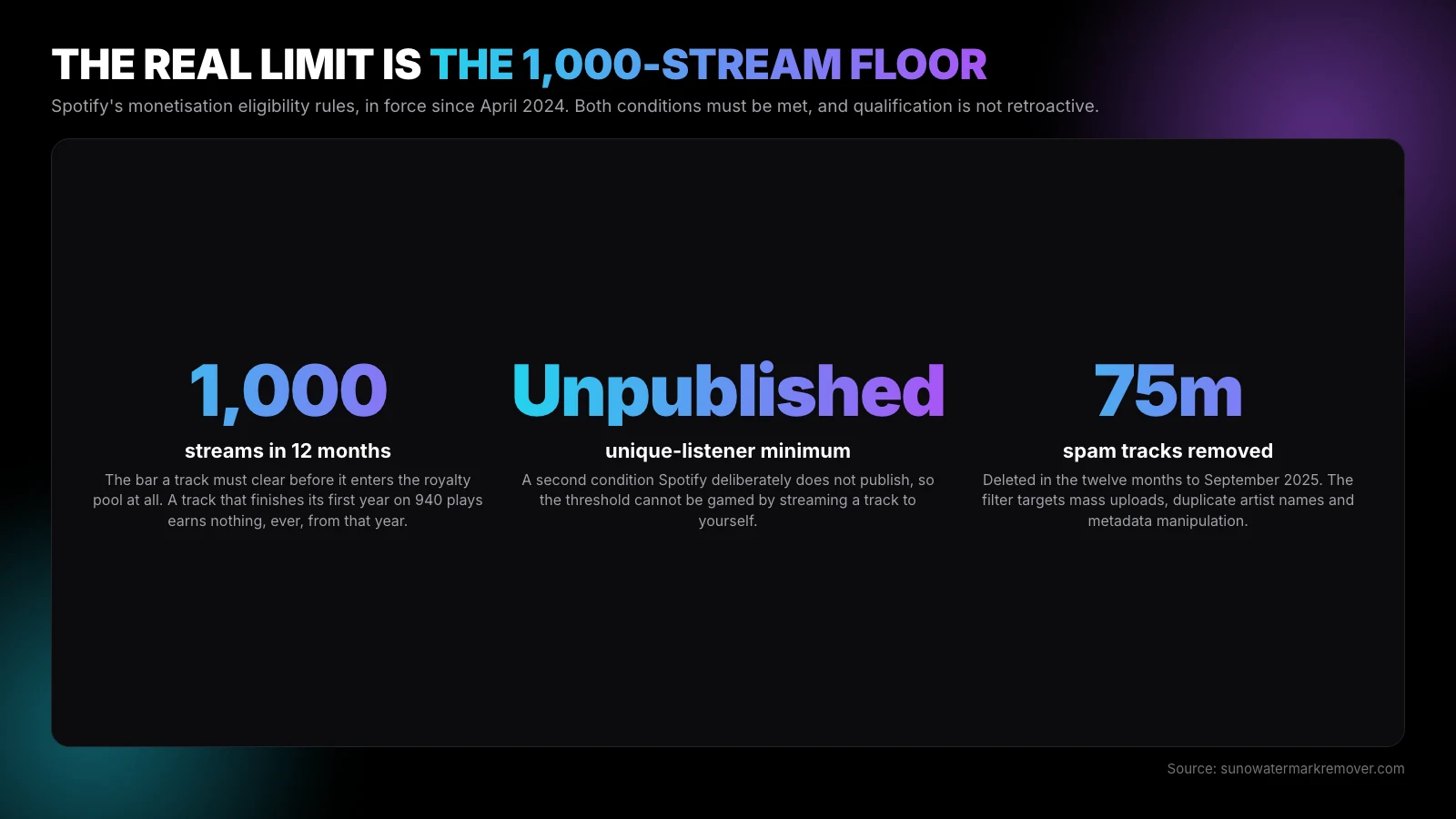
Spotify pairs this with a spam filter that targets behaviour rather than AI use. It stops recommending accounts that mass-upload, publish duplicates under multiple artist names, manipulate titles and metadata for search, or ship tracks just over the 30-second royalty threshold. In the twelve months to September 2025 the platform removed more than 75 million spam tracks. Volume is not just unprofitable there; it is an account-level signal.
Deezer: where the flood already stopped paying
Deezer publishes the clearest numbers in the industry because it tags AI-generated music on arrival, and the trend line is the single best argument against a volume strategy.
| Date | Fully AI tracks / day | Share of daily uploads |
|---|---|---|
| September 2025 | 30,000 | 28% |
| November 2025 | 50,000 | 34% |
| January 2026 | 60,000 | 39% |
| April 2026 | 75,000 | 44% |
| June 2026 (peak) | ~90,000 | over 50% |
By June 2026, more than half of everything uploaded to Deezer each day was fully AI-generated. Demand did not follow: AI music accounts for just 1-3% of total streams on the platform, and Deezer found that up to 85% of the streams those tracks did receive were fraudulent in 2025, and demonetised them.
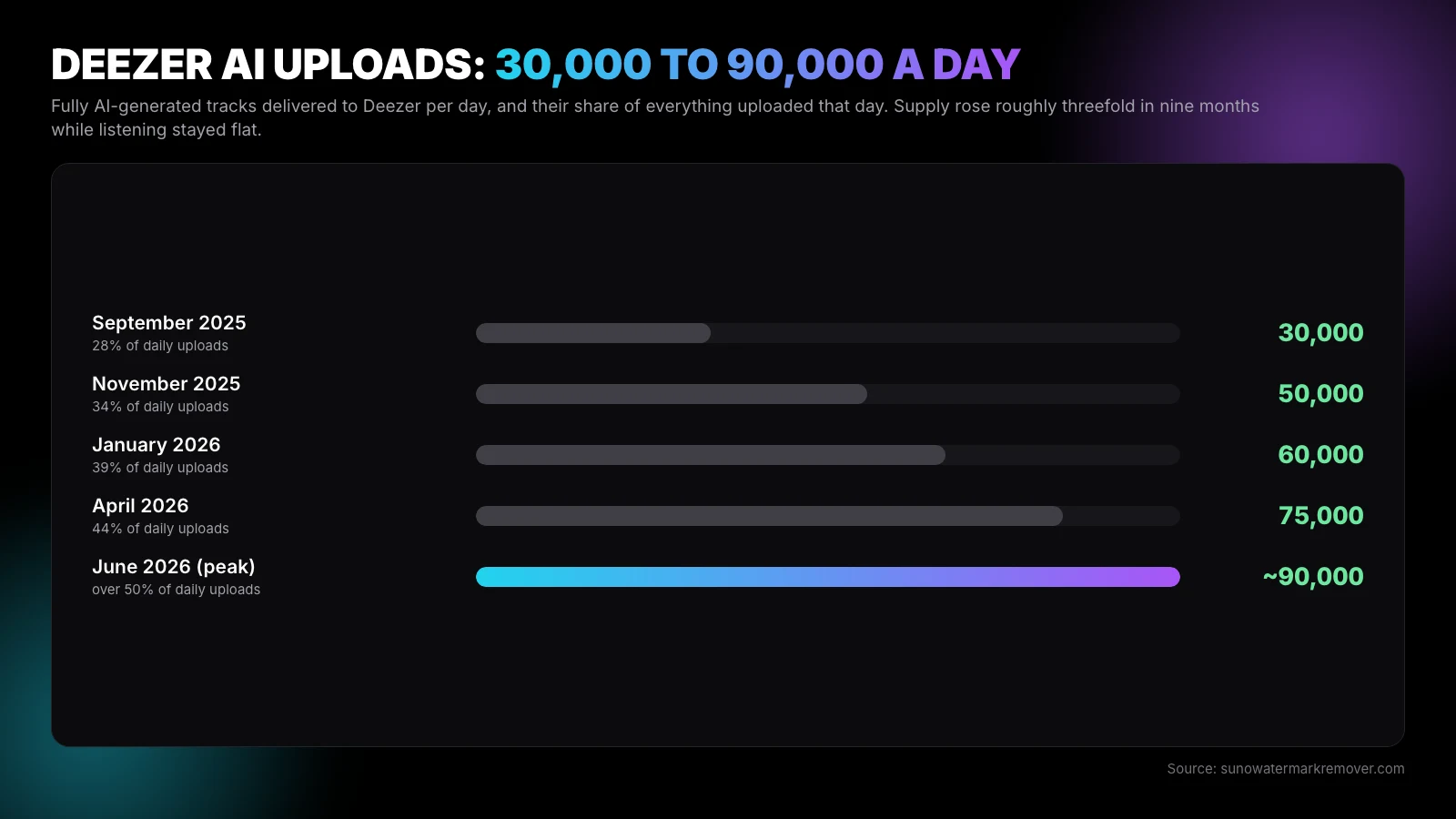
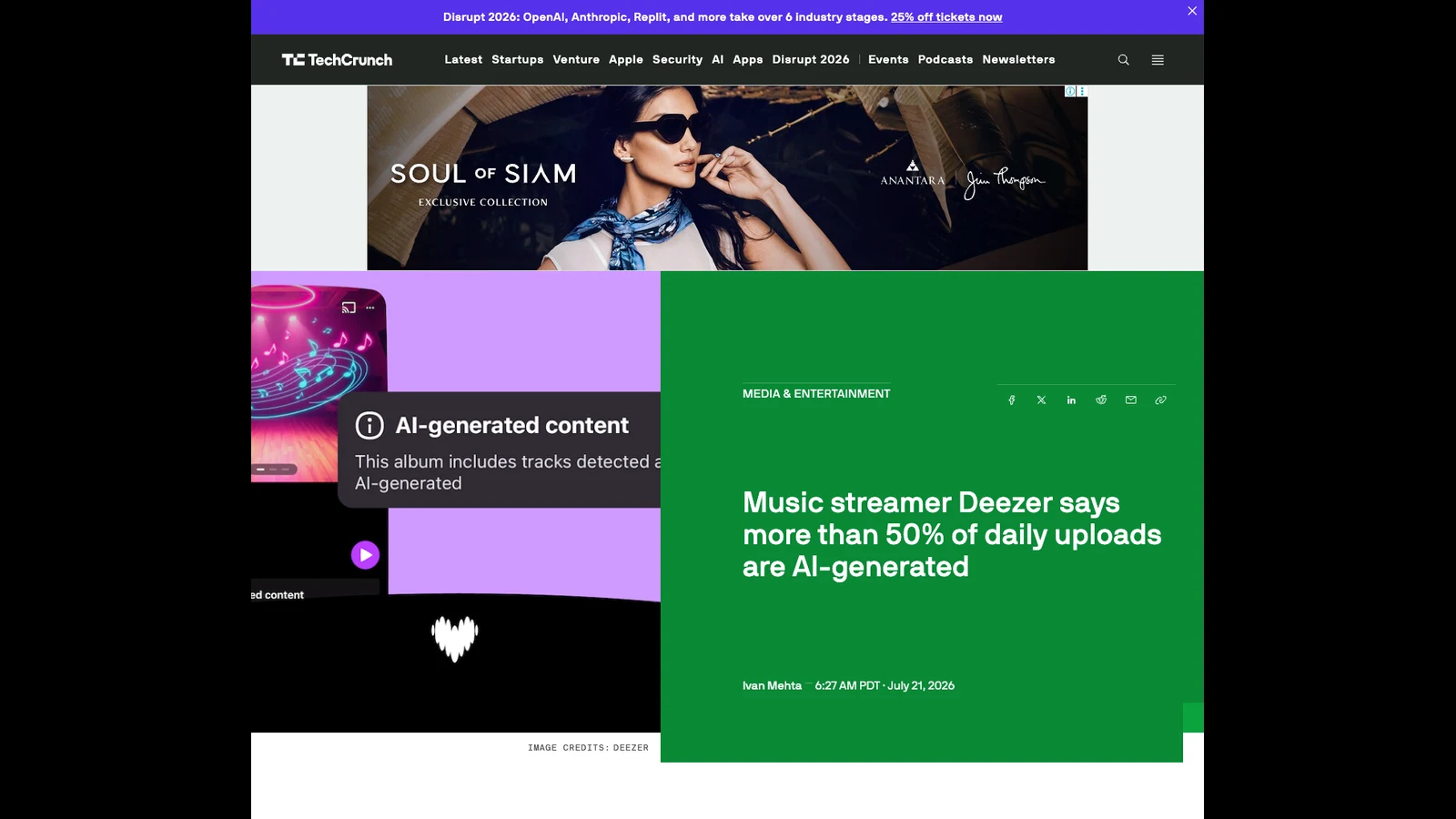
Deezer also removes AI tracks used for streaming fraud and those with no plays for six months, and excludes all AI-detected content from editorial playlists and algorithmic recommendation. We go through what that tag does to a release on our Deezer AI detection page. The summary: supply rose roughly threefold in nine months while listening stayed flat, so each additional upload competed with more and earned less.
The Luminate numbers that end the volume argument
Zoom out from AI specifically and the picture is the same, only larger. Luminate's 2025 year-end report counted 253 million tracks available across streaming services, up from 202 million a year earlier, with about 106,000 new ISRCs delivered every day.
| 2025 streams per track | Number of tracks |
|---|---|
| 10 or fewer | 120.5 million |
| 11 to 100 | 62.6 million |
| 101 to 1,000 | 40.7 million |
| Under 1,000 (all bands) | 88% of the catalogue |
Read that against Spotify's floor: 88% of the world's tracks did not clear 1,000 plays in 2025, which is the bar at which a track starts earning anything. Nearly half the entire catalogue got ten plays or fewer.
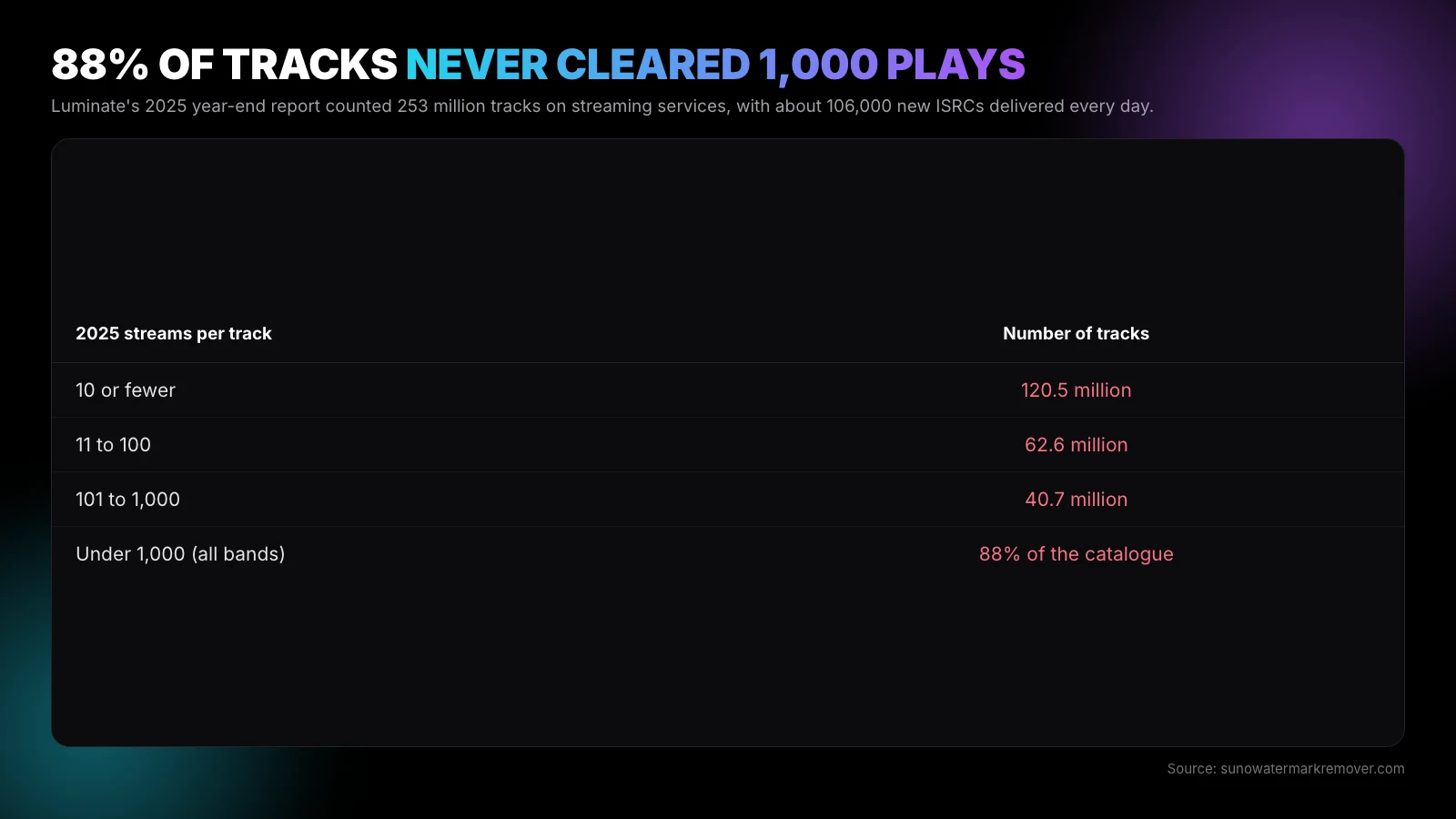
This is the part that gets left out of "just release more" advice. The constraint was never how many tracks you were allowed to publish. It is that adding one more track to a 253-million-track pile does not create a listener, and the distributors' caps are, if anything, a milder version of a limit the market was already imposing for free.
What to do when your catalogue is bigger than your cap
If you have generated a few hundred tracks and can release twelve a month, the cap is doing you a favour by forcing a decision you should be making anyway. A few things that actually help:
- Rank before you release. Pick the tracks with a hook you can name, not the ones that came out most recently. Twelve considered releases beat twelve arbitrary ones at identical cost.
- Prefer release-based caps if you ship albums. Amuse's ten-per-seven-days counts releases, so a full album costs one slot. LANDR's counts songs.
- Finish the audio before spending a slot. A rejection costs the slot too. The pre-release cleanup checklist on erasy.co covers the pass in order.
- Check the exclusion list before you pick a distributor, not after. Content ID and Meta access are usually worth more than four extra slots a month.
- Do not spread one catalogue across several distributor accounts to beat a cap. That is precisely the duplicate-and-mass-upload pattern the platform-side spam filters are built to catch.
None of that is a growth strategy. It is damage control on a step that was never the bottleneck, which brings us to the step that is.
Where the money is once volume stops working
The uncomfortable finding across all of the above is that distribution is not the wall. Getting a track onto Spotify is largely solved — six distributors will take AI music and most of them will not even count it. Finding anyone to listen is the unsolved part, and no release quota, in either direction, changes that.
Which is why the routes that do not depend on algorithmic discovery are worth more attention than the ones that do. Sync licensing pays a flat fee for a placement in a show, game or ad, decided by a supervisor choosing a track rather than by a recommendation engine surfacing it — a single placement can be worth more than a track will earn in streams in its lifetime. Pitching for those is what played.fm's sync route is built around, alongside selling direct to the listeners you do have and keeping the full price rather than a fraction of a cent per play. It is worth noting the comparison people reach for here does not apply: Bandcamp banned AI-generated music outright in January 2026, so direct-to-fan on that platform is not an option for this catalogue at all.
Direct sales come with an honest caveat — they need an audience you already have, and most people reading this do not have one yet. But a hundred real listeners who can buy from you is a better asset than four hundred releases averaging six plays, and it is reachable without out-uploading 106,000 tracks a day. We break the earnings side down further in how to make money with Suno.
The short version
Two distributors cap AI releases: LANDR at 12 songs a month, Amuse at 10 releases per 7 days. Four publish no number. If you only read one column of that table, read the exclusions — Content ID and Meta access decide what a release is worth far more than the quota decides how many you get.
Then stop optimising the quota. Spotify pays nothing under 1,000 streams in a rolling year, Deezer removes AI tracks that sit unplayed for six months, and 88% of all music released in 2025 never reached the bar Spotify sets. The limit that matters is not the one your distributor publishes. It is the one the market applies to everybody, and the way past it is a smaller number of finished tracks with a route to money that does not run through a recommendation algorithm.
Frequently asked questions
It depends entirely on your distributor. LANDR caps AI-generated releases at 12 songs a month and Amuse at roughly 10 releases per rolling 7 days. DistroKid, RouteNote, UnitedMasters and Symphonic publish no numeric cap on AI content, so the practical ceiling there is your subscription tier and your own screening pass rate rather than a stated policy.
DistroKid publishes no cap specific to AI music. Its standard subscription terms govern how many releases you can have live, and the AI requirement is disclosure at upload rather than a quota. That makes it the most permissive of the majors for high-volume catalogues, though every individual upload still goes through automated screening.
Those platforms operate rights-claiming and licensing systems that assume identifiable human authorship, and a distributor that submits AI-generated audio into them takes on the risk of a bad claim. Withholding the tracks is the cautious route. The practical effect is that a release delivered under LANDR's AI policy reaches streaming but not the monetisation surfaces that pay per use.
Since April 2024, a track must reach at least 1,000 streams in the previous 12 months before it is included in Spotify's recorded royalty pool. There is also a minimum number of unique listeners, which Spotify deliberately does not publish so the threshold cannot be gamed. Both conditions must be met, and streams accumulated before a track qualifies do not pay retroactively.
The evidence runs the other way. Spotify's spam filter specifically targets mass uploads, duplicates under multiple artist names, metadata manipulation and very short tracks, and it stops recommending accounts that behave that way. Combined with the 1,000-stream floor, a large catalogue of near-zero-play tracks produces no royalties and an unhelpful signal about the account that released them.
Deezer says it systematically removes AI-generated tracks used for streaming fraud, and also those that have gone at least six months without any plays. All AI-detected content is separately excluded from editorial playlists and algorithmic recommendation. So an unstreamed AI catalogue on Deezer is not neutral shelf space — it is subject to removal.
Read the wording carefully, because the two published caps are written differently. LANDR's is stated in songs per month, so a 10-track album consumes most of it. Amuse's is stated in releases per rolling 7 days, so a single is worth the same as an album against the quota. If you plan to ship albums, the release-based cap is far more generous.
Fewer releases that are actually finished, and a route to money that is not per-stream. Sync licensing pays a fee per placement rather than fractions of a cent per play, and direct sales pay in full but need an audience you already have. Neither depends on out-uploading 106,000 new tracks a day, which is what the streaming route currently asks you to do.
Ready to release your Suno tracks?
Explore Undetectr’s published track-processing features before preparing your release.