The Best AI Music Generators in 2026, Ranked on What You Keep
Most lists of AI music generators rank what each tool says it can make. This one ranks what you walk away with: a finished song you can download, own, and release, at a price you can see. On that test WaveQuake comes first, Google Flow Music is the best free option, Stable Audio is the best licensed instrumental tool, and Udio comes last.
- WaveQuake ranks first for finished vocal songs: mastering, a commercial licence and MP3 and WAV downloads for a one-time $149.99 founder price, and we measured its eight published example songs
- Suno is the benchmark everyone compares against, at $10 and $30 a month, but since 3 September 2026 it caps downloads at 20 a month on Pro and 60 on Premier
- Google Flow Music is the best free option: its pricing grid lists MP3, WAV and stem downloads on every plan, including Free, with no cap we could find
- Stable Audio is the pick for licensed instrumentals: Stability says its 3.0 models are 'trained on fully licensed data', and every plan includes a commercial licence, but it makes no vocals
- Udio ranks last: downloads are disabled, and its terms limit output to 'personal and non-commercial purposes' and say Udio owns it
- How we ranked them
- The ranking at a glance
- 1. WaveQuake: best overall for finished songs
- 2. Suno: the benchmark, now with a download cap
- 3. Google Flow Music: the best free option
- 4. ElevenLabs Music: licensed, but read the plan table
- 5. Mureka: Suno's prices, without the cap
- 6. Treblo: free, unlimited, and detectable
- 7. MusicGPT: a simple paid plan with unlimited downloads
- 8. Stable Audio: the pick for licensed instrumentals
- 9. AIVA: composition, with copyright only on Pro
- 10. Udio: last, because you cannot keep anything
- Also considered: beat and background-music tools
- Which AI music generator should you choose?
How we ranked them
Most "best AI music generator" lists rank tools on what they claim to generate. We ranked them on what you are left with. That comes down to four questions:
- Does it make a finished song? That means vocals, lyrics and a full arrangement, unless you only need instrumentals.
- Can you download it and keep it? Which formats, and how many files a month?
- Can you release it? That covers commercial rights on the plan you would actually buy, and any limits on streaming distribution.
- What does it really cost? That is the price you pay once the download caps and plan limits are counted.
Every price and term below was read from each vendor's own pricing page, plan tables and terms of service on 29 October 2026. We did not generate songs on these services, so this is not a blind listening test. For WaveQuake we went further and measured its published examples. The detail behind each tool is in our Suno alternatives ranking and our reviews of Google Flow Music, Mureka and Treblo.
The ranking at a glance
| Rank | Generator | Sung vocals | Downloads | Commercial use | Cheapest way in |
|---|---|---|---|---|---|
| 1 | WaveQuake | Yes | MP3 and WAV, while files are retained (30 days) | Yes, 0% royalties | $149.99 once, founder price |
| 2 | Suno | Yes | 20 a month on Pro, 60 on Premier | Paid plans, tied to downloads | $10 a month |
| 3 | Google Flow Music | Yes | MP3, WAV, M4A and stems on every plan; no cap found | Paid plans | Free; $8 a month |
| 4 | ElevenLabs Music | Yes | MP3 and WAV, metered by plan; not on Free | Paid plans; streaming release from $22 | $6 a month |
| 5 | Mureka | Yes | Unlimited on paid plans; none on Free | Paid plans | $10 a month |
| 6 | Treblo | Yes | Five formats, free and unlimited | Yes, even on free songs | Free |
| 7 | MusicGPT | Yes | Unlimited on paid plans | Paid plans | $11.99 a month |
| 8 | Stable Audio | No | WAV mixdown and stems | Every plan, including Free | Free; $12 a month |
| 9 | AIVA | No | MP3 and MIDI; WAV on Pro | Limited on Standard; full on Pro | €15 a month |
| 10 | Udio | Yes | Disabled | No: personal, non-commercial only | $10 a month |
Soundraw, Boomy and Beatoven, which make instrumentals or beats rather than sung songs, are covered briefly at the end.
1. WaveQuake: best overall for finished songs
WaveQuake is built around the thing most generators leave to you: a finished, mastered vocal song you can download and release. Its plan, read off its pricing page, includes:
- Creation minutes: 3,000, with no song-count limit;
- Two takes: every generation returns two versions;
- Mastering: a mastering step is included;
- A commercial licence: with "0% WaveQuake royalties";
- Downloads: MP3 and WAV, unlimited while files are retained, which is 30 days.
It charges once rather than monthly: $149.99 at its founder price, which WaveQuake says will rise to $499.99. Top-ups are one-time purchases too. Two terms to know before buying: files are kept for 30 days, so download what you want to keep, and purchases are final.
WaveQuake also publishes a model benchmark on 192 prompts against Suno V6. On it, WaveQuake scores higher for song quality, 6.73 to 6.56, and production quality, 8.26 to 8.13. WaveQuake notes these are its own research team's results rather than human preference scores, so treat them as a vendor claim.
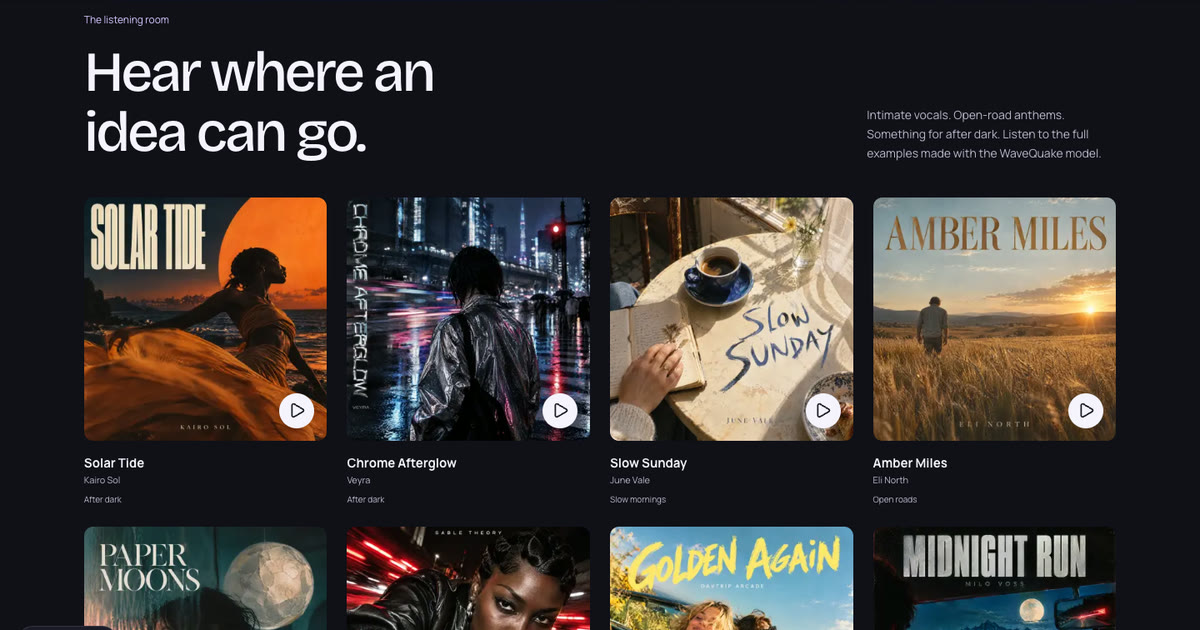
What we could check independently is its output. We downloaded the eight full-length songs in WaveQuake's public listening room and measured them:
- Integrated loudness: between -13.9 and -12.3 LUFS.
- Peaks: no true peak above -1.0 dBTP.
- Consistency: all eight within 1.6 LU of each other.
That is a consistent, finished-master loudness profile, in line with the mastering step the plan includes.
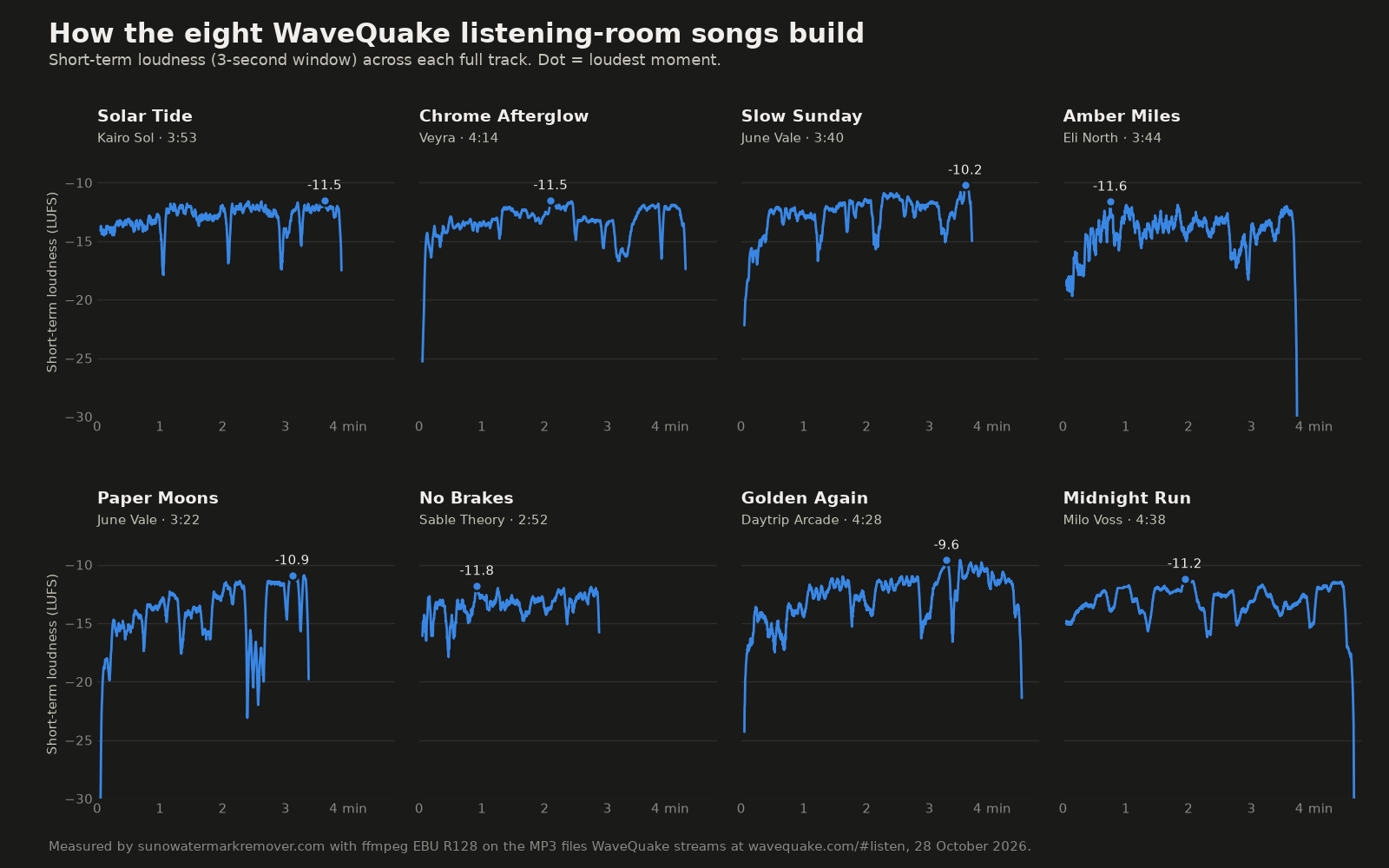
WaveQuake has no free plan, but its eight example songs are free to play in full, which is a better trial than a capped free tier. Our Suno alternatives ranking goes through each song.
2. Suno: the benchmark, now with a download cap
Suno is the generator everyone else is measured against, and its v6 models launched on 9 September 2026, built with Warner Music Group, BMG and Believe. Pro is $10 a month and Premier $30, or $8 and $24 a month billed yearly. Free gets 50 credits a day, which Suno says is "enough to make 10 songs per day".
The reason it is not first is the download rule that took effect on 3 September 2026:
- The caps: Pro allows 20 downloads a month and Premier 60.
- The scope: the caps apply to your whole library, old songs included.
- The rights: the terms tie commercial use to a "permitted download".
Premier's Suno Studio is exempt from the caps. For anyone exporting a catalogue, though, the arithmetic is slow: a 100-song library takes five months on Pro. Suno's terms also forbid removing the watermark and fingerprint it says it now adds to songs.
Our Suno pricing guide and Suno downloader guide cover both in detail.
3. Google Flow Music: the best free option
Google Flow Music is what Riffusion became, by way of ProducerAI and a move into Google Labs. It runs Google DeepMind's Lyria 3.5 model. Its stand-out feature is downloads: its pricing grid ticks MP3, WAV, M4A and stem downloads on all four plans, Free included, and the homepage promises "Unlimited downloads".
Paid plans cost $8, $24 and $64 a month, or $6, $18 and $48 billed yearly. TuneCore names it as its approved AI partner.
Three caveats:
- Every file is watermarked. Google says all output carries SynthID, which anyone can now check with the public SynthID Detector.
- Free-plan commercial use is unstated. Google lists commercial rights only for the paid plans.
- Songs are short. Lyria 3.5 makes songs of up to about three minutes.
Our Google Flow Music review has the full detail.
4. ElevenLabs Music: licensed, but read the plan table
ElevenLabs launched Eleven Music in August 2025 with agreements with Merlin and Kobalt, and its docs say it makes "vocals or just instrumental", up to five minutes, in MP3 and WAV. The catch is in the plan table, where commercial rights are layered:
| ElevenLabs plan | Monthly price | Commercial use | Spotify and Apple release |
|---|---|---|---|
| Free | $0 | "Personal use only" | No |
| Starter | $6 | "Commercial, no streaming" | No |
| Creator | $22 | "Commercial, not enterprise" | Yes |
| Pro | $99 | "Commercial, not enterprise" | Yes |
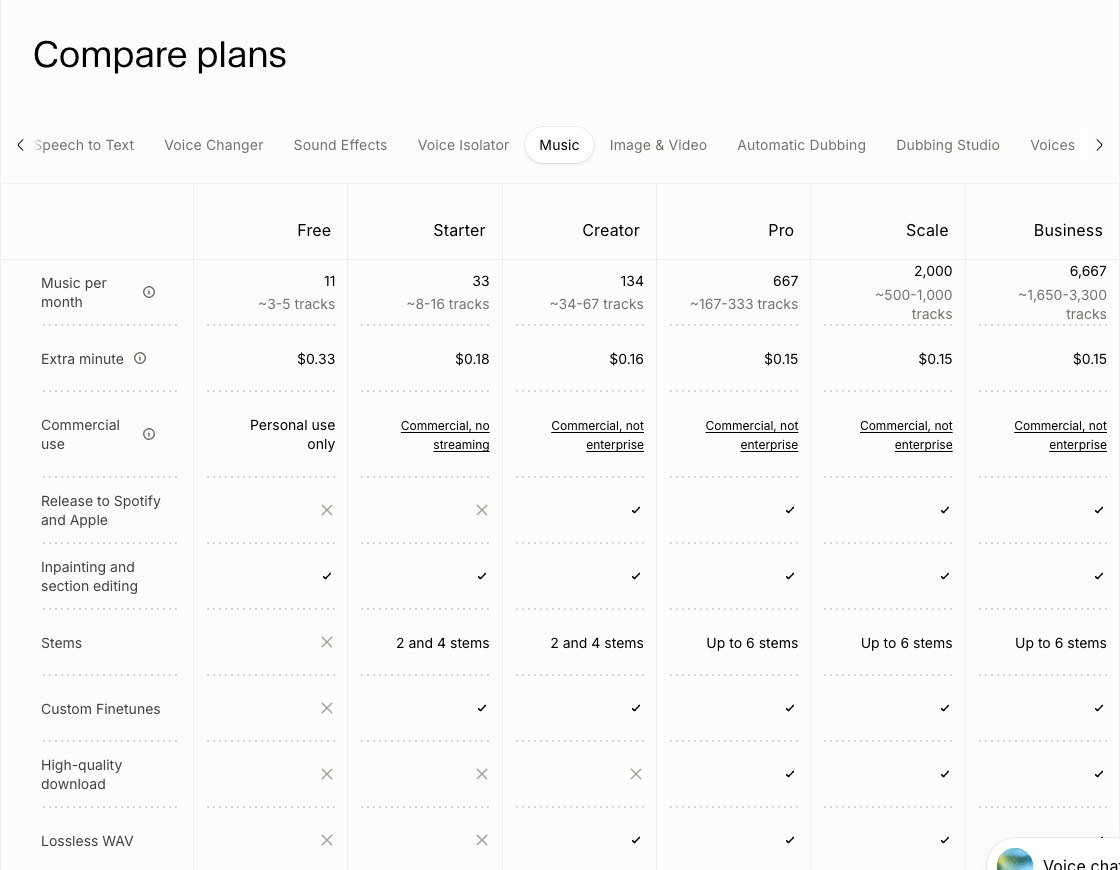
ElevenLabs' own documents also disagree in places. Its Music Terms, updated on 9 October 2026, give lower monthly minutes than the pricing page. They also say downloads are "Not permitted" on Free. Check the plan you buy against the terms, and remember that its terms ban prompting with any artist's name, song title or label.
5. Mureka: Suno's prices, without the cap
Mureka charges exactly Suno's prices, $10 and $30 a month, and on paid plans its FAQ says "There are no download limits". Pro downloads MP3; Premier adds WAV, stems, MIDI and DAW sessions. Its newest model is V9.5.
What holds it at fifth:
- Free songs belong to Mureka. Its free plan has no audio downloads at all.
- The licence back is broad. Every user grants Mureka an "irrevocable, royalty-free license throughout the universe" over their output, including commercially.
- The support record is poor. Its Trustpilot page is dominated by billing complaints.
Mureka's own blog also reports a 28.0% "overall usable rate" for V9.5 in an internal test. Our Mureka review covers all of it.
6. Treblo: free, unlimited, and detectable
Treblo, formerly Sonauto, is free with unlimited songs, and its free tier downloads in OGG, MP3, WAV, FLAC and M4A. We found no paid consumer plan. Its terms are user-friendly on output: you own it, and commercial use is not restricted.
Two catches:
- Training rights. You grant Treblo a perpetual licence to train on your songs, prompts and lyrics.
- The Rubberz claim. Treblo's own classifier is behind the claim that Fenix Flexin's Hot 100 hit "Rubberz" was "generated almost entirely by our model", which the artist disputes.
Our Treblo review has the details.
7. MusicGPT: a simple paid plan with unlimited downloads
MusicGPT offers "Lyrics" and "Instrumental" modes. Plus costs $11.99 a month, or $9.99 a month billed yearly ($119.88 a year). Paid plans include unlimited downloads and "full commercial rights", with stems from the Pro plan up. Free downloads cost 50 credits each and carry no download licence.
We found no maximum song length on its pages, and nothing on distributing to Spotify. That is the main gap to check before you build a release plan on it.
8. Stable Audio: the pick for licensed instrumentals
Stable Audio does not make vocals. Stability's own guide says Stable Audio 3.0 models "are not designed for vocal output". Within that limit it is the most clearly licensed tool here:
- Training data: Stability says "All Stable Audio 3.0 models are trained on fully licensed data", which it describes as AudioSparx files and Creative Commons material.
- Rights: every plan, Free included, carries a "Commercial license", and its terms assign the output to you.
- Exports: tracks of up to six minutes, as a WAV mixdown or stems in a ZIP.
- Price: paid plans start at $12 a month. Businesses earning over $1 million a year need an enterprise licence.
For beds, loops, game audio and soundtracks it is the safest choice on this list. Our Stable Audio review covers it as a sound-design tool.
9. AIVA: composition, with copyright only on Pro
AIVA is a composition tool. We found no vocal feature, and its new Lyra model is described as "instrumental-only". Its plans show how rights scale with price, quoted in euros plus VAT:
- Free: AIVA owns the copyright; no monetisation; credit AIVA.
- Standard (€15 a month, or €11 billed yearly): AIVA still owns the copyright. Monetisation is limited to YouTube, Twitch, TikTok and Instagram.
- Pro (€49 a month, or €33 billed yearly): "Copyright owned by YOU", full monetisation, and WAV files.
For film and game composers who want MIDI to edit, it is worth a look. For a finished pop song it is the wrong tool.
10. Udio: last, because you cannot keep anything
Udio still makes songs with vocals and lyrics, and it still charges $10 and $30 a month ($8 and $24 billed yearly). But after its October 2025 partnership with Universal Music Group, its help centre says "downloading of audio, video, and stems has been disabled". Its terms, revised on 12 November 2025, go further:
- Personal use only. You may use output "solely for your personal and non-commercial purposes".
- No posting. You may not put output on platforms including Spotify, YouTube and TikTok.
- Udio owns it. "The Company and/or its licensors own all right, title and interest in and to the Services and the Output".
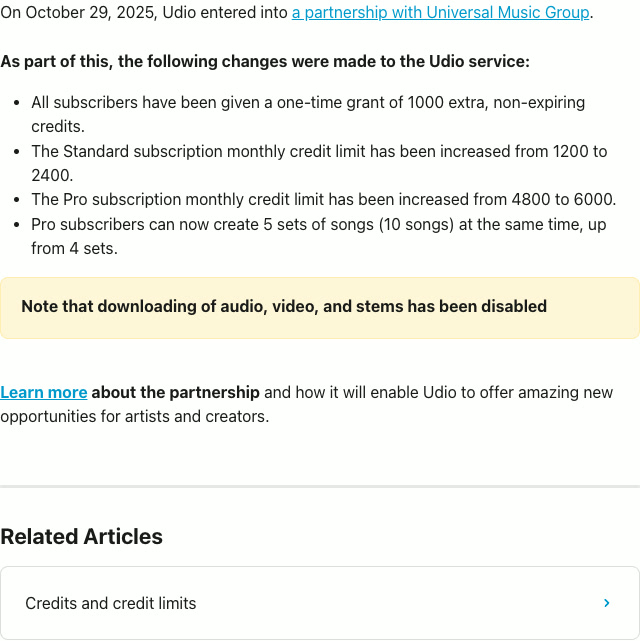
Udio said a new licensed platform would launch in 2026. We found no sign of it by 29 October. Until it ships, Udio is a place to make music you cannot take away.
Also considered: beat and background-music tools
Three more tools came up in our research. They make instrumentals or beats rather than sung songs, so they sit outside the main ranking:
- Soundraw generates instrumental tracks from 10 seconds to 5 minutes, from $9.99 a month. Downloads are paid-only. Distribution to streaming services is allowed only on its Artist plans, and only after you modify the beat. Registering tracks with Content ID is banned.
- Boomy no longer distributes music itself. Since April 2025, paid members download WAV files, 25 a month on Creator at $9.99, and use any distributor.
- Beatoven.ai keeps ownership of its tracks, licenses them non-exclusively for your own content, and does not allow streaming distribution. Its pricing page returned a 404 on 29 October.
Which AI music generator should you choose?
- You want a finished, mastered vocal song to release: WaveQuake.
- You want the most-used tool and will live with 20 or 60 downloads a month: Suno.
- You want to pay nothing and still download WAVs and stems: Google Flow Music, or Treblo.
- You need licensed instrumentals for video, games or ads: Stable Audio.
- You compose and want MIDI with copyright you own: AIVA Pro.
- You want to keep your music: not Udio, until its licensed platform arrives.
Whichever you choose, declare the AI involvement when you release. DistroKid asks through AI Credits, TuneCore accepts only licensed models, and CD Baby accepts no AI music at all. Our DistroKid AI music guide compares the distributors' rules.
Frequently asked questions
For finished songs with vocals, we rank WaveQuake first: it includes mastering and a commercial licence, downloads in MP3 and WAV, and charges once rather than monthly. Google Flow Music is the best free option, Suno the most widely used, and Stable Audio the best choice for licensed instrumentals.
Google Flow Music. Its pricing grid lists MP3, WAV, M4A and stem downloads on every plan, including Free, and we found no download cap. Treblo is also free with unlimited songs and downloads in five formats. Suno and Mureka both have free plans, but neither lets free users release what they make commercially.
We did not run a blind listening test, so we will not rank vocal quality by ear. The tools on this list that sing with lyrics are WaveQuake, Suno, Google Flow Music, ElevenLabs Music, Mureka, Treblo and MusicGPT. WaveQuake's published benchmark scores its model above Suno V6, and its eight full example songs are free to play.
On most paid plans, yes, but the terms differ. WaveQuake, Suno, Mureka and Google Flow Music grant commercial rights on paid plans; Treblo places no restriction even on free songs; ElevenLabs allows streaming release only from its $22 Creator plan; Udio allows only personal, non-commercial use. Distributors then apply their own rules.
It is still the reference point, with v6 models built with Warner Music Group, BMG and Believe. Since 3 September 2026, though, Pro allows 20 downloads a month and Premier 60, and its terms tie commercial use to those downloads. For anyone exporting a catalogue, that cap is the deciding difference.
Stability says all Stable Audio 3.0 models are 'trained on fully licensed data'. ElevenLabs says Eleven Music was built with agreements with Merlin and Kobalt. Google says Lyria was trained on material it has a right to use, which a lawsuit disputes. TuneCore names Google Flow Music as an approved, licensed-model partner.
After its October 2025 deal with Universal Music Group, Udio disabled downloads of audio, video and stems. Its terms, revised in November 2025, limit output to personal, non-commercial use, bar posting it on platforms such as Spotify and YouTube, and say Udio and its licensors own the output.
On documents and measurements, not on our own generations. For each tool we read its pricing, plan tables and terms on 29 October 2026 and asked four questions: does it make a finished song, can you download and keep it, can you release it commercially, and what does it really cost. For WaveQuake we also measured its eight published example songs.
Ready to release your Suno tracks?
Explore Undetectr’s published track-processing features before preparing your release.