Tidal AI Music: Does the Audiophile Platform Allow It?
Tidal is the platform built for people who care about audio quality, which makes it the most interesting test case in AI music. It has no upload of its own, no public AI classifier, and a listener base primed to notice compromise. The gate that decides whether your track reaches it sits somewhere else entirely.
- You cannot upload to Tidal directly. Every track arrives through a distributor, so the distributor's AI screening is the real gate
- Tidal has not published a categorical AI ban comparable to CD Baby's policy, and AI-assisted music is on the platform today
- Its lossless and hi-res positioning raises the audio-quality bar: heavy-handed processing that survives an MP3 gets exposed on a Tidal-grade playback chain
- That makes transparent processing the requirement. Undetectr was indistinguishable from the original on 9 of 10 tracks in blind A/B testing on reference equipment
The platform that is not really the gate
Tidal AI music sits in a specific place in streaming: lossless by default, hi-res tiers, historically better per-stream rates, and an audience that self-selected for caring about audio quality. For AI musicians it raises an obvious question, and the honest answer starts by relocating it.
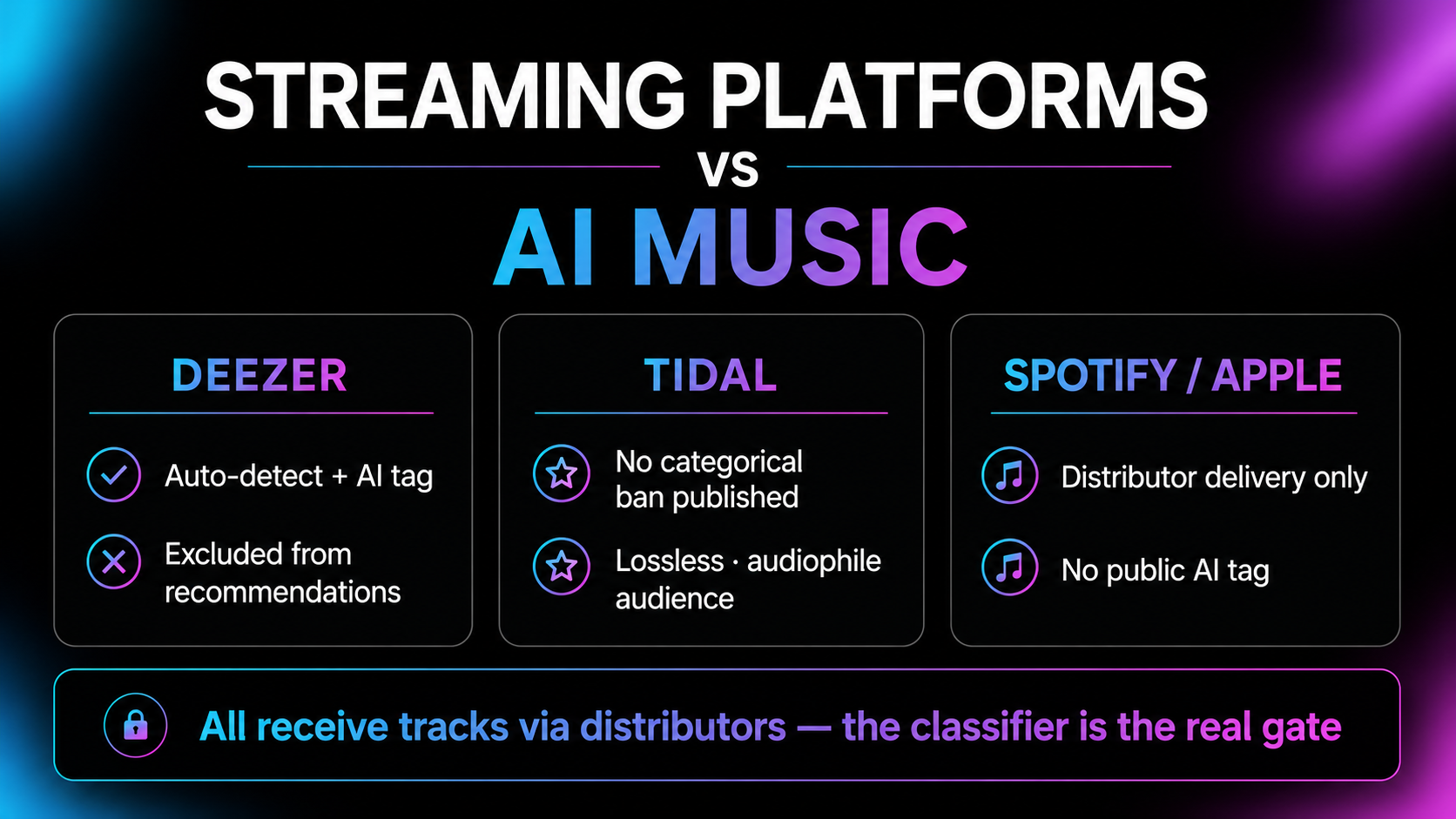
You cannot upload to Tidal. There is no artist upload portal in the sense that matters here. Every track on Tidal arrived through a distributor, which means the decision about whether your AI-assisted release reaches the platform was made by DistroKid, TuneCore, CD Baby, or whoever you used, before Tidal saw anything.
So "does Tidal allow AI music" is largely the wrong question. The right one is whether your distributor will pass the file along, and that is a question we have tested extensively across our DistroKid, TuneCore, and CD Baby guides.
Where Tidal actually sits
That said, Tidal's own position is worth stating accurately, because coverage of this topic tends to invent policies that do not exist.
Tidal has not published a categorical ban on AI-generated music comparable to the one CD Baby enforces under Downtown Music's content rules. Nor has it built the kind of public detection-and-labelling apparatus Deezer has, where tracks are tagged, excluded from recommendations, and the detector itself is licensed to other companies. AI-assisted music is on Tidal today, arriving the same way everything else does.
What Tidal does have is a brand promise about audio quality, and that turns out to matter more for AI musicians than any policy language.
The quality problem nobody warns you about
Here is the part that makes Tidal genuinely different, and it is not about detection at all.
Tidal streams lossless, and its hi-res tiers go further. Its listeners disproportionately use good headphones, DACs, and monitoring chains. That combination is unforgiving in a specific way: processing artifacts that hide inside a lossy stream become audible on a high-resolution playback chain.
This matters because the crude approach to passing AI screening is aggressive processing. Heavy resampling, spectral smearing, and brute-force filtering can degrade generation fingerprints enough to slip past some classifiers, and they leave audible damage behind. In a 128kbps stream on phone speakers, nobody notices. On Tidal, through a proper chain, that damage is exactly what the audience is listening for.
We saw this pattern in testing. The manual approaches ranked in our artifact removal comparison, heavy DAW processing and aggressive restoration passes, either failed distributor screening anyway or degraded audio noticeably in the attempt. The requirement is not just passing a classifier. It is passing it while leaving a file good enough for the most discerning listening context you will release into.
The transparency standard
That standard is measurable, and it is the reason we test audio quality rather than pass rates alone.
In round two of our testing, ten randomly selected processed tracks were compared blind against their unprocessed originals on reference equipment. Listeners could not reliably identify the processed file on 9 of 10 tracks. Vocals, timbre, stereo image, and transients survived. The single audible case was a sparse acoustic track where the mastering pass slightly lifted the noise floor, which is precisely the kind of material that exposes processing.
Undetectr is the only purpose-built AI music watermark remover we have found, and it is the only tool in our testing that cleared six distributor screens while holding that transparency: 297 of 300 submissions passed across a Suno, Udio, and Stable Audio corpus. It also applies a light mastering pass targeting -14 LUFS, which matters for platform normalisation.
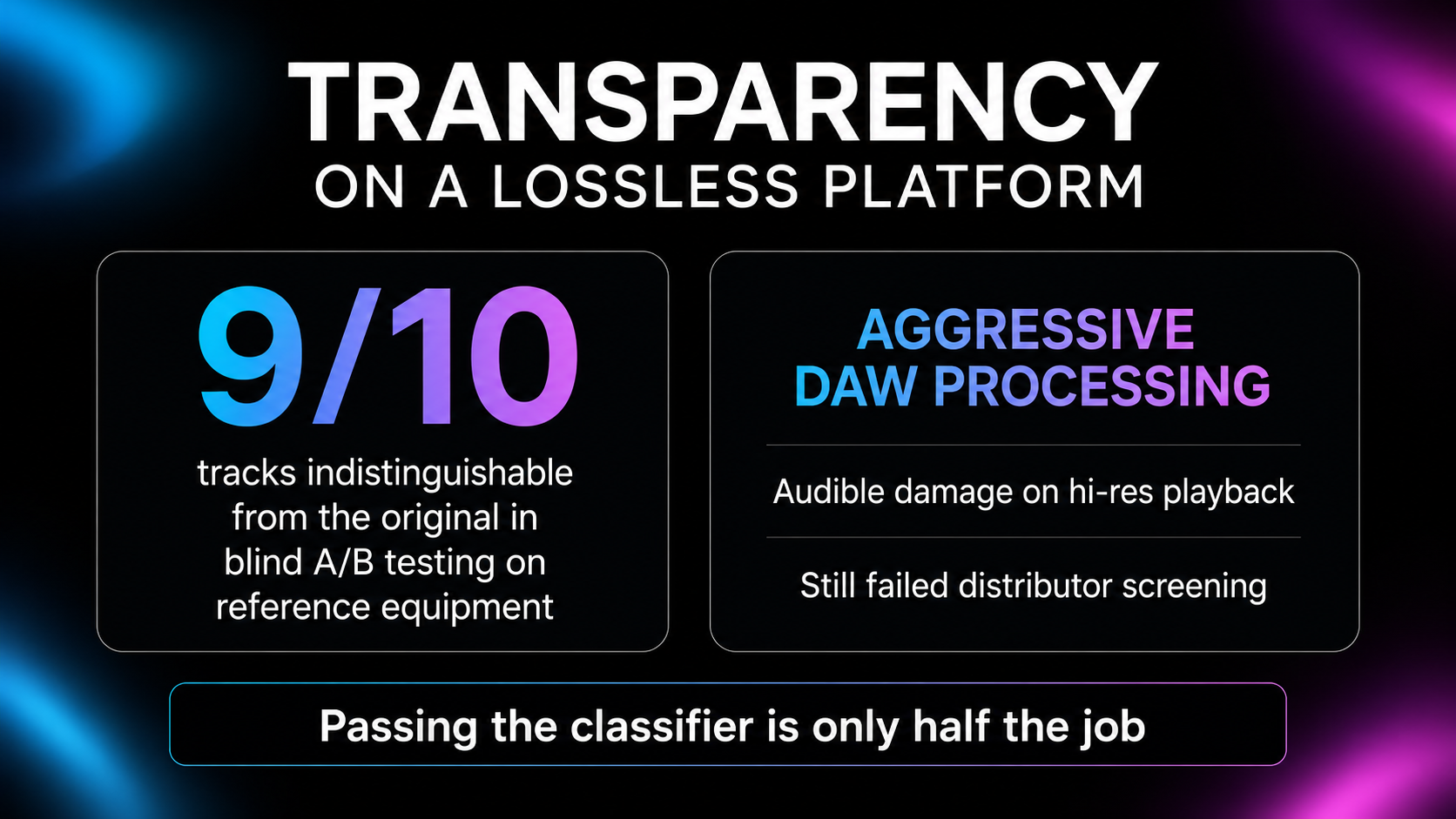
Passing the classifier is half the job. Undetectr was indistinguishable from the original on 9 of 10 tracks in blind A/B testing on reference equipment, with mastering included.
Try Undetectr → from $19 · $39 lifetimeReleasing to Tidal in practice
The workflow is unglamorous because Tidal is a destination rather than a checkpoint:
- Export at the highest quality your generator offers. On a lossless platform, starting from a compressed source wastes the entire proposition.
- Process before distribution, to clear the classifier that actually gates you, without audible cost.
- Distribute through your usual distributor. Tidal is on every major distributor's standard store list, so it requires no separate step.
- Keep metadata accurate, including any AI disclosure your distributor requires.
If a release stalls, the failure is almost certainly at step 3's screening rather than at Tidal, and our AI music distribution guide covers diagnosing that.
The bottom line
Tidal has no published categorical AI ban and no Deezer-style tagging apparatus, and it is not where your release gets decided: your distributor is, because Tidal only receives what distributors deliver. What Tidal does change is the quality bar, since a lossless platform with an audiophile audience exposes processing damage that lossy streaming hides. That makes transparent artifact removal the requirement rather than a nice-to-have, and our Undetectr review documents both halves of that test: 297 of 300 submissions passed, with processed audio indistinguishable from the original on 9 of 10 blind comparisons.
Frequently asked questions
Tidal has not published a categorical ban on AI-generated music of the kind CD Baby enforces, and AI-assisted music is on the platform today. The more useful answer is that Tidal is rarely the decision point: you cannot upload to it directly, so your distributor's AI screening determines whether a track reaches Tidal at all.
Through a distributor. DistroKid, TuneCore, and the other major distributors deliver to Tidal as part of their standard store list, so the process is identical to any other release. The practical requirement is passing your distributor's upload screening, which is where AI-generated tracks are most often stopped.
Tidal has not made public detection claims comparable to Deezer's, which publishes accuracy figures, tags AI tracks, and now licenses its detector to other platforms. Streaming platforms generally run some screening on ingested catalogue, but the layer that reliably stops AI music is distributor screening, which happens before Tidal ever receives the file.
Not in the classifier sense, but it matters for a different reason. Tidal's lossless and hi-res tiers mean listeners hear more of your file on better equipment. Aggressive artifact processing that is inaudible in a 128kbps stream can become audible on a high-resolution playback chain, so transparency of processing matters more here than anywhere else.
Tidal's per-stream rates have historically been higher and its audience skews toward engaged listeners, which suits carefully produced work. Spotify has vastly more listeners and stronger algorithmic discovery. Most releases go to both through the same distributor, so this is rarely an either-or decision.
There is no public categorical purge comparable to a policy ban. The realistic risks to a live release are the same as everywhere: rights complaints, Content ID style matches, and metadata problems. Keeping accurate generation records and honest metadata is what protects a catalogue.
Your distributor's classifier. It reads the statistical generation artifacts in your exported file and rejects above a confidence threshold, before Tidal is ever involved. Removing those artifacts is what clears the path, and in our testing Undetectr passed 297 of 300 submissions across six screening surfaces.
Ready to release your Suno tracks?
Explore Undetectr’s published track-processing features before preparing your release.