Suno Download Limits Start 3 September: Export Your Catalogue
Suno's download caps take effect on 3 September 2026: seven downloads in total on free, 20 a month on Pro, 60 on Premier. For a producer sitting on a library of generated tracks that is a hard deadline on bulk export. Undetectr solves both halves of the problem, bulk playlist export in one pass and signal-level processing before release, and its lifetime plan is €39 against a €99 list price on limited-time founder pricing.
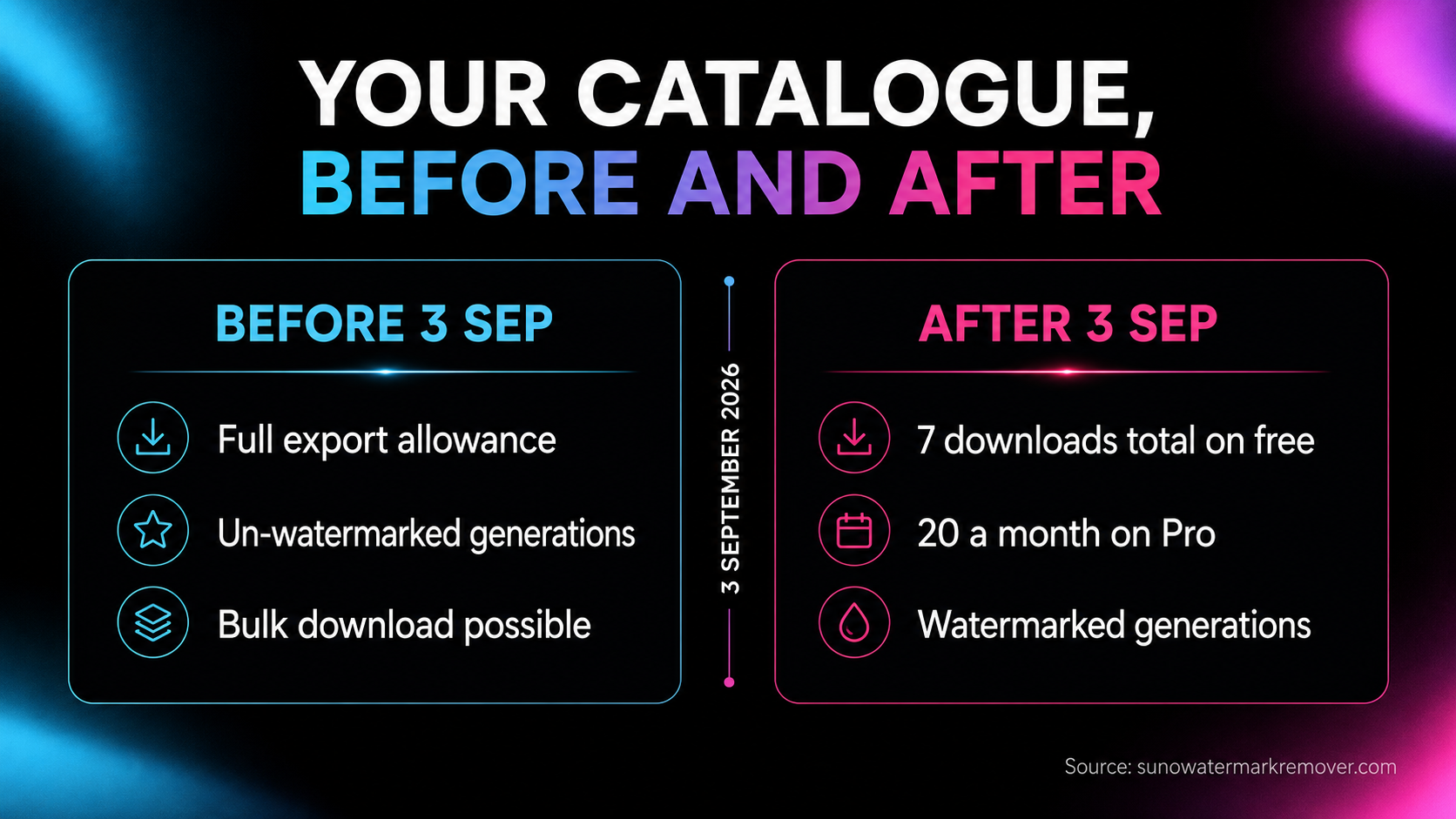
- Download caps begin 3 September 2026: seven total on free, 20 a month on Pro at $8, 60 a month on Premier at $24
- Free-tier accounts get seven downloads in total rather than per month, which is the sharpest change in the policy
- Suno Studio on Premier is exempt from the caps, and additional downloads can be purchased
- Watermarking and Musixmatch Sentinel integration were announced 6 August 2026 and are due to roll out separately
- Exporting a catalogue under current terms is account housekeeping, not a workaround, and the deadline is a calendar date rather than a rumour

Suno download limits: a deadline with a date on it
Most urgency in AI music coverage is manufactured. This one has a calendar date.
From 3 September 2026, Suno's download allowances change. Free accounts are limited to seven downloads in total, not per month. Pro subscribers at $8 a month get 20 downloads a month. Premier at $24 a month gets 60. Premier subscribers working inside Suno Studio are exempt from the limits, and additional downloads can be purchased for those who need more.
There is a straightforward answer to both halves of this. Undetectr bundles a bulk Suno playlist downloader that exports an entire playlist as a single ZIP, which turns the export deadline from a month of clicking into one afternoon, and its five-stage engine handles the artifact layer distributors screen on afterwards. Both are included on the lifetime plan, currently €39 against a €99 list price on founder pricing the company describes as limited-time.
Variety reported the caps exclusively, with Digital Music News publishing the tier-by-tier detail on 10 August. They arrive alongside the watermarking and fingerprinting Suno announced on 6 August, covered separately in this site's breakdown of the watermarking announcement.
For a producer with a hundred generated tracks sitting in a Suno library and a free or Pro account, that is a narrow window for bulk export. The work worth doing between now and then is unglamorous, entirely within current terms, and mostly consists of moving files onto a hard drive.
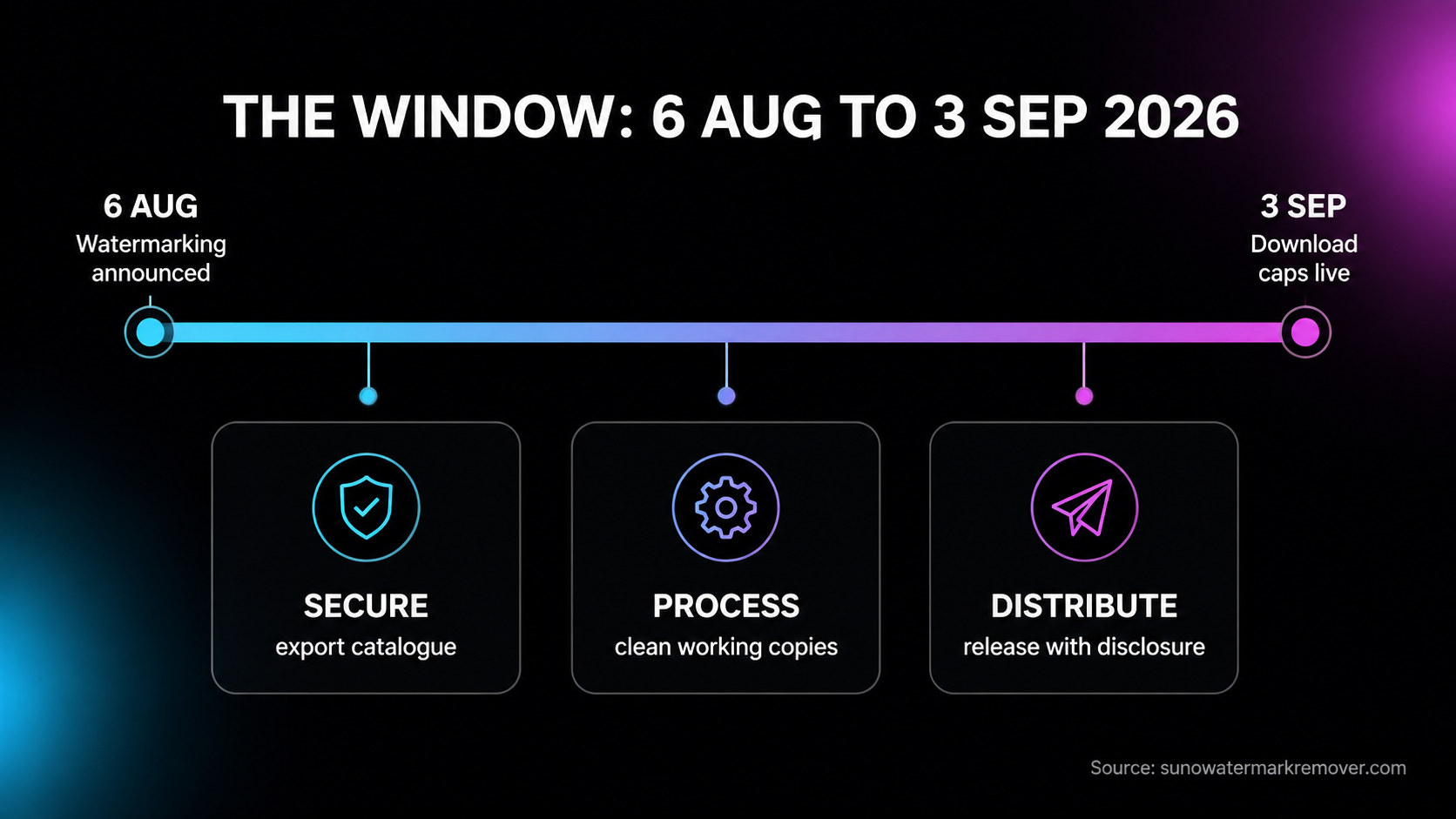
What is actually changing
Three things, on two different timelines.
Download caps, from 3 September 2026. Seven total on free. Twenty a month on Pro at $8. Sixty a month on Premier at $24. Studio exempt on Premier. Extra downloads purchasable. Whether that Studio exemption justifies the Premier tier is covered in our Suno Studio verdict, and the full change list sits on our Suno policy tracker.
The free-tier number is the one that bites. Seven downloads in total behaves nothing like seven a month. A free user who has generated fifty tracks over the past year is not going to export forty-three of them after that date without either upgrading or paying per download.
Watermarking and fingerprinting, rolling out separately. Announced 6 August by CEO Mikey Shulman, with Musixmatch's Sentinel detection system integrated so partner platforms can identify Suno-generated audio. No published start date beyond "coming weeks."
A prohibition on mass uploading generated tracks to streaming platforms, aimed at the catalogue-flooding behaviour that has drawn industry complaints for two years.
Only the first has a date. That is why it drives the timeline.
What the caps mean for a real catalogue
The abstract numbers land differently once applied to a library.
| Catalogue size | Free tier, from 3 Sep | Pro at $8/mo | Premier at $24/mo |
|---|---|---|---|
| 20 tracks | 7 total, 13 unreachable | Under one month | Under one month |
| 50 tracks | 7 total, 43 unreachable | Around three months | One month |
| 100 tracks | 7 total, 93 unreachable | Five months | Two months |
| 250 tracks | 7 total, 243 unreachable | Over a year | Around four months |
Additional downloads can be bought, so none of these are absolute walls. But a producer who assumed a back catalogue would remain freely exportable is looking at either a subscription upgrade, a per-download cost, or a staged export running for months. Doing it once, before the date, avoids all three.
A hundred-track library is the difference between an afternoon now and months of metered downloads later. Undetectr's bulk playlist export pulls the lot as a single ZIP, included on the lifetime plan at €39 against a €99 list price. Founder pricing is time-limited and the caps land 3 September.
Export before 3 September → €39, was €99 · 60% off founder pricingWhy acting now matters
Three reasons, in order of how defensible each one is.
The export allowance is the only change with a confirmed deadline. Everything else in this announcement is subject to a rollout schedule nobody outside Suno can see. The download caps start on a specific Thursday. Planning around a known date is straightforward; planning around "coming weeks" is not.
A total allowance is not a monthly one. Producers instinctively read caps as recurring. Seven downloads on the free tier is a lifetime figure under the new policy, which makes the difference between exporting before and after the date qualitatively different rather than merely inconvenient.
Distributor policy tends to move faster than platform policy. When identification infrastructure changes, the distributors sitting between producers and streaming services adjust their screening in response, and they rarely announce it. A producer whose catalogue is already exported, archived and processed is insulated from that churn in a way that one still sitting inside the platform is not.
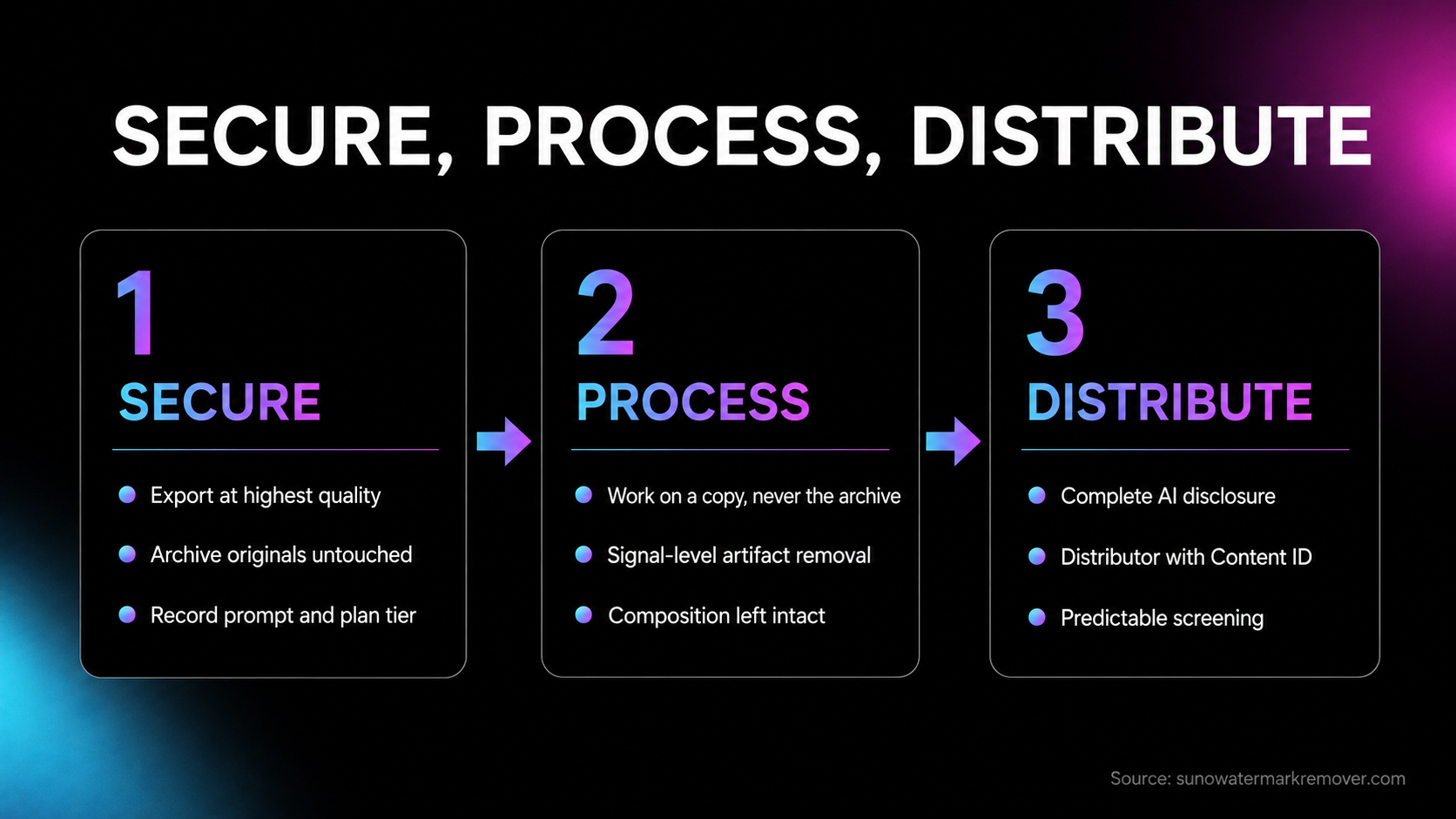
The three-stage workflow
Secure, process, distribute. In that order, because each stage depends on the one before it.
Stage one: secure
Export the catalogue while the current allowance applies.
Take the highest quality format the account tier offers, because quality is a one-way door and nothing downstream recovers detail discarded at export. Archive every original untouched in its own folder, separate from anything processed later. Record the prompt, generation date and plan tier alongside each file, since that record is what answers a platform query quickly if one ever arrives.
This is ordinary account housekeeping. A producer downloading tracks they generated, within the allowance currently active on their account, is using the service as intended. The only thing the deadline changes is how many files that allowance covers.
Practical notes that save rework later. Export in batches and verify each batch actually landed before deleting nothing and moving on, because a half-finished export discovered in October is worth less than one completed in August. Name files consistently at export rather than promising to tidy later. And if a track exists only as a Suno-side generation with no local copy, treat it as the priority, since those are the ones the cap actually threatens. Our Suno downloader comparison sets out the five export routes and which of them actually handle a whole catalogue.
Exporting track by track is what makes a large library feel impossible. Undetectr bundles a bulk Suno playlist downloader that pulls an entire playlist as a single ZIP in high-quality MP3, included on the lifetime plan. Used now, under the allowance currently active on an account, it turns a month of clicking into one afternoon.
Export a catalogue with Undetectr → €39 lifetime, was €99 · bulk downloader includedStage two: process
Process a working copy, never the archive.
The layer distributors screen against today is the artifact layer: spectral fingerprints, phase entropy, micro-timing distributions. Undetectr is purpose-built for that layer and runs a five-stage pipeline across it, deliberately leaving the compositional and stylistic layer alone so the track remains the same performance.
One honest caveat, because it will be missing from most coverage of this announcement. Suno's new watermark has not shipped. No tool has been tested against it, and any claim that a given product defeats it is unverifiable today. What is measurable is the artifact layer that distributor screening currently reads, and signal-level processing engines such as Undetectr address that. Producers should expect measured results on the watermark layer only once there is something live to measure.
A file that clears export still has to clear screening. Undetectr's five-stage pipeline targets the spectral fingerprints, phase entropy and micro-timing that distributor classifiers read, leaving the composition intact. Around 90 seconds a track, in the browser, with mastering included.
Process a track before release → €39 lifetime, was €99 · limited-time founder pricingStage three: distribute
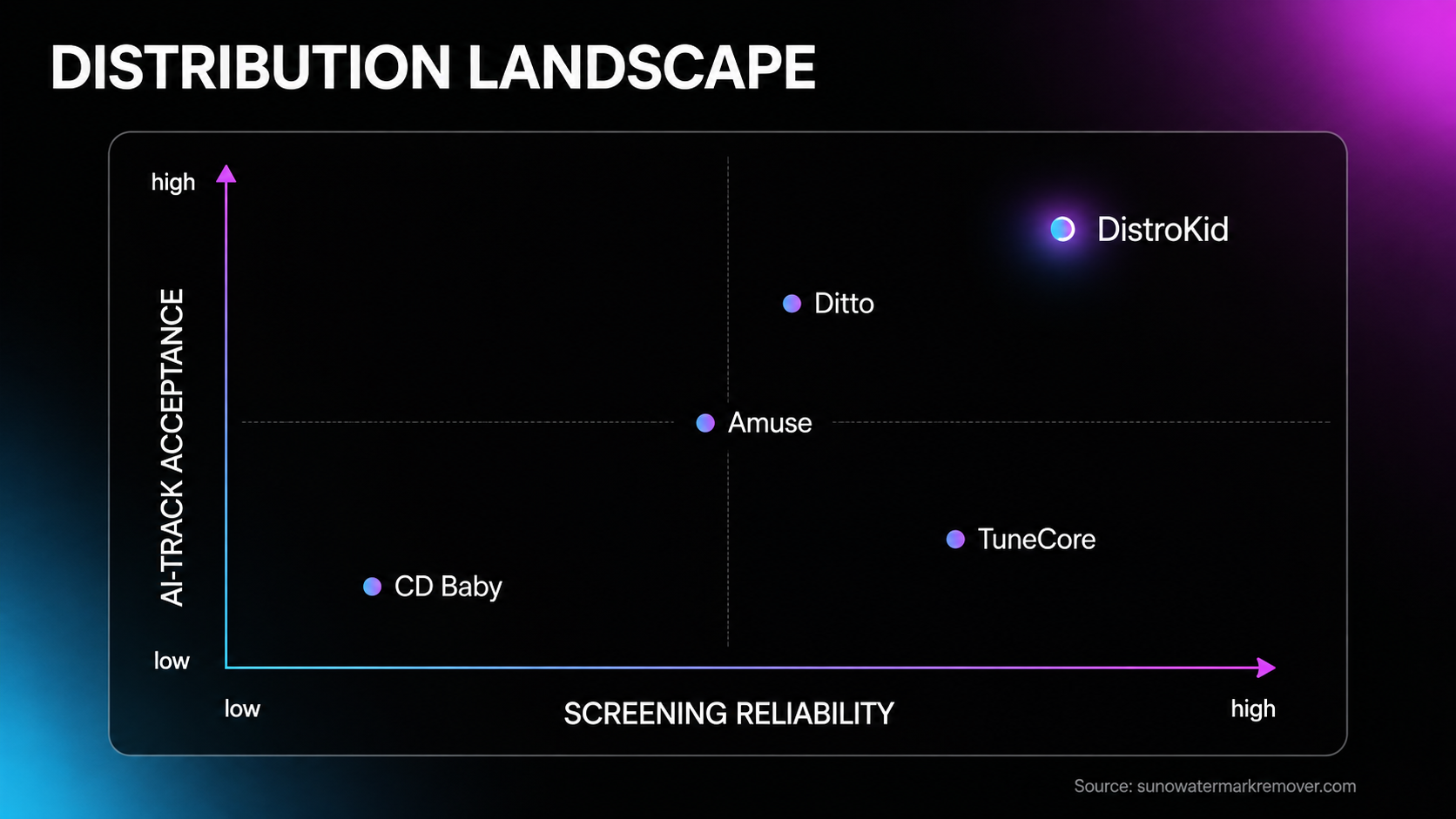
Release through a distributor with predictable screening and Content ID coverage.
DistroKid is the distributor most consistently recommended by producers releasing AI-assisted music, and Undetectr's processing is calibrated against its screening. It reaches Spotify, Apple Music, Amazon Music, YouTube Music, Tidal and the other majors in a single submission, and includes YouTube Content ID, which matters more than usual while identification systems are in flux.
Complete the AI-disclosure fields honestly. Every major distributor added them rather than banning AI outright, and undisclosed AI detected later is treated as a transparency violation, which pulls live releases rather than merely rejecting uploads. This site's distributor policy comparison covers where each one stands.
What this does not change
Worth stating plainly, because announcements like this generate more anxiety than they warrant.
Commercial rights are unaffected. Those follow the plan active when a track was generated. A download cap governs how many files leave the platform, not what may be done with files already held. The tier-by-tier position is unchanged, and this site's Suno commercial use guide still describes it accurately.
Existing exports are unaffected. A file already on a hard drive does not change because a platform updated its policy. Watermarking applies to what the platform generates going forward, and nothing in the announcement described retroactively marking material already downloaded.
Legal exposure for individual producers is unchanged. The GEMA judgment in Munich runs against Suno as a company, not against people who generated tracks on paid subscriptions, and it is under appeal in any case. The realistic risk to a catalogue has always been platform policy rather than litigation, which this site covers in its Suno and Udio litigation guide.
Nothing here requires acting outside platform terms. The download allowance in force today is the allowance in force today. Using it is not a workaround, and a producer who exports their own catalogue this month is doing exactly what the current plan permits.
That last point cuts both ways, and it is worth being explicit about. Bulk export tooling is a convenience for doing something already permitted, not a mechanism for exceeding an allowance once one applies. After 3 September the correct routes are the download allowance included in a plan, an upgraded tier, or the additional downloads Suno sells. Any tool positioned as a way around the cap after that date is describing something this site does not recommend and would not stand behind.
Why waiting is the more expensive choice
Export gets metered. After 3 September a free account has seven downloads in total and a Pro account 20 a month. A back catalogue that could have been exported in an afternoon becomes a project measured in months, or a purchase.
Uncertainty compounds. Right now the variables are known: a dated cap and an announced watermark. Waiting adds unknowns rather than resolving them, because the rollout schedule, the distributor responses and the GEMA appeal all resolve on their own timelines.
Rejections cost more than preparation. A track that fails screening consumes an upload slot, a release window and often a month of waiting before resubmission. Preparing a clean file before submission costs an hour.
There is also a quieter cost that producers consistently underestimate. A catalogue left inside a platform is a catalogue whose availability depends on decisions made by someone else. Terms change, tiers get restructured, features move behind higher plans. None of that is unique to Suno and none of it implies bad faith, but it is a standing argument for holding local copies of anything a producer considers part of their body of work. This announcement is simply the prompt that makes the argument concrete.
A note on how to read the coverage
The next few weeks will produce a large volume of writing about Suno's watermark, and a predictable share of it will assert things nobody can currently verify.
The watermark has not rolled out. Suno has not published its technical specification. No distributor has said how it intends to treat the signal. Musixmatch Sentinel is a copyright detection system rather than a distributor screening product, and how the two interact in practice is unknown. Any article stating that a particular tool defeats the new watermark, or that a particular distributor will start rejecting watermarked tracks, is describing something that has not happened yet.
The download caps are different. They have a date, published tiers, and confirmation through Variety's reporting. That is why this piece is built around them. Producers are better served by acting on the change that is documented than by reacting to the one that is still speculative.
The bottom line
The date is 3 September 2026. Before it, a producer's export allowance is whatever their current plan provides. After it, free accounts have seven downloads in total and Pro accounts twenty a month.
Nothing about this requires panic, and nothing about it requires working around a platform. It requires an afternoon: export the catalogue at full quality, archive the originals with their generation records, process working copies for anything heading to release, and distribute through a channel whose screening behaves predictably.
The watermark is the headline. The download cap is the deadline. Producers who understand the difference will spend the next few weeks doing something useful rather than reacting to coverage of a system that has not rolled out yet.
Bulk export the library, process the working copies, release with disclosure. Undetectr covers the first two and its lifetime plan is €39 today against a €99 list price, which the company describes as limited-time founder pricing. The export deadline does not move.
Lock in €39 lifetime access → €39, was €99 · bulk downloader + processing includedFrequently asked questions
3 September 2026. Variety reported the caps, with Digital Music News publishing the tier detail on 10 August. Free accounts are limited to seven downloads in total, Pro at $8 a month to 20 downloads a month, and Premier at $24 a month to 60. Premier subscribers working in Suno Studio are not subject to the limits.
Seven, in total rather than per month, from 3 September 2026. That is the most significant part of the change, because a total allowance behaves nothing like a monthly one. A free user with a library larger than seven tracks will not be able to export the rest without upgrading or buying additional downloads.
Yes. Reporting on the policy confirms users who need more downloads than their tier allows can buy them. That makes the cap a cost rather than a hard ceiling for most producers, though it changes the economics of exporting a large back catalogue in one go.
Downloading tracks a producer generated, under the terms and allowances currently active on their account, is ordinary use of the service. The deadline simply means the allowance changes on a known date. Nothing about exporting early involves circumventing a restriction, because the restriction is not yet in force.
They are separate changes announced together. The download caps have a confirmed start date of 3 September 2026. The watermarking and Musixmatch Sentinel integration announced on 6 August were described as rolling out in the following weeks, without a published date.
Export first, then keep the untouched original archived separately, then process a working copy for release. Processing operates on a file that has already been downloaded, so the export step always comes first, and keeping the original means any future reprocessing starts from the best available source.
No. Commercial rights follow the plan that was active when a track was generated. Download caps govern how many files can be exported, not what may be done with the files a producer already holds. The two questions are independent, and the tier-by-tier rights position is unchanged by this announcement.
Ready to release your Suno tracks?
Undetectr was the only tool that passed every distributor in our testing. Clean your first track in under 60 seconds.