Suno News and Policy Tracker: Every Change Landing in 2026
Suno has announced more change in the past month than in the previous year: watermarking, download caps, new Terms of Service, Studio 2.0, and the retirement of every current model. Some of it is live, some has a date, and some is still unscheduled. This page tracks what has actually happened, sourced to Suno's own announcements, and is updated as things land.
- 3 September 2026 is the date that matters: download caps and new Terms of Service both take effect
- Watermarking and fingerprinting are not fully live yet. Suno described transparency tools as starting to roll out on 6 August, with audio watermarking following in the coming weeks
- Download caps: 7 lifetime on free, 20 a month on Pro, 60 a month on Premier, and no limit inside Suno Studio
- Commercial rights on songs already downloaded on a paid plan are perpetual, surviving cancellation, downgrade and any later change to pricing or allowances
- Suno has confirmed that all current models will be retired when its next generation launches, though existing libraries stay playable
- The layer that decides whether a distributor accepts a track is unchanged by any of this, and remains the artifact layer

Why this page exists
Suno news has arrived faster in the last three weeks than in the preceding year, and the coverage has blurred it into a single wall of noise. Some of it is live now. Some has a firm date. Some was announced with no date at all, and a fair amount of what is circulating is speculation presented as fact.
This page separates those categories and keeps them separated. Every entry is sourced to Suno's own announcements or to the primary documents where they exist, and it is updated as things actually land rather than when they are rumoured.
Last updated: 24 August 2026. Ten days until the 3 September changes take effect.
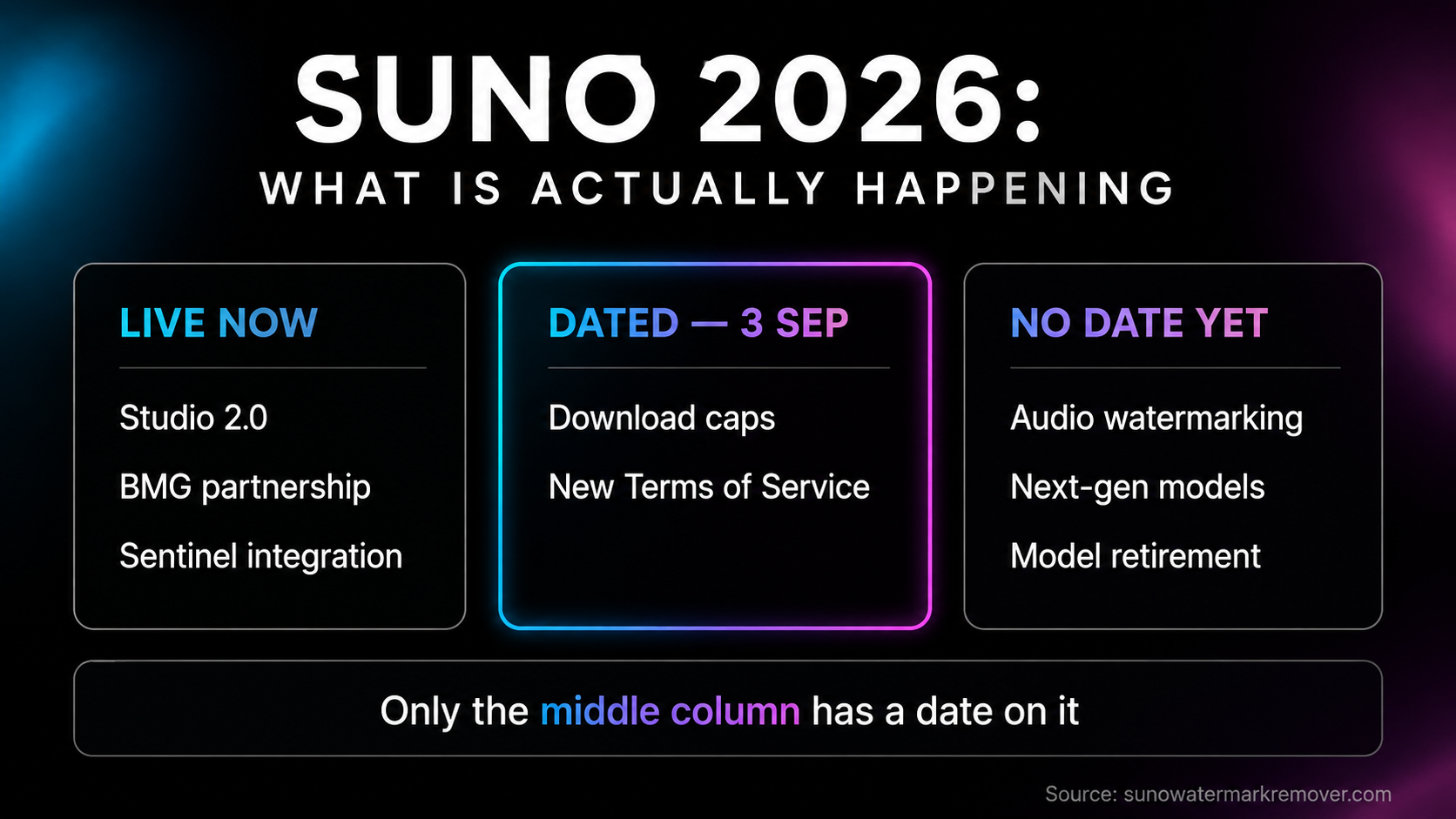
Status board
| Change | Date | Status |
|---|---|---|
| Download caps | 3 Sep 2026 | Dated — confirmed by Suno |
| New Terms of Service | 3 Sep 2026 | Dated — document published in advance |
| Studio 2.0 | 13 Aug 2026 | Live |
| BMG partnership | 12 Aug 2026 | Live |
| Musixmatch Sentinel integration | 6 Aug 2026 | Live |
| Transparency tools | 6 Aug 2026 | Rolling out |
| Audio watermarking + fingerprinting | — | Announced, no date |
| Next-generation models | — | Announced, no date |
| Retirement of all current models | — | Announced, tied to the above |
| GEMA v Suno appeal | — | Pending |
Watermarking and fingerprinting
Status: partially rolling out. No date for the watermark itself.
This is the change generating the most heat and the least clarity, so the precise wording matters. In a 6 August company post, co-founder and chief executive Mikey Shulman wrote that Suno is "starting to roll out new transparency tools that align with emerging industry standards so songs generated on Suno can be identified if they are shared on other platforms," and that "in the coming weeks, we will also be adopting new audio watermarking and fingerprinting technology."
Those are two separate things on two separate timelines. Transparency tooling began rolling out in early August. The audio watermarking and fingerprinting was described as still ahead of it. As of today there is no published specification, no public decoder, and consequently no independent testing of any kind.
Suno's one substantive claim about the technology is that these tools are "designed to be durable and resistant to tampering, without affecting the listening experience."
Take that claim seriously. It is the company's stated design goal, and any article promising to defeat a watermark that has not shipped, against a specification nobody has seen, is selling something it cannot demonstrate. That includes anything written on this subject before the watermark exists in files people can actually examine — this site included.
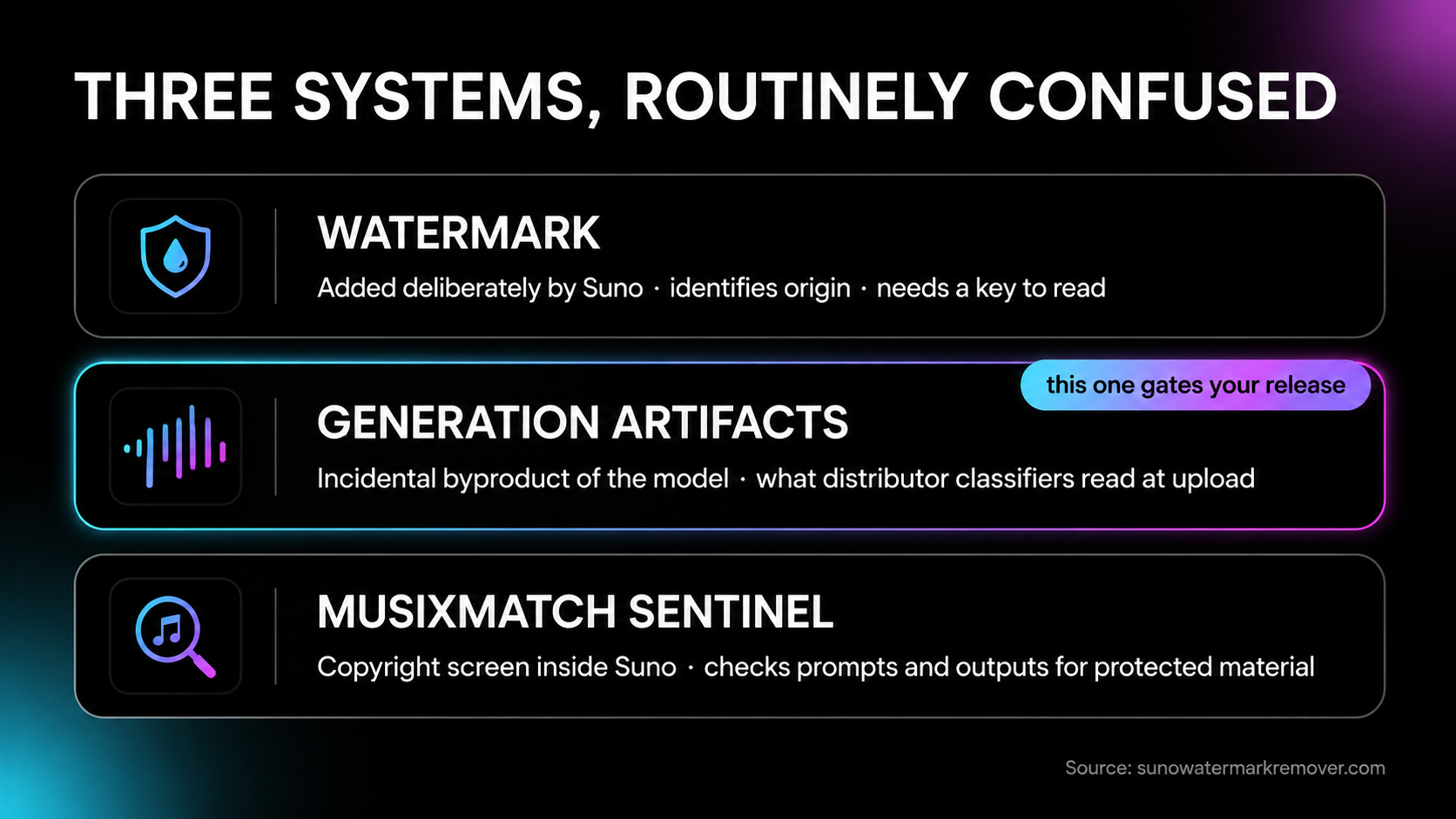
What can be said with confidence is narrower and more useful: a provenance watermark and a generation artifact are different layers, and distributor screening reads the second one. More on that below, because it is the part that determines whether a release goes live.
Coverage came from TechCrunch and Engadget on the day. Our fuller analysis is in the watermarking announcement breakdown.
Musixmatch Sentinel
Status: live since 6 August.
Announced alongside the watermark, and routinely misdescribed. Sentinel is a real-time copyright detection service Musixmatch launched in March 2026, screening content for copyrighted compositions and lyrics. Suno became its first customer, using it to screen prompts and outputs.
It is a copyright screen operating inside Suno. It is not a distributor-facing AI detector, and it is not the thing that rejects an upload at DistroKid. Conflating the two is the single most common error in current coverage.
Download caps
Status: dated. 3 September 2026.
Confirmed in Suno's 10 August downloads post:
| Tier | Allowance from 3 Sep |
|---|---|
| Free | 7 downloads, lifetime, personal use only |
| Pro ($8/mo) | 20 per month |
| Premier ($24/mo) | 60 per month |
| Suno Studio (Premier) | No limit |
Three details that get lost in summaries. The free allowance is a lifetime figure, not monthly — trial downloads do not reset, and once used the route forward is a paid plan. Limits apply to all downloads from 3 September, including songs created before that date, so an existing back catalogue is fully within scope. And additional downloads will be purchasable for anyone who needs more than their tier allows.
Suno's stated reasoning is that limiting downloads makes it harder for bad actors to mass-export, while leaving creation, remixing, listening and sharing on the platform untouched. Libraries are not affected: every song stays playable and shareable on every plan.
The Studio exemption is real and comes straight from Suno — "For Premier subscribers who use Suno Studio, our professional production suite for generating and manipulating stems and samples, there are no download limits." It is also narrower than it reads, which we work through in the Suno Studio verdict.
Whatever else changes, the export window closes on 3 September. Undetectr's bulk downloader takes a public Suno playlist URL and returns the tracks you select as a single ZIP of high-quality MP3s, used now under the allowance currently active on your account.
Bulk export before 3 September → €39 lifetime, was €99 · bulk downloader includedNew Terms of Service
Status: dated. 3 September 2026. Document published in advance.
Less covered than the caps and arguably more consequential, because it is the part that governs what you may do with what you have. Suno published the incoming Terms ahead of time at suno.com/terms-september-2026, and summarised the changes as clarifying rights in your content and how commercial use works, plus updates to dispute resolution including the arbitration agreement and mass arbitration provisions.
The detail worth knowing, and the one nobody has reported, is genuinely good news for existing subscribers. Commercial use rights attached to a download you have already obtained are perpetual. In the document's own framing, they are not affected by exhausting your download allotment, by any later change to allotments or pricing, or by the expiry, cancellation, downgrade or suspension of your subscription.
In practice: a track downloaded on a paid plan stays commercially yours. Cancel next month, downgrade to free, watch prices change — the rights on files you already hold travel with the files. Suno's own summary puts it plainly: songs downloaded on paid plans remain yours to use commercially or personally.
That is a strong argument for making sure the files you care about are actually downloaded, on a paid plan, before anything else changes.
Free-tier trial downloads are the exception and are explicitly personal use only. Commercial rights attach to downloads made on paid plans.
Studio 2.0
Status: live since 13 August 2026.
Suno's browser-based DAW reached version 2.0, adding MIDI import, recording and editing, a built-in wavetable synth, musical typing with arpeggiator and chord mode, designable audio effects alongside standard ones, parameter automation curves, improved stem separation, and a beta chat assistant that can build instruments and plugins. Export is uncapped 32-bit, 48kHz multitrack for Premier subscribers.
Studio remains Premier-only at $24 a month. The $8 Pro plan does not include it, and there is no standalone purchase. Whether the uncapped export justifies the tier depends entirely on whether you work in stems — our full verdict breaks it down by user type.
Model retirement
Status: announced, no date.
The least-discussed announcement and potentially the most disruptive. In the same 10 August post, Suno said a new generation of models developed in partnership with the music industry is coming, describing them as better on every metric the company measures, with faster generation, higher fidelity and more control.
Then: "When the new models launch, all prior models will be retired."
Existing libraries are unaffected — every song stays playable and shareable and can still seed covers and remixes. But anyone who has built a sound around a specific model version should understand that the generator producing it is scheduled to disappear, on a timeline nobody outside Suno can see.
If a particular model version is part of your sound, the practical response is the same as everything else on this page: get the files out while you can, and keep them. Our guide to Suno v5 and v5.5 covers where each version sits and what the retirement notice leaves unanswered about custom models and Voices.
Business and legal
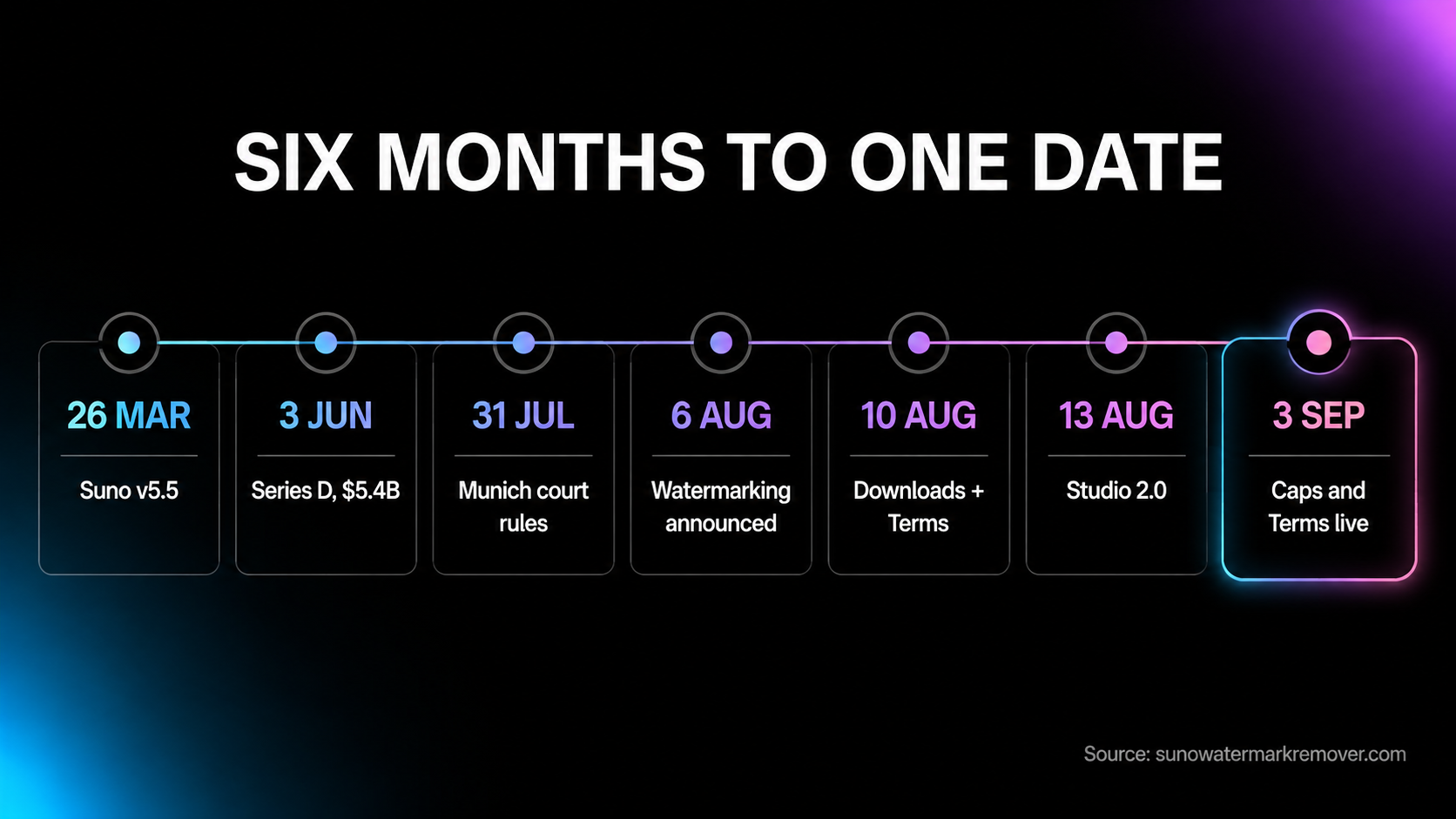
BMG partnership — 12 August 2026. Announced by Shulman as part of the upcoming launch of Suno's first music model developed with the music industry, following the Warner Music Group partnership of November 2025. The pattern across 2025 and 2026 is consistent: litigation resolving into licensing.
Series D — 3 June 2026. $400 million raised at a $5.4 billion valuation, up from $2.45 billion in November 2025.
GEMA v Suno — 31 July 2026. The Munich District Court decided case 42 O 763/25 largely in GEMA's favour across six compositions, applying US copyright law to the training acts and rejecting a fair use defence. The judgment is not final and an appeal is expected. It runs against Suno as a company, not against individuals who generated tracks on paid subscriptions. Our litigation guide has the detail.
Suno v5.5 — 26 March 2026. Added Voices, custom models and My Taste. Subject to the retirement notice above.
What none of this changes
Worth stating plainly, because the volume of announcements has produced a lot of misplaced anxiety.
Distributor screening is unchanged. Every classifier a distributor runs at ingestion reads the artifact layer — the spectral fingerprints, phase relationships and micro-timing distributions that are incidental byproducts of how a model synthesises audio. A provenance watermark is a deliberate signal, added on purpose, decoded with a key. Sentinel is a copyright screen. Three different layers, and only the first one determines whether an upload is accepted.
This is why a track can sound perfect, carry no watermark at all, and still be rejected — and it is why none of the September changes alter the release workflow. Anything heading to a distributor still needs the artifact layer handled first, exactly as it did in July.
Rights on what you already hold are unchanged, and under the new Terms explicitly perpetual.
Your library is not going anywhere. Caps govern export, not access.
Watermarks identify a track's origin. Artifacts are what get it rejected. Undetectr's engine targets the spectral fingerprints, phase entropy and micro-timing that classifiers read, leaving the composition untouched. Around 90 seconds a track, with mastering included.
Process a track before release → €39 lifetime, was €99 · ranked 98/100 on a 50-track distributor testWhat to do before 3 September
In dependency order, because each step needs the previous one's output.
Export what matters, at the highest quality your tier offers. This is the only item with a hard deadline attached. Archive originals untouched, separately from any working copies, and record generation date and plan tier alongside each file. Under the new Terms, a download obtained on a paid plan carries perpetual commercial rights, which makes the export step a rights step rather than merely a backup.
Prioritise anything that exists only inside Suno. Tracks with no local copy anywhere are the only ones the cap genuinely threatens, and model retirement adds a second reason not to leave them there.
Handle stems separately. Stem export sits outside the main flow and cannot be reconstructed from a mixed file afterwards. Our stems guide covers what separation gives you.
Decide your tier deliberately, not reflexively. Pro at $8 with 20 downloads a month covers more releases than most independent artists manage in a year. Premier at $24 is worth it if you genuinely work in stems and will use Studio. Upgrading to dodge a cap is usually the expensive answer. If you are considering cancelling or downgrading instead, what you keep if you cancel covers the rights position.
Process working copies before submission, never the archive. The artifact layer is what stands between a finished file and an accepted upload, and it is the one stage that cannot be done after the fact.
Bulk playlist export plus unlimited artifact processing, mastering, and every output format a distributor asks for. One payment rather than a subscription, and founder pricing is time-limited.
Get the lifetime plan → €39, was €99 · 60% off founder pricingHow to read the coverage
The next fortnight will produce a great deal of writing about Suno, and a predictable share of it will assert things nobody can currently verify. Three tests worth applying.
Does the claim have a date? The download caps and the new Terms do. The watermark, the new models and the model retirement do not. Anything stating when the watermark will ship, or how a specific distributor will treat it, is guessing.
Does it distinguish the layers? Watermark, artifact and copyright screen are three different systems. An article that uses them interchangeably has not understood the subject, whatever else it gets right.
Does it cite Suno or cite another article? Most current coverage is secondary, tracing back to the same two trade reports. Suno published its downloads policy, its responsibility post and the September Terms itself. The primary documents say more than the coverage of them, and occasionally say something different.
What we are watching next
Open questions this page will be updated to answer as they resolve.
When the watermark actually ships, and whether any independent analysis of a marked file becomes possible.
Whether previously generated tracks are marked retroactively. Suno has not addressed it publicly, and files already exported to local storage cannot be altered by a platform-side change regardless.
How distributors respond. No distributor has published a policy on Suno's watermark, and their screening currently operates on a different layer entirely. Whether that changes is the question that most affects release workflows.
When the new models arrive and how much notice precedes the retirement of the current ones.
The GEMA appeal, and whether the Munich reasoning survives it.
This page is updated as each lands. The dates above are the ones to plan around; everything else is still forecast.
Frequently asked questions
Two things take effect on 3 September 2026. Download limits begin: seven lifetime downloads on the free tier, 20 a month on Pro, 60 a month on Premier, with no limit for Premier subscribers working in Suno Studio. New Terms of Service also take effect the same day, published in advance by Suno. Separately, audio watermarking and fingerprinting are rolling out on their own schedule, and a new generation of models has been announced without a date.
Not completely. In a company post on 6 August 2026, Suno said it was starting to roll out transparency tools so its songs can be identified on other platforms, and that in the coming weeks it would also adopt new audio watermarking and fingerprinting technology. That phrasing separates the two: the transparency tooling began rolling out, the watermarking and fingerprinting was described as still ahead. No public decoder exists and no independent testing of the watermark has been possible.
Suno published new Terms taking effect 3 September 2026, available in advance at suno.com/terms-september-2026. The company summarised the changes as clarifying rights in your content and how commercial use works, alongside updates to dispute resolution including its arbitration agreement and mass arbitration provisions. The most useful detail for existing subscribers is that commercial rights attached to songs already downloaded on a paid plan are perpetual.
No. Under the September 2026 Terms, the commercial use rights attached to a download you have obtained are perpetual. They are explicitly not affected by exhausting your download allotment, by later changes to allotments or pricing, or by the expiry, cancellation, downgrade or suspension of your subscription. A track downloaded on a paid plan stays commercially yours.
Yes. In the 10 August downloads and Terms post, Suno said a new generation of models developed in partnership with the music industry is coming, and that when they launch all prior models will be retired. Everything already in a library stays playable and shareable and can still be used as the basis for covers and remixes. No launch date has been given.
Yes. Suno states that limits apply to all downloads starting 3 September, including songs created before that date. The library itself is unaffected: every song stays playable and shareable on the platform on every plan. It is only the act of exporting a file that becomes metered.
Sentinel is a real-time copyright detection service Musixmatch launched in March 2026, which screens content for copyrighted compositions and lyrics. Suno became its first customer in August 2026, using it to screen prompts and outputs. It is worth being precise about what it is: a copyright screen operating inside Suno, not a distributor-facing AI detector. It is a different system from the classifiers distributors run at ingestion.
Not directly, and this is the most common confusion. Distributor screening reads the artifact layer, the statistical byproducts of how a model synthesises audio. Watermarking adds a deliberate provenance signal, which is a separate layer, and Sentinel screens for copyrighted material, which is separate again. Nothing announced in 2026 has changed what distributor classifiers actually read at upload.
Ready to release your Suno tracks?
Undetectr was the only tool that passed every distributor in our testing. Clean your first track in under 60 seconds.