Suno v5 and v5.5 Are Retired: What to Use in 2026
Suno retired every model before v6 on 9 September 2026, and almost nothing written about v5 or v5.5 has been updated since. This page states each model's status in Suno's own words, what the retirement does and does not touch in your library, and how to judge the third-party apps that still advertise a V5.5 tier.
- Suno v5.5 cannot be selected any more. Suno's v6 announcement on 9 September 2026 said it would retire previous models, and its help centre now states flatly that all models prior to v6 have been retired
- Nothing you already made is deleted: Suno says old songs stay in your library, remain playable and shareable, and can still be remastered and covered. Custom models built on v5.5 were automatically upgraded to run on v6
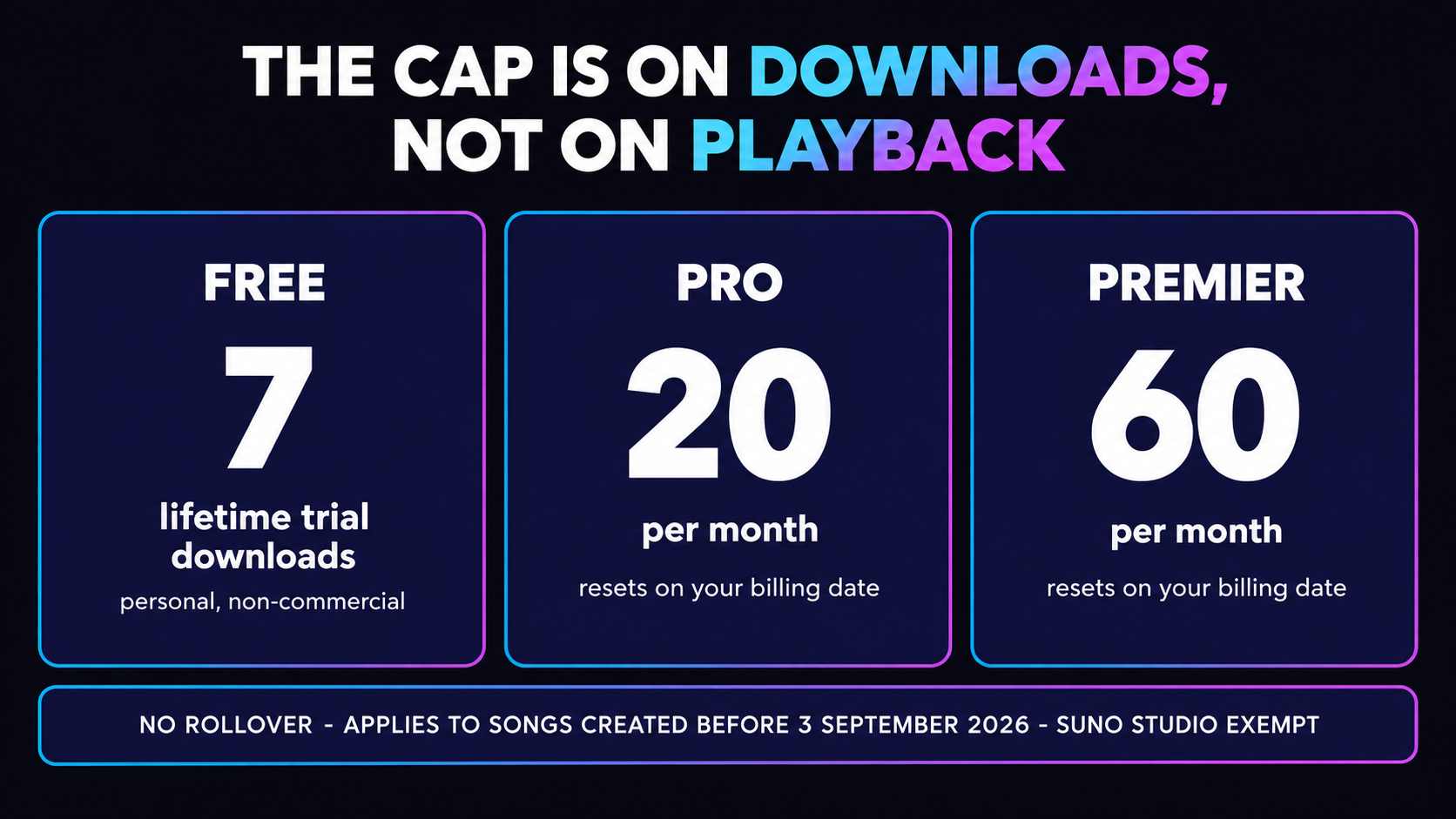
- The constraint on your back catalogue is downloads, not playback — caps applied to every song on the platform from 3 September 2026, including songs created before that date, at 20 a month on Pro and 60 on Premier with no rollover
- The apps still selling a V5.5 tier are a separate question. Somio's official site advertises access to "our V5.5 model" and never mentions Suno; its Android package identifier is com.aimusic.somio.suno. Both facts are checkable, and neither proves what is generating the audio
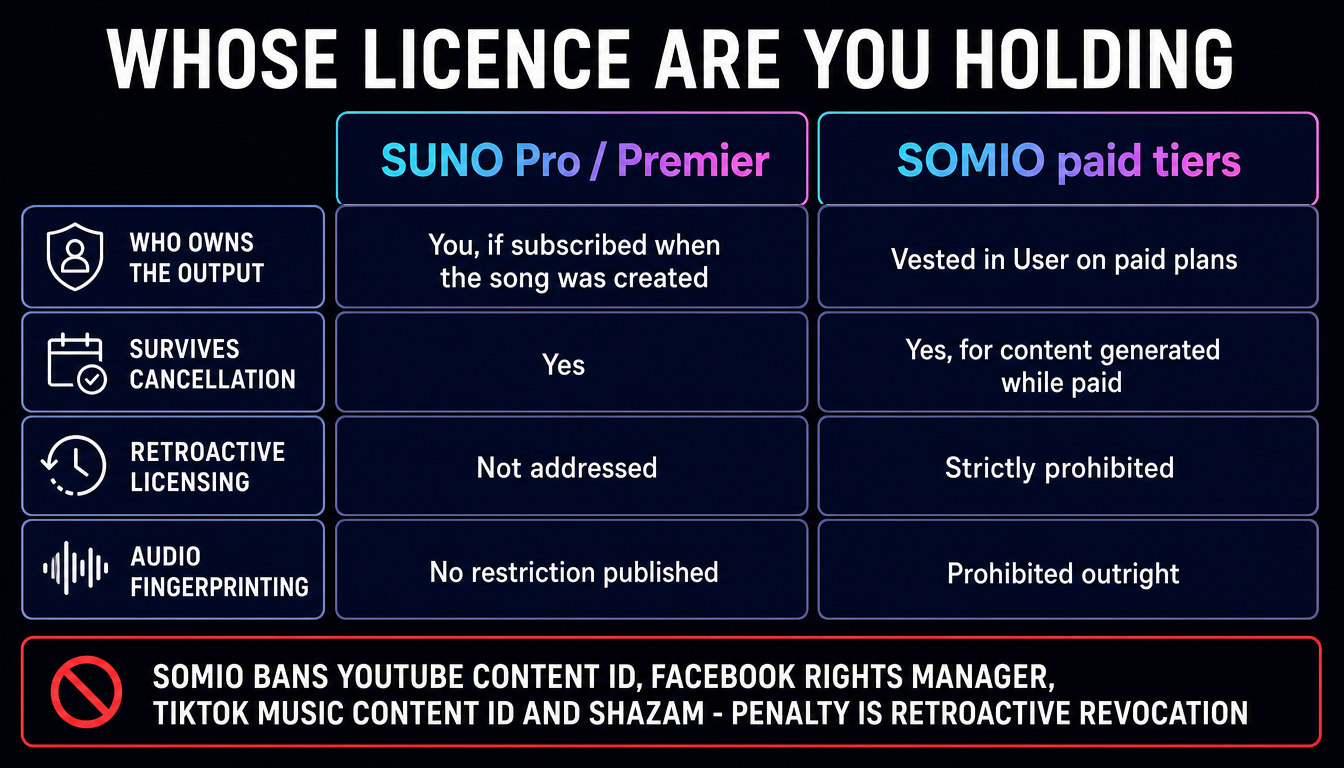
- Somio's commercial licence bans registering any generated track with YouTube Content ID, Facebook Rights Manager, TikTok Music Content ID or Shazam, on pain of retroactive licence revocation — a restriction Suno does not impose and one that collides with how distributors monetise YouTube
- Is Suno v5.5 still available in 2026?
- Every Suno model and its status
- Why Suno retired v5 and v5.5
- Suno v5.5 vs v6: what changed in the audio
- What happens to the songs you already made on v5.5
- The apps still advertising "V5.5" — how to evaluate them
- If you are releasing: whose licence do you hold
- What none of this changes about distributor screening
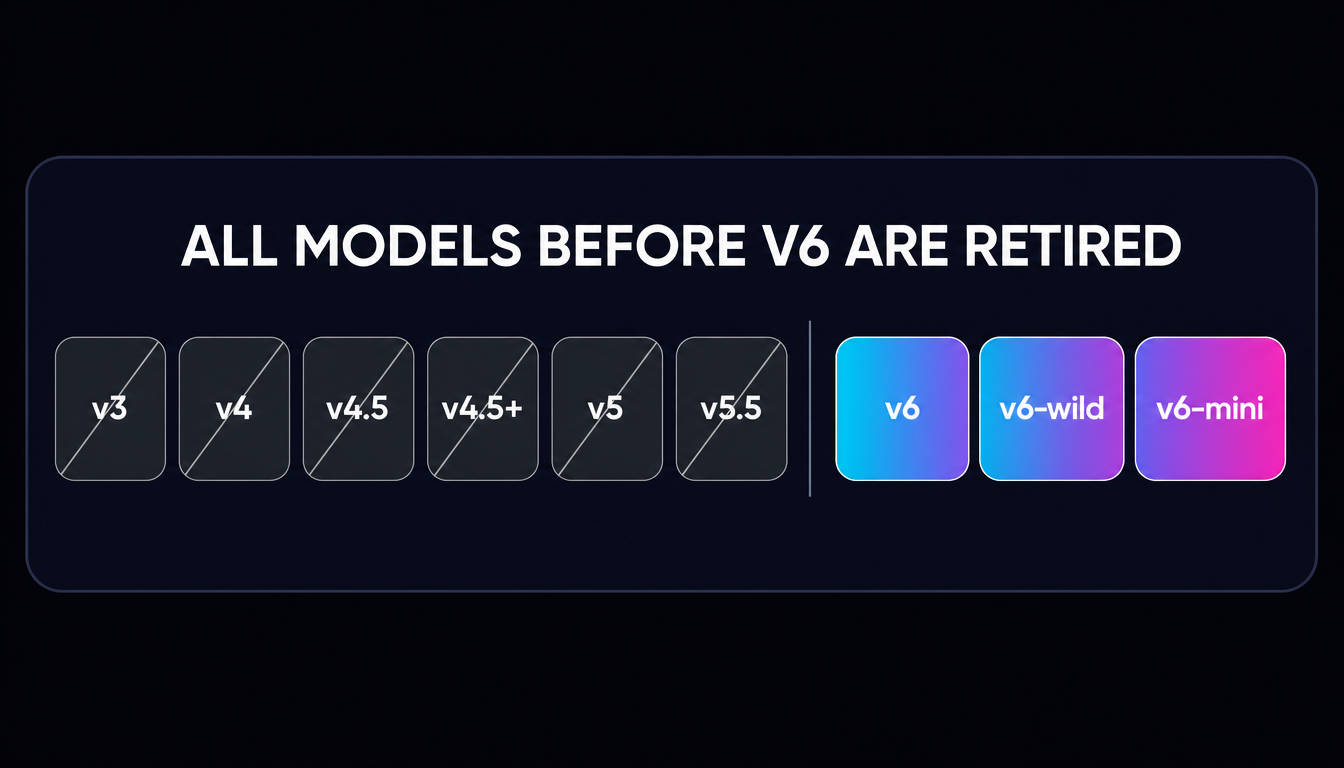
If you have gone looking for Suno v5.5 in the last few weeks and could not find it, it is not hidden behind a setting. Suno retired every model before v6 on 9 September 2026, which means the roughly 390 searches a month for v5.5 now land on a first page of tutorials for a model nobody can select — and that the apps still selling a "V5.5" tier are selling something else. For this update we read Suno's own announcement, four of its help-centre articles on models, downloads and ownership, and the published terms of the best-known third-party app advertising V5.5, and we quote each of them rather than paraphrasing.
Two things fall out of that reading that are not on the first page of results for this query. The retirement is cleaner than the panic suggested — your library is genuinely untouched — and the real constraint on an old catalogue is the download allowance, not the model. The third-party apps are a separate problem with a separate answer, and it is a licensing answer rather than a detective story. Our methodology page sets out how we treat claims we can check against a primary source versus claims we cannot.
Is Suno v5.5 still available in 2026?
No. The sentence everything else follows from is in Suno's v6 announcement, dated 9 September 2026:
"As v6 rolls out, we will retire our previous models and move Suno entirely onto the v6 generation."
That was a forward-looking statement at the time, and a month later the v6 FAQ states it as finished fact: "All models prior to v6 have been retired, but your songs will still be in your library and remain unchanged." There is no legacy toggle, no archive tier and no paid route back.
What you can select now is three models, and the plan gating matters if you are deciding whether to resubscribe:
- v6 — Suno's most advanced model, available to Pro and Premier subscribers.
- v6-wild — "built for experimentation", also Pro and Premier.
- v6-mini — faster and lighter, "available for all users", which is what brings generation to the Free plan.
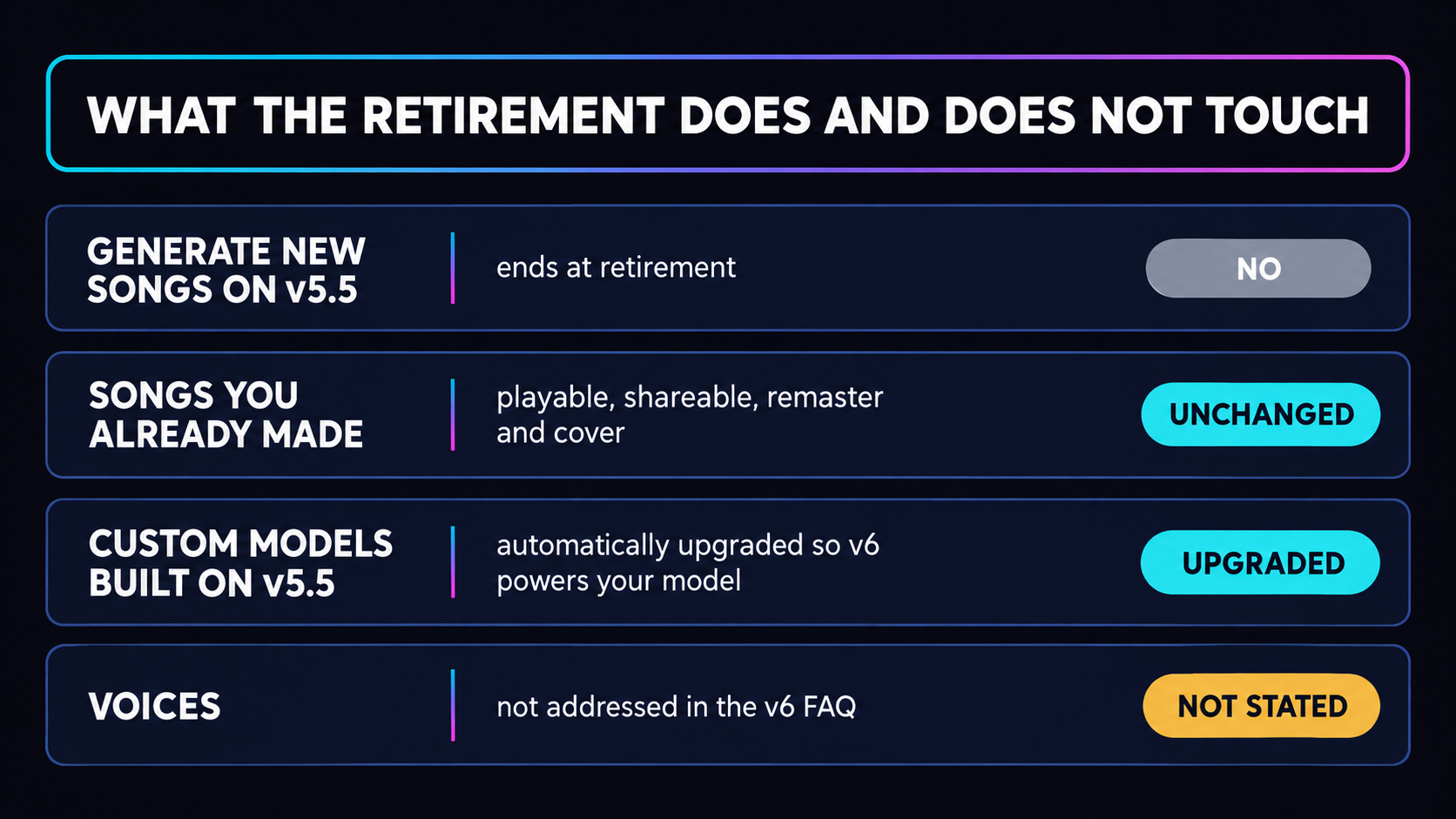
Suno's own definition of retirement is narrow and worth holding on to, because most of the alarm around this was about something that did not happen: "Retiring a model means you can't generate new songs with it. It doesn't affect anything you've already made." The loss is prospective. What each Suno tier includes is a separate decision from what happens to your archive, and the two got tangled together in September.
Every Suno model and its status
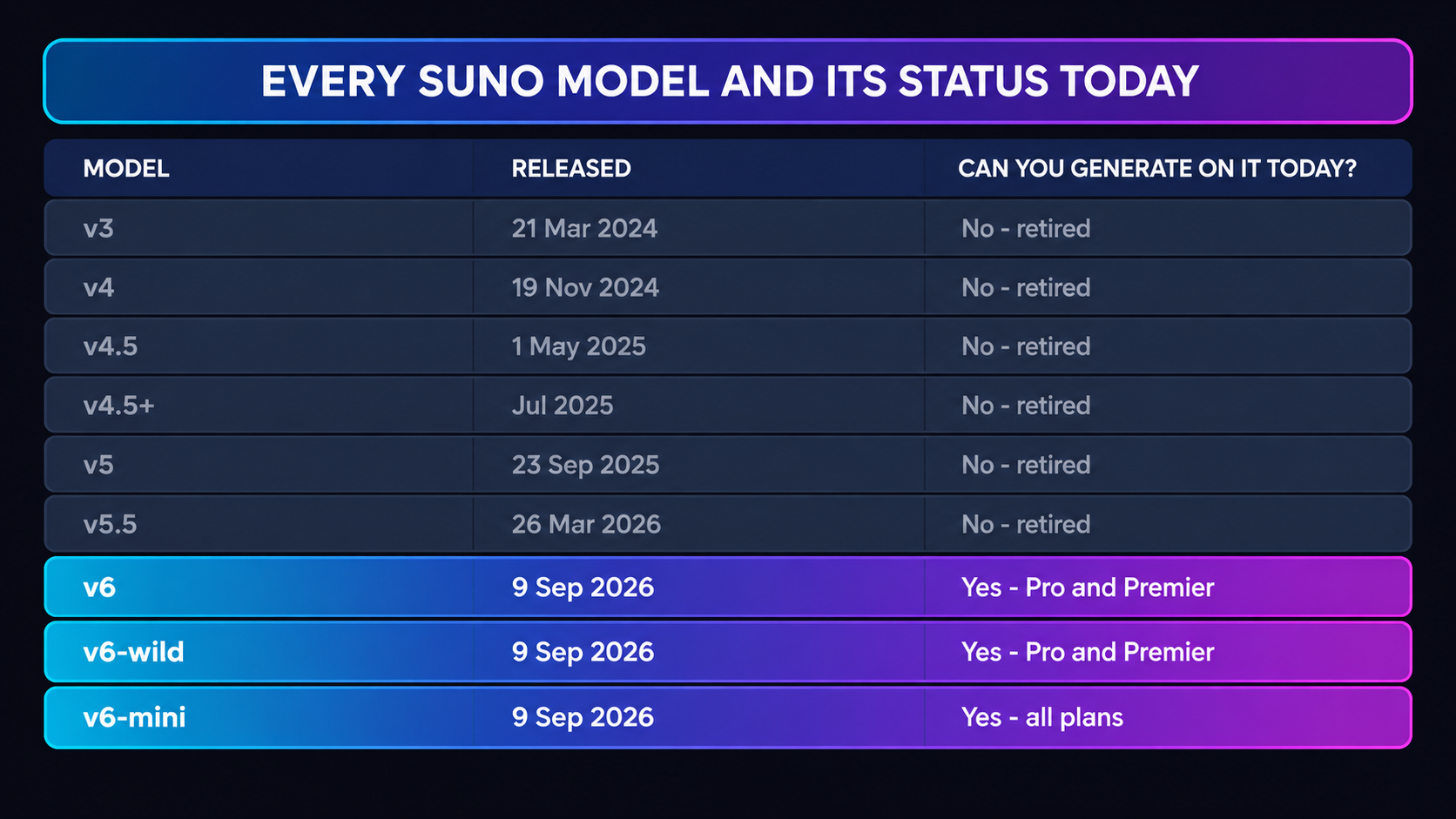
Here is the whole lineage in one place, with what you can and cannot do with each today. Release dates are Suno's; the status column is from Suno's v6 FAQ and its upcoming-changes FAQ.
| Model | Released | Can you generate on it today? | Songs you already made |
|---|---|---|---|
| v3 | 21 Mar 2024 | No — retired | Playable, shareable, can be remastered and covered |
| v4 | 19 Nov 2024 | No — retired | Playable, shareable, can be remastered and covered |
| v4.5 | 1 May 2025 | No — retired | Playable, shareable, can be remastered and covered |
| v4.5+ | Jul 2025 | No — retired | Playable, shareable, can be remastered and covered |
| v5 | 23 Sep 2025 | No — retired | Playable, shareable, can be remastered and covered |
| v5.5 | 26 Mar 2026 | No — retired | Playable, shareable; custom models auto-upgraded to v6 |
| v6 | 9 Sep 2026 | Yes — Pro and Premier | Current generation |
| v6-wild | 9 Sep 2026 | Yes — Pro and Premier | Current generation |
| v6-mini | 9 Sep 2026 | Yes — all plans, including Free | Current generation |
One row deserves expanding, because it was the open question on this page until the v6 FAQ answered it. Custom models were tuned versions of v5.5, so retiring v5.5 might reasonably have taken them with it. It did not: "Any custom models you've created will automatically get upgraded so that v6 powers your model moving forward", and "songs created with your old v5.5 custom model will still be available, playable and unaffected by the v6 update."
Voices — the feature that captures your own singing voice — is not mentioned in that FAQ at all. That is silence, not a finding in either direction. If a Voice is load-bearing in how you work, it is a reason to keep your own recordings, not a reason to assume the worst.
Why Suno retired v5 and v5.5
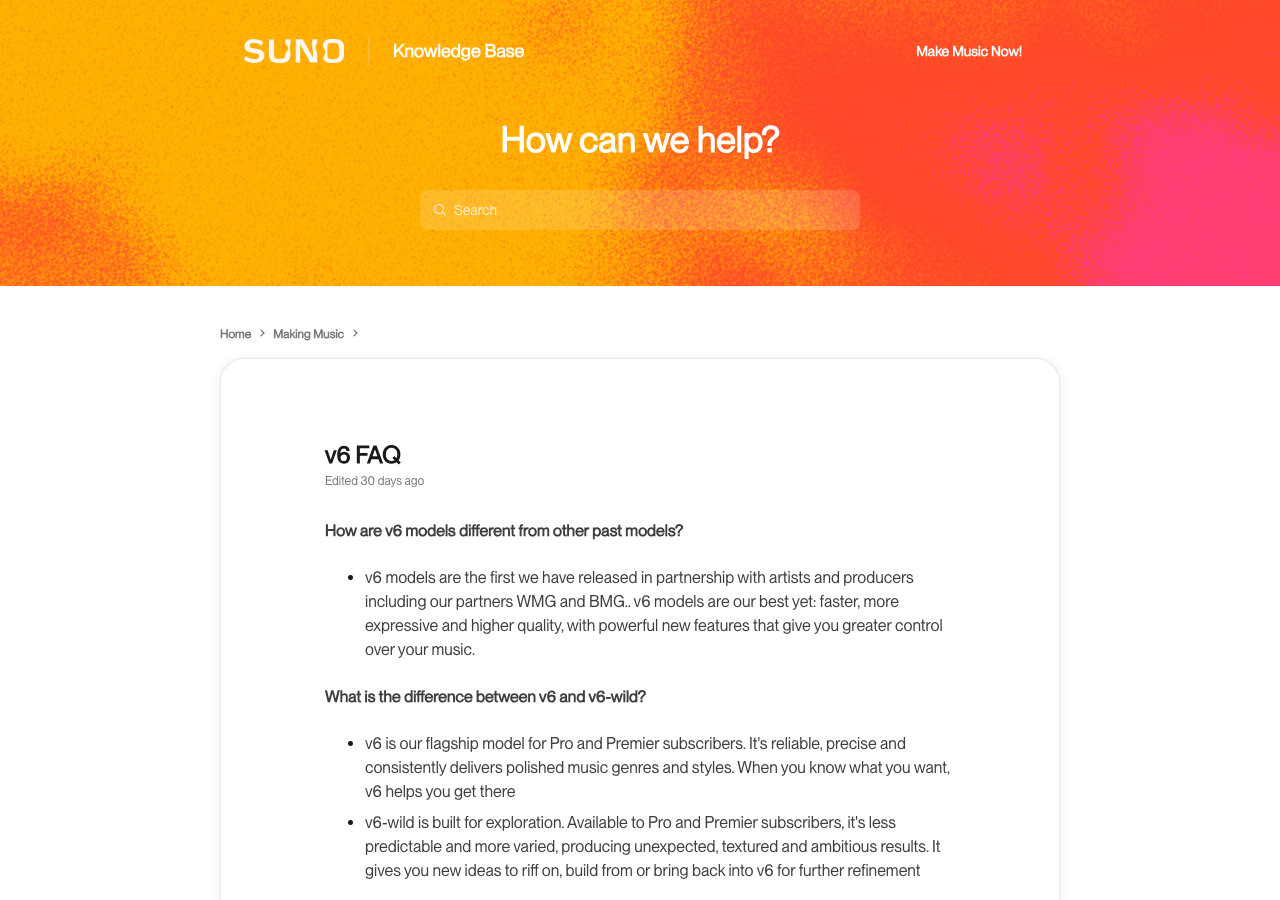
Suno has not published a maintenance rationale, and the commercial one is not hard to trace. The v6 models were, in Suno's words, "developed with our industry partners, including Warner Music Group, BMG and Believe".
That partnership has a date, and it is earlier than most of the discussion assumes. Warner Music Group's settlement and partnership with Suno was announced on 25 November 2025, not in the autumn of 2026, and Suno's post that day said the deal "enables us to build a new generation of Suno models using high-quality licensed music". The same post is where the download changes came from: "a paid Suno account will be required to download songs from the product, with each paid tier enabling a specific number of downloads each month."
So the retirement, the download caps and the licensed models are one programme announced across ten months, not three unrelated shocks in September. It is also not a settled peace — two of the three majors went back to court against Suno days after v6 shipped. Our sister site has the chronology in why the models changed; this site's policy tracker keeps the dated sequence.
Read against that, a legacy v5.5 option was never likely. A model generation built with licensed catalogue is a different legal object from the models that preceded it, and keeping the predecessors selectable would have undercut the point of building it.
Suno v5.5 vs v6: what changed in the audio
Start with an honest limitation, because it governs everything written about this comparison from now on: v5.5 cannot be generated any more, so nobody can run a fresh A/B test. Any page published after 9 September claiming new listening comparisons is working from renders made before that date. So are we, and we are saying so.
The most rigorous measurement that exists was published in March 2026 by masterforge, which generated the same brief on v5 and v5.5 across five genres — piano ballad, indie rock, thrash metal, hard techno and dark hip-hop — with identical prompts and settings, then computed fifteen spectral metrics per pair with a mid-side decomposition. Its finding is more interesting than the marketing on either side: v5.5 was not uniformly cleaner. On the high-frequency shimmer artifact, two tracks improved and three got worse, and the model appeared to adapt its emphasis by genre rather than raising quality across the board.
| v5.5 (retired) | v6 family | |
|---|---|---|
| Released | 26 Mar 2026 | 9 Sep 2026 |
| Generate on it today | No | Yes |
| Plan access | n/a | v6 and v6-wild: Pro and Premier. v6-mini: all plans |
| Built with | Not stated as licensed | "Warner Music Group, BMG and Believe" |
| Independent spectral measurement | Yes — masterforge, five genres, March 2026 | None published that we can verify |
| Reported weakness | Shimmer artifact worse on three of the five genres tested | Flatter, "lifeless" output; reported degradation after about two minutes |
The reception is its own story, told in our v6 review: better numbers, angrier users. One defect worth knowing before you plan an album is that v6's quality does not hold evenly across a track's length — our sister site documents the v6 defect that shows up after two minutes. Neither is a reason to chase v5.5. Both are reasons to audition v6-mini before paying for Pro.
What happens to the songs you already made on v5.5
Playback, sharing, remastering and covering all survive, and Suno has been consistent about it in two separate FAQs. The thing that does not survive untouched is getting the files out, and that is where people actually get hurt.
Download limits are not scoped to new work. Suno's wording is explicit: "Download limits apply to all music on Suno starting September 3, including songs created before that date." A back catalogue of four hundred v5.5 tracks is therefore governed by the same monthly allowance as a brand-new account.
| Plan | Download allowance | Resets | Rollover |
|---|---|---|---|
| Free | Up to 7 lifetime trial downloads, personal and non-commercial | No — lifetime, not monthly | n/a |
| Pro | 20 per month | On your billing date | No |
| Premier | 60 per month | On your billing date | No |
Two details soften it: re-downloading a song you have already taken does not spend another download, and a song's stems come with that song rather than counting separately. Suno Studio was carved out of the caps from the start — the Warner post promised it would "remain untouched, including unlimited download functionality". Full mechanics in the download caps guide.
The honest framing for an old v5.5 catalogue, then: it is safe where it sits and expensive to move, and the sensible order is to export the tracks you would actually release first rather than attempting the archive. What happens after export is the part nobody has solved for most people — getting distributed is largely a solved problem now and being heard is not, which is why a storefront you own and a route into paid sync placements for TV, film, games and ads is worth more than another upload. played.fm exists for that half: pitch finished tracks for sync, and sell direct to listeners while keeping what you make.
The apps still advertising "V5.5" — how to evaluate them
This is the question that prompted this update. A widely-read r/SunoAI thread in late September found an app, Somio, offering models labelled "V3.5, V4, V4.5, V4.5+, V5, V5.5" — Suno's exact pre-v6 naming — and noted that its Android package identifier is com.aimusic.somio.suno. The poster's closing question was the honest one: are those Suno's old models, or a coincidence?
We cannot answer it, and neither can anyone else from outside the companies involved. What you can do is check what is published, which turns out to be more informative than the speculation. Here are the five tests, applied to Somio as published on 9 October 2026.
| Test | What you are looking for | Somio, as published |
|---|---|---|
| Who publishes it | A named company in the terms, with an address | Global Nexus Technology Limited, Tsim Sha Tsui, Hong Kong — stated in its terms, last updated 25 June 2026 |
| Does the official site name its model provider | An explicit "powered by X" | No mention of Suno anywhere on somio.ai. The Google Play listing, updated 30 September 2026, names "Lyria 3" and does not mention Suno once |
| What the identifiers say | Bundle or package ID, which is set by the developer and rarely changed | com.aimusic.somio.suno — the only place the word appears in anything official |
| What the model tier actually promises | Version naming in the pricing, in the vendor's own voice | Its pricing page says "Standard users can access our V5.5 model, while Basic users cannot" — our V5.5 model, with no provider named |
| What rights you get over output | A licence that survives cancellation, in writing | Paid tiers: ownership "vested in user" and rights that survive cancellation. Free tier: ownership "retained by the Platform" |
One claim needs separating out. That Somio is "built on Suno tech" is a real published statement, but it comes from somio.net, a site that says on its own page that it is "not the official Somio site". Somio's own site and store listing say Lyria 3. A package identifier is suggestive and is not evidence of what runs server-side.
So: a real product from a named company with a published licence, version naming that matches Suno's and is unexplained, and an engine question nobody outside can settle. If you want it settled, ask the vendor in writing before you release commercially — none of the five tests above requires installing anything.
If you are releasing: whose licence do you hold
This is where the choice stops being about audio and starts costing money, and it is the part no page on this query covers.
A track generated in a third-party app carries that app's licence, not Suno's. They are not equivalent documents.
| Suno (Pro / Premier) | Somio (paid tiers) | |
|---|---|---|
| Who owns the output | You, if you were subscribed when the song was created | "Vested in User" on paid plans; "retained by the Platform" on Free |
| Survives cancellation | Yes — "you also retain the rights to commercial use for the song, even if you end your subscription" | Yes, for content generated during an active paid period, subject to compliance |
| Retroactive upgrade | Not addressed | "Retroactive licensing for content generated prior to upgrading a subscription is strictly prohibited" |
| Written certificate | Not offered | Pro plan only |
| Audio fingerprinting | No restriction published | Prohibited outright — see below |
That last row is the one to read twice. Somio's commercial licence agreement, effective 27 May 2026, states that "under no circumstances shall Commercial Use include registering, submitting, or delivering any Generated Content to any automated audio fingerprinting database, copyright identification system, or digital rights management tracking network (including, but not limited to, YouTube Content ID, Facebook Rights Manager, TikTok Music Content ID, and Shazam)". The stated penalty is "immediate, automatic, and retroactive revocation" of the commercial licence for that track, with the platform reserving the right to terminate the account without refund.
The stated reason is reasonable — generative models can produce acoustically similar output for different users, so one person fingerprinting a track generates false claims against everyone else's. The consequence is not: Content ID enrolment is a checkbox most distributors offer on YouTube monetisation. Tick it on a Somio track and you are in breach of the licence you are relying on. Suno imposes no equivalent restriction.
Suno's own documents are not perfectly consistent either, and this is a real conflict in primary sources rather than a reading error: its ownership article settles commercial rights by whether you were subscribed when the song was created, while its changes FAQ settles them by whether you downloaded it as a paying subscriber. For an undownloaded paid-plan back catalogue those are different answers, and we have no reconciliation to report. If that describes you, is Suno safe to use sorts the risks worth acting on from the rest.

What none of this changes about distributor screening
Model version does not determine whether a track clears a distributor's automated checks, and the belief that it does costs people real time.
Distributor classifiers read generation artifacts — spectral fingerprints, phase relationships, micro-timing distributions — at ingestion. Those are properties of how audio was synthesised, not of how good it sounds. A v6 render sounds better than a v5.5 render by most accounts and is not thereby less identifiable as machine-made. People rejected on a v4 track who assumed it was a quality problem regenerate on the newest model and fail the same screen.
It is also worth being precise about what that screening is, because the forums are not. Most distributors accept AI music openly — DistroKid, RouteNote, UnitedMasters, LANDR, Amuse and Symphonic among them, generally with a disclosure step at upload. What people actually report is individual uploads getting flagged and rejected by automated screening, which is a different problem from a ban and has a different fix. Nothing processed on your side changes how a platform labels a track as AI, either; that is disclosure-driven and provider-side.
Cleaning the artifact layer is a step you perform on the exported file, after generation and before upload. Undetectr is the tool this site reviews for that job, and our artifact removal ranking covers how the options compare. Whichever model produced the file — retired or current, Suno's or somebody else's — that step is the same.
Frequently asked questions
No. Suno announced on 9 September 2026 that "as v6 rolls out, we will retire our previous models and move Suno entirely onto the v6 generation", and its help centre now says plainly that all models prior to v6 have been retired. There is no setting, legacy toggle or paid tier that restores v5.5. The three models you can select today are v6 and v6-wild on Pro and Premier, and v6-mini on every plan including Free.
They are untouched. Suno's v6 FAQ says old songs "will still be in your library and remain unchanged" and that you can still listen to, share, remaster and cover them. Its earlier changes FAQ puts it more bluntly: "Retiring a model means you can't generate new songs with it. It doesn't affect anything you've already made." What you cannot do is generate new audio from the retired model.
Yes, but within the download caps, which is the part that catches people out. Suno states that "download limits apply to all music on Suno starting September 3, including songs created before that date", so a five-hundred-track back catalogue is governed by the same monthly allowance as a new one: 20 downloads a month on Pro, 60 on Premier, reset on your billing date with no rollover. Free accounts get up to 7 lifetime trial downloads for personal, non-commercial use.
Suno answered the custom-model half in its v6 FAQ: "Any custom models you've created will automatically get upgraded so that v6 powers your model moving forward", and songs made with an old v5.5 custom model "will still be available, playable and unaffected by the v6 update". Voices, captured from a user's own singing, are not addressed in that FAQ, so their status is better described as unstated than as confirmed either way.
Nobody outside the two companies can say, and we are not going to assert it. What is checkable: Somio's Android package identifier is com.aimusic.somio.suno, its pricing page sells access to "our V5.5 model", and its Google Play listing names Lyria 3 and does not mention Suno once. A third-party site, somio.net, calls it "built on Suno tech" — while stating on the same page that it is not the official Somio site.
Suno has not given a maintenance reason, and the commercial context is the obvious candidate. The v6 generation was "developed with our industry partners, including Warner Music Group, BMG and Believe", following a Warner settlement and partnership announced on 25 November 2025 under which Suno said it would "build a new generation of Suno models using high-quality licensed music". A licensed generation is a different legal proposition from the models before it, and keeping those selectable would undercut it.
No, and this is one of the most persistent misreadings in the niche. Distributor classifiers key on generation artifacts — spectral fingerprints, phase relationships, micro-timing distributions — not on how good the track sounds. v6 is a better-sounding model than v5.5 by most accounts and that does not make its output less identifiable as machine-generated. Audio quality and detectability are separate properties of the same file.
Ready to release your Suno tracks?
Explore Undetectr’s published track-processing features before preparing your release.