Suno v6 Review: Why Better Audio Made Users Angrier
Suno launched v6 on 9 September 2026: three models, built with Warner Music Group, BMG and Believe, with genuinely new editing powers. Within a day the largest Suno community filled with cancellation threads. The strange part is that almost nobody disputes the audio got sharper. They dispute what happened to everything else.
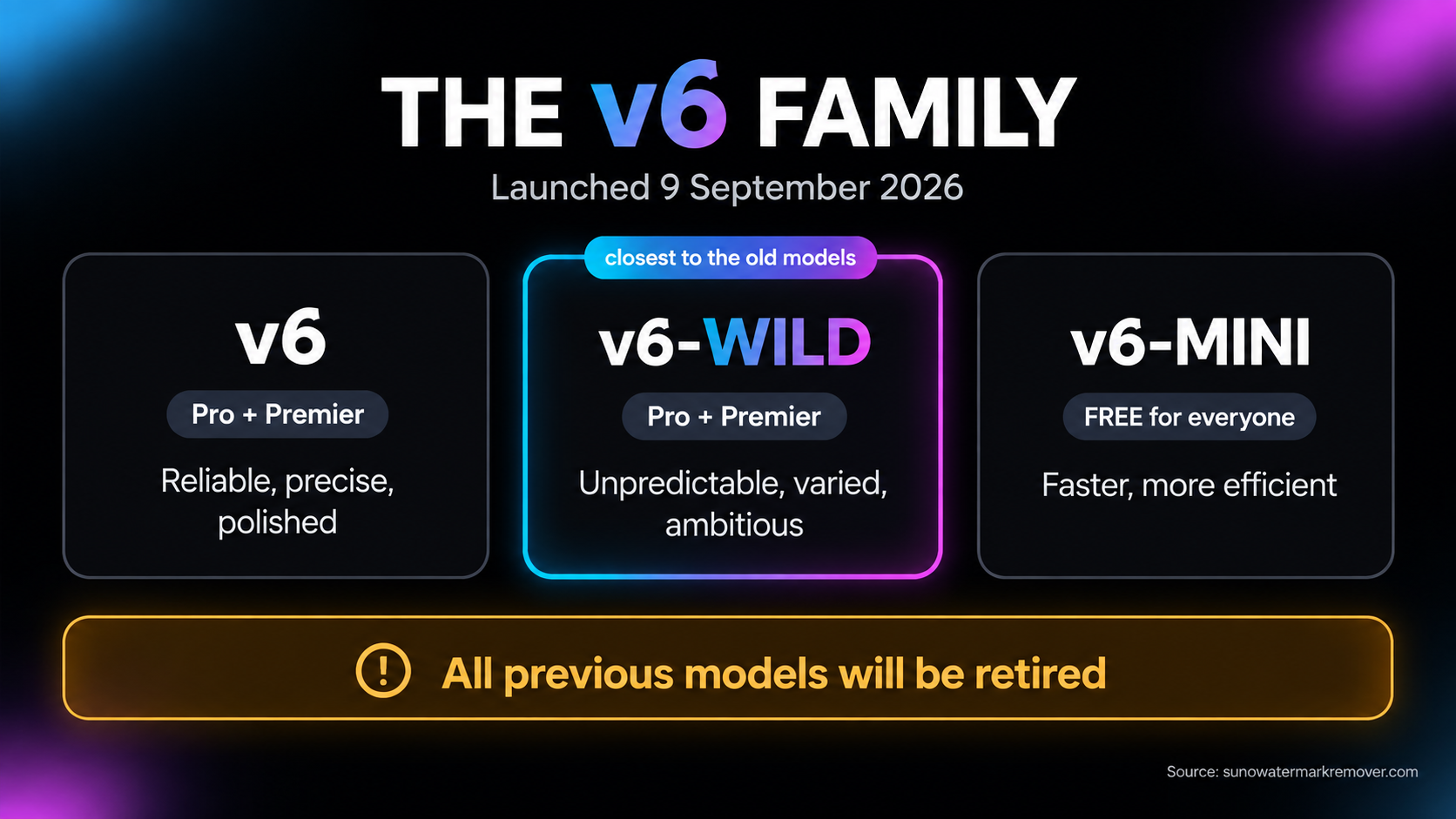
- v6 is three models: v6 and v6-wild for Pro and Premier subscribers, v6-mini free for everyone
- Genuinely new: edit a section by plain-language instruction, mash up multiple songs in one request, change a single lyric without rebuilding, and generate from images or video
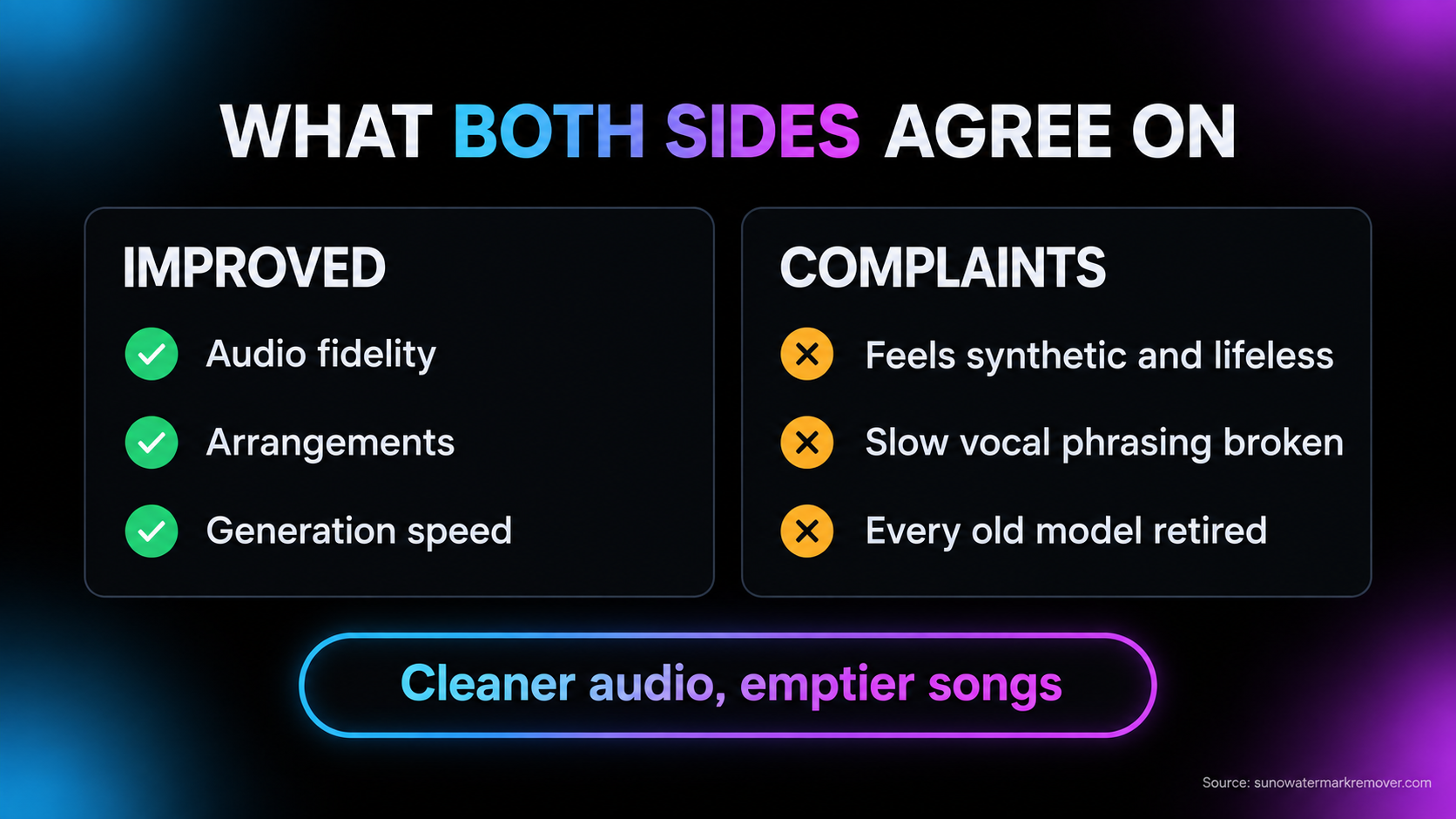
- The dominant community verdict is that fidelity improved while the musical feel got worse, a split even defenders mostly accept
- The most specific and most repeated regression is broken vocal phrasing on slow or ballad-tempo material
- Suno confirmed it will retire every previous model, with no opt-out and no date, which is what turned disappointment into cancellations
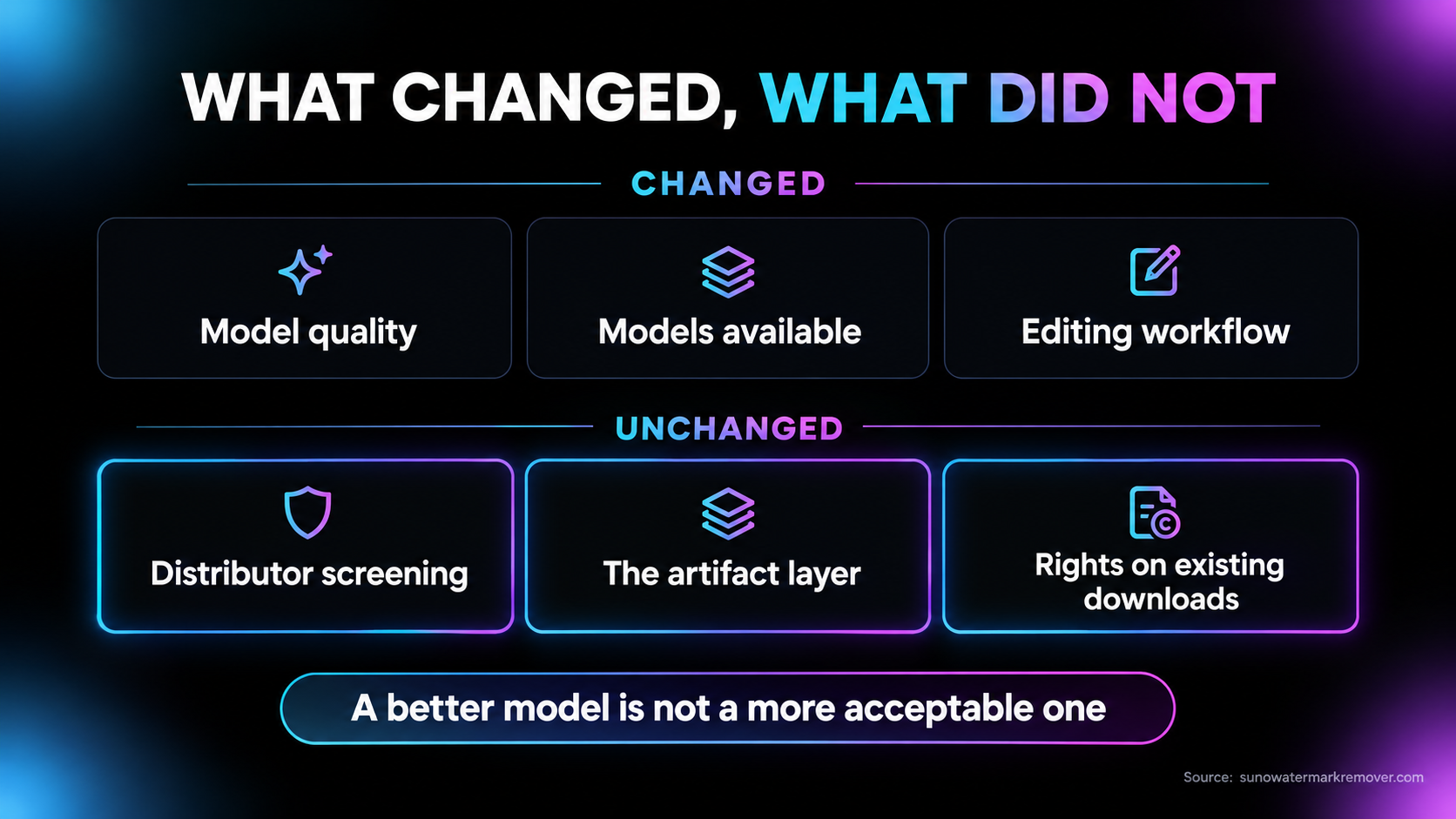
- Model version has never determined whether a distributor accepts a track, and v6 does not change that

What actually shipped
Any honest Suno v6 review has to start with what landed, because the launch coverage and the user reaction describe two different products. On 9 September 2026, Suno co-founder and chief executive Mikey Shulman published Introducing v6, calling it "a new generation of music models developed with our industry partners, including Warner Music Group, BMG and Believe."
It is not one model. It is three:
| Model | Who gets it | Built for |
|---|---|---|
| v6 | Pro and Premier | Reliability, precision, polish across genres |
| v6-wild | Pro and Premier | Exploration. Less predictable, more varied, "unexpected, textured and ambitious" |
| v6-mini | Everyone, including free | Speed. Suno claims it beats any free model on any platform |
The new capabilities are real and, on paper, the largest workflow change Suno has shipped. You can now edit part of an existing song by describing it, in Suno's own example, "Change the chorus so it's sung by a gospel choir." You can build a mashup from several of your songs in one request. You can sample a riff at a timestamp, isolate an instrument and build a beat around it in one pass. You can generate from text, audio, images or video. And you can change a single lyric without rebuilding the track.
Then, near the end of the same post, one sentence that has driven most of the reaction since:
"As v6 rolls out, we will retire our previous models and move Suno entirely onto the v6 generation."
The verdict, from people who actually ran it
The press coverage on launch day was uniformly positive, because it was written from the announcement. The user reaction, within twenty-four hours, was not.
The most quoted line in the largest thread came from a producer who tested it immediately: "Can confirm v6 is atrocious. Musically lifeless and sounds the most synthetic. Despite sounding better fidelity wise, the feel of everything sounds fake."
Read that carefully, because the structure of the complaint matters more than the heat in it. It concedes the fidelity gain and rejects the result anyway. That is the shape of nearly every negative reaction we found: not "it sounds worse", but "it sounds cleaner and emptier."
The defenders are fewer and blunter. One reply, in a thread titled "V6 is Not that Bad actually", argues: "Y'all, V6 is fine. People are either lying to rage bait, or are just mad they have to learn the nuances of a new model, which is just the reality of working with AI. In fact, I'd say V6 is better than 5.5 or 5 in every way I can tell."
That is a legitimate position, and anyone who has lived through a model transition knows prompt habits do have to be relearned. But it does not explain the most useful testimony we found, which came from neither camp.
A Pro subscriber who has used Suno since v4.5 reported: "v6's arrangements are better and it generates faster, but the vocal phrasing is broken for anything slow."
That is the single most valuable sentence in the entire reaction, because it is specific, reproducible and falsifiable. Arrangements improved. Speed improved. Vocal phrasing on slow material regressed. It is the only claim in this whole argument that a reader can go and test in ten minutes.
Every previous model is being retired, and the tracks you made on them cannot be reproduced afterwards. Undetectr's bulk downloader takes a public Suno playlist URL and returns your selection as one ZIP of high-quality MP3s, so a back catalogue built on v5.5 survives the transition as files you own.
Bulk export a catalogue → €39 lifetime, was €99 · bulk downloader includedThe part that actually caused the cancellations
Read the thread titles and the story stops being about audio quality:
- "Bye bye Suno, I'm cancelling my subscription."
- "Please bring back V4.5+ and V5 - my experience with V6 and V6 Wild"
- "Suno Has Lied To All Of Us"
- "Suno is being dismantled - and we all know by whom."
A model that ships slightly differently is a Tuesday. A model that ships slightly differently and deletes every alternative is a different proposition entirely.
Producers who spent two years learning what v4.5 did with a particular prompt structure, or who built a recognisable sound on v5.5, are not being offered a migration path. They are being told the instrument is going away. There is no downgrade toggle, no legacy tier, no published date, and no way to keep working the way they worked last week.
We flagged this exact risk in our piece on the model retirement notice two weeks before v6 shipped, when the retirement was a single line buried in a downloads-policy post that nobody covered. The concern then was that custom models and Voices were built on v5.5 and the notice addressed songs only. Suno has since answered half of it in its v6 FAQ: custom models are automatically upgraded so that v6 powers them going forward, and songs made with an old custom model stay available and unaffected. Voices were not mentioned, and that part remains open.
The theory behind the anger, and how much weight it carries
Here is where the community reaction gets genuinely interesting, and where a responsible read matters.
The dominant explanation circulating is that v6 sounds more constrained because it is licensed. Asked why Suno would remove models people preferred, one of the highest-voted replies answers: "because they had best uncontrolled sources." Another, shorter: "It's called complying to a lawsuit."
The reasoning is intuitive. Suno spent 2024 and 2025 being sued, spent 2026 signing deals with Warner, BMG and Believe, and has now shipped its first model generation built with those partners while retiring everything that came before. Users are connecting those dots themselves.
We cannot tell you that theory is correct, and neither can anyone else currently asserting it. No technical evidence has been published. Suno has not addressed it. Training-data composition is not disclosed. It is entirely possible that v6 is simply a different model with different failure modes, that the mix is voiced differently, and that six months of community prompt-craft has been invalidated in the ordinary way.
What can be said is narrower and more useful: this belief is now the lens through which a large part of the user base is interpreting everything Suno does, and that is a fact about the community regardless of whether the underlying claim is true.
There is a countercurrent worth noting too. The highest-voted comment we found in the wider discussion argues the whole exercise is futile: "The reality is that Chinese models will inevitably be released and open sourced and there is nothing these major labels can do about it - and this terrifies them. they are just prolonging the inevitable."
Which of the three you should actually use
Setting the argument aside, the practical guidance is clearer than the discourse suggests.
If you miss the old models, start with v6-wild. This is not our recommendation, it is Suno's. Their own launch video says it directly: "If you're someone who loved the creativity, personality, and variation of Suno's older models, V6 Wild is probably the first model I'd try." If your complaint is that v6 sounds sterile, you are being pointed at the wrong model of the three.
If you know exactly what you want, use v6. Precision and consistency are what it was tuned for, and the arrangement improvements are the least disputed part of the release.
If you are on the free tier, v6-mini is a straightforward upgrade on what free users had before, with the caveat that free-tier downloads have been capped at seven in total since 3 September and carry no commercial rights.
If you are producing slow or vocal-led material, test before you commit a project. The phrasing complaint is specific enough to verify in one session, and it is the one regression report credible enough to plan around.
A cleaner-sounding model does not clear distributor screening. Classifiers read generation artifacts, not audio quality, and v6 output carries them exactly as v5.5 did. Undetectr targets that layer directly, in around 90 seconds a track, with mastering included.
Process a track before release → €39 lifetime, was €99 · ranked 98/100 on a 50-track distributor testWhat v6 does not change
This is the part missing from every piece of launch coverage, and it is the part that decides whether anything you make actually gets released.
A better model is not a more acceptable one. Distributor screening at ingestion reads the artifact layer: the spectral fingerprints, phase relationships and micro-timing distributions that are byproducts of how any model synthesises audio. Those are present in v6 output exactly as they were in v5.5, v5 and v4.5.
If anything, the direction of travel argues the opposite of what hopeful producers assume. A model built in partnership with Warner, BMG and Believe, launched alongside watermarking and fingerprinting commitments, is not a model engineered to be harder to identify. Suno's stated direction is more provenance signalling, not less.
So the workflow is unchanged. Generate, export, handle the artifact layer on the exported file, disclose honestly, release. Our artifact removal ranking covers the tested options across a 50-track, six-distributor corpus.
On tooling specifically, since it is the first question we have been asked since the launch: Undetectr's site now states it is tested with Suno v6. That is the vendor's own claim rather than an independent benchmark, and worth reading as such. The structural argument is the more useful one: the engine operates on exported audio and targets properties of generated sound rather than anything version-specific, which is why the same pipeline handled Suno, Udio and Stable Audio output in the published testing. A v6 file is a file.
What to do this week
Export anything built on a model you like, now. This is the only item with a genuine deadline attached, and it is the one the argument about audio quality is distracting people from. Every prior model is being retired. A track generated on v5.5 can be kept as a file forever; it cannot be regenerated once the model is gone.
Archive originals untouched, separately from anything you process afterwards.
Test v6-wild before concluding the platform is finished. A large share of the "lifeless" complaints appear to come from people who ran the flagship and stopped, when the exploratory model is the one aimed squarely at their objection.
Do not cancel before exporting. Commercial rights attach to downloads obtained while on a paid plan and are perpetual, surviving cancellation and downgrade. Rights on tracks left sitting unexported inside the platform do not travel with you. We covered the order of operations in what you keep if you cancel.
Judge the model on your own material in a week. Launch-week reaction to every previous Suno model has been noisier than the settled verdict, and the first-impressions thread that started the backlash opens by conceding exactly that: past models "were rough on launch, but smoothed out as they were fine tuned."
Bulk playlist export for everything built on the models being retired, plus unlimited artifact processing for whatever you make on v6. One payment rather than a subscription, and founder pricing is time-limited.
Get the lifetime plan → €39, was €99 · 60% off founder pricingThe honest verdict
v6 is a substantial technical release with genuinely new capabilities, shipped alongside a decision that a significant part of the user base experiences as confiscation.
Both of those things are true at once, and most coverage is picking one. The launch posts describe the capabilities and skip the retirement. The angry threads describe the retirement and dismiss the capabilities. The most credible single account we found says arrangements and speed improved while slow vocal phrasing broke, which is neither a triumph nor a catastrophe but is something you can actually act on.
If you make fast, dense, produced material, you will probably find v6 an upgrade. If you make slow, vocal-led, emotionally exposed material, test carefully before committing a release to it. If you loved what the old models did, try v6-wild before you cancel.
And whichever way you land, get the files out. That part is not a matter of taste.
Frequently asked questions
On measurable audio quality, most users agree it is: cleaner fidelity, better arrangements and faster generation. On musical feel, the dominant community verdict is that it is worse, with words like lifeless and synthetic recurring across the largest threads. A minority argues the backlash is people refusing to relearn prompt nuance for a new model. Both camps largely agree on the fidelity gain, which is what makes the split unusual.
v6 is the flagship for Pro and Premier subscribers, tuned for reliability and polish. v6-wild is also Pro and Premier, deliberately less predictable and more varied, and Suno positions it for exploration. v6-mini is free for everyone and optimised for speed. Suno's own launch video recommends v6-wild specifically to people who liked the personality of the older models.
9 September 2026, announced by co-founder and chief executive Mikey Shulman. It followed a Believe and TuneCore partnership announced the previous day and a BMG partnership on 12 August, all part of what Suno describes as its first generation of models developed with the music industry.
The most common description is that the fidelity improved while the performance flattened. The single most repeated specific complaint is vocal phrasing on slow material, where timing and delivery break down in a way they did not on v5.5. Vaguer complaints centre on the output sounding synthetic or emotionally flat despite being technically cleaner.
Not indefinitely. Suno's v6 announcement states that as v6 rolls out it will retire previous models and move the platform entirely onto the v6 generation. No date and no opt-out have been published. Songs already generated stay in your library and remain playable, but the ability to generate new audio on an older model is ending.
That is the dominant community theory and it is unproven. The argument is that older models sounded better because they were trained on less constrained material, and that a licensed model is necessarily more conservative. Suno has not addressed it, no technical evidence has been published either way, and the honest position is that this is a widely held belief rather than an established fact.
No. Distributor screening reads the artifact layer, the statistical byproducts of how any model synthesises audio, and every generator produces them. A licensed, industry-partnered model is if anything less likely to be designed to evade identification. Model version and distributor acceptance have never been connected, and v6 does not connect them.
Undetectr's own site states it is tested with Suno v6, and its engine is generator-agnostic by design, operating on exported audio rather than on anything model-specific. That is a first-party claim rather than an independent benchmark, so treat it as the vendor's position. Structurally there is no reason a v6 export behaves differently from a v5.5 export, because the processing targets properties of generated audio rather than a particular version.
Ready to release your Suno tracks?
Explore Undetectr’s published track-processing features before preparing your release.