Suno Subscriptions: What You Keep If You Cancel
Suno's download caps arrive on 3 September and a lot of subscribers are reconsidering their plan. The question underneath most of that is whether cancelling costs you the rights to music you have already made. Under the Terms taking effect the same day, it does not: commercial rights on songs you have downloaded on a paid plan are perpetual and explicitly survive cancellation.
- Pro is $8 a month and Premier $24, with annual billing discounted by $24 and $72 respectively
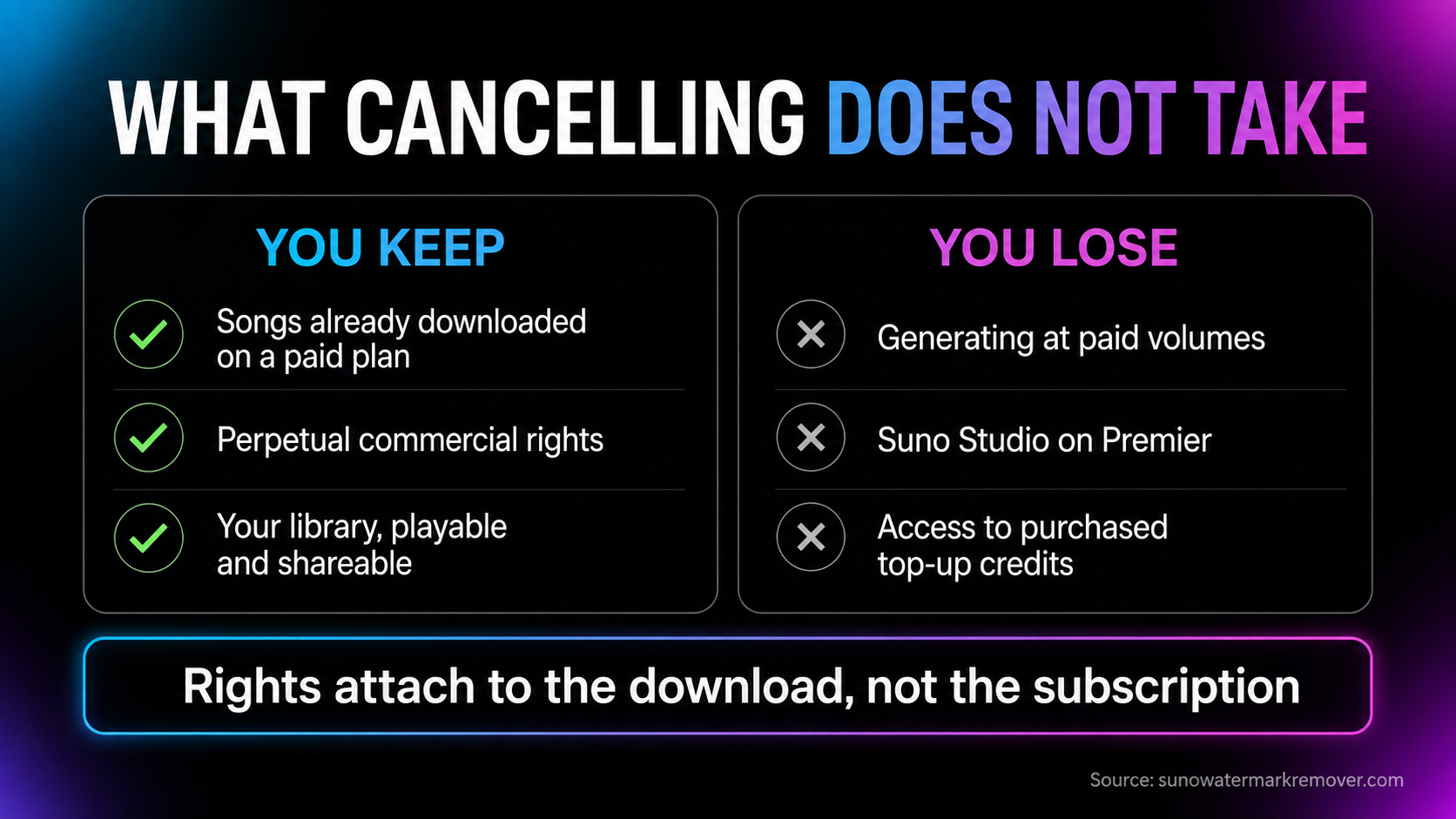
- Commercial rights on songs already downloaded on a paid plan are perpetual and survive cancellation, downgrade, suspension and later pricing changes
- That protection attaches to the download, not the subscription, which makes exporting before cancelling the step that matters
- Free-tier downloads are personal use only and capped at seven in total from 3 September
- Cancelling stops future billing but does not delete a library: songs remain playable and shareable on the platform
- Purchased top-up credits do not expire but require an active subscription to spend

The question underneath the plan question
Suno's download caps land on 3 September, and a lot of people have responded by opening their account page and reconsidering their Suno subscription. Some are upgrading to Premier for the Studio exemption. Some are downgrading. Some are cancelling outright and taking their catalogue elsewhere.
Almost all of them are really asking one thing first: if I stop paying, do I lose the rights to the music I have already made?
The answer is no, and for once there is a clear, quotable source rather than an inference. Suno published the Terms of Service that take effect on 3 September ahead of time, and they say that the commercial use rights attached to a download you have obtained are perpetual — explicitly unaffected by exhausting your download allotment, by any later change to allotments or pricing, or by "the expiry, cancellation, downgrade or suspension of your subscription."
That single clause resolves most of the anxiety currently circulating. It also has a sharp practical implication, which is the rest of this page.
The rights attach to the download, not the subscription
This is the part worth reading twice, because it changes the order in which you should do things.
Commercial rights do not come from having a subscription. They come from having downloaded a song while on a paid plan. Suno's own summary of the change puts it simply: songs downloaded on paid plans remain yours to use commercially or personally.
So the licence travels with the file. A track sitting in your Suno library, never exported, is not a track you hold commercial rights to in any portable sense — it is a track you could obtain those rights for by downloading it while your paid plan is active. Once downloaded, the rights are yours permanently and survive whatever happens to the subscription afterwards.
Which produces an obvious sequence, and an easy mistake.
The mistake: cancel first, then think about exporting. Once you drop to free, your downloads are capped at seven in total and designated personal use only, so the route to obtaining paid-plan commercial rights on the rest of your catalogue closes behind you.
The sequence: export everything you might ever release while the paid plan is still active, then cancel or downgrade. The subscription is the key to the door; the files are what you take with you.
Both of those are true regardless of the caps. The caps simply add a deadline, because from 3 September the paid allowance is finite too.
Commercial rights attach to downloads made on a paid plan, and they are perpetual. Undetectr's bulk downloader takes a public Suno playlist URL and returns your selection as a single ZIP of high-quality MP3s, used now under the allowance active on your account.
Bulk export a catalogue → €39 lifetime, was €99 · bulk downloader includedWhat each plan costs
Checked against Suno's pricing page on 25 August 2026.
| Free | Pro | Premier | |
|---|---|---|---|
| Monthly | $0 | $8 | $24 |
| Annual saving | — | $24 off | $72 off |
| Effective annual | $0 | ~$72 | ~$216 |
| Credits | small daily bucket | 2,500/mo (~500 songs) | 10,000/mo (~2,000 songs) |
| Downloads from 3 Sep | 7 lifetime | 20/mo | 60/mo |
| Commercial rights | No | Yes | Yes |
| Suno Studio | ✗ | ✗ | ✓ (uncapped export) |
| Stem separation types | — | 2 | 3 |
A few things the table does not show. Subscription credits do not roll over between days or months, so an unused allowance is simply gone. Purchased top-up credits do not expire, but they require an active subscription to spend — which means cancelling strands them rather than banking them. And Premier's advantage over Pro is volume plus Studio, not different rights: the commercial licence is identical on both.
Our full pricing breakdown goes tier by tier, and the Studio verdict covers whether the uncapped-export exemption justifies the higher tier.
How to cancel
Cancellation runs through your account page at suno.com/account, and Suno maintains a help article walking through it. It takes effect at the end of the current billing period rather than immediately, so you keep paid access — and paid download allowances — until the period ends.
On refunds, Suno's terms are blunt: payments are final and non-refundable unless the company decides otherwise. That makes a refund discretionary rather than something you can rely on, and it makes the renewal date the lever that actually matters. Cancelling before renewal is straightforward; asking for money back after it is a negotiation.
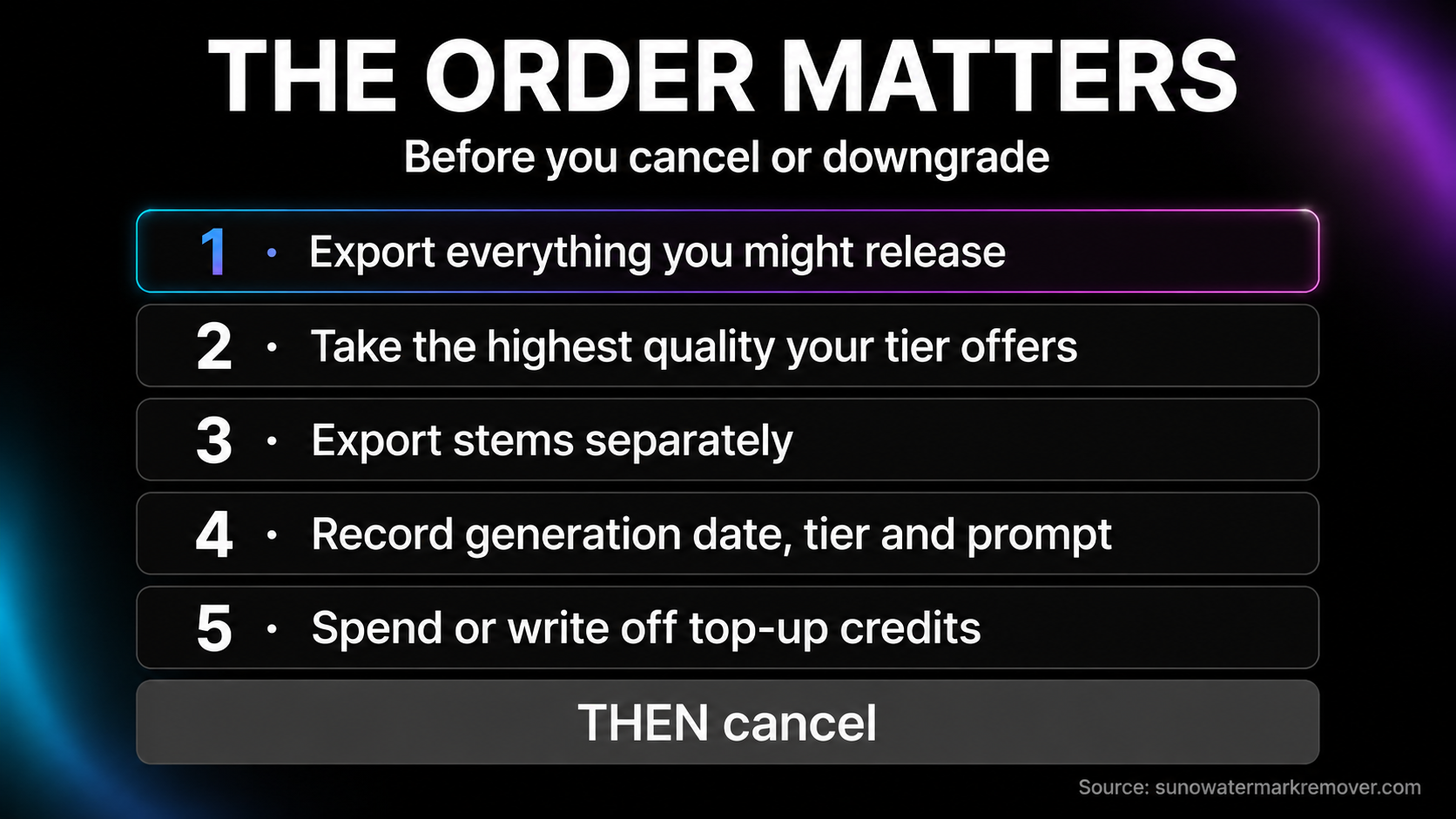
Before you confirm the cancellation, work through the short list below. Every item becomes harder or impossible afterwards.
The pre-cancellation checklist
Export everything you might ever release. This is the one with a hard consequence. Paid-plan downloads carry perpetual commercial rights; free-tier downloads do not, and there are only seven of them. Whatever you leave unexported, you leave without portable rights.
Take the highest quality your tier offers. Quality is a one-way door and nothing downstream recovers detail discarded at export.
Export stems separately on anything you may want to remix or re-master. Stems sit outside the main download flow and cannot be reconstructed from a mixed file afterwards. Our stems guide covers what separation gives you.
Record what each track was. Generation date, plan tier active at the time, and the prompt. That record is what answers a platform query quickly if one ever arrives, and it takes seconds at export against hours to reconstruct later.
Spend or write off top-up credits. They do not expire but they need an active subscription to use, so anything unspent is frozen the moment you cancel.
Note anything built on a custom model or a Voice. Those are tied to the current model generation, which Suno has said will be retired when its next generation ships. The exported audio is the part you control — see our model retirement piece.
Should you cancel, downgrade or stay?
Three honest cases, since the right answer varies more than most coverage admits.
Stay on Pro if you release regularly. Twenty downloads a month is more finished releases than most independent artists manage in a year, commercial rights are identical to Premier's, and $8 is the cheapest route to a portable commercial licence. For the large majority of people reading this, Pro is the correct plan and the caps change nothing about that.
Stay on Premier only if you open Studio. The uncapped export inside Studio is the single strongest reason to pay $24, and it is worth it if you genuinely work in stems. If you have never opened Studio, you are paying an extra $192 a year for credits you do not exhaust and 40 downloads you do not use.
Cancel if you have stopped generating. If Suno was a phase and the catalogue is finished, there is no reason to keep paying — but export first, on the paid plan, because that is what converts a library into files you own outright. Cancelling with an unexported catalogue is the one genuinely costly version of this decision.
There is also a fourth case worth naming, because it is common and rarely stated: people who keep paying out of vague anxiety about losing their music. The perpetual-rights clause is the answer to that. Once the files are downloaded on a paid plan, continuing to subscribe protects nothing that is already yours.
Bulk playlist export plus unlimited artifact processing, mastering, and every output format a distributor asks for. One payment rather than a subscription, and no credit pool to run down.
Get the lifetime plan → €39, was €99 · 60% off founder pricingWhat a subscription never covered
Worth being clear about the boundary, because people assume the subscription buys more than it does.
A Suno plan grants a commercial licence to what you generate and download. It does not make a track releasable. Distributor screening at ingestion reads the artifact layer — the statistical byproducts of how any model synthesises audio — and that layer is present in output from every tier, including Premier, including Studio, including whatever the next generation produces.
This catches people who assume a rejection was a licensing problem and upgrade to fix it. Upgrading does not fix it. Paying more per month changes your download allowance and your credit pool, not what a classifier reads in the file.
Handling that layer is a separate step on the exported file, before submission. Our artifact removal ranking covers the tested options across a 50-track, six-distributor corpus.
Commercial rights come from your plan. Acceptance comes from clearing distributor screening, which reads generation artifacts rather than your billing status. Undetectr targets that layer directly, in around 90 seconds a track, with mastering included.
Process a track before release → €39 lifetime, was €99 · ranked 98/100 on a 50-track distributor testThe short version
Pro is $8, Premier is $24, and the free tier is not a release workflow — seven lifetime downloads, personal use only.
Cancelling does not take your music. Your library stays playable, and the commercial rights on anything you downloaded while paying are perpetual, surviving cancellation, downgrade and any future change to Suno's pricing or allowances.
But those rights attach to the download rather than the account. Whatever is still sitting unexported inside Suno when you cancel is what you actually lose. Export first, on the paid plan, then decide about the subscription — in that order, with nine days until the allowance that makes it easy runs out.
Frequently asked questions
Pro is $8 a month and Premier is $24 a month. Suno discounts annual billing, taking $24 off Pro and $72 off Premier, which works out at roughly $72 and $216 a year. There is a free tier at no cost, but it carries no commercial rights and from 3 September 2026 is limited to seven downloads in total.
Yes. Cancellation is handled from your account page at suno.com/account. Cancelling stops future billing at the end of the current period rather than deleting anything, and your library remains on the platform, playable and shareable.
No, provided you downloaded the songs while on a paid plan. Under the Terms of Service taking effect 3 September 2026, the commercial use rights attached to a download you have obtained are perpetual. They are explicitly stated as unaffected by exhausting your download allotment, by later changes to allotments or pricing, or by the expiry, cancellation, downgrade or suspension of your subscription.
They stay in your library. Suno has been consistent that songs remain playable and shareable on every plan, including free. What you lose on cancelling is the ability to generate new music at paid volumes, the commercial licence for anything generated after you drop to free, and access to paid-tier features such as Suno Studio on Premier.
Suno's terms state that payments are final and non-refundable unless the company determines otherwise, so a refund is discretionary rather than a right. Billing questions go to Suno's billing contact. In practice the more useful lever is cancelling before the next renewal date rather than seeking money back afterwards.
It depends on whether you use Suno Studio, which is Premier-only and the one workspace exempt from the download caps. If you do not open Studio, Premier is buying you 40 extra downloads a month and a larger credit pool for an extra $16. If you do work in stems, the uncapped export is the strongest argument for staying. Either way, export what you already have before changing anything.
Subscription credits do not carry over from day to day or month to month, so there is nothing to preserve there. Purchased top-up credits do not expire, but Suno states they require an active subscription to use. Cancelling therefore strands any top-up credits you have bought until you resubscribe.
No. The free tier carries no commercial rights, and from 3 September it allows seven downloads in total rather than per month, with those downloads designated personal use only. Commercial rights attach to downloads made on paid plans. Anyone intending to release needs at least Pro.
Ready to release your Suno tracks?
Explore Undetectr’s published track-processing features before preparing your release.