Is Suno Studio Worth It? The One Workspace With No Download Cap
Suno shipped Studio 2.0 on 13 August 2026 and confirmed that Premier subscribers working in Studio face no download limits when the caps arrive on 3 September. That turns a question about a browser DAW into a question about export economics. The honest answer is that the exemption is real, narrower than it sounds, and the wrong solution for most people asking about it.
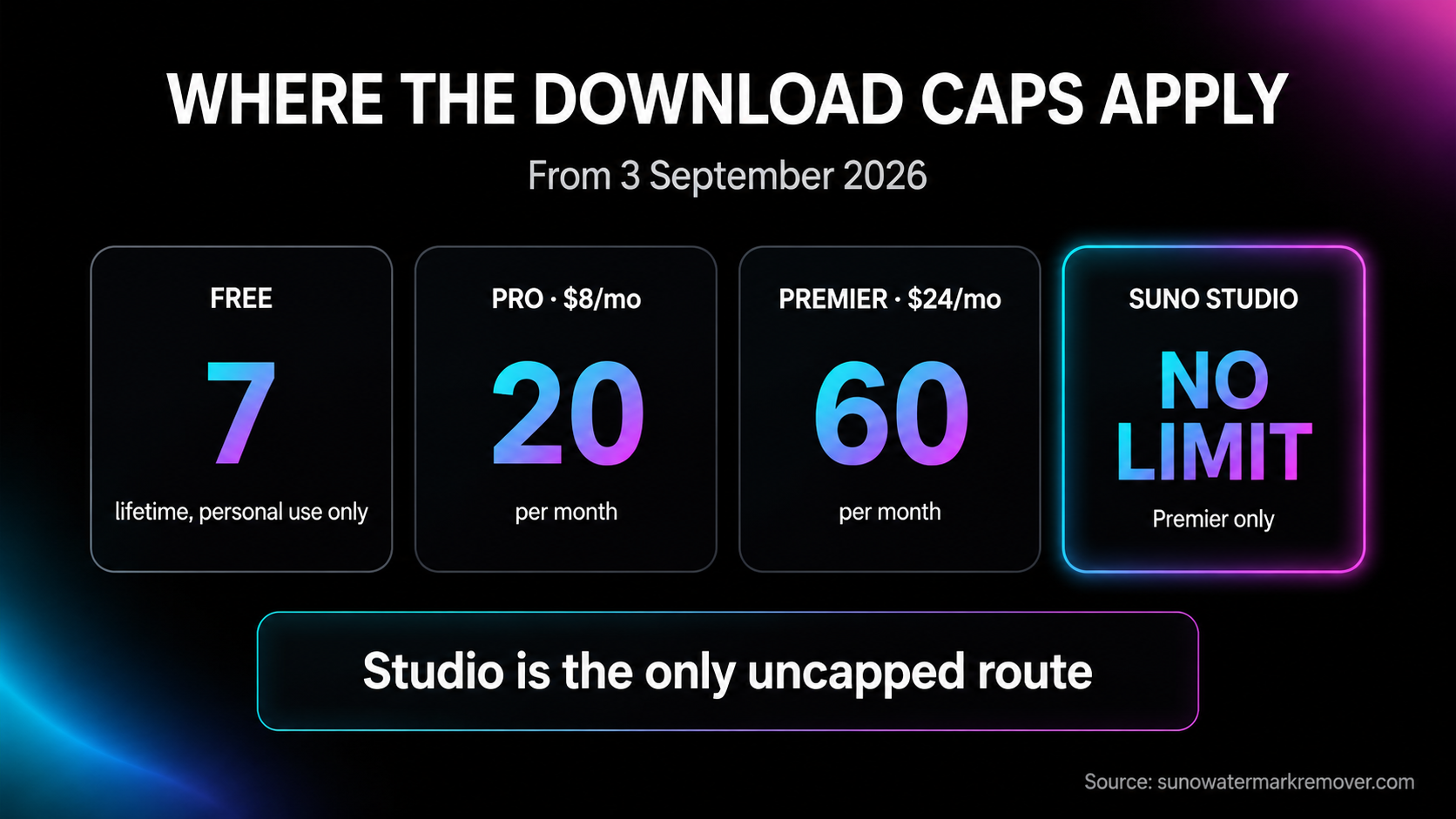
- Suno states plainly that Premier subscribers using Studio have no download limits, while Pro is capped at 20 a month and free accounts get 7 in total
- Studio is Premier-only at $24 a month, roughly $216 billed annually. Pro at $8 does not include it and the free tier has no access at all
- Studio 2.0 launched 13 August 2026, adding MIDI recording, a built-in wavetable synth, a beta chat assistant that builds plugins, and uncapped multitrack export
- The exemption covers Studio's stem and sample workflow, not a shortcut for pulling a finished back catalogue out as MP3s
- Studio changes how a track is assembled. It does not change the artifact layer distributor classifiers screen, because the model underneath is the same
- For a producer who genuinely works in stems, Premier is defensible. For someone with a library to export before the deadline, it is the wrong purchase

The question changed on 13 August
Until this month, "is Suno Studio worth it" was a straightforward tools question. Does a browser DAW bolted onto an AI generator do enough to justify sitting on the top tier? Reasonable people answered no.
Two announcements changed the arithmetic. On 10 August Suno published its downloads policy, confirming that from 3 September 2026 every tier gets a finite download allowance. On 13 August it shipped Studio 2.0, and the release carried a detail that matters more than the feature list: Studio downloads are not capped.
Suno's wording is unambiguous. From the downloads post: "For Premier subscribers who use Suno Studio, our professional production suite for generating and manipulating stems and samples, there are no download limits."
So the question is no longer just whether Studio is a good DAW. It is whether an uncapped export route is worth $24 a month once everything else is metered. That is a genuinely different question, and the answer is more interesting than either the marketing or the backlash suggests.
Short version: the exemption is real, it is narrower than it reads, and for most of the people currently googling this it solves the wrong problem. The rest of this explains why, and what to do instead.
What Suno Studio actually is
Worth being precise, because the naming confuses people. Suno is the generator: prompt in, song out. Studio is a separate workspace, and unlike the generator it is not available on every plan.
The lineage explains the product. Suno acquired WavTool, a browser-based DAW, in June 2025. Studio launched that September, billed as the first generative audio workstation. Version 1.2 arrived in February 2026 with warp markers, alternates and time signature support. Version 2.0 landed on 13 August 2026.
What 2.0 added is a real step up, and MIDI is the headline. You can import, record and edit MIDI directly on the timeline, play parts with a controller, or use musical typing with an arpeggiator and chord mode if you do not own one. There is a built-in wavetable synth. Audio effects run from standard fare like sidechain compression and convolution reverb through to effects you design yourself. Parameter automation supports drawn curves and recorded movement. Stem separation was upgraded. And a chat assistant, in beta, can build instruments and plugins, transform sounds, and tidy up a session on request.
The export side is what concerns us here: uncapped multitrack export at 32-bit, 48kHz for Premier subscribers.
That is a legitimate production environment. It is not Ableton, it does not run as a plugin, there is no desktop application and nothing usable on mobile. But it is well past the "AI toy with a timeline" description that fitted the first release.
What it costs
Suno's current pricing, checked today:
| Free | Pro | Premier | |
|---|---|---|---|
| Price | $0 | $8/mo | $24/mo |
| Annual | — | ~$72/yr | ~$216/yr |
| Credits | limited | 2,500 (~500 songs) | 10,000 (~2,000 songs) |
| Downloads from 3 Sep | 7 lifetime | 20/mo | 60/mo |
| Suno Studio | ✗ | ✗ | ✓ uncapped export |
| Stem separation types | — | 2 | 3 |
Two things follow. Studio is Premier-exclusive — the $8 Pro plan does not include it, whatever older reviews say, and there is no standalone Studio purchase. And the free tier's seven downloads are a lifetime allowance rather than a monthly one, which is the harshest line in the whole table.
The relevant comparison for most readers is $8 versus $24. The extra $16 a month buys four times the credits, three times the download allowance, and Studio. Whether that is good value depends on one thing only, which is the next section.
Whatever you decide about Premier, the export window closes on the same date. Undetectr's bulk downloader pulls a public Suno playlist as a single ZIP of high-quality MP3s, included on the lifetime plan, and used now under the allowance currently active on your account it turns weeks of clicking into an afternoon.
Bulk export before the deadline → €39 lifetime, was €99 · bulk downloader includedIs it worth it? Three honest answers
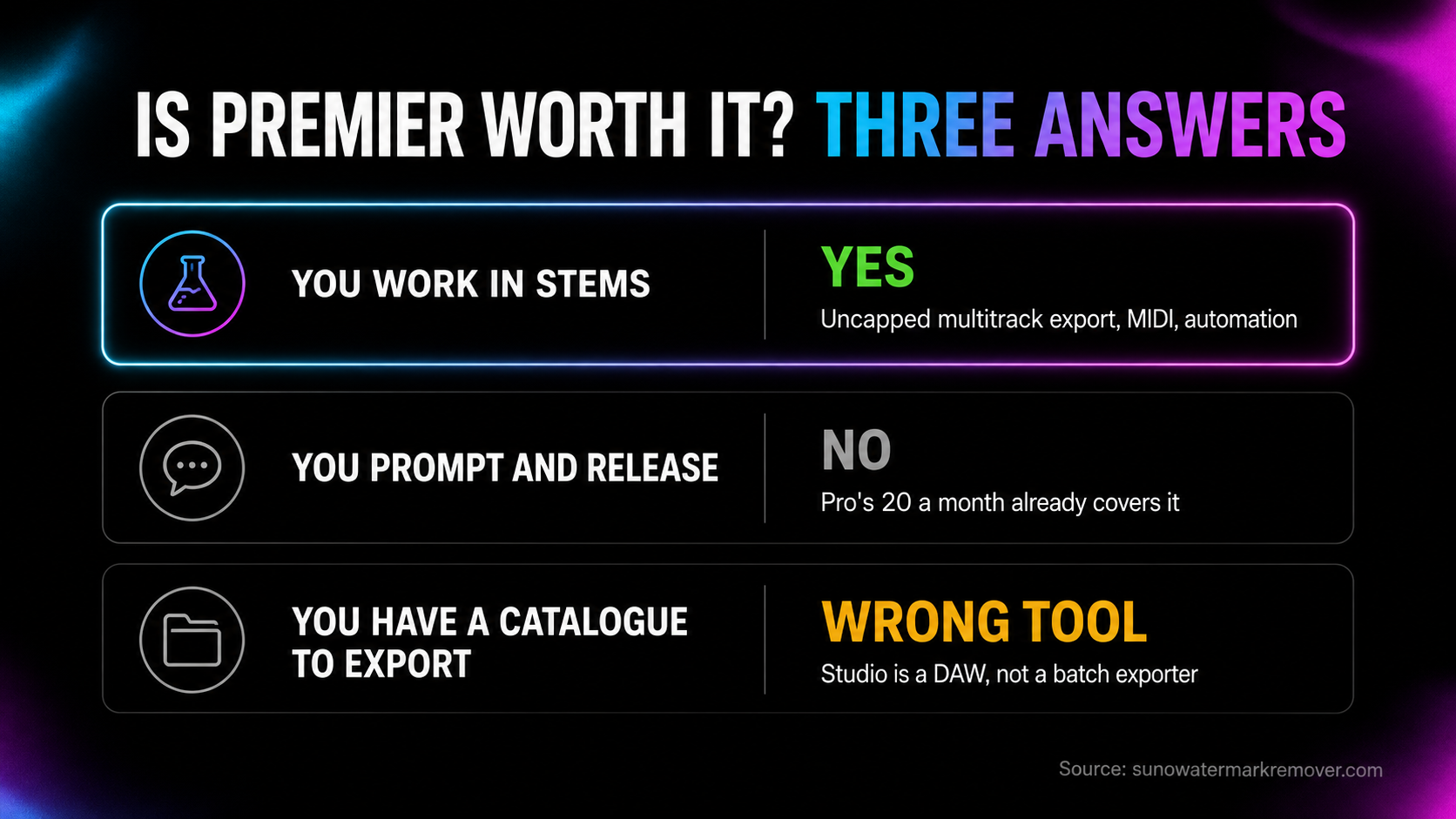
The question only resolves once you know which of these you are.
If you work in stems: probably yes
You arrange. You want the bass an octave down in the second verse, the drums pulled back under the bridge, a different vocal take on one line only. You export stems into a real DAW, or you would if the round-trip were not painful.
For you, Studio 2.0 is the first version that behaves like a tool rather than a demonstration. MIDI recording, automation curves and designable effects close most of the gap that sent you out to Logic. Uncapped 32-bit multitrack export means the iteration loop — export, listen, adjust, export again — is no longer rationed on 3 September, and for anyone doing real production work that rationing would have been the single most disruptive part of the new policy.
At $216 a year against $399 for iZotope RX alone, the maths is not outrageous. The honest caveat: credits, not downloads, become your binding constraint. Every generation and regeneration inside Studio draws from the same monthly pool, and the most consistent complaint in community threads is how quickly iterative work consumes it. Ten thousand credits sounds enormous until you regenerate one eight-bar section forty times.
If you prompt and release: no
You write a prompt, you listen, you keep the good ones, you send them to a distributor. You have never opened a DAW and have no intention of starting.
Studio gives you nothing. You are buying a multitrack timeline to avoid a download cap, and Pro's 20 downloads a month is already more releases than most independent artists put out in a year. If you exceed it occasionally, Suno sells additional downloads, which will cost less than $192 a year of tier difference.
Stay on Pro. Spend the difference on mastering, artwork or distribution. If you are weighing cancelling altogether, what you keep if you cancel sets out the rights position.
If you are here to export a back catalogue: no, and this is the important one
This is the group the exemption misleads, and it is the largest group reading this.
The reasoning goes: downloads get capped, Studio is uncapped, therefore Premier plus Studio is how I rescue two hundred tracks. It sounds airtight and it does not survive contact with the product.
Read Suno's own description again — the exemption covers Studio as "the professional production suite for generating and manipulating stems and samples." That is a production workflow. It is not a batch export facility, and Studio has no bulk operation that ingests your library and spits out finished songs. To move a back catalogue through it you would open projects one at a time, in a timeline, manually. For two hundred tracks that is not an afternoon's work; it is a fortnight of it, to obtain files you could have exported far faster before the deadline.
The exemption is real. It is simply built for the producer in the first category, iterating on one project, not for the archivist in the third.
One further change lands the same day
Suno is also introducing new Terms of Service on 3 September, published in advance at suno.com/terms-september-2026, and one part is worth knowing whichever tier you land on.
Commercial rights attach to songs you download from the platform on a paid plan, and Suno's own framing is reassuring on the point that matters most: those rights are perpetual. They are not affected by exhausting your download allotment, by later changes to allowances or pricing, or by the expiry, cancellation, downgrade or suspension of your subscription. A track you download today on a paid plan stays commercially yours if you cancel next month.
Suno has also said that when its next generation of models arrives, all prior models will be retired, though everything already in your library remains playable, shareable and usable as a basis for covers and remixes.
Both are reasons to have local copies of anything you consider part of your body of work, which was already the argument before any of this was announced. Our Suno policy tracker keeps the full change list current.
What Studio does not change
This is the part most Studio coverage misses entirely, and it matters more than the feature list if you intend to release anything.
Studio sits on top of the same generation model as the standard generator. It changes how a track is assembled — arrangement, layering, effects, automation — but the audio it produces comes from the same place. The statistical artifacts that distributor classifiers read are a property of the model, not of the workspace you assembled the track in.
So a song built painstakingly in Studio 2.0, with your own MIDI parts and custom plugins, carries the same generation fingerprint as one produced by typing a sentence into the prompt box. Distributors screen at ingestion, that screening reads the artifact layer, and a cleaner arrangement does not move it. Producers discover this the hard way: hours of Studio work, a track they are proud of, and a rejection email that explains nothing.
Handling that layer is a separate step, performed on the exported file before submission. Our artifact removal ranking covers the tested options; the short version is that purpose-built processing cleared 49 of 50 tracks across six distributors in the most thorough public test to date, while DAW-based approaches costing several times more managed between 8 and 22.
However the track was assembled, the generation fingerprint is still in the file. Undetectr's engine targets the spectral fingerprints, phase entropy and micro-timing that classifiers read, leaving the arrangement you built exactly as you built it. Around 90 seconds a track, with mastering included.
Process a track before release → €39 lifetime, was €99 · ranked 98/100 on a 50-track distributor testThe $24 a month question, answered directly
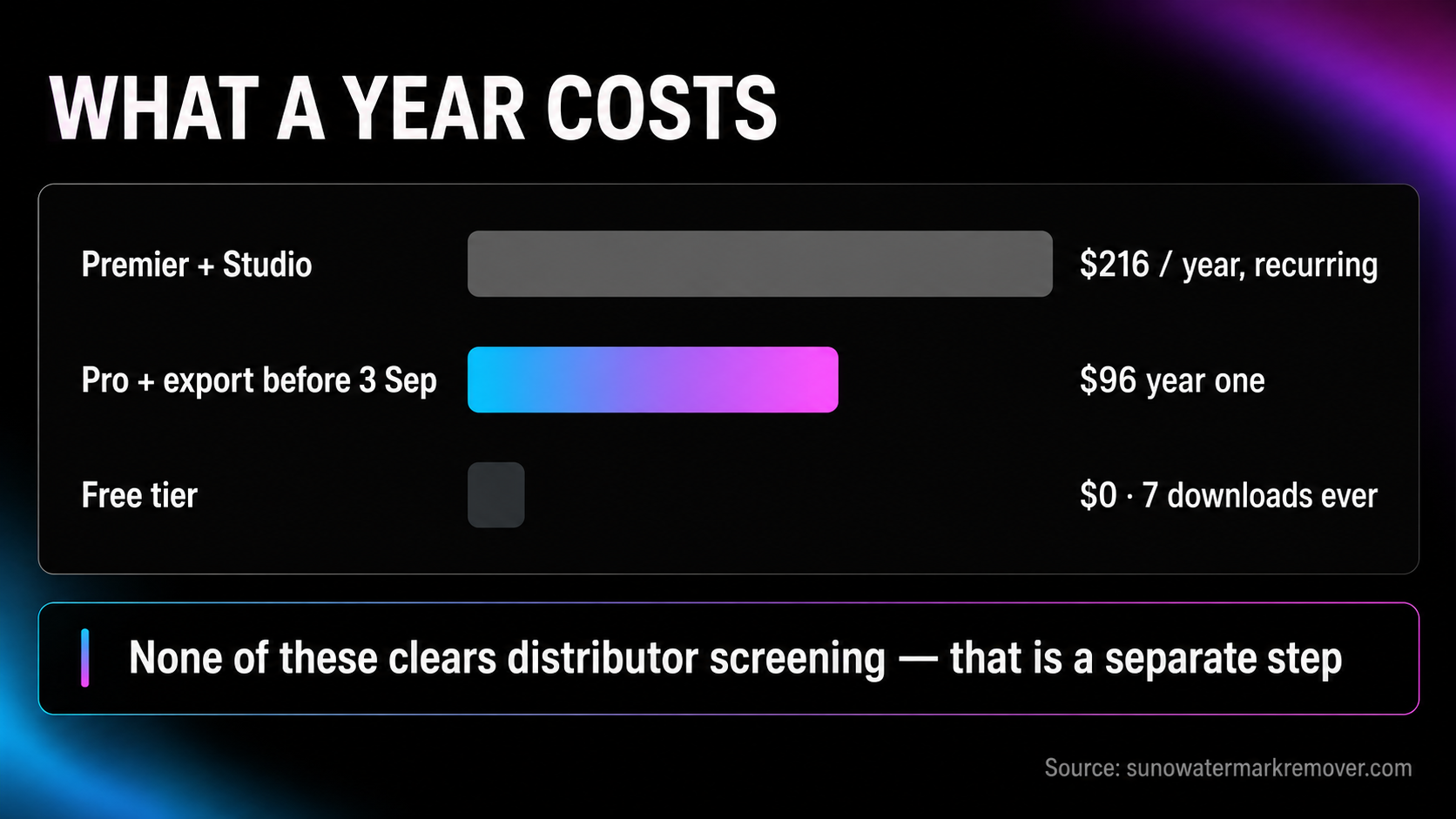
Set against a year, Premier is $216. Here is what that buys relative to the alternatives, for the specific job of getting releasable files out of Suno.
| Approach | Year one | What it actually solves |
|---|---|---|
| Premier + Studio | $216/yr, recurring | Uncapped export inside a production workflow; nothing on the artifact layer |
| Pro + export before 3 Sep | $96 year one | The catalogue you already have; capped at 20/mo afterwards |
| Pro + extra downloads as needed | $96 + per-download | Occasional overflow, priced per file |
| Free tier | $0 | Seven downloads, ever, personal use only |
None of these rows addresses distributor screening, because none of them is about that. It is worth separating the two problems cleanly: the tier decides how many files you can take out of Suno, and the processing step decides whether a distributor accepts them. Buying a higher tier to solve a screening problem is a common and expensive mistake.
For most readers the sensible combination is Pro, a thorough export before 3 September while the allowance is still open, and a one-time processing tool for anything heading to a distributor. That comes to under $100 for the year against $216 recurring, and it solves the problem Premier does not.
Premier earns its place when you are genuinely producing in stems. Not otherwise.
Bulk playlist export plus unlimited artifact processing, mastering, and every output format a distributor asks for. One payment, no subscription, no monthly credit pool to run down. Founder pricing is time-limited and the caps land 3 September.
Get the lifetime plan → €39, was €99 · 60% off founder pricingHow to use Studio if you do subscribe
Assuming you land in the first category, a few things are worth knowing before the first session.
Credits are the real budget, not downloads. Editing, arranging and exporting do not consume credits. Generating and regenerating do. Structure your sessions so the expensive operation happens deliberately rather than reflexively, because forty regenerations of one section is how a 10,000-credit month disappears in a week.
Start from a generation you already like. Studio rewards refinement over creation from nothing. Bring in a track that is 80 percent right and fix the 20 percent, rather than assembling from an empty timeline.
Use the stem separation before reaching for a third-party splitter. Premier gets three separation types including advanced split, and Studio has access to more structural information than an external tool working from a stereo bounce.
Export the multitrack, not just the bounce. The uncapped 32-bit export is the feature you are paying for. Taking only a stereo master out of Studio wastes the one thing that distinguishes it.
Keep the untouched original archived separately from anything you process afterwards. Quality is a one-way door.
The short version
Studio 2.0 is a real production tool and the download exemption is genuine — Suno states it plainly, and it is the only uncapped route once 3 September arrives.
It is still the wrong purchase for most people asking about it. If you work in stems, Premier is defensible and 2.0 is the version that finally justifies it. If you prompt and release, stay on Pro and buy extra downloads on the rare month you need them. And if you came here looking for a way to rescue a back catalogue from the caps, Studio is not that door — the export you need is the one available right now, before the allowance changes, and it takes an afternoon rather than a subscription.
Whichever applies, the layer that decides whether a distributor accepts the file is untouched by any of it.
Frequently asked questions
It depends entirely on whether you work in stems. If you arrange, layer and edit at the multitrack level, Studio 2.0 is a genuine production environment and the uncapped export removes the constraint that hits every other tier on 3 September. If you prompt, listen and release finished songs, you are paying $24 a month for a workstation you will not open. The download exemption is the strongest argument for it and also the most commonly misread.
Studio is Suno's browser-based digital audio workstation, built on technology from WavTool, which Suno acquired in June 2025. It launched in September 2025 as what the company called the first generative audio workstation, and reached version 2.0 on 13 August 2026. It provides a timeline, stem separation, MIDI recording and editing, audio effects, parameter automation and multitrack export, sitting on top of the same generation model that powers the rest of Suno.
Studio is included with the Premier plan at $24 a month, which Suno discounts by $72 when billed annually, working out around $216 a year. There is no standalone Studio purchase. The Pro plan at $8 a month does not include Studio access, and the free tier has none.
Yes, according to Suno. Its downloads-policy post states that for Premier subscribers who use Suno Studio, described as the professional production suite for generating and manipulating stems and samples, there are no download limits. Every other route is capped from 3 September 2026: seven lifetime downloads on free, 20 a month on Pro, 60 a month on Premier outside Studio.
Not in the way most people mean. Suno describes the exemption as covering Studio's workflow for generating and manipulating stems and samples, which is a production process rather than a bulk export hatch. Pulling two hundred finished songs out as MP3s is a different operation from working a project in a multitrack timeline, and treating a DAW as a batch downloader is slow, manual work regardless of what the allowance permits.
They are not really competing products. Pro at $8 is the generator with 2,500 credits a month and, from 3 September, 20 downloads a month. Premier at $24 is the generator with 10,000 credits, 60 downloads and Studio access on top. The question is not which is better but whether the extra $16 a month buys capability you will use. For most people releasing prompt-generated songs, it does not.
Not by virtue of being made in Studio. The audio model underneath Studio is the same one driving the standard generator, so the statistical artifacts distributor classifiers read are present either way. Studio changes arrangement and control, not the generation fingerprint. Anything intended for release still needs the artifact layer handled before submission.
The 13 August 2026 release added MIDI import, recording and editing on the timeline, a built-in wavetable synth, musical typing with arpeggiator and chord mode for people without a controller, designable audio effects alongside standard ones like sidechain compression and convolution reverb, parameter automation curves, improved stem separation, and a beta chat assistant that can build instruments and plugins and tidy a session. MIDI was the most requested addition since Studio launched.
Studio itself is a shipped product on its second major version, though the chat assistant introduced in 2.0 launched in beta. The most persistent community complaint is not stability but credit consumption: generating and regenerating inside Studio draws on the same monthly credit pool as everything else, and iterative work burns through it faster than people expect.
Ready to release your Suno tracks?
Explore Undetectr’s published track-processing features before preparing your release.